


The Temple of Olympian Zeus, or Olympieion, is one of Athens’ most dramatic ancient sites. Its towering Corinthian columns rise from a wide open field just a few minutes’ walk from the Acropolis and Syntagma Square, making it an easy and rewarding stop for first-time visitors. This guide walks you through what the site is, how to visit in 2026, how to see nearby Hadrian’s Arch and other attractions, and how to fit Olympieion into a smart first-timer’s Athens itinerary.
Get the latest updates straight to your inbox!
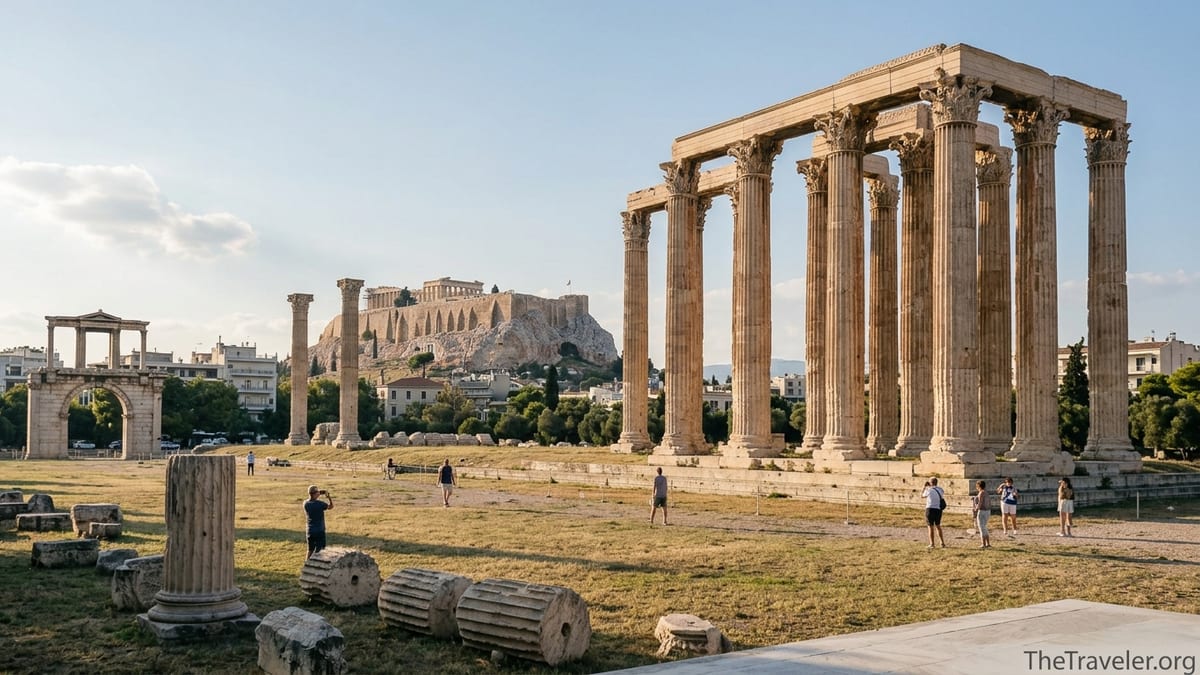
What Is the Temple of Olympian Zeus and Why Visit
The Temple of Olympian Zeus was once one of the largest temples in the ancient world, dedicated to Zeus, king of the gods. Today, 15 of its original 104 marble columns still stand, with one dramatic column lying toppled on the ground, giving you a real sense of the temple’s immense scale. Standing at the fence line, you can frame the columns with the Acropolis rising behind them, one of the classic postcard views of Athens.
For first-time visitors, Olympieion offers a different experience from the often-crowded Acropolis. The archaeological park is a broad, grassy enclosure that feels spacious and calm, especially in the early morning or late afternoon. You can walk along the ancient outlines of the temple’s foundations, study the Corinthian capitals scattered around, and appreciate how the sanctuary once dominated this part of the city.
The site is also historically important as a symbol of Roman Athens. Although the Athenians began the temple in the 6th century BC, it was the Roman emperor Hadrian who finally completed it in the 2nd century AD. Visiting today lets you see how Greek and Roman eras overlap: the Acropolis, representing classical Athens, visible uphill, and the colossal Roman temple and arch below.
Unlike some indoor museums, a visit here is short, simple and outdoors. Many travelers report spending around 30 to 60 minutes on site before continuing on to the nearby National Garden, Panathenaic Stadium, Plaka or the Acropolis. That makes Olympieion an ideal stop on a half-day walking circuit through the historic center.
Location, How to Get There and On-the-Ground Layout
The Temple of Olympian Zeus sits just southeast of central Syntagma Square, between the Acropolis and Ardittos Hill. The main entrance is on Vasilissis Amalias Avenue, the busy boulevard that runs along the eastern edge of the National Garden. If you are standing in Syntagma Square facing the Greek Parliament, the site is about a 10 to 15 minute walk straight down Amalias toward the Acropolis.
For public transport, the easiest option is the Athens metro. The closest stop is Akropoli station on Line 2 (the red line). From Akropoli, it is roughly a 7 to 8 minute walk: you exit onto Makrygianni, walk toward the Acropolis Museum, then follow Dionysiou Areopagitou and down toward Hadrian’s Arch, which stands directly in front of the temple site. Alternatively, Syntagma station (Line 2 and Line 3) is about a 10 to 12 minute walk away. Several city buses and the hop-on hop-off sightseeing buses also run along Amalias Avenue and stop near the entrance.
Once you enter the archaeological site, you will find a broad, open field with a clearly marked path looping around the temple remains. The standing columns rise from a raised platform in the middle of the enclosure, and you can walk almost all the way around them. On clear days, photographers often position themselves near the southeastern side of the park to capture the temple’s columns with the Parthenon perfectly aligned behind them.
There is minimal shade inside the site. A few low trees near the perimeter and along the path offer short breaks from the sun, but you should expect full exposure in the central area around the columns. There is usually a small ticket booth and security checkpoint at the entrance on Amalias. Basic signage is in Greek and English, explaining the temple’s history and the phases of its construction. There are no large indoor exhibition spaces here; it is more of an outdoor stroll than a museum visit.
Tickets, Prices and Opening Hours in 2026
As of mid‑2026, the Temple of Olympian Zeus operates as a standalone archaeological site managed by the Hellenic Ministry of Culture. The previous combined ticket that once bundled seven major sites in Athens, including the Acropolis and Olympieion, has been discontinued. Travelers now purchase individual tickets for each site, which has noticeably increased total sightseeing costs, especially if you plan to see multiple ruins in a short stay.
Standard adult admission to the Temple of Olympian Zeus is typically in the range of a modest single-site fee compared with headline attractions like Delphi or the Acropolis. Prices have risen in recent seasons, so you should expect that a visit for one adult will cost in the low double digits in euros rather than the older single‑digit pricing. Reduced tickets are usually available for EU students and some other categories, and children from EU countries often enter free with ID. Non‑EU students and other visitors may also find seasonal reductions, but these change regularly so it is best to check the official Hellenic Heritage ticket platform or the Ministry of Culture’s site shortly before you travel.
Opening hours follow the standard pattern for Greek archaeological sites. In the summer season, the Temple of Olympian Zeus generally opens in the early morning, around 8:00, with last entry in the early evening, and closes slightly earlier in the winter months when daylight is shorter. The site sometimes closes or has reduced hours on major Greek holidays such as January 1, March 25, Easter Sunday, May 1, August 15 and December 25 to 26. Because heat waves and strikes are not uncommon in Athens, build a little flexibility into your schedule and confirm the exact hours a day or two before you plan to visit.
Many travelers buy tickets on the spot at the entrance, since queues here are usually much shorter than at the Acropolis. However, if you are visiting in peak season from June to early September, or if you are on a tight schedule, consider purchasing your ticket in advance through the official online ticketing system used for Greek state-run sites. This lets you bypass the payment line and go straight to the security check, useful if you are combining the visit with a timed Acropolis entry on the same morning.
From Peisistratos to Hadrian: A Compressed History
The story of the Temple of Olympian Zeus begins in the 6th century BC, when the Athenian tyrant Peisistratos and his sons envisaged a colossal Doric temple dedicated to Zeus. Their ambition outstripped their resources, and construction soon stalled. For centuries, the half-finished foundations stood as a reminder of an abandoned project, even as the Athenians built the Parthenon and other masterpieces on the Acropolis.
Work resumed briefly in the 3rd century BC under the Hellenistic ruler Antiochus IV Epiphanes, who brought in the Roman architect Cossutius and changed the design to the Corinthian style you see expressed in the surviving columns. Again, the project ground to a halt after Antiochus’ death. The sanctuary remained a construction site of sorts, ancient yet incomplete, as successive political changes and wars reshaped the Mediterranean world.
It was the Roman emperor Hadrian, a philhellene who admired Greek culture, who finally completed the temple in the early 2nd century AD. Hadrian transformed the area into a vast sanctuary, filled with statues and a monumental cult image of Zeus. The dedication of the temple around 131 to 132 AD was a major event in Roman Athens and coincided with the construction of Hadrian’s Arch, which marked the symbolic boundary between “old” and “new” Athens.
Over the following centuries, earthquakes, invasions and the steady recycling of building materials reduced the great temple to the ruin we see today. Many of its columns and marble blocks were quarried for later buildings, including churches and houses in medieval and Ottoman Athens. The 15 surviving columns and the single fallen one, toppled in a storm in the 19th century, are therefore rare survivors. Knowing this backstory as you circle the site helps you imagine the temple not as an isolated ruin but as a witness to more than 2,500 years of Athenian history.
Hadrian’s Arch and Nearby Sights to Combine
Hadrian’s Arch stands directly in front of the Temple of Olympian Zeus, on the edge of Vasilissis Amalias Avenue. The 18‑meter‑tall marble gateway is free to visit and open at all hours, making it a natural starting or finishing point for your time at Olympieion. The arch carries two inscriptions: one facing the Acropolis that refers to “Athens, the ancient city of Theseus” and one facing the temple side that praises “the city of Hadrian.” The messages symbolically separate classical Athens from the Roman imperial city that Hadrian helped reshape.
Practical tip: many visitors walk from Syntagma down Amalias, stop first at Hadrian’s Arch for photos, then cross into the ticketed temple site immediately behind it. After the temple visit, you can return to the arch for another look at different light, since the traffic and background shift throughout the day. Street vendors sometimes set up nearby selling water, fresh orange juice and souvenirs, which can be convenient if you need a quick refreshment before continuing.
The area around the temple is rich with other attractions that are easy to bundle into the same half‑day. To the north, the National Garden offers shaded walking paths, small ponds and a quiet escape from the city noise, ideal after spending time in the sun at the archaeological site. To the east, a short walk brings you to the Panathenaic Stadium, the all‑marble arena that hosted the first modern Olympic Games in 1896; sports enthusiasts often visit both on the same morning.
To the west and northwest, the pedestrian street Dionysiou Areopagitou leads you toward the Acropolis Museum and the Acropolis entrance itself. Many first‑time visitors plan a route that starts at Syntagma, continues to Hadrian’s Arch and the Temple of Olympian Zeus, crosses through the National Garden for a brief rest, then heads up toward the Acropolis for a late afternoon climb. Alternatively, you can reverse the order, visiting the Acropolis first thing in the morning to avoid crowds and heat, then walking downhill to Olympieion once it is fully open.
Planning Your Visit: Timing, Photography and Practical Tips
When planning your visit, timing can greatly affect your experience. In the summer, Athens can be extremely hot by midday, with little shade at the temple site. Aim for early morning opening time or visit after 17:00, when the sun is lower and temperatures begin to ease. Early visitors often find themselves nearly alone in the park, with soft light on the columns and long shadows on the grass, which is ideal for photography.
From a practical standpoint, wear comfortable walking shoes suitable for gravel and uneven ground, and bring water, sunscreen and a hat. There is usually a small kiosk or vendors nearby on Amalias Avenue, but once you are inside the archaeological enclosure, options are limited. If you are visiting multiple open-air sites in one day, consider carrying a light scarf or shawl for additional sun protection. In winter and early spring, the grass can be damp and the footing slightly muddy after rain, so waterproof footwear is a good idea.
Photography is one of the highlights here. Classic shots include standing outside the fence on Amalias and shooting across the site to capture the columns with the Acropolis behind them, or framing Hadrian’s Arch in the foreground with the temple beyond. Inside the site, walk around to the southeastern side to photograph the fallen column, which lies like a marble spine on the ground, its fluted drums still in sequence. Tripods and drones are generally not allowed without special permission, but handheld cameras and smartphones are fine, and you will see plenty of visitors stopping along the perimeter path to compose their shots.
If you enjoy sketching or quiet contemplation, the Temple of Olympian Zeus is also a pleasant place to pause. The broad open space contrasts with the denser ruins of the Roman Agora or the busy climb of the Acropolis. Some travelers like to bring a small picnic to enjoy just outside the site in the National Garden, then step into the temple enclosure for a focused 30 to 40 minute visit before continuing their day.
First-Time Athens Tips: Fitting Olympieion into Your Itinerary
For a first visit to Athens, most travelers stay in central neighborhoods like Syntagma, Plaka, Monastiraki or Koukaki. From all of these, the Temple of Olympian Zeus is within easy walking distance, which makes it simple to integrate into your schedule without extra transport costs. For example, if you stay in a small guesthouse near Monastiraki Square, you can stroll through Plaka’s narrow streets, pass by the Lysicrates Monument and arrive at Hadrian’s Arch and the temple in around 20 to 25 minutes.
A common pattern is to allocate one full day to the Acropolis and its surrounding sites, and a second day to museums and other landmarks. On your “Acropolis day,” you might reserve a timed entry between 8:00 and 9:00, explore the hill and its slopes for two to three hours, visit the Acropolis Museum late morning, take a lunch break in Koukaki, and then walk down to the Temple of Olympian Zeus in the late afternoon when the sun is less harsh. This sequencing lets you see the Acropolis at its best while still leaving mental energy for Olympieion’s more open, contemplative setting.
Budget-wise, be aware that the end of the combined ticket means separate admissions add up quickly. For a couple or family intending to visit the Acropolis, the Ancient Agora, the Roman Agora, Hadrian’s Library, Kerameikos and the Temple of Olympian Zeus, total costs can now exceed 100 euros per person in high season. To keep expenses manageable, some travelers choose two or three major sites and then enjoy the many free or low-cost experiences nearby, such as wandering Plaka, watching the guards change at the Hellenic Parliament on Syntagma Square, or walking the pedestrian route around the Acropolis.
Finally, keep an eye on practicalities like heat, crowds and local transport. In July and August, schedule outdoor ruins for early or late in the day and use midday for long lunches or museum visits. If you are using the metro, note that it can be busy during commuter peaks around 8:00 to 9:00 and 17:00 to 19:00. Walking between central neighborhoods is often faster and more pleasant, especially along pedestrian streets such as Dionysiou Areopagitou, where you can spot the Arch of Hadrian rising ahead as you make your way toward the Temple of Olympian Zeus.
FAQ
Q1. How long do I need to visit the Temple of Olympian Zeus?
Most visitors spend around 30 to 60 minutes inside the site, enough time to walk the loop path, take photos of the standing and fallen columns, and read the information panels.
Q2. Can I buy Temple of Olympian Zeus tickets on the day of my visit?
Yes, you can usually buy tickets directly at the entrance kiosk on Vasilissis Amalias Avenue, and queues here tend to be shorter than at the Acropolis, especially outside peak hours.
Q3. Is the old combined ticket that included the Temple of Olympian Zeus still available?
No, the multi‑site combined ticket that once bundled the Acropolis and several other ruins has been discontinued, so you now purchase a separate ticket for the Temple of Olympian Zeus.
Q4. What is the best time of day to visit for photos?
Early morning and late afternoon usually offer softer light, cooler temperatures and fewer crowds, making them ideal for capturing the columns with the Acropolis in the background.
Q5. Is the site suitable for children and strollers?
Yes, the site is relatively flat and open, and many families visit with children. Some paths are gravel rather than paved, so a sturdy stroller with larger wheels works better than a very lightweight model.
Q6. Are there guided tours specifically for the Temple of Olympian Zeus?
Some walking tours of central Athens include a stop at the Temple of Olympian Zeus and Hadrian’s Arch, but many visitors explore independently, using guidebooks or audio guides for background.
Q7. Can I see Hadrian’s Arch without entering the ticketed site?
Yes, Hadrian’s Arch stands on the edge of the sidewalk along Vasilissis Amalias Avenue and is free to view at any time; you do not need a ticket to walk around the base and take photos.
Q8. Is there shade or shelter inside the Temple of Olympian Zeus?
There is very little shade inside the enclosure, mostly from a few small trees along the perimeter, so bring a hat, sunscreen and water, especially in summer months.
Q9. How close is the Temple of Olympian Zeus to the Acropolis and Acropolis Museum?
The temple is within a 10 to 15 minute walk of the Acropolis Museum and the Acropolis entrance, linked by pedestrian streets such as Dionysiou Areopagitou and the area around Hadrian’s Arch.
Q10. Are toilets and other facilities available on site?
Basic visitor facilities are available in or near the site, but they are limited compared with larger museums, so it is wise to plan restroom and refreshment breaks in nearby cafes or the National Garden.