


More news on this day
Dubai Airports has awarded a total of AED 120,000 in prize money to student teams at its 2026 “Re-code the Future” hackathon, using AI prototypes built over three days in November to explore new ways of easing operational pressure and improving the passenger experience at Dubai International (DXB) and Al Maktoum International (DWC).
Get the latest news straight to your inbox!
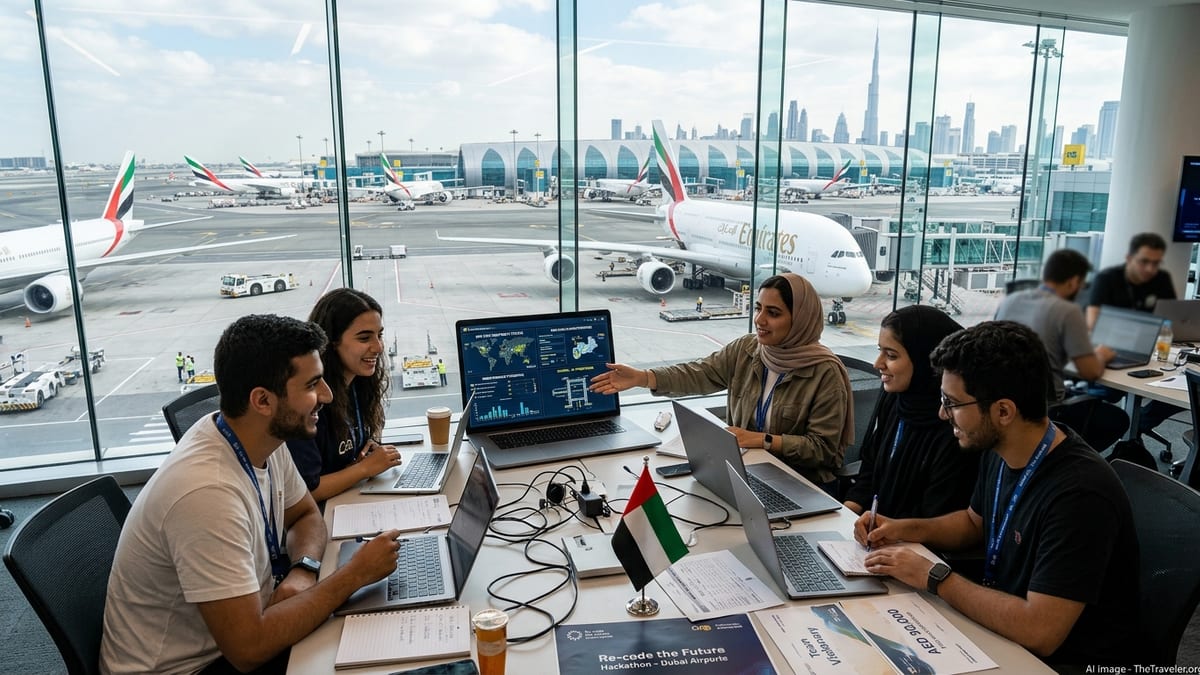
Three days, 50 students and airport problems drawn from real operations
Held from 13 to 15 November 2026 at the Dubai Airports Learning & Development Centre, the “Re-code the Future” hackathon brought together 50 students in 10 teams from schools and universities across the UAE. Working with synthetic datasets and scenarios based on Dubai Airports’ own operations, teams were asked to apply AI to specific challenges such as detecting equipment faults before they disrupt flights, coordinating decisions during low-visibility conditions and helping passengers navigate packed terminals.
Organised by Dubai Airports’ technology function, the event was framed as a way to generate practical concepts that could one day be piloted in the live environment, rather than a purely theoretical competition. Judging criteria published ahead of the event emphasised realistic value for DXB and DWC, responsible use of AI, and a credible path from prototype to potential adoption, although organisers were clear that the weekend’s outputs would remain test concepts for now.
The hackathon followed a record year for DXB, which handled 95.2 million passengers in 2025, operating close to its physical capacity while preparing for longer term growth via expansion at DWC. That traffic backdrop helps explain why Dubai Airports is searching for tools that could smooth disruption, protect gate capacity and keep passenger flows manageable without relying solely on major infrastructure projects.
Basira: winning concept targets gate equipment faults before they hit passengers
First prize of AED 50,000 went to American University of Sharjah’s team “Cache Us If You Can” for Basira, an AI-driven tool designed to flag faults in critical gate equipment and rank maintenance tasks by their likely impact on passengers and gate availability. The concept uses operational data to prioritise issues that could delay boarding, extend turnarounds or temporarily remove a gate from use, helping engineers focus on the problems most likely to cause knock-on disruption.
For travellers, the potential benefit of a system like Basira is indirect but tangible if it is ever piloted and refined. Earlier detection of faults in boarding bridges or power units, and smarter scheduling of maintenance crews, could reduce the number of last-minute stand changes or delays that stem from equipment failures rather than airline scheduling. At this stage, however, Basira remains a hackathon prototype, with no timetable announced for testing within DXB or DWC’s live operation.
Dubai Airports has not disclosed detailed performance metrics from the prototype, such as forecast reductions in delays or gate closures, and there is no public indication yet that Basira has moved beyond the concept stage. Travellers should therefore see it as an example of where airport-side innovation is heading, not as a live system that will immediately change the reliability of their upcoming flights.
Marsad and DXB One: concepts for disruption control and wayfinding
Second prize, worth AED 30,000, went to Team Visionary from the University of Birmingham’s Dubai campus for Marsad, a shared operations dashboard aimed at giving airlines, airport teams and other stakeholders a common picture during major disruption scenarios. The hackathon briefing highlighted dense fog as a key use case, with the prototype intended to help different control rooms coordinate decisions on ground handling, gate assignment and passenger communications from a single source of operational truth.
In theory, a tool like Marsad could shorten the time it takes to recover from weather events or airspace disruptions by reducing the number of conflicting or duplicated decisions across teams. For passengers, that could eventually translate into clearer information on delays, fewer last-minute gate changes and more predictable rebooking processes. As with Basira, though, Dubai Airports has not announced any formal pilot for Marsad, and there is no confirmation that the dashboard is connected to live systems at DXB.
Third place was shared by two teams, each receiving AED 20,000. Dubai-It, representing American University in the Emirates, presented DXB One, a web-based application using AI to help passengers find their way through the terminal and discover relevant services throughout their journey. The concept is aimed at easing the experience in a hub that routinely handles millions of transfer passengers each month, but it currently exists only as a hackathon prototype and is not part of Dubai Airports’ official app ecosystem.
Spectre’s disruption dashboard and what changes for travellers today
The other third-place finisher, Spectre, was a mixed-schools team that developed an operational dashboard for tracking disruption response across the airport. The tool focused on giving managers a live view of how mitigation measures were progressing, from clearing backlogs at security and immigration to repositioning staff and equipment around the terminal. As with Marsad, the emphasis was on situational awareness rather than direct passenger-facing features.
None of the winning ideas has been confirmed for production deployment, and Dubai Airports has not issued an implementation schedule or named specific flights, terminals or timeframes where travellers might encounter these systems. For now, the impact on passengers is therefore indirect: the hackathon helps the airport operator test which AI concepts are promising enough to explore further, while giving students exposure to real-world aviation challenges.
For travellers planning to use DXB or DWC in the coming months, the practical advice remains unchanged. Schedules, minimum connection times and airport facilities are still governed by existing systems and processes, and any future AI-driven tools would be introduced gradually, with separate announcements if and when they move into pilot or general use.
What to watch next at DXB and DWC
Dubai Airports has signalled that the 2026 event is the start of an ongoing student-focused innovation programme, with a reference to “See you in 2027” on the hackathon’s official site indicating plans for a follow-up edition. While details for the 2027 competition have not yet been published in full, the message suggests that AI and data science challenges tied to operational efficiency and passenger experience are likely to remain on the agenda.
In parallel, Dubai is proceeding with long-term expansion at DWC, supported by substantial investment that aims to shift more of the region’s growth to the newer airport over the next decade. For travellers, the most immediate implications will continue to come from conventional capacity increases and network changes, with experimental AI tools like Basira, Marsad and DXB One potentially playing a supporting role if they eventually graduate to pilot projects.
Before travelling, passengers should continue to rely on official airline and airport channels for confirmed information on flight status, terminal assignments and wayfinding tools. If Dubai Airports begins testing any of the hackathon concepts in live operations, further announcements are likely to clarify when and where those changes will be visible to people passing through DXB or DWC.