


Assessing the complexity of Thailand’s bureaucracy is critical for anyone considering relocation for work, investment, or long-term residence. Bureaucratic design influences how easily newcomers can interact with public authorities, set up a business, secure utilities, or comply with local regulations. This briefing explains Thailand’s Bureaucracy Complexity Score as a composite concept, outlines the main structural drivers of administrative difficulty, and evaluates ongoing reforms that may affect how manageable the Thai state apparatus feels in practice.
Defining the Thailand Bureaucracy Complexity Score
In a relocation context, a Bureaucracy Complexity Score is a comparative indicator that captures how difficult it is to complete common administrative tasks in a country. For Thailand, this score reflects multiple dimensions: the number of agencies involved in a procedure, the volume of required documents, the predictability of processing times, the degree of digitalization, and the extent to which outcomes depend on personal discretion rather than clear rules. It is not a single official index, but rather a synthesized reading drawn from governance indicators, business environment data, and reported user experience.
Global governance data position Thailand as a mid-range performer. The World Bank’s Government Effectiveness and Regulatory Quality indicators place Thailand around the global median, indicating moderate quality of public services and policy implementation, but with clear room for improvement in transparency and consistency.([worldscorecard.com](https://worldscorecard.com/scorecards/thai-scorecard/government-effectiveness/?utm_source=openai)) This aligns with survey evidence from Thai business federations and opinion polling which point to persistent red tape as a drag on competitiveness and administrative satisfaction.
For relocation decision-making, Thailand’s Bureaucracy Complexity Score can be summarized as “moderate-to-high complexity with improving digital tools.” Procedures are usually possible and ultimately achievable, but often require more steps, physical visits, and follow-up than in the most streamlined OECD systems. At the same time, digital government initiatives and one stop service models are gradually reducing friction in specific domains.
This composite score should be interpreted as sector-specific rather than uniform. Corporate registration, construction permitting, and some investment-related interactions are comparatively structured, while immigration-linked tasks, local registrations, and interactions with smaller provincial offices can be significantly less predictable.
Structural Drivers of Bureaucratic Complexity in Thailand
Thailand’s administrative structure is highly segmented, with ministries, departments, and provincial offices retaining strong vertical hierarchies. OECD analysis notes overlapping regulatory responsibilities and a dense licensing environment, with no comprehensive inventory of all permits and licenses at the national level.([oecd.org](https://www.oecd.org/en/publications/oecd-economic-surveys-thailand-2025_426b9bc0-en/full-report/strengthening-productivity-through-better-product-market-regulation_1342e232.html?utm_source=openai)) This fragmentation increases the number of contacts and touchpoints required for individuals and companies to complete even routine tasks.
Another core driver is procedural opacity. Draft regulations are not always published in accessible plain language, and requirements can vary in practice between offices even when the legal framework is identical.([oecd.org](https://www.oecd.org/en/publications/oecd-economic-surveys-thailand-2025_426b9bc0-en/full-report/strengthening-productivity-through-better-product-market-regulation_1342e232.html?utm_source=openai)) This creates a gap between written rules and lived experience, often leading applicants to rely on informal brokers or third-party service providers to navigate uncertainty.
Thailand’s civil service has undergone multiple waves of reform since the late 1990s. However, policy research highlights that many agencies still operate under traditional New Public Management logic, emphasizing control and compliance rather than citizen-centric service design and integrated digital workflows.([lamintang.org](https://lamintang.org/journal/index.php/ijeste/article/view/957?utm_source=openai)) Patronage structures and low perceived morale among some civil servants, as reflected in domestic opinion polling, also contribute to uneven service quality and limited initiative to simplify procedures at the counter level.([bangkokpost.com](https://www.bangkokpost.com/thailand/general/2768361/thai-civil-servants-fed-up-with-system-poll?utm_source=openai))
For relocators, these structural factors manifest as complex paperwork requirements, narrow service windows, and a strong emphasis on exact document format. Errors or deviations can trigger rejections without clear explanations, forcing applicants to repeat steps and extend timelines.
Key Process Dimensions Behind the Complexity Score
Several process dimensions are particularly important when translating Thailand’s bureaucracy into a practical complexity score for relocation planning. The first is procedural density: the average number of steps, signatures, and required documents for a given transaction. In Thailand, even basic registrations may require multiple copies of identity documents, certified translations, passport photos, and various stamps or endorsements from different authorities.
The second dimension is time predictability. While headline processing times can appear competitive on paper, real-world timelines often extend due to queuing, limited daily quotas, or requests for additional documentation. Business community surveys repeatedly identify permitting delays and administrative uncertainty as key constraints on investment and operations.([thaiexaminer.com](https://www.thaiexaminer.com/thai-news-foreigners/2025/10/07/red-tape-and-bureaucracy-are-killing-the-thai-economy-91-per-cent-of-top-executives-says-it-is-far-too-much/?utm_source=openai)) This unpredictability increases the effective complexity score for anyone who must coordinate work, school, or relocation milestones around administrative approvals.
Third, discretion and case-by-case decision-making play a larger role than in some benchmark jurisdictions. Rules are sometimes interpreted differently between offices or even between officials within the same office. Applicants who arrive with complete, impeccably formatted documentation can move quickly, but those with unusual circumstances or incomplete records may face lengthy clarification cycles. This discretionary environment elevates the complexity score because outcomes depend not only on compliance but also on individual interpretation.
Finally, the linguistic operating system of the bureaucracy is overwhelmingly Thai. While certain central agencies and investment promotion bodies offer English-language interfaces, many local offices provide limited English support. For non-Thai-speaking relocators, this magnifies perceived complexity, as understanding forms, notices, and verbal instructions may require interpreters or intermediaries.
Digital Government and One Stop Service: Complexity Reducers
Thailand’s digital government agenda is the main downward force on the Bureaucracy Complexity Score. Successive governments have committed to moving services online, creating integrated platforms, and reducing document duplication. The Digital Government Development Agency promotes a one stop service approach and has adopted a multi-year roadmap to integrate services for foreigners between 2023 and 2027.([dga.or.th](https://www.dga.or.th/en/our-services/one-stop-service/?utm_source=openai))
Concrete advancements include the expansion of online portals for selected business registrations, tax filings, and some public services, as well as the rollout of apps for identity verification and digital interaction with state agencies. COVID-19 accelerated the deployment of digital systems such as check in platforms and remote applications, which laid the foundation for broader e government capabilities.([en.wikipedia.org](https://en.wikipedia.org/wiki/Thai_Chana?utm_source=openai))
However, research on Thailand’s transition to digital government emphasizes that many initiatives remain siloed, with individual ministries building separate apps and platforms.([en.thairath.co.th](https://en.thairath.co.th/money/tech_innovation/tech_companies/2910859?utm_source=openai)) This limits the complexity reduction potential, because users still need to manage multiple accounts, interfaces, and document uploads rather than interacting through a unified, life event based portal.
For relocators, the practical impact is mixed. In certain domains such as corporate compliance, online tax payment, or selected metropolitan services, digitalization can significantly reduce queuing and paperwork. In other areas, particularly those involving personal status, immigration, or local registration, physical presence at offices and paper documents remain the norm, preserving a relatively high complexity score.
Business Environment Signals Relevant to Bureaucracy Complexity
Historical ease of doing business rankings have portrayed Thailand as relatively business friendly in the global context, at times ranking within the top 25 worldwide for overall ease.([doingbusiness.org](https://www.doingbusiness.org/content/dam/doingBusiness/media/Annual-Reports/English/DB10-FullReport.pdf?utm_source=openai)) Such scores reflected comparatively efficient processes in specific areas such as starting a business, dealing with construction permits, and getting electricity, when measured against regional peers.
More recent assessments, including OECD surveys and domestic business sentiment polls, provide a more nuanced picture. They highlight ongoing concerns about overlapping regulations, burdensome product market rules, and the absence of streamlined licensing frameworks.([oecd.org](https://www.oecd.org/en/publications/oecd-economic-surveys-thailand-2025_426b9bc0-en/full-report/strengthening-productivity-through-better-product-market-regulation_1342e232.html?utm_source=openai)) A 2025 survey reported that more than nine out of ten senior executives considered Thailand’s red tape to be excessive and a direct constraint on economic performance.([thaiexaminer.com](https://www.thaiexaminer.com/thai-news-foreigners/2025/10/07/red-tape-and-bureaucracy-are-killing-the-thai-economy-91-per-cent-of-top-executives-says-it-is-far-too-much/?utm_source=openai))
For corporate relocations, this means that while certain flagship processes are reasonably structured, the cumulative cost of dealing with multiple agencies, renewing permits, and responding to regulatory changes can be significant. The Bureaucracy Complexity Score for medium to large enterprises is therefore higher than what headline rankings alone might suggest, especially when sector specific licences or regulatory approvals are involved.
Small firms and individual entrepreneurs can face an even steeper complexity gradient, particularly if they attempt to navigate procedures without specialized local administrative support. The system tends to favor those with resources to engage consultants who understand detailed procedural expectations at each stage.
Everyday Administrative Experience for Relocators
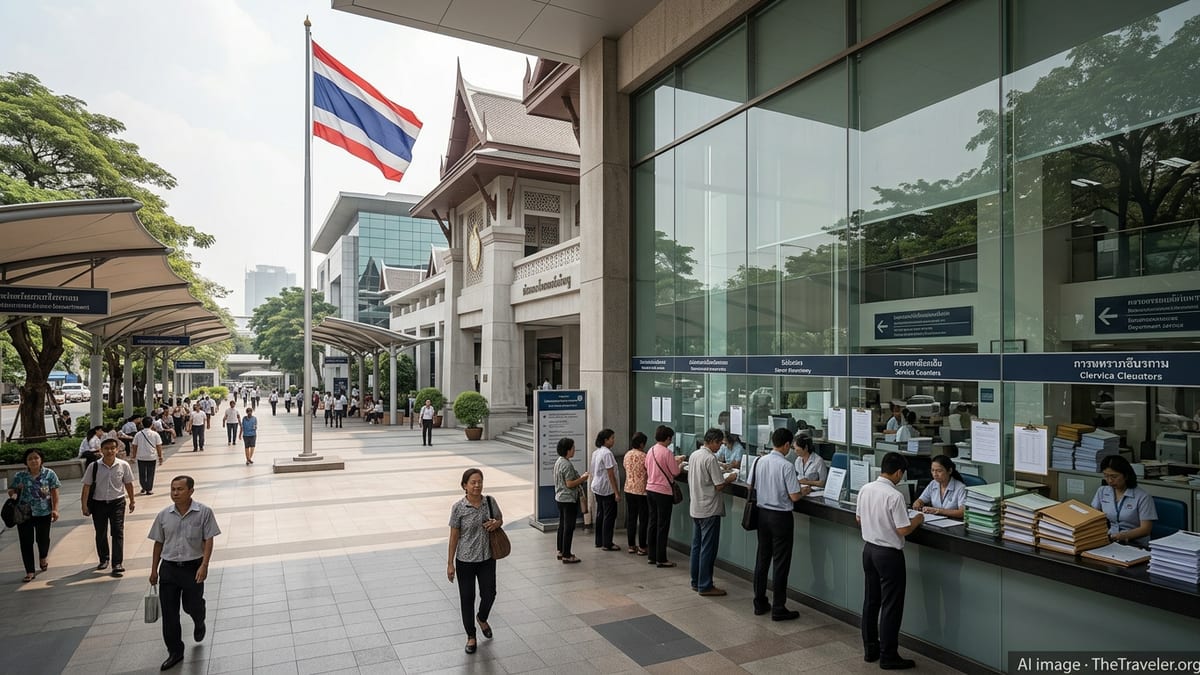
From an everyday perspective, complexity is shaped less by macro indicators and more by how state offices function in practice. Common characteristics of Thai bureaucratic interaction include strict adherence to office hours, limited daily service quotas for some procedures, and line based queuing that may require arriving early in the morning to secure a slot.
Documentation standards are typically exacting. Officials may require original documents, certified translations into Thai, multiple photocopies, and specific photo formats. Small discrepancies in names, addresses, or passport details across documents can lead to requests for reissuance or additional affidavits. For relocators managing work or family commitments, these additional steps can substantially increase the perceived complexity score.
Another notable feature is the widespread use of in person stamped forms, physical signatures, and paper records, particularly outside major urban centers. Even where online pre submissions exist, it is common for finalization to require appearance at a counter with printed copies and physical identification.
At the same time, user experiences are highly heterogeneous. Some relocators report efficient, courteous service when arriving fully prepared with complete documentation, while others encounter opaque delays or inconsistent interpretation of rules. This variability at the front line is a defining element of Thailand’s bureaucracy complexity profile.
The Takeaway
Thailand’s Bureaucracy Complexity Score reflects a landscape of moderate to high administrative difficulty mitigated by gradual, but incomplete, digital reform. Structurally, fragmented responsibilities, dense licensing frameworks, and limited procedural transparency keep the underlying complexity level elevated. Ongoing initiatives to create one stop services and expand e government platforms are beginning to reduce complexity in targeted domains, but have not yet produced a universally streamlined experience.
For individuals and organizations evaluating relocation, the key implication is that Thailand’s bureaucracy is navigable but not frictionless. Processes are generally feasible and supported by a stable administrative apparatus, but they demand significant preparation, careful document management, and often local expertise. Those who plan for frequent in person interactions, factor in buffer time for delays, and leverage emerging digital tools where available will experience a more manageable complexity score than those who assume fully harmonized, paperless government.
Decision makers should calibrate expectations accordingly. Thailand offers a functioning, reform oriented bureaucracy, but at present it remains procedurally demanding compared with the most administratively streamlined jurisdictions. The trajectory of reforms is positive, yet relocators in the near term should treat bureaucratic navigation as a central operational consideration rather than an afterthought.
FAQ
Q1. What does Thailand’s Bureaucracy Complexity Score represent in practical terms?
The score represents how difficult it is to complete common administrative procedures, including registrations, permits, and routine interactions with state agencies, based on steps required, time predictability, and clarity of rules.
Q2. Is Thailand considered a high bureaucracy country compared with global peers?
Thailand sits in a mid-range position globally: not among the most bureaucratically challenging countries, but clearly more complex than the most streamlined OECD systems.
Q3. How much has digital government reduced bureaucratic complexity in Thailand?
Digital government initiatives have reduced complexity for selected services such as some business registrations and tax procedures, but many key interactions still require in person visits and paper documentation.
Q4. Are procedures consistent across different Thai provinces and offices?
Core legal requirements are national, but implementation can vary. Different offices sometimes interpret rules or documentation requirements differently, which increases practical complexity.
Q5. How important is Thai language ability for dealing with bureaucracy?
Thai language ability significantly reduces complexity. While some central agencies offer English support, many local offices operate primarily in Thai, making translation assistance valuable.
Q6. Does using local consultants or facilitators meaningfully lower the complexity score?
Engaging experienced local advisors generally lowers the effective complexity, as they understand specific documentation standards, office practices, and sequencing of procedures.
Q7. Are business related bureaucratic processes easier than personal administrative tasks?
Flagship business processes can be relatively well structured, especially for larger investors, while personal status, local registrations, and certain permits often involve more variability and in person steps.
Q8. How predictable are processing times for common Thai administrative procedures?
Official timelines exist, but real processing times can vary due to queues, documentation issues, and discretionary review, so building in time buffers is advisable.
Q9. Is Thailand’s bureaucracy improving or getting more complex over time?
The overall trend is gradual improvement due to digitalization and reform efforts, though progress is uneven and many legacy paper based procedures remain in place.
Q10. What is the main practical strategy to manage Thailand’s bureaucracy complexity when relocating?
The most effective strategy is proactive preparation: obtain clear checklists, confirm requirements with the specific office in advance, allow extra time, and use digital channels where available, ideally supported by local expertise.