


Thailand offers a relatively predictable day-to-day environment for most foreign residents, yet it operates within a structurally fragile political system shaped by recurring coups, judicial interventions and deep elite-populist tensions. This briefing evaluates how Thailand’s current political dynamics, protest patterns and security risks translate into practical stability considerations for expats and long-term foreign assignees as of early 2026.
Overview of Thailand’s Political Trajectory and Coup Risk
Modern Thai politics has been marked by repeated military interventions and abrupt changes of government. Since 2006, Thailand has experienced two full military coups, in 2006 and 2014, and several periods of military-backed or caretaker rule. While no coup has occurred since 2014, the armed forces and conservative royalist networks retain significant influence over key institutions, including the judiciary and elements of the bureaucracy. This creates an environment where formal electoral outcomes can be re-shaped after the fact through legal and constitutional mechanisms.
The 2023 general election initially delivered a strong mandate for a reformist party that campaigned on reducing military and royal influence. Subsequent political maneuvering prevented that party from forming a government, and in August 2024 it was formally dissolved and its leaders banned from politics for proposing reform to Thailand’s strict laws on criticism of the monarchy. This followed the dissolution of a predecessor reformist party in 2020. Such interventions signal that Thailand’s political order remains closely managed and that actors perceived as threatening core state interests can be neutralized outside normal electoral competition.
Since mid 2024 Thailand has cycled through more than one prime minister and, by late 2025, entered another period of political uncertainty following the removal of a prime minister by the Constitutional Court and the subsequent dissolution of parliament ahead of fresh elections. A conservative party aligned with more traditional interests has since emerged as a leading force in the latest polls. For expats, this pattern indicates that while the basic state machinery and economic life continue to function, political volatility at the elite level persists and sudden shifts of government remain plausible over a multi-year horizon.
From a relocation risk standpoint, the probability of another formal military coup in the near term is lower than during the 2013–2014 crisis period but cannot be dismissed entirely. The armed forces still act as an ultimate veto player if elite conflict escalates or if electoral outcomes are perceived as existentially threatening to established interests. At the same time, the system has demonstrated a strong capacity to keep institutions running and maintain basic order even during intense political contestation, which limits day-to-day disruption for most foreign residents.
Protest Dynamics and Exposure Risk for Foreign Residents
Thailand has a long record of large-scale street protests, including in 2010, 2013–2014 and 2020–2021. Demonstrations have at times been prolonged, occupying central Bangkok intersections and government districts for weeks, and have occasionally involved clashes between protesters and security forces using live ammunition, rubber bullets, water cannon and tear gas. However, these episodes are intermittent rather than continuous, and protest-related violence is usually localized to specific areas and time windows.
Recent years have seen a shift from mass occupation-style protests to more episodic rallies, particularly around sensitive judicial decisions, constitutional court rulings or high-profile royal or military controversies. Since the dissolution of the reformist party in 2024, protests have occurred but have generally been smaller and more tightly controlled by the authorities compared with the peak youth-led demonstrations of 2020. Security forces now move quickly to disperse gatherings, sometimes making preemptive arrests using a range of public order, computer crime and monarchy-related laws. This has had a dampening effect on protest size and duration, but not eliminated the possibility of sudden flare-ups.
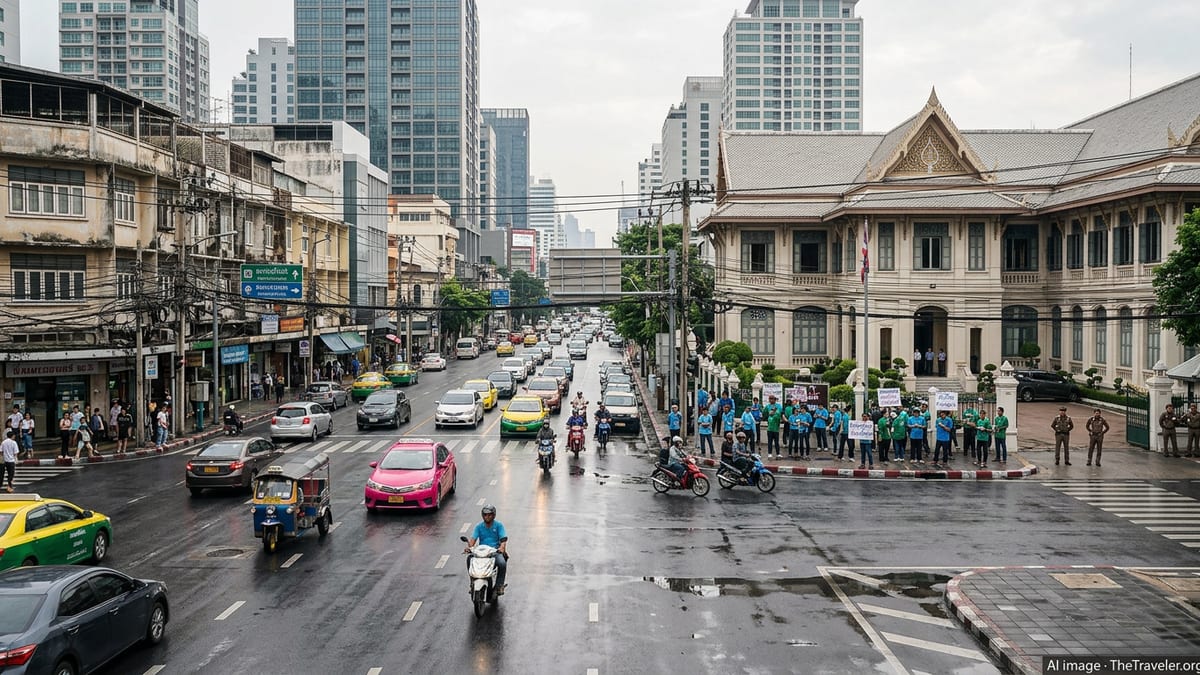
For foreign residents and assignees, direct targeting in political unrest remains rare. Demonstrations are overwhelmingly focused on domestic political actors rather than foreigners. The primary risk is collateral exposure: being caught in traffic disruptions, tear gas deployment, or sporadic clashes. Political rallies in Bangkok typically occur around key sites such as the Democracy Monument, Ratchaprasong intersection, Government House, Parliament, and major university campuses. Routine expat residential areas and business districts may be located nearby, particularly in central Bangkok, which means situational awareness and route flexibility are important during periods of heightened tension.
Corporate security assessments generally rate the likelihood of unrest in Thailand as medium with a low to medium impact for well-prepared organizations and individuals. Practical mitigation measures for expats include monitoring local news and embassy alerts, avoiding announced protest locations, allowing extra travel time when rallies are expected, and ensuring offices and residences have alternative access routes. For families with children, international schools in Bangkok and Chiang Mai have experience activating remote learning or adjusted hours during major protest activity, which helps limit direct exposure while preserving educational continuity.
Regional Security Variations and Conflict Zones
Thailand’s security environment is not uniform. The three southernmost provinces bordering Malaysia, along with parts of a neighboring province, have experienced a low-intensity separatist insurgency since the early 2000s. This conflict has resulted in several thousand deaths over two decades, primarily among security forces and local residents. Although violence levels have declined at times, and recent years have seen tentative efforts to reduce incidents, sporadic bombings and shootings continue to occur in these border areas.
Most foreign embassies and government advisories recommend against non-essential travel to these southernmost provinces and advise particular caution in certain border districts. For multinational companies and NGOs operating there, dedicated security protocols are standard, including movement controls, vetted transport and active incident monitoring. These conditions make the region generally unsuitable for typical corporate or lifestyle-driven expat postings, and most long-term foreign residents are concentrated instead in Bangkok, Chiang Mai, the Eastern Economic Corridor industrial zones and major resort provinces further north.
Outside the deep south and limited border flashpoints, Thailand’s political-security risk profile is more closely tied to national political developments and urban protest cycles than to organized violence. Intermittent localized clashes can also occur around politically sensitive court verdicts or parliamentary decisions, usually confined to central Bangkok or provincial city centers. Foreign residents in these areas can reduce exposure by avoiding government buildings and protest focal points during tense periods and by following employer or landlord guidance on security posture.
For relocation planning, regional differentiation is important. Assignments in Bangkok and major northern or eastern cities can be considered broadly stable for expats who apply standard urban security practices and remain aware of political developments. Postings in the insurgency-affected southern border provinces require a higher risk tolerance, specialized security support and careful assessment of organizational duty-of-care capabilities.
Legal and Civic Space Constraints Relevant to Foreigners
Thailand’s political environment is constrained by extensive legal tools that authorities use to manage dissent, including national security legislation, computer crime laws, emergency provisions and strict offenses related to defamation of the monarchy. Over the last decade, thousands of protesters and activists have faced legal proceedings under such laws, and some have been subjected to restrictive bail conditions, travel bans or pre-trial detention. The space for overtly critical political speech, particularly online, is therefore narrower than in many liberal democracies.
For foreign residents, the primary implication is not a high likelihood of arrest, but the need for caution in public political expression. Foreigners are not central actors in domestic political debates, yet there have been isolated cases of non-citizens facing investigation or deportation for comments or activities perceived as interfering in Thai politics or as disrespectful to the monarchy. Social media posts, participation in protests, or public commentary that would be routine in some countries can carry greater legal risk in Thailand if interpreted as political agitation.
Relocation policies for staff assigned to Thailand increasingly include guidance on political neutrality in public forums, including refraining from joining demonstrations, avoiding political slogans or symbols, and exercising restraint in online commentary accessible in Thailand. Corporate codes of conduct often advise employees and their dependents to treat the monarchy and the military as extremely sensitive topics and to avoid sharing satirical or critical content related to these institutions, even in private messaging groups that could be screenshotted and disseminated.
At the same time, most expats who focus on professional and social life rather than activism experience limited direct interaction with the coercive side of the Thai state. Contract enforcement, civil administration and routine dealings with authorities are generally predictable, though sometimes slow or bureaucratic. The practical risk level increases for politically engaged academics, journalists, NGO workers or those in sectors that intersect with human rights and governance issues, who should factor potential legal and reputational exposure into their relocation assessment.
Institutional Resilience and Continuity of Daily Life
Despite recurring political crises, Thailand’s state and economic institutions have shown a high degree of operational resilience. Past coups and episodes of mass protest have rarely led to widespread breakdown of services. Banks, utilities, telecommunications, transport networks and essential public services have typically continued to function, including during weeks-long protest occupations of central Bangkok or under formal military rule. For businesses, this continuity has helped sustain Thailand’s attractiveness as a regional hub despite its reputation for political volatility.
Courts and regulatory bodies continue to operate even when they are themselves central players in political disputes, such as high-profile party dissolution cases or prime ministerial disqualifications. For foreign investors and residents, this means contracts, property rights and corporate structures are broadly respected, albeit within a politicized macro-environment. International companies have generally been able to navigate changes of government without abrupt expropriation or wholesale regulatory reversals, relying instead on incremental policy adjustments and bureaucratic continuity.
For expats and their families, this institutional robustness translates into relatively limited disruption to daily life even when headlines signal political turmoil. Schools, hospitals, shopping areas and transport services in Bangkok and major cities generally remain open throughout periods of unrest, with occasional short-term adjustments to operating hours or security procedures near protest zones. Employers and relocation providers typically activate contingency plans that may shift working patterns temporarily toward remote work or alternative office locations.
Nonetheless, the cumulative effect of recurring political disputes can shape long-term sentiment. Some foreign professionals view Thailand’s politics as a chronic background risk that must be managed rather than an acute deterrent. Others may prefer jurisdictions with more stable institutional arrangements for senior executive postings or for relocating with school-age children. The key assessment factor is tolerance for periodic uncertainty at the national level in exchange for a lifestyle environment that is, in practice, usually calm and functioning at the local level.
Implications for Corporate Risk Management and Policy Design
Organizations relocating staff to Thailand increasingly treat political risk as a core component of assignment planning rather than a peripheral concern. Risk assessments commonly rate Thailand in the mid-range of political and security risk: higher than many OECD destinations but lower than high-conflict states. For most sectors, the key issues are not armed conflict or systemic collapse, but intermittent unrest, legal uncertainty in sensitive political areas and a structural possibility of sudden leadership change.
Practical measures often adopted by employers include political risk briefings for incoming staff, enrollment in security alert systems, and explicit instructions to avoid participation in demonstrations. Many organizations also ensure that their crisis management plans for Thailand cover scenarios such as large-scale protests blocking central business district access, emergency decrees restricting movement or assembly, and airport disruptions caused by political sit-ins. These plans usually emphasize flexible working arrangements, secure transport options and clear communication chains.
Relocation benefits packages may incorporate provisions for temporary evacuation or optional short-term relocation to a neighboring country during serious unrest, particularly for families with young children or for employees with health vulnerabilities. While such evacuations are rarely required, the existence of a pre-agreed protocol provides reassurance to assignees and helps employers meet duty-of-care obligations. Insurance policies are also reviewed to ensure they include coverage for political violence and associated disruptions where appropriate.
On the policy side, some organizations apply differentiated location risk weightings within Thailand, treating Bangkok and key industrial regions as moderate-risk hubs suitable for long-term assignments, while classifying the conflict-affected deep south as requiring enhanced security resources or short-duration rotations. This allows companies to leverage Thailand’s economic opportunities while aligning deployment patterns with their internal risk tolerance and the evolving political landscape.
The Takeaway
Thailand presents a mixed picture of political stability for expats and foreign residents. At the structural level, it remains a country with deep and unresolved tensions between elected populist or reformist forces and entrenched military-royalist elites. Judicial interventions in politics, party dissolutions, prime ministerial removals and periodic constitutional changes are likely to continue. These factors mean Thailand cannot be classified as a fully stable liberal democracy and carries an enduring risk of political shocks.
At the same time, the operational environment experienced by most expats is relatively stable. Political unrest is intermittent and geographically concentrated, the long-running insurgency is confined to distant southern provinces rarely used for mainstream expat postings, and state institutions have demonstrated substantial resilience in maintaining services and economic activity during crises. Foreign residents who stay away from political activism, respect local legal sensitivities and follow routine security precautions generally experience a predictable and secure living environment.
For individuals and organizations evaluating relocation, Thailand is best viewed as a moderate political risk destination: suitable for many long-term assignments, but requiring structured risk management, awareness of legal and civic constraints, and readiness for episodic political turbulence. Decision-makers should align relocation choices with their tolerance for such background volatility, ensuring that crisis plans, communication strategies and duty-of-care frameworks are in place before committing to a move.
FAQ
Q1. Is Thailand currently considered politically stable for long-term expats?
Thailand offers day-to-day stability for most expats, but its political system is structurally fragile, with recurring judicial interventions, party dissolutions and periodic leadership changes that can generate uncertainty.
Q2. How likely is large-scale political unrest to disrupt daily life in Bangkok?
Large-scale protests do occur intermittently, mainly in central Bangkok, but they typically affect specific areas and routes. Most expats experience inconvenience from traffic and temporary disruptions rather than direct harm.
Q3. Are foreign residents targeted during political protests?
Foreigners are rarely targeted. Demonstrations focus on domestic political actors, and risk to expats is generally collateral, such as being near clashes, tear gas or sudden roadblocks.
Q4. Which regions of Thailand are most affected by political violence?
The three southernmost provinces along the Malaysian border are affected by a long-running insurgency. Most expats live elsewhere, where political risk is tied mainly to urban protests and national-level instability.
Q5. Could another military coup happen, and how would it affect expats?
The possibility of a future coup cannot be ruled out, although it is lower than during past crises. Historically, coups have caused political uncertainty but limited disruption to basic services used by expats.
Q6. How restrictive is Thailand’s legal environment on political speech for foreigners?
Thailand has strict laws on national security and the monarchy. Foreign residents are advised to avoid protests and public political commentary, especially online, to reduce legal exposure.
Q7. Do political changes in Thailand usually affect foreign businesses and jobs?
Changes of government can alter policy direction and regulatory emphasis, but foreign businesses typically continue operating. Institutional continuity in economic management has been relatively strong across political cycles.
Q8. How prepared are Thai cities and employers for periods of unrest?
Bangkok and major employers have experience managing unrest, often using remote work, adjusted hours and security advisories. International schools and large companies usually have contingency plans in place.
Q9. Is Thailand a suitable posting for expat families given the political situation?
For many families, Thailand is workable, as unrest is episodic and services remain reliable. Suitability depends on each family’s risk tolerance and the robustness of the employer’s duty-of-care measures.
Q10. What practical steps should expats take to manage political risk in Thailand?
Key steps include monitoring local news and embassy alerts, avoiding protest areas, maintaining flexible travel plans, following employer security guidance, and exercising caution in political speech both offline and online.