


Frankfurt Airport is one of Europe’s busiest hubs and, thankfully, one of the best connected. Whether you are heading into Frankfurt city center for a short stay or transferring straight to another German city, choosing the right transport option can save you time, money and stress. This guide walks you through the main ways to get to and from Frankfurt Airport, using concrete examples so you know what to expect on the ground.
Get the latest updates straight to your inbox!
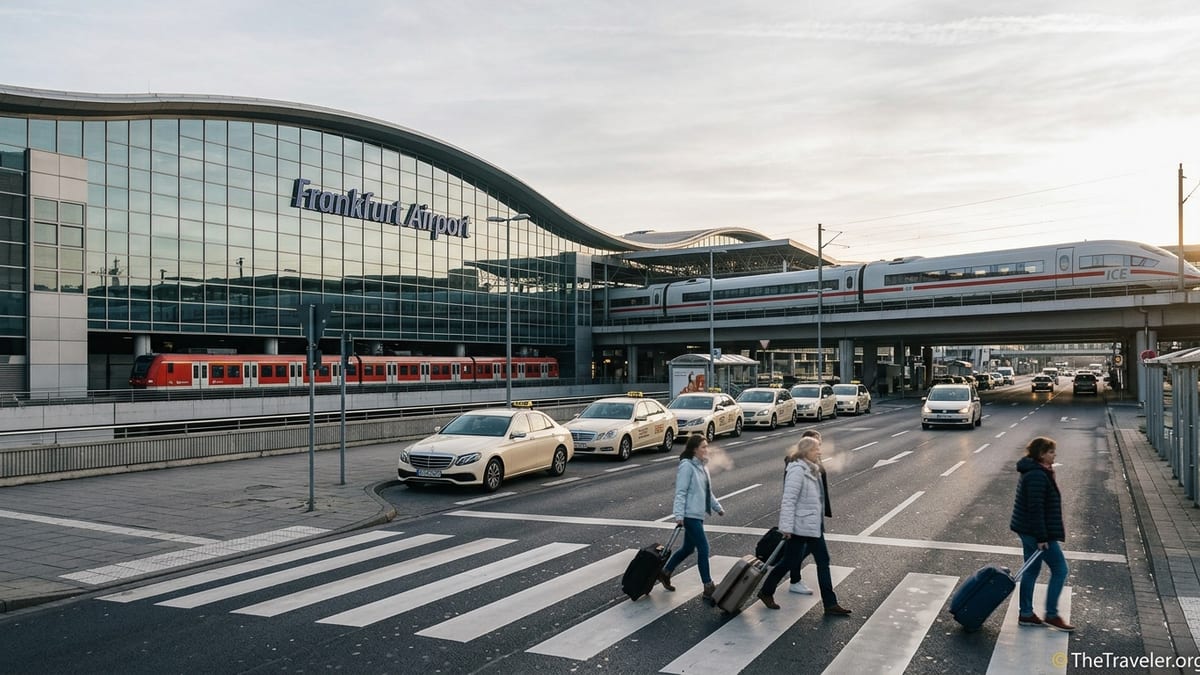
Understanding Frankfurt Airport’s Location and Terminals
Frankfurt Airport sits about 12 kilometers southwest of Frankfurt’s city center, directly beside the major A3 and A5 motorways. In normal traffic, a car or taxi ride from the airport to Frankfurt Hauptbahnhof, the main train station on the edge of the center, takes around 20 to 25 minutes. In rush hour, especially on weekday mornings and late afternoons, that can easily stretch to 40 minutes or more, which is one reason many travelers prefer the reliability of the S-Bahn suburban trains.
The airport itself has two main passenger terminals used by most airlines: Terminal 1, the large multi-pier complex largely dominated by Lufthansa and its Star Alliance partners, and Terminal 2, used by a mix of international carriers. A driverless SkyLine people mover and a shuttle bus connect the terminals inside the airport grounds. When you follow signs for public transport, you will see that most trains and buses are accessed from Terminal 1, so passengers arriving at Terminal 2 typically take the SkyLine first and then walk to the station areas.
One important detail for planning your journey is that Frankfurt Airport has two different railway stations: the Regionalbahnhof for local and regional trains, and the Fernbahnhof for long-distance ICE and IC services. They are a short walk apart but serve different purposes. Local trips into Frankfurt city use the underground regional station beneath Terminal 1, while long-distance trains to cities like Cologne, Munich or Berlin call at the elevated glass-and-steel long-distance station across from Terminal 1.
Because of this layout, it helps to decide before you arrive whether your priority is getting quickly into central Frankfurt or transferring directly onward by train to another region. A traveler staying at a hotel near Frankfurt Hauptbahnhof, for example, will almost always be better off heading straight to the S-Bahn platforms in the regional station, while someone connecting to an ICE to Stuttgart or Hamburg may walk a few extra minutes to the long-distance station instead.
Fast and Affordable: S-Bahn and Regional Trains
For most visitors heading between Frankfurt Airport and the city center, the S-Bahn suburban trains are the best all-around option. Lines S8 and S9 run from the Regionalbahnhof under Terminal 1 to Frankfurt Hauptbahnhof and on through the downtown “City Tunnel” with stops such as Hauptwache and Konstablerwache. Typical journey time from the airport to Hauptbahnhof is about 10 to 15 minutes, and trains usually run every 10 to 15 minutes throughout the day.
Tickets are sold through the Rhine-Main Transport Association (RMV) system. As of mid-2026, a standard adult single ticket from Frankfurt Airport to stations in the central city is typically in the mid-single-digit euro range per person, with reduced fares for children. You can buy tickets from RMV machines clearly marked with a green logo near the station entrance or use contactless payment and mobile apps. A common real-world scenario is a family of four landing in Terminal 1, walking downstairs, buying two adult and two child tickets at the machine and being on an S8 toward Frankfurt Hauptbahnhof within 20 minutes of clearing customs.
If you are staying in a central neighborhood such as the Altstadt, the banking district around Willy-Brandt-Platz, or the shopping area near Zeil, consider staying on the S-Bahn past Hauptbahnhof and getting off at Hauptwache or Konstablerwache. For example, a business traveler booked at a hotel near Hauptwache can ride the S9 from the airport to Hauptwache in around 20 minutes and then walk five minutes to their hotel, avoiding the busy tram and bus stops outside the main station.
Regional trains (Regionalbahn or Regional-Express) also use the airport’s regional station and can be handy for nearby cities along the Rhine-Main corridor. For instance, someone whose meeting is in Mainz might take a regional train directly from the airport to Mainz Hauptbahnhof in roughly 30 minutes. However, for central Frankfurt itself, the S8 and S9 lines remain the simplest choice because they run so frequently and stop at the main inner-city hubs. When in doubt, look for departures labeled S8 or S9 toward Frankfurt or Hanau on the electronic displays.
Long-Distance Connections: ICE and IC Trains From the Airport
Frankfurt Airport’s long-distance station, signed as “Frankfurt Flughafen Fernbahnhof,” makes it possible to step off a long-haul flight and board a high-speed ICE train directly to cities across Germany. The station is located in a striking glass structure a short walk from Terminal 1, connected by enclosed walkways and escalators. Many ICE services between Cologne and Frankfurt, as well as routes toward Stuttgart, Munich, Berlin and other major centers, include a stop here, which can save you a trip into Frankfurt Hauptbahnhof.
In practice, this means that a traveler landing from North America in the morning can clear passport control, follow the signs for “Fernbahnhof / Long-distance trains,” and an hour later be on a 300 km/h ICE heading toward Cologne or Stuttgart. Typical journey times from the airport long-distance station are roughly one hour to Cologne, around three hours to Berlin with a change on some routes, and about three hours to Munich depending on the service. Tickets can be purchased in advance on Deutsche Bahn’s official booking channels or at DB ticket machines and travel centers located in the station concourse.
Many airlines, led by Lufthansa, also cooperate with Deutsche Bahn in an AIRail or Rail&Fly system, where a train ticket is combined on the same booking reference as your flight. In that scenario, the airport long-distance station effectively becomes your “rail terminal.” A traveler flying from New York to Frankfurt, then “onward” to Stuttgart by train, might find that their boarding pass lists the ICE train number rather than a flight. One advantage is that if the train is delayed, the airline and rail operator coordinate rebooking options similar to a missed connecting flight, though it is still wise to allow a conservative buffer when connecting from air to rail.
As with any long-distance train travel in Germany, delays and equipment changes can occur, so building in extra time before a departing flight is prudent. If you are heading from another German city to catch a flight at Frankfurt Airport, frequent travelers often aim for an earlier ICE arrival, treating the airport as if it were an international destination requiring an extra cushion. For example, someone traveling from Nuremberg might choose an ICE scheduled to arrive at Frankfurt Airport almost three hours before departure, leaving room for disruptions, security queues and the walk from the platform to their departure gate.
Taxis, Rideshares and Private Transfers
For door-to-door convenience, particularly if you have heavy luggage or are arriving late at night, taxis and rideshare services are the next most common choice. Official taxis wait in dedicated ranks immediately outside the arrivals halls at both terminals. Vehicles are usually beige Mercedes sedans or minivans equipped with meters. A typical metered fare from Frankfurt Airport to central areas around Hauptbahnhof, the banking district or the Altstadt often falls in a general range of around 30 to 45 euros depending on traffic, time of day and precise address.
In a concrete example, a solo traveler arriving on an evening flight with a suitcase and carry-on might step out of Terminal 1, join the taxi queue and be dropped at a hotel near Frankfurt Hauptbahnhof in about 25 minutes if traffic is moderate. The meter may show a fare somewhere in the mid-30s in euros, plus an optional small tip. For a group of three or four colleagues sharing a cab to the same hotel, splitting that fare can be competitive with the cost of individual train tickets, especially if they value arriving directly at the lobby instead of navigating platforms and underpasses.
Rideshare platforms such as Uber and Bolt currently operate in the Frankfurt region under the local regulatory framework. Pickup points are typically located near the public arrivals areas, though exact meeting spots can change. Travelers who prefer app-based booking might order a car while waiting for their luggage and walk to the designated pickup zone once the driver is nearby. Prices for rideshare trips between the airport and central Frankfurt can vary with demand, but in non-peak hours they are often similar to or slightly below the taxi range for comparable vehicles and routes.
For those traveling to destinations farther afield without direct train connections, pre-booked private transfers and shuttle operators offer another alternative. For example, a business traveler heading directly from Frankfurt Airport to an office campus in a Rhein-Main suburb might arrange a car service that tracks their flight and waits in the arrivals hall with a name sign. While the per-trip cost is higher than a standard taxi, the predictability and fixed pricing can be appealing for corporate travelers and families who prefer to avoid on-the-spot decisions after a long flight.
Regional Buses and Airport Shuttle Services
Beyond trains and taxis, Frankfurt Airport is a hub for regional and long-distance buses. Directly outside the terminals you will find bays for local buses that connect to nearby towns and suburbs, as well as coach stops used by intercity bus companies. These services can be useful if you are heading to destinations that do not have frequent rail connections or if you are watching your budget closely.
One concrete example is the network of shuttle buses operating between Frankfurt Airport and cities such as Mainz, Mannheim or Heidelberg. Some services run on a scheduled shared-ride basis, where minibuses depart at set times and pick up passengers at agreed meeting points at the airport. A traveler landing in the morning might book a seat on a late-morning shuttle to Heidelberg, store their luggage under the minibus and relax on board for the journey south, arriving at a central drop-off spot or even directly at a hotel depending on the operator’s route.
Private companies also brand their services as airport shuttles, often using modern coaches with luggage compartments and onboard Wi-Fi. For instance, travelers heading toward the Rhine or Moselle regions may find it convenient to use a dedicated airport coach that runs via intermediate cities such as Mainz. While such coaches generally take longer than high-speed trains, they can avoid the need to change at busy rail hubs and may provide a more predictable door-to-door experience for passengers uncomfortable with transfers.
When considering buses and shuttles, it is important to check schedules in advance and pay attention to pick-up locations at the airport, which can be in specific bays or on particular levels of the terminal forecourts. Unlike trains, which run very frequently between the airport and Frankfurt city, many shuttle buses operate only a few times per day. If your flight is delayed, you may need a backup plan such as the S-Bahn or a taxi, so building in some flexibility is wise.
Driving, Car Rental and Drop-Off Options
For travelers who plan to explore the wider region or continue on to smaller towns, renting a car at Frankfurt Airport can make sense. Major international rental companies maintain desks in both terminals, with vehicle pick-up areas in multi-level parking garages attached to the airport. The airport sits at the junction known as the Frankfurter Kreuz, where the A3 and A5 autobahns intersect, giving direct access to north-south and east-west routes across Germany.
In a typical scenario, a family arriving for a week-long holiday in the Rhine Valley might pre-book a compact SUV, collect the keys at a rental counter in Terminal 1 and follow signs from the garage to the A3 toward Wiesbaden and Koblenz. Within about 40 minutes they could be checking into a guesthouse along the Rhine. The advantage is the flexibility to stop at small towns and vineyards that are not well served by public transport, although this comes with the responsibility of navigating German road signs, varying speed limits and sometimes heavy traffic around the metropolitan area.
When driving to the airport for a departing flight, private cars can use short-term drop-off zones directly in front of the terminals for quick unloading, usually subject to strict time limits. Longer stays involve parking in the airport’s multi-story garages or longer-term lots, which charge daily rates. Many frequent flyers based in the Frankfurt region combine a short drive to a Park & Ride lot near an S-Bahn station with a quick train ride to the airport, which can be more economical than leaving a car parked at the terminal for a week.
For outbound travelers returning a rental car, it is important to allow extra time to refuel if required and to find the correct return ramp for the specific company. Rental car returns are generally well signposted, but congestion at peak times can add several minutes just to reach the garage entrance. Once the car is checked in, it is a short walk or elevator ride back into the terminal building for check-in and security.
Choosing the Best Option for Different Types of Travelers
The “best” way to get to or from Frankfurt Airport will vary depending on your priorities, budget and destination within the region. Business travelers staying near Frankfurt Hauptbahnhof or in the central banking district often choose the S-Bahn for its speed and predictability during the day, especially when they travel with only hand luggage. A 15-minute train ride from the airport regional station to Hauptbahnhof, followed by a short walk to an office tower on Mainzer Landstrasse, can be both faster and cheaper than threading through traffic in a taxi.
Families with young children or older relatives, on the other hand, may value simplicity over absolute speed. For a family of four with two large suitcases each, hauling luggage through station corridors and onto a crowded S-Bahn at rush hour can be tiring. In such a case, a taxi van or pre-booked private transfer directly from the arrivals curb to a central hotel can feel worthwhile, even if it costs more than four single train tickets. The ride may take 30 minutes in traffic, but everyone arrives together at the hotel door without changing vehicles.
Travelers heading straight from the airport to other German cities should think carefully about long-distance trains. If your destination is directly served from Frankfurt Airport’s long-distance station, as is the case with Cologne on the high-speed line, it often makes sense to board there instead of detouring via Frankfurt Hauptbahnhof. However, for some routes with frequent departures from the city’s main station, it can be quicker or more flexible to ride the S-Bahn into town first and catch a different ICE from there. For example, someone traveling to Kassel might opt for an S9 to Hauptbahnhof followed by an ICE that departs from the main station, taking advantage of better departure times or seat availability.
Budget-conscious travelers, including students and backpackers, frequently combine options. One common pattern is to arrive at Frankfurt Airport, buy an RMV ticket for the S-Bahn to the city, check into a hostel or budget hotel near the main station, and then continue onward the next day using a discounted long-distance train ticket purchased in advance. This staged approach spreads out the cost and avoids arriving in a new city late at night. Meanwhile, those staying in nearby towns like Offenbach, Wiesbaden or Darmstadt may find that a mix of S-Bahn and regional trains from the airport provides a good compromise between price and convenience.
The Takeaway
Frankfurt Airport’s dense web of transport options is both a strength and a potential source of confusion, especially for first-time visitors. Trains from the Regionalbahnhof offer the fastest and most economical route into central Frankfurt, while the long-distance station turns the airport into a de facto rail hub for much of Germany. Taxis, rideshares and private transfers add a layer of comfort and door-to-door service that many travelers appreciate after a long flight.
The key to making the right choice is to match the option to your needs. If you value speed and cost, follow the signs to the S8 or S9 trains and be in the city within minutes. If your onward journey is to another major German city, check whether an ICE from the airport long-distance station can take you there directly. If you are traveling with heavy luggage, a large group or mobility concerns, consider booking a taxi, rideshare or shuttle ahead of time for a smoother door-to-door experience.
By understanding how Frankfurt Airport is laid out and how each transport mode works in practice, you can turn what might have been a stressful transfer into a straightforward part of your journey. With a little planning, your first step into Germany can be as efficient and comfortable as the rest of your trip.
FAQ
Q1. What is the fastest way to get from Frankfurt Airport to the city center?
The fastest option for most travelers is the S-Bahn suburban trains, specifically lines S8 and S9 from the airport’s regional station to Frankfurt Hauptbahnhof or central stops like Hauptwache. The journey usually takes around 10 to 15 minutes, and trains run frequently throughout the day.
Q2. How much does it cost to go from Frankfurt Airport to central Frankfurt by train?
A standard adult single ticket on the local RMV network from Frankfurt Airport to the central city typically costs in the mid-single-digit euro range, with reduced fares available for children. Exact prices can change, so it is best to check the latest fares on the ticket machines or official apps at the time of travel.
Q3. Should I use the regional station or the long-distance station at Frankfurt Airport?
Use the regional station if you are traveling into Frankfurt city center or nearby towns on S-Bahn or regional trains. Use the long-distance station, signed as Frankfurt Flughafen Fernbahnhof, if you are catching an ICE or IC train to other major cities such as Cologne, Stuttgart or Munich. Your ticket or journey planner will show which station your train departs from.
Q4. How long does a taxi from Frankfurt Airport to the city center take and what does it cost?
In normal traffic, a taxi ride from the airport to central Frankfurt usually takes around 20 to 30 minutes. Typical fares fall somewhere in a general range of about 30 to 45 euros depending on the time of day, traffic conditions and your exact destination. Taxis wait at official ranks outside both terminals.
Q5. Are rideshare services like Uber available at Frankfurt Airport?
App-based rideshare services such as Uber and Bolt do operate in the Frankfurt area under local rules. Pickup locations are usually in designated areas near the arrivals halls, and the apps will guide you to the exact meeting point. Prices are dynamic and can be similar to or slightly lower than standard taxis, especially outside peak times.
Q6. What is the best option for a family with a lot of luggage?
For families with several suitcases or young children, a taxi, rideshare or pre-booked private transfer is often the most comfortable choice, as it avoids stairs and train crowds. If budget is a concern and your accommodation is close to an S-Bahn station, using the S8 or S9 can still work, but be prepared to handle bags on and off the train and through station corridors.
Q7. Can I travel directly from Frankfurt Airport to other German cities by train?
Yes, many long-distance ICE and IC trains stop at Frankfurt Airport’s long-distance station. You can travel directly to major cities such as Cologne, Stuttgart, Munich and others without going into Frankfurt Hauptbahnhof first. However, for some destinations it may be faster or more flexible to take the S-Bahn into the city and board a different long-distance train there.
Q8. Is it worth renting a car at Frankfurt Airport?
Renting a car is worthwhile if you plan to explore regions with limited public transport, such as smaller towns in the Rhine, Taunus or countryside areas. The airport sits at a major motorway junction, so driving access is straightforward. Within central Frankfurt, though, trains, trams and buses are usually more convenient than dealing with city traffic and parking.
Q9. What should I consider if I have a long-distance train connection after my flight?
Allow generous buffer time between your flight’s scheduled arrival and your train’s departure to account for immigration, baggage claim and possible delays. If your train ticket is part of an AIRail or Rail&Fly package combined with your flight, check the conditions carefully, but it is still sensible to choose a connection that gives you breathing room, especially at busy times.
Q10. Are there late-night and early-morning transport options from Frankfurt Airport?
Service frequency on S-Bahn and regional trains decreases late at night and early in the morning, though some connections usually remain. If you arrive very late or depart very early, taxis and rideshares are often the most reliable options. It is wise to check timetables in advance for overnight or early-morning travel and consider booking a car in advance if your schedule is tight.