


Smaller, quieter and in many ways better preserved than nearby Pompeii, Herculaneum should be one of the easiest archaeological sites to enjoy in southern Italy. Yet many visitors still walk away frustrated, exhausted or convinced they have “seen it all” when they have barely scratched the surface. Most problems are not caused by the site itself but by avoidable planning mistakes, confusion with transport and tickets, or unrealistic expectations about what Herculaneum actually offers. Understanding these pitfalls before you go can turn a rushed box‑ticking stop into one of the most memorable experiences of your time around Naples and the Amalfi Coast.
Get the latest updates straight to your inbox!
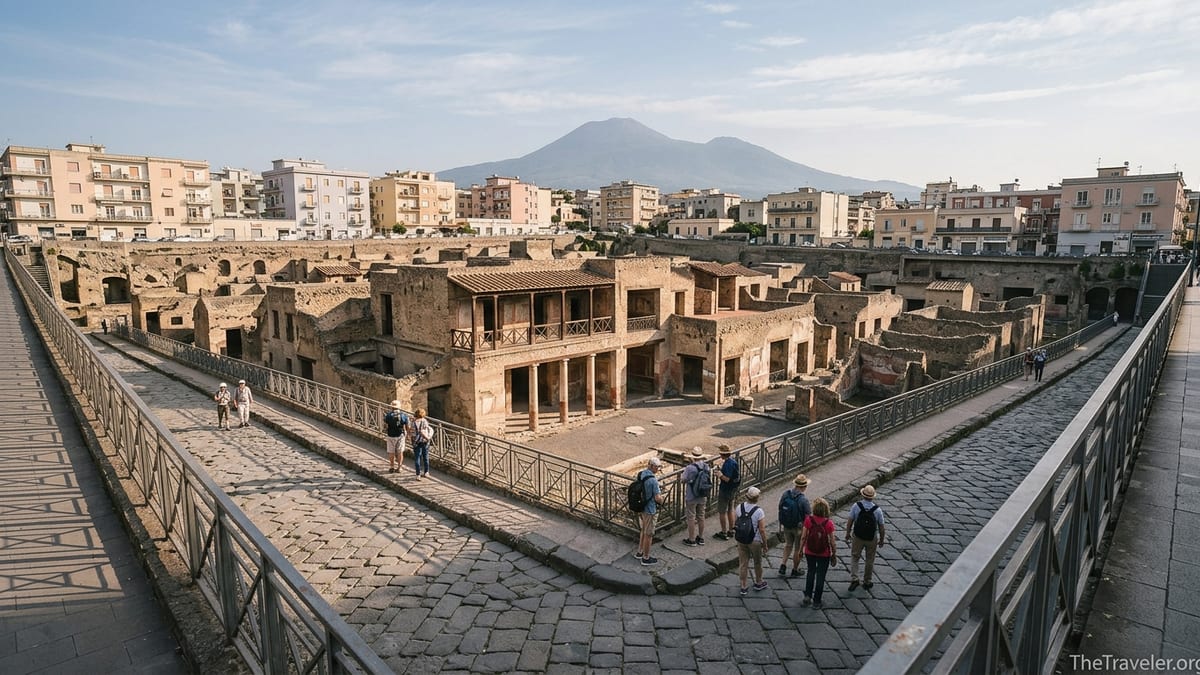
Arriving Unprepared: Underestimating Herculaneum’s Scale and Story
One of the biggest misconceptions is that Herculaneum is just a “mini Pompeii” that can be treated as a quick filler stop. It is smaller in area, but the level of preservation is far more intimate and three dimensional, with multi‑storey houses, frescoes, carbonised wood and everyday objects still in place. Visitors who wander in without context often spend 60 rushed minutes walking the main street, glance at a few houses, then leave having missed the deeper story of how this seaside town was entombed by a superheated avalanche rather than ash. Because they expected a simple ruins stroll, they have not read up on the eruption, downloaded a map or even thought about which buildings to prioritise.
A common real‑world example: travellers on a tight Amalfi Coast itinerary sometimes squeeze Herculaneum into a two‑hour gap between hotel check‑out in Sorrento and an evening train from Naples. They arrive mid‑day in summer, discover there is a descent into the excavated bowl, uneven alleys and staircases, and no time left to explore the boathouses, baths or shoreline. They end up spending more time in transit than on site. In reality, most people who enjoy Herculaneum plan at least 2.5 to 3 hours inside the archaeological park and build in an extra hour around it for tickets, toilets and a break before or after.
The other aspect of arriving unprepared is ignoring the emotional weight of the place. Unlike Pompeii, where many bodies were found scattered through the streets, Herculaneum’s most haunting discoveries are concentrated in the vaulted boat houses by the ancient shoreline, where hundreds of people died waiting to be rescued. Visitors who do not know this before they enter sometimes skip that lower area entirely, assuming it is just an out‑of‑the‑way corner, and only realise what they missed when they read about it later.
Getting Lost in Transport and Tickets
Confusion over how to reach Herculaneum is another classic mistake. Many visitors know vaguely that a local train runs from Naples and Sorrento but do not realise they need the Circumvesuviana or Campania Express services to the station called Ercolano Scavi. Arriving at Napoli Centrale, they follow signs to the wrong platforms or buy long‑distance Trenitalia tickets to “Ercolano” or “Portici – Ercolano,” only to find themselves a 30‑minute walk from the ruins instead of the 10‑minute downhill stroll from Ercolano Scavi. Others board a fast Campania Express train without the right ticket, then face a fine or are told to get off and wait for the slower commuter service.
A very typical real‑world scenario: a couple staying in central Naples plans to “just hop on the Circumvesuviana” in the morning. They arrive at Napoli Garibaldi station around 10:30, discover a crowded, partly outdated timetable board in Italian, and only realise after boarding that their train is an all‑stops service that takes more than 30 minutes. By the time they reach Ercolano Scavi the heat is building and tour groups have arrived. A simple check of the EAV timetable the night before, or asking their hotel which specific train to aim for, would have allowed them to catch a semi‑fast service or the less crowded Campania Express at a fixed time.
Tickets also trip people up. As of 2026, individual Herculaneum entry typically costs in the mid‑teens of euros per adult, while a combined Pompeii + Herculaneum ticket is only slightly higher and valid for 48 hours from first use. Many travellers decide on the day that they might “also see Pompeii tomorrow,” buy single Herculaneum tickets at the gate, and then discover the combo pass would have saved them money. Others purchase third‑party “priority” tickets from resellers at inflated prices in Naples or online, not realising that queues at Herculaneum’s official ticket office are usually short outside of peak mid‑morning in August.
Finally, some visitors still turn up assuming card payments will be a problem and queue at the single ticket window simply to pay cash. In practice, the official ticket office and the small authorised resellers nearby routinely accept major credit and debit cards. Carry some euros as a backup, but do not waste time hunting for an ATM at Napoli Centrale when you could already be on the train with tickets bought digitally.
Timing It Badly: Heat, Crowds and Rushed Schedules
Herculaneum is less crowded than Pompeii but it is not immune to timing mistakes. The most common error is arriving at peak heat and peak group‑tour hours. In summer, bus tours from cruise ships and Amalfi Coast hotels tend to drop visitors between about 10:30 and 14:30. That is exactly when the sun is highest and shade is patchy inside the ruins. Travellers who sleep in, have a late breakfast in Naples and only board the Circumvesuviana around 11:00 often find themselves queueing at security behind multiple groups, then spending their entire visit moving around clusters of 20 to 30 people squeezed into small houses.
A smarter pattern is to aim for the first wave of entry shortly after opening, or to come in the late afternoon. For example, on a typical July day, catching a train from Napoli Garibaldi around 8:30 can put you at the ticket office before 9:00, with the light still soft and the stone cool enough that you are comfortable walking the lanes. You can then leave around lunchtime and head back to Naples for a long meal in the shade, or continue on to the Naples Archaeological Museum. Alternatively, visiting after 15:30 often means many day‑trippers have already gone back to their buses, and you will have entire streets nearly to yourself during the golden hour.
Another frequent mistake is trying to combine Herculaneum, a full climb to the crater of Vesuvius, and a half‑day in Pompeii in one go. On paper the distances look small. In reality, you are dealing with connections between trains and private shuttle buses, timed entry slots for Vesuvius, and unavoidable waiting. Travellers who book a midday Vesuvius shuttle from Ercolano, spend two hours on the mountain, and then try to squeeze Pompeii into the late afternoon routinely end up skipping Herculaneum altogether or barely glancing at the ruins on the way back to the station. A more realistic approach is to pair Herculaneum with either Vesuvius or the museum in Naples on the same day, and save Pompeii for a separate, full day.
Skipping Interpretation: No Guide, No Audio, No Context
Arriving at Herculaneum without any way of understanding what you are seeing is one of the most quietly damaging mistakes. Unlike some ancient sites that are dominated by a single amphitheatre or temple, Herculaneum is mostly houses, workshops and public baths. Without context, one richly decorated room can blend into another. Visitors who rely solely on the limited on‑site panels often finish their visit saying it was “nice but similar” to other ruins, overlooking how revolutionary details like preserved wooden balconies or carbonised furniture are.
There are several ways to fix this, but many people do not plan ahead. The official audio guide, rented just inside the entrance, costs only a modest supplement per person and covers key buildings on a recommended route. Yet some travellers skip it to save a few euros, then spend their whole visit trying to interpret fragments of Latin inscriptions on their own. Others show up hoping to join an English‑speaking group on the spot, only to discover that licensed guides are already engaged with pre‑booked tours or require a minimum fee that makes a private tour expensive for a solo traveller.
In practice, the happiest visitors tend to do one of three things. Some pre‑book a small‑group tour with a licensed guide or archaeologist meeting at the entrance, accepting that they will pay more but gain a narrative thread that covers everything from urban planning to the final hours in the boathouses. Others download a reputable self‑guided walking tour app before they arrive and bring headphones, allowing them to move at their own pace while still hearing explanations as they step into the House of the Deer or the Suburban Baths. A third group reads a concise guidebook chapter the night before, marks a few buildings on the official map and uses on‑site panels merely as a supplement.
One particularly common oversight is ignoring the small but useful Virtual Archaeological Museum (MAV) a few minutes’ walk from the entrance. Travellers who rush to “see the ruins and leave” often skip this entirely, but families and visually oriented visitors who start at MAV usually find that its reconstructions and multimedia rooms help them imagine how Herculaneum looked before the eruption. It also provides air‑conditioned respite on a hot day, which can make the rest of your exploration much more pleasant.
Underestimating Practicalities: Footwear, Facilities and Safety
Because Herculaneum looks compact on a map and sits at sea level below the modern town, many visitors assume it is an easy, casual stroll that can be done in sandals or light city shoes. Once inside, they discover uneven basalt paving stones, narrow step‑downs between house thresholds and streets, and occasional detours up and down stairs. People wearing smooth‑soled fashion sneakers or flimsy flip‑flops often find themselves slipping on polished stone, especially if a brief shower has made surfaces damp. Twisted ankles in shallow steps are not uncommon, and the archaeological park explicitly warns visitors to pay attention to irregular ground.
Facilities are another area where expectations do not always match reality. There are toilets and a small refreshment point, but they are limited compared to a big city museum. In busy months you may find queues for the restroom and for cold drinks at mid‑day. Travellers who arrive with no water, assuming they can buy it easily inside, can spend the first half hour looking for a vending machine instead of exploring. A more sensible approach is to fill a reusable bottle before leaving Naples or Sorrento, carry a hat and lightweight covering, and treat the site as an outdoor hike through stone streets rather than a purely cultural stop.
On the safety front, the area between Ercolano Scavi station and the entrance to the archaeological park is generally busy with tourists, locals and small businesses. However, like any urban neighbourhood in greater Naples, petty crime and aggressive begging can occur. A recurring real‑world pattern is visitors stepping off the train and immediately engaging with people at the station exit who offer “special shuttle deals,” insist that the site is closed, or try to steer them into particular taxis or souvenir shops. While most are simply hustling for commissions, a few can be persistent. Keeping your valuables zipped away, declining unsolicited help politely but firmly and walking directly down the main road toward the clearly signposted entrance avoids most issues.
Inside the ruins, the main concern is simple heat and fatigue. There is little shade in some sections and, unlike a city centre, nowhere to duck into an air‑conditioned cafe every few minutes. Older visitors or anyone with heart or mobility issues who push themselves too hard in July or August often end up cutting the visit short. Building in short breaks in shaded porticoes, using sunscreen and wearing breathable clothing will do far more for your experience than any trendy travel gadget.
Ignoring What Is Not There: Missing the Naples Museum and Other Sites
Another subtle mistake is judging Herculaneum only by what remains on site, without realising how much of its finest art and many artefacts are now in the Naples National Archaeological Museum. Visitors sometimes walk through the houses, appreciate the walls and mosaics, but wonder why they do not see more statues, jewellery or everyday objects. They leave thinking Herculaneum is “a bit bare” compared to glossy coffee‑table books, not realising that those photographs were often taken in Naples, not in the ruins themselves.
In practical terms, this means that anyone seriously interested in Roman daily life should consider pairing Herculaneum with the museum on the same day or the next. For example, spending the morning in Herculaneum, having a late lunch in central Naples and then exploring the museum for two to three hours in the afternoon allows you to connect frescoes and mosaics to specific houses you have just walked through. Travellers who skip the museum because they are focused only on “the ruins themselves” often regret it later when they learn that some of the most important finds from both Pompeii and Herculaneum are displayed there.
Similarly, people who fly through Herculaneum on a checklist sometimes miss nearby experiences that can round out the story. The ancient theatre of Herculaneum, reachable via organised visits from the modern town, provides a very different sense of the buried city, while the climb up Vesuvius gives powerful context for the scale of the eruption. None of these are essential for a first‑time visitor with limited time, but being aware of them allows you to make an informed choice instead of discovering them by chance after your schedule is already full.
Mismanaging Expectations Compared With Pompeii
Finally, many visitors walk into Herculaneum carrying expectations shaped entirely by Pompeii. Some assume they will find a vast forum, long avenues of grand public buildings and open vistas of broken columns. Others imagine that, because it is smaller, Herculaneum must be a “consolation prize” for those who cannot handle the size of Pompeii. Both attitudes can lead to disappointment. Herculaneum’s magic lies in its dense, almost neighbourhood‑scale intimacy: narrow streets flanked by two‑ and three‑storey houses, intact wooden doors, and details like carbonised shelves or a wooden chest preserved in situ.
A frequent mistake is visiting Herculaneum directly after a full day at Pompeii and expecting a similar impact. After walking 15 kilometres in the sun among Pompeii’s wide streets and theatres, some travellers arrive at Herculaneum the next morning already tired. They see its more compact footprint and assume it will be a repeat, glance at a few houses and leave early. Those who do the reverse often have a richer experience: starting in Herculaneum, getting to grips with the domestic scale and superb preservation, then moving on to the broader urban panorama of Pompeii the following day.
There is also a tendency to treat Herculaneum as the “short, easy” option for children, which can backfire. While kids often enjoy the multi‑storey houses and the idea of walking through real ancient streets, the emotional heft of the boathouses and the constant talk of volcanic destruction can be intense. Parents who prepare younger visitors with age‑appropriate explanations beforehand, and who intersperse the ruins with breaks at the nearby seafront or a gelato stop in modern Ercolano, usually have a much better time than those who arrive expecting the site itself to do all the entertaining.
The Takeaway
Herculaneum rewards curiosity, context and a bit of planning far more than it does speed. Most of the frustrations you hear in passing comments on trains or in hotel lobbies stem from the same small set of avoidable mistakes: confusion over which train to take and where to get off, arriving at the hottest and busiest hours, underestimating how long a meaningful visit really takes, and walking in without any narrative to connect the stones under your feet. By contrast, visitors who check transport times the night before, buy the most appropriate ticket combination, arrive early or late in the day, wear sensible footwear and bring a guide, audio or app tend to leave saying Herculaneum was one of the highlights of their trip.
If you think of the site not as a quick add‑on to Pompeii but as a distinct town with its own tragic story, the experience changes dramatically. You start to notice the details: a balcony that survived a pyroclastic surge, carbonised beams supporting an upper floor, the cramped boathouses that became final refuges. With realistic expectations and a little forethought, Herculaneum stops being a rushed stop on the Circumvesuviana line and becomes what it truly is: one of the most intimate, haunting windows into everyday Roman life anywhere in the Mediterranean.
FAQ
Q1. How much time do I really need to visit Herculaneum properly?
Most visitors are comfortable with about 2.5 to 3 hours inside the archaeological park, plus an extra hour for getting there, buying tickets and taking a short break nearby.
Q2. What is the easiest way to get to Herculaneum from Naples?
The most convenient option for most travellers is the Circumvesuviana or Campania Express train from Napoli Garibaldi to Ercolano Scavi station, followed by a straightforward 10‑minute downhill walk to the entrance.
Q3. Is it worth buying a combined ticket for Herculaneum and Pompeii?
If you plan to visit both sites within two days, the combined ticket usually offers better value than buying individual entries, and it keeps your planning flexible in case you swap the order of visits.
Q4. Do I really need a guide or audio guide at Herculaneum?
You can walk the site without one, but most people find a licensed guide, organised small‑group tour or official audio guide dramatically improves their understanding of the houses, baths and boathouses.
Q5. What should I wear and bring for a summer visit?
Comfortable closed shoes with good grip, a hat, sunscreen and a refillable water bottle make a big difference, as much of the site is exposed and the stone surfaces can be uneven and hot.
Q6. Is the walk between Ercolano Scavi station and the ruins safe?
During the day the route is generally busy with locals and tourists, and most visitors feel safe, but it is still wise to keep valuables secure and decline unsolicited offers of “help” or tours at the station.
Q7. Can I visit Herculaneum and climb Vesuvius on the same day?
Yes, many travellers do both, but it works best if you keep the day focused on those two experiences and avoid squeezing in Pompeii as well, which usually leads to a rushed schedule.
Q8. Are there good options for food and drinks near the site?
There are small cafes and snack bars near the entrance and along the road from the station, but choice is limited, so some visitors prefer to bring a light snack and plan a more substantial meal back in Naples or Sorrento.
Q9. Is Herculaneum suitable for children and older travellers?
Yes, provided you factor in the heat, uneven ground and emotional content of the boathouses; regular breaks, sensible footwear and clear explanations tend to make the visit rewarding for most ages.
Q10. How does Herculaneum compare to Pompeii if I only have time for one?
Herculaneum is smaller, more intimate and better preserved in vertical detail, while Pompeii is larger and grander; if you prefer depth over size and have limited time, Herculaneum can be the more manageable and less overwhelming choice.