


More news on this day
On message boards dedicated to solo travel, one destination is routinely singled out as a red-line: Algeria’s Sahara, a vast desert region portrayed as too risky to tackle alone. Yet in 2026, as government advisories are refined and specialist operators expand into once-closed areas, the gap between online warnings and the regulated reality on the ground is becoming harder for travelers to ignore.
Get the latest news straight to your inbox!
Why Algeria’s Sahara Became a Solo Travel Red Flag
For years, discussions on major solo travel forums have placed Algeria alongside a small group of destinations widely described as off-limits without a group or guide. Contributors frequently cite government travel advisories that highlight terrorism, kidnapping and banditry risks in remote desert zones, particularly near borders with Mali, Niger and Libya. These concerns filtered into online communities, where the shorthand advice to prospective solo travelers hardened into a simple message: do not go.
Recent official guidance helps explain this perception. An updated advisory from the United States in August 2026 explicitly instructs travelers not to undertake large overland journeys in the Sahara outside an organized tour, noting that emergency responders are unlikely to reach remote areas quickly and that kidnappings have occurred in the trans-Sahara region. The same notice lists several southern wilayas, including Tamanrasset and Tindouf, as areas to avoid due to terrorism and kidnapping risks.
Other governments echo the caution. The United Kingdom’s Foreign, Commonwealth and Development Office currently advises against all travel to some Saharan areas and against all but essential travel to others, including stretches of border with Tunisia, while separate sections flag the Sahara as a region where the security situation can deteriorate with little warning. Australian, Irish, Canadian, French and New Zealand advisories similarly point to a heightened threat of terrorism and kidnapping outside major cities, particularly in border and desert regions.
This alignment across multiple national advisories has helped entrench the country’s image on travel forums. For many solo travelers, especially women, the combination of stark official language and second-hand anecdotes presents a compelling case to strike Algeria’s interior from their shortlist, even as neighboring desert destinations attract growing numbers of independent visitors.
What the 2026 Advisories Actually Say About Going Solo
Closer reading of the latest guidance, however, paints a more nuanced picture than the blanket rejections often seen online. The current United States advisory rates Algeria overall at a mid-level warning, urging increased caution countrywide while reserving the strongest “do not travel” language for specific border zones and for independent, long-distance overland travel in the Sahara. It differentiates between remote desert corridors and more accessible northern regions, where major cities such as Algiers and Oran host regular commercial flights and hotel infrastructure.
Travel advice from the United Kingdom, France and others similarly distinguishes between the densely populated north and sparsely inhabited south. French guidance updated in September 2026 highlights the region around Tamanrasset and other Saharan areas as requiring particular vigilance, while acknowledging that security measures have been strengthened on key tourist routes and around certain desert towns. Irish and New Zealand notices advise against non-essential travel to desert and border regions but frame visits to main urban centers as possible for well-prepared travelers who closely monitor security updates.
Several advisories also point out that Algerian authorities devote significant resources to safeguarding officially sanctioned tourism. The United Kingdom notes that state security forces accompany many organized desert excursions, and that checkpoints and permit systems are designed in part to channel visitors onto routes deemed safer. Public information from specialist tour agencies active in the Sahara indicates that itineraries are vetted by provincial authorities before departure, with requirements that groups register daily positions and carry satellite communication in areas without mobile coverage.
These layers of control underscore an important distinction often lost in forum debates: while independent, improvised roaming across the desert remains strongly discouraged, travel within structured frameworks is not only allowed but actively regulated. For solo travelers accustomed to complete freedom of movement, this can feel restrictive. For others, it represents a calculated trade-off that makes a visit possible under conditions that governments and local operators consider acceptable.
Permits, Guides and the Reality of “No Solo” Rules
Regulation is central to how Algeria manages access to its desert. Recent English-language guidance compiled from tour operators and official notices indicates that foreign visitors attempting multi-day treks or bivouacs in the deep Sahara are required to book through licensed local agencies, which in turn must file detailed itineraries for approval. A 2026 advisory-oriented overview, drawing on French and other diplomatic sources, notes that unregistered solo travel in these areas is, in practice, not permitted.
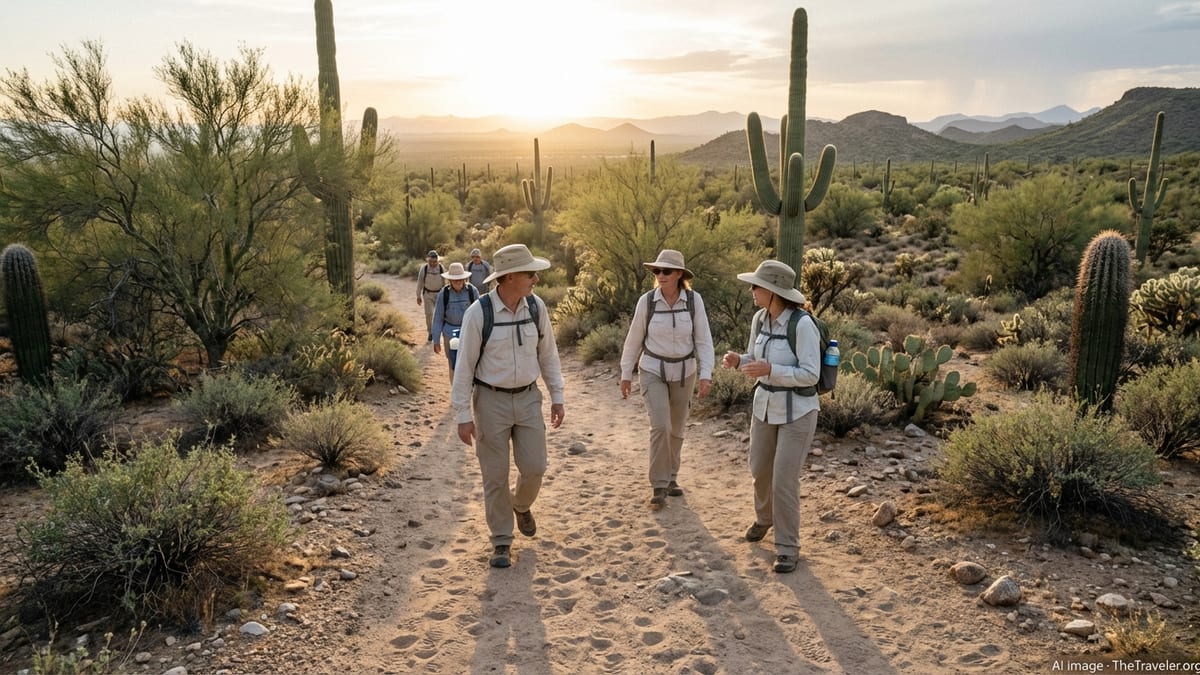
On the ground, this means that a traveler arriving alone in southern hubs such as Tamanrasset or Djanet is typically asked to join an organized group or arrange a bespoke guided circuit rather than striking out independently. Local agencies provide four-wheel-drive vehicles, drivers familiar with desert tracks, and often Tuareg guides responsible for liaising with checkpoints and gendarmerie posts. Some agencies also arrange required internal flight tickets and hotel stays so that the entire journey can be presented as a single, preauthorized package.
Government advisories point out that, in addition to security concerns, basic infrastructure issues make unsupported solo travel risky. Cellular coverage drops off soon after leaving major towns, fuel stations are far apart, and mechanical breakdowns can quickly become life-threatening without access to recovery vehicles or satellite phones. The United States and Australian services both stress that emergency medical care is limited outside key urban centers, another reason cited for insisting that foreigners move with professional support in sparsely populated regions.
In effect, the much-discussed “ban” on solo travel to the Algerian Sahara is less a formal prohibition on being alone in the country and more a network of administrative and practical barriers to unsupervised movement in high-risk zones. A traveler can still arrive without companions, book accommodation individually and explore major cities with usual urban precautions, but once the itinerary shifts toward remote dunes and plateaus, the system channels visitors into escorted formats.
How Much Does a Regulated Desert Adventure Cost?
Cost is another factor that shapes online perceptions of Algeria as an unwelcoming destination for solo visitors. With authorities and foreign advisories emphasizing guided travel, independent backpacker-style budgets are difficult to achieve. Publicly advertised prices from specialist operators, updated for the 2025 to 2026 season, suggest that a week-long desert circuit from Djanet or Tamanrasset typically starts around the equivalent of several hundred euros per person when joining a scheduled small group, rising significantly for private departures.
Sample itineraries marketed to foreign tourists show that a six to eight day 4x4 tour with camel excursions and camping can include airport transfers, internal permits, meals, tents and local staff. Operators explain in their published material that prices reflect not only logistics in remote areas but also compliance with regulatory requirements, such as maintaining radio or satellite communication, carrying sufficient water and fuel reserves, and planning routes approved by security services.
For solo travelers, the key budget challenge is scale. A single person commissioning a private vehicle, driver and guide may face costs several times higher than those paid by individuals within a group of six or eight. Some agencies now advertise “fixed date” departures specifically designed to assemble solo travelers into mixed groups, allowing costs to be shared while still meeting safety expectations set by authorities and foreign governments.
Publicly available forum discussions from the past year indicate that travelers who have booked such group expeditions generally report feeling well supported, though they note that itineraries leave limited room for spontaneous detours. Those seeking unstructured wandering or long, solo overland drives report abandoning Algeria in favor of neighboring countries where self-drive rentals and independent desert camping remain easier to arrange.
Balancing Online Warnings With On-the-Ground Realities
The divergence between travel forum warnings and the evolving situation in Algeria highlights a broader tension in how risk is discussed online. Government advisories updated through 2026 continue to describe very real security threats in parts of the Sahara and along several borders, and there is broad consensus across Western, African and Middle Eastern governments about the seriousness of terrorism and kidnapping risks in those regions. At the same time, these documents also outline pathways for structured tourism that many forum summaries compress into a simple “do not go.”
Specialist operators with longstanding experience in the Sahara argue in their public materials that, under current regulations, many classic landscapes such as the Tassili n’Ajjer plateau or the dunes around Djanet can be visited under controlled conditions. Some point out that the requirement to travel in convoys and register routes is intended to keep both visitors and local communities safer, even if it conflicts with the independence prized by seasoned solo travelers.
For individuals deciding whether to visit, the most practical takeaway is that Algeria’s desert is neither the unrestricted playground portrayed in early adventure narratives nor an absolute no-go zone for foreigners. It is a heavily managed environment where foreign travel is possible, but only for those willing to accept official constraints on movement, share transport with others and invest in higher-cost, professionally led itineraries.
As winter and spring 2026 to 2027 tour dates appear on agency schedules, forum debates are likely to continue. Some travelers will conclude that the combination of advisory language and movement controls makes Algeria’s Sahara an unnecessary gamble. Others, reassured by regulated structures and updated information, will see in the same rules a reason to reconsider a desert country that has long been marked, in bold letters on their screens, as a place they should never visit alone.