


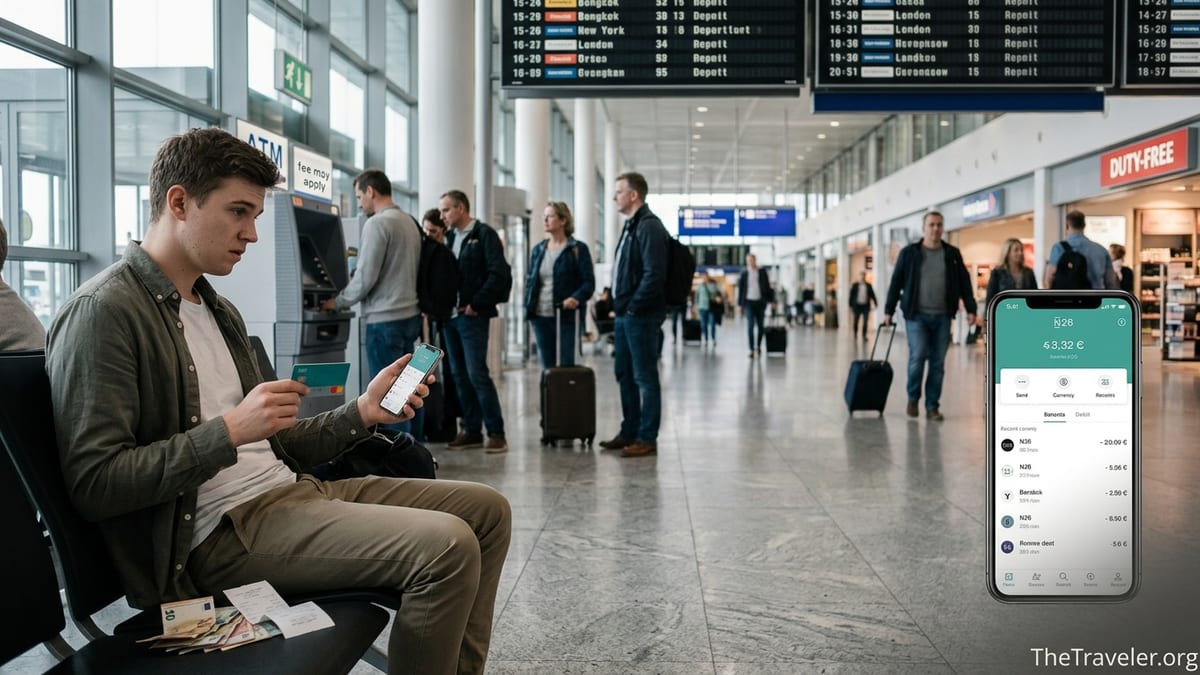
N26 has become a go to bank for digital nomads, Erasmus students and weekend city hoppers across Europe. On paper it looks ideal for travel: no foreign transaction fee on card payments, a slick app, and accounts you can open from your phone in minutes. But when you take an N26 card on the road, a different picture can emerge. Between ATM surcharges, plan fees, subtle exchange rate costs and customer service gaps when things go wrong, the real price of “free” travel banking can be surprisingly high.
Get the latest updates straight to your inbox!
Why N26 Looks So Good for Travelers at First Glance
N26 is built around a simple promise that sounds perfect if you spend a lot of time abroad. Card payments in foreign currencies are processed at the Mastercard exchange rate and N26 does not add its own foreign transaction fee on top for any of its main plans. Official support pages spell this out clearly, highlighting that payments in dollars, pounds or yen use Mastercard’s rate rather than a separate bank margin. For a traveler used to traditional banks that routinely add 2 to 3 percent on top of card purchases abroad, this feels refreshingly fair.
The account line up also looks travel friendly at first. The free Standard plan comes without a monthly fee and allows card use worldwide, while paid tiers such as Smart, Go and Metal add benefits like more free ATM withdrawals, travel insurance packages and zero N26 fee on foreign currency cash withdrawals. Independent reviews in 2026 describe N26 as a good fit for expats and frequent travelers because of this zero markup on card payments and the real time app notifications every time the card is used.
In practical terms, this can work well in many everyday situations. A long weekend in London is a classic test. Pay a 60 GBP dinner bill with an N26 Standard card, choose to be charged in pounds rather than euros at the terminal, and you will typically see the equivalent euro amount that matches the live Mastercard rate, with no extra line of fees taken by N26 itself. Compared with a legacy bank card adding three percent, you could be saving a couple of euros on that meal alone.
For digital nomads or US expats living in Berlin who regularly pay for coworking in Lisbon, flights in dollars and Airbnb stays in British pounds, this simple, largely fee free card payment model is a genuine advantage. The problem is that travel spending is about much more than tapping a card in a cafe. The hidden costs start to appear as soon as you hit an ATM, rely on cash, or run into trouble with a transaction abroad.
The Real Cost of “Free” ATM Withdrawals Abroad
ATM use is where the N26 marketing promise often collides with reality. N26’s own support materials explain that customers on Standard, Business Standard and Smart accounts pay a 1.7 percent fee on cash withdrawals made outside the eurozone. Only the higher tier plans such as Go and Metal waive this particular fee. That 1.7 percent is charged on top of any ATM charges from the local bank and is separate from the Mastercard conversion spread built into the exchange rate itself.
Consider an example in Bangkok, where ATMs routinely charge local fees to foreign cards. A traveler with an N26 Standard account takes out the equivalent of 200 euros in Thai baht. The ATM itself adds a fixed local fee, which in Thailand is commonly around 220 baht, roughly 5 to 6 euros depending on the day’s rate. N26 then adds its own 1.7 percent foreign currency withdrawal fee, about 3.40 euros on a 200 euro withdrawal. The traveler has just paid close to 9 to 10 euros in total fees to get cash for street food and taxis, and that is before considering the small margin between Mastercard’s rate and the mid market rate you might see on a currency site.
The free withdrawal limits within the eurozone also have traps. Many country specific pricing overviews in 2026 highlight that the free Standard plan only includes a small number of euro cash withdrawals per month, for instance two or three, before a per withdrawal fee applies, often around 2 euros per additional withdrawal. A backpacker using N26 as their main account in Spain or Italy might take out 40 euros at a time for small expenses and discover at the end of the month that half a dozen extra withdrawals have triggered 12 euros in fees, even though each trip to the ATM felt harmless.
The impact gets sharper for long trips. Imagine a three month interrail journey where you cross from the eurozone into Switzerland, then the UK, then Eastern Europe. If you rely on the free Standard plan and need cash several times a week in non euro countries, that 1.7 percent fee plus any ATM surcharges can easily climb past 50 or 100 euros over the full journey. Suddenly, the free bank account is more expensive than some specialist travel cards that charge a modest monthly fee but no foreign currency withdrawal markup.
Subscription Plans and the Subtle Math of “Upgrading for Travel”
To avoid those ATM costs, N26 encourages heavier users to upgrade to paid plans. In 2026 price comparisons across German and European banking sites show the Smart plan at about 4.90 euros per month, the Go plan at around 9.90 euros, and Metal at roughly 16.90 euros. Higher tiers increase the number of free euro ATM withdrawals and, crucially for travelers, remove N26’s 1.7 percent fee on non euro cash withdrawals. They may also include travel insurance bundles underwritten by partners such as Allianz.
On a short trip, the math can work out. Picture a traveler from France planning a two week holiday in the United States who upgrades from Standard to Go for a single month at 9.90 euros. Over the trip, they withdraw the equivalent of 800 euros in dollars across several ATMs, each of which also charges a local 3 to 5 dollar fee. With Standard, N26 would add about 13.60 euros in its own fees at 1.7 percent, more than the price of the upgrade. By moving to Go and making sure to downgrade again afterward, the traveler can save roughly a few euros and gain some travel insurance coverage in the process.
However, many users do not downgrade promptly. Reviews of N26 in 2026 note that people often stay on plans like Go or Metal for months or years after a big trip, even when their everyday life involves little foreign travel. That turns a clever one month strategy into a recurring cost. A digital nomad who keeps a Metal subscription year round at 16.90 euros per month spends more than 200 euros a year for benefits they might only fully use during a few weeks of international travel.
The other subtle issue is opportunity cost. Several independent comparison sites in 2026 point out that N26’s premium tiers are priced similarly to new competitors that also offer no fee ATM withdrawals abroad but with higher interest on balances or better local support in specific markets. A traveler who upgrades an N26 plan primarily to avoid the 1.7 percent cash withdrawal fee might be better off opening a dedicated multi currency travel card with free withdrawals up to a monthly allowance, using N26 only for day to day euro payments.
Exchange Rate Nuances, DCC and the Invisible Price of Convenience
Although N26 does not add its own foreign transaction fee on card payments, that does not mean you always get the perfect exchange rate. Mastercard’s rate typically sits very close to the mid market rate that you would see on a transparent currency converter, but there is still a small spread and a separate markup that Mastercard charges as part of its network fees. N26 itself explains that this markup is a small percentage of the European Central Bank reference rate, which means there is a built in cost each time your euros are converted into another currency.
The bigger danger is dynamic currency conversion, or DCC. This is when a merchant or ATM outside the eurozone offers to convert the transaction into euros for you, claiming to give you clarity on how much you will pay. N26 cannot fully protect you from this because the choice is made at the terminal. If you are in New York and the hotel’s payment terminal asks whether to charge your N26 card 400 dollars or a fixed 380 euros, accepting the euro option almost always means the hotel’s bank applies its own poor exchange rate and a large hidden margin. What looked like a perk, seeing the amount in euros, can add 3 to 7 percent to the cost of the stay.
While this is not unique to N26, it interacts with the bank’s marketing in a misleading way. Travelers come to trust that N26 is “fee free abroad” and may not scrutinize terminal screens as closely as they would with a traditional bank, assuming that any conversion offered is part of the N26 experience. In reality, they should be doing the opposite: always choosing to pay in the local currency and letting Mastercard handle the conversion. Failing to do so undercuts the main advantage of using N26 in the first place.
Exchange rate timing is another subtle issue. N26 notes that exchange rates are dynamic and that the final euro amount can change slightly between the moment a card imprint is taken and when the purchase is fully settled. On a volatile day for the pound or the dollar, a traveler might see a restaurant bill for 50 GBP show as 58 euros in the app at the time of payment and 59 euros once the transaction fully posts. The difference is small, but if you are working with a tight budget on a long trip, these fluctuations can make reconciling your spending more confusing, especially when combined with hold amounts from hotels or car rentals.
Customer Service, Account Freezes and the Risk of Being Stranded
Purely financial fees are only part of the hidden cost picture. Access to support when you are on the road can be even more important. N26 has invested heavily in a slick app interface and online chat support, but it has no high street branches and no traditional phone helpline in many markets. When things go wrong, the impact on a traveler can be severe.
In recent years, public complaints in user forums and consumer communities have described accounts being frozen after apparently routine payments or incoming transfers, with cards suddenly unusable while an internal review takes place. Commenters recount situations where a relatively small card payment of under 100 euros or a transfer from a family member triggered a compliance review. In some cases, the freeze reportedly lasted weeks, during which N26 support could only offer generic explanations about anti money laundering checks and asked customers to wait for an email update.
For someone at home, an unexpected account review is frustrating but manageable if they have other banking relationships. For a solo traveler whose N26 account is their main source of money on a trip to Mexico or Morocco, it can become a crisis. Imagine arriving in Marrakech, paying a 79 euro equivalent hotel deposit with your N26 card and finding a few hours later that every subsequent transaction is declined because your account has been flagged. If chat support is overloaded and responses are slow over a weekend, you could be left with no access to your funds, unable to pay for accommodation or a flight home, while your money sits locked in the account under internal review.
Dispute handling is another pain point. Online posts describe cases where N26 customers who were scammed on card terminals abroad, or who spotted fraudulent charges, felt that the bank was slow to investigate or sided with the merchant and card network. Some recount being told that chargeback rules did not allow a refund, even when they believed they had reported the fraud promptly. For travelers relying on N26 as a safety net, the cost of having to absorb several hundred euros in unreimbursed fraud can dwarf any savings on foreign transaction fees.
Practical Ways Travelers End Up Overpaying With N26
When you combine plan pricing, ATM behavior and human habits, a pattern emerges. Many of the hidden costs of N26 travel spending are not outright tricks but the result of small structural decisions that add up. A student moving from Italy to study in the Netherlands might sign up for N26 Standard and happily tap their card everywhere, seeing no foreign transaction fees. When they take their first holiday to Prague, they rely exclusively on cash for small purchases. Each 100 euro equivalent withdrawal in Czech koruna outside the eurozone attracts the 1.7 percent fee from N26 plus the local ATM surcharge. Over a five day trip, four small withdrawals could easily cost more than 15 euros in total fees.
Another common pattern involves the physical card cost. On some N26 tiers, particularly Standard, the basic account is free but ordering a physical Mastercard debit card carries a one off delivery fee of around 10 euros. A traveler who primarily uses mobile wallets such as Apple Pay or Google Pay might still order the physical card “just in case” for an upcoming trip, then end up losing it or never using it because contactless by phone works almost everywhere in their destination. The card fee becomes an indirect travel cost that was easy to overlook among all the other pre trip expenses.
Then there is the temptation to rely on cash simply because dealing with foreign card terminals feels confusing. A German traveler in Japan might worry about DCC and therefore decide that withdrawing large chunks of cash in yen from an ATM is safer. Each withdrawal on a Standard account involves the same 1.7 percent fee from N26, and Japanese convenience store ATMs often apply their own charge for foreign cards, perhaps 110 to 220 yen. Over a two week trip where the traveler withdraws the equivalent of 1,000 euros in total, the cumulative fees can quietly reach 30 or 40 euros, money that could have stayed in their pocket if they had used card payments more confidently and chosen local currency at terminals.
Finally, the hidden costs extend beyond the trip itself. Some users pay for premium plans primarily for the travel insurance element, assuming that carrying Metal or Go will protect them on the road. Yet the insurance policies usually come with exclusions and conditions, such as requiring that the trip be paid from the covered account or imposing strict documentation rules in case of a claim. A traveler who pays 16.90 euros per month for a year for a Metal card, partly to have peace of mind on a single big journey, might still find a claim rejected because a cruise ticket was bought with another card. The combination of subscription fees and a denied claim creates a double hit.
How to Use N26 More Safely and Cheaply When You Travel
None of this means that N26 is unusable for travel. It simply means you need to approach it with a clear strategy. One step is to be honest about your likely cash needs. If you know you will be traveling extensively outside the eurozone and using ATMs several times per month, pricing out the monthly cost of upgrading to a plan without the 1.7 percent foreign currency withdrawal fee can make sense. Work with your own numbers: if you expect to withdraw 1,000 euros worth of foreign currency over a trip, Standard will cost you about 17 euros in N26 fees alone, not counting local ATM surcharges. If a one month upgrade costs under 10 euros and you remember to downgrade afterward, the math might favor the upgrade.
Second, pay by card wherever it is reasonably safe and accepted, and always choose to be charged in the local currency. In a cafe in London or a restaurant in New York, that means selecting pounds or dollars when the terminal asks. If the staff try to push the euro option, politely insist on the local currency. By keeping DCC out of the picture, you let N26’s main selling point, card payments at the Mastercard rate with no extra foreign fee, actually work for you.
Third, do not rely on N26 as your only bank when you travel. Even if your everyday life is entirely digital and you are happy with app only support at home, it is sensible to carry at least one backup card from another provider, ideally one that is not linked to the same Mastercard network. That way, if N26 freezes your account for an unexpected review or if the app becomes inaccessible while you are on a remote island with patchy data, you are not stranded without funds.
Finally, keep an eye on recurring plan charges. Set a calendar reminder on your phone for a few days after you return from a major trip to review your N26 plan in the app. If you upgraded to Go or Metal just for a holiday, downgrading promptly can save you hundreds of euros over several years. Treat travel focused plans as temporary tools rather than permanent status symbols.
The Takeaway
N26 earns its popularity with travelers by removing one of the most visible irritations of cross border spending: the foreign transaction fee on card payments. Used wisely, it can indeed be a strong companion on the road, especially for people who mainly pay by card, stay within the eurozone or travel occasionally to nearby countries. The app’s clear interface, instant spending notifications and modern feel all add to the appeal.
At the same time, the real cost of using N26 for travel spending sits in the details that are easy to miss. A 1.7 percent markup on foreign currency cash withdrawals on lower tiers, strict limits on free euro ATM use, paid plan subscriptions that quietly renew every month, and the very real risk of account freezes or slow fraud handling all represent forms of risk or expense that travelers need to factor in. None of these appear on a glossy billboard in a European airport, but they matter when you are far from home and every euro counts.
If you choose to travel with N26, do it with eyes open. Calculate whether a temporary upgrade makes sense, favor card payments in the local currency, carry a backup card, and pay close attention to any messages about account reviews or unusual activity. In a landscape where new travel friendly banking products appear every year, N26 remains a useful tool, but not a magic solution. The more you understand the hidden costs, the more control you keep over your travel budget.
FAQ
Q1. Is N26 really free to use for payments abroad?
N26 does not add a separate foreign transaction fee on card payments in other currencies, but Mastercard’s exchange rate includes a small built in margin and some terminals apply dynamic currency conversion if you are not careful.
Q2. How much does N26 charge for ATM withdrawals outside the eurozone?
On Standard, Business Standard and Smart accounts, N26 typically charges a 1.7 percent fee on the amount withdrawn in foreign currency, on top of any local ATM surcharge. Higher tier plans like Go and Metal remove N26’s own 1.7 percent charge.
Q3. Are ATM withdrawals in euros always free with N26?
No. Free withdrawals in euros are limited per month and depend on your plan and country of registration. Once you exceed your allowance, N26 adds a per withdrawal fee, often around a couple of euros each time.
Q4. Is it worth upgrading to a paid N26 plan just for one trip?
It can be if you expect to withdraw a lot of cash outside the eurozone. Compare the one month plan cost to what you would otherwise pay in 1.7 percent withdrawal fees, and set a reminder to downgrade after the trip.
Q5. How can I avoid bad exchange rates when paying with N26 abroad?
Always choose to pay in the local currency at card terminals and ATMs, not in euros. This avoids dynamic currency conversion by the merchant’s bank and lets Mastercard’s rate apply instead.
Q6. What happens if N26 freezes my account while I am traveling?
If N26 flags your account for review, card payments and withdrawals can be blocked until the review is finished. Support is usually via chat and email, so resolution may take time, which is why it is wise to carry a backup card from another bank.
Q7. Does N26’s travel insurance cover all trips automatically?
No. Insurance benefits on premium plans usually come with conditions, such as paying for the trip from the covered account or meeting minimum stay or distance requirements, and claims can be rejected if criteria are not met.
Q8. Are there fees for getting or replacing an N26 physical card?
On some plans, especially the free Standard tier, ordering a physical Mastercard debit card involves a one off delivery fee, and card replacement can also carry a charge, which becomes an indirect cost of preparing for travel.
Q9. How do N26’s hidden costs compare to other travel cards?
N26 is competitive on card payments but less generous on cash, especially on lower tiers. Some specialist travel cards offer free or cheaper ATM withdrawals up to a monthly limit or include better interest on balances for a similar subscription price.
Q10. What is the safest way to use N26 as a frequent traveler?
Use N26 primarily for card payments in local currency, keep cash withdrawals to a minimum, consider a temporary upgrade for intensive trip periods, and always maintain a separate backup card or account in case of technical issues or compliance reviews.