


More news on this day
As airlines, agencies, and hospitality brands accelerate the use of generative and agentic AI, travel’s biggest competitive edge is increasingly shifting back to people: the experts who step in when automation hits its limits, risks, or regulatory guardrails.
Get the latest news straight to your inbox!
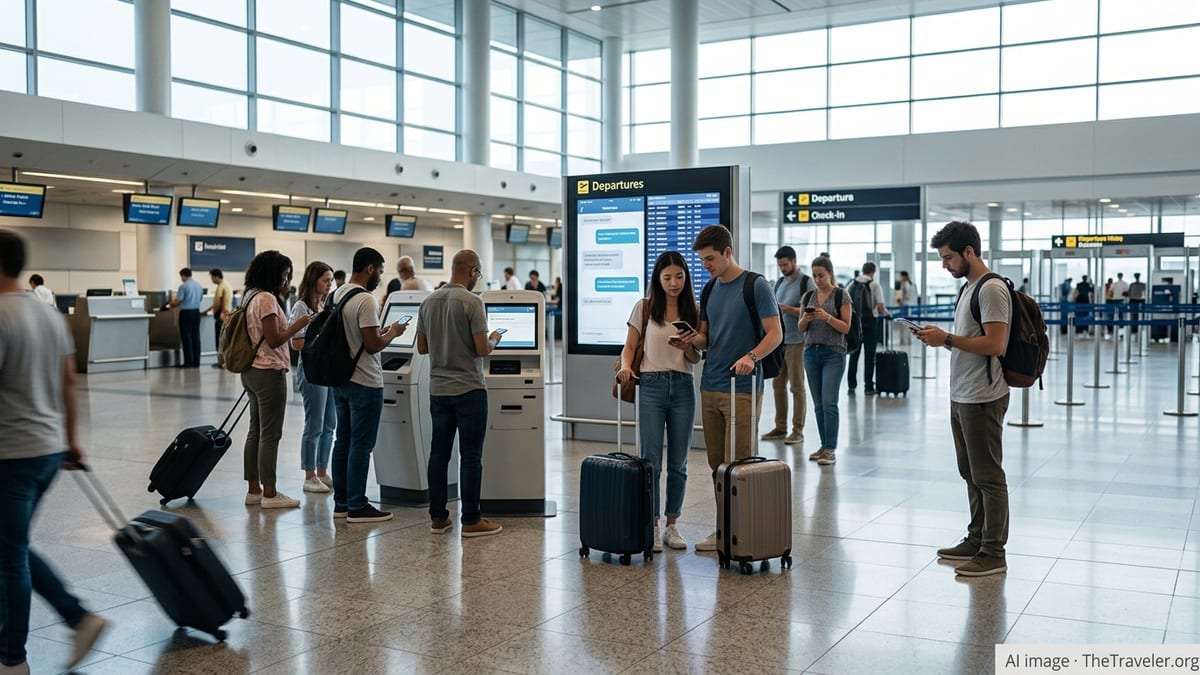
AI is scaling fast, but travelers still judge the recovery moment
Across the travel journey, AI is becoming a default layer for discovery, booking, and service, driven by the promise of faster answers and lower support costs. Industry research published in 2026 has described an agent-led environment in which comparison shopping, booking flows, and service requests are increasingly mediated by software agents, while many travel providers also report expanding AI use in customer-service and operational settings.
But the same research highlights a persistent tension: travelers may use AI to plan, yet they worry about what happens when something goes wrong. Publicly available survey results released by Expedia Group in 2026 found that concerns about AI-driven transactions often concentrate on after-purchase support, including fears of poor customer service during problems or disruptions.
In practice, the travel experience is often defined by the “recovery moment,” the rebooking, refund, missed connection, medical issue, or documentation snag where context matters and the cost of a wrong answer is high. That is where expert support functions as a brand’s insurance policy, turning an automated front door into a reliable end-to-end experience.
Automation works best when escalation to a human is designed in
Travel organizations are increasingly formalizing escalation pathways rather than treating “talk to an agent” as an exception. Customer-service platforms have been publishing updated operational guidance in 2026 on how AI agents should transfer conversations to people, emphasizing that escalation should be planned for situations such as unrecognized intent, missing workflows, or when automation cannot safely complete a request.
The push for structured escalation reflects a broader lesson from early deployments: AI can handle high-volume routine questions, but complex travel cases often require cross-system actions and judgment. Reaccommodation during irregular operations, multi-party itineraries, special service requests, and policy-based exceptions are areas where a trained human can interpret nuance, weigh tradeoffs, and document a defensible decision.
Recent government-facing deployments also illustrate the split between routine guidance and edge cases. Published coverage in September 2026 described a Salesforce-built AI agent for the U.S. Transportation Security Administration focused on answering common traveler questions at scale, reporting high resolution rates for routine inquiries. The model underscores why human staff still matter: even strong self-service performance does not eliminate the need for expert support when situations fall outside the script, involve accessibility needs, or require updated interpretation during operational change.
Regulation is making “human oversight” a travel operations requirement
Beyond customer expectations, the compliance environment is hardening around accountability and transparency. In the European Union, publicly available information on the AI Act and related 2026 updates has pointed to new enforcement milestones and transparency rules taking effect in August 2026, alongside broader efforts to support implementation. For travel companies selling into or operating within the EU, that timeline adds pressure to demonstrate governance, staff readiness, and appropriate oversight for AI-assisted processes.
One of the most immediate operational implications is that organizations cannot treat AI as a black box that simply replaces a queue. Systems must be monitored, staff must be trained to understand limitations, and processes must exist to challenge or override automated outcomes. Even when a tool is not formally categorized as “high risk,” travel brands increasingly face expectations to explain how decisions are made, how errors are corrected, and how customers can reach a responsible human when needed.
That regulatory direction aligns with the realities of travel service: documentation rules, payment disputes, accessibility requirements, and cross-border consumer protections are not areas where companies can afford ambiguous automated decisions. Human expertise is becoming not just a service feature, but part of a defensible control environment.
Why expert support is becoming a differentiator for advisors and brands
The modern travel advisor community offers a clear signal on where human value remains strongest. Research findings published in 2026 by Travel Market Report indicated that many advisors are comfortable using AI tools, yet the vast majority still prefer human support over automation when building relationships and solving client issues. For suppliers, that preference translates into an operational mandate: if the advisor channel is expected to drive premium bookings, supplier-side expert desks and fast escalation paths become part of the product.
At the same time, industry analysts have argued that AI will reshape how travelers discover and compare options, potentially reducing traditional brand touchpoints earlier in the funnel. That shift can make human support even more important at the decisive moment, when a traveler needs confidence to book a complicated trip, or needs a capable advocate when plans break down.
For travel brands, the emerging playbook is not “AI versus humans,” but “AI plus experts.” Automation can absorb repetitive questions, prefill forms, summarize chats, and surface policy answers; experts can manage exceptions, negotiate tradeoffs, and protect loyalty during disruptions. In 2026, the companies that communicate that handoff clearly, and staff it accordingly, are positioning themselves to compete on trust rather than just speed.