


More news on this day
As airlines, airports, and travel brands deploy chatbots, “agentic” AI, and biometric identity tools to speed up service, the industry’s competitive edge is shifting from automation alone to something harder to scale: expert human support that can take over quickly when trips go sideways.
Get the latest news straight to your inbox!
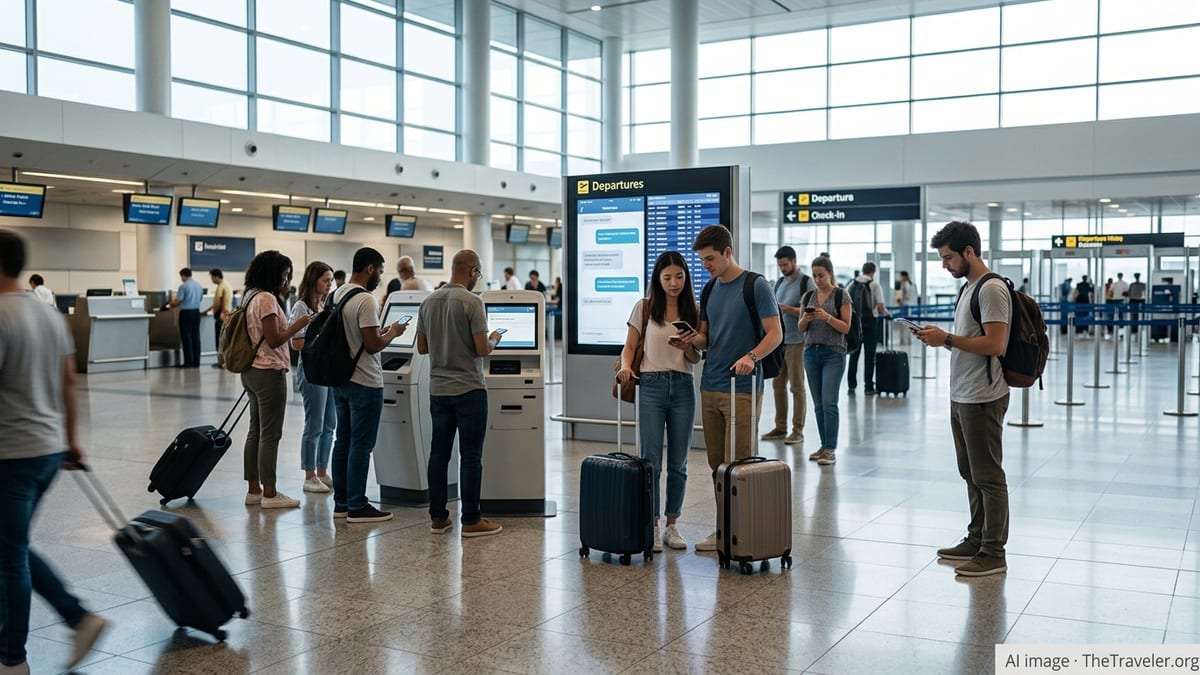
AI is taking the first contact, but not the full responsibility
Recent deployments show how quickly AI is becoming the front door for traveler questions. Microsoft-published customer stories describe Air India’s “AI.g” system handling large volumes of daily queries, with a small share of conversations routed to human agents for escalation. Finnair has also highlighted its updated AI assistant “Sisu,” positioned as a multilingual helper that can guide customers to the right channel, including Manage Booking or a customer service agent, while stopping short of completing purchases or itinerary changes on its own.
Airlines are also pushing beyond traditional scripted chatbots toward more autonomous systems. An AWS case study describes Ryanair consolidating multiple domain-specific agents into a single AI architecture in early 2026 and scaling automated chat across markets and languages. Meanwhile, published industry coverage has pointed to efforts to make AI feel more “on-brand,” including designs that detect friction and offer handoff to a human with the conversation context preserved.
But the same examples underline an important boundary: even high-performing automation is optimized for routine tasks, not full accountability for complex disruptions. In travel, “routine” can flip to “high stakes” quickly, such as missed connections, accessibility needs, weather-driven rebooking chains, or time-sensitive refund eligibility. That is where expert support becomes more valuable, not less.
Refunds, delays, and passenger rights raise the stakes for accurate answers
In the United States, passenger protections have become more prescriptive in ways that put a premium on correct guidance. The U.S. Department of Transportation’s 2024 final rule on refunds and other consumer protections codified clearer expectations around refunds in cancellation and certain disruption scenarios, and DOT materials continue to emphasize refund rights and related consumer information. For travelers, the practical consequence is that the “right next step” is often time-sensitive and depends on details such as whether a rebooked itinerary is accepted and whether a disruption meets defined thresholds.
At the same time, DOT rulemaking activity has kept the conversation about what counts as a “significant” change or delay in view. A Federal Register document published in December 2025 discussed definitions and thresholds used in the Department’s analysis of potential updates, illustrating how technical these determinations can be. That technicality is exactly where AI can be risky: a confident but slightly wrong explanation can cost a traveler money, or push them into choices that limit later options.
Separately, DOT has spotlighted customer-service accessibility as a consumer issue. In a DOT passenger rights rulemaking document, Section 505 of the 2024 FAA Act is described as requiring large U.S. airlines to maintain, without charge and available at all times, at least one live-assistance pathway such as a telephone line staffed by live agents or a chat option that enables reaching a live agent within a reasonable time to the greatest extent practicable. As AI handles more front-line contacts, the operational differentiator becomes how quickly and effectively an experienced human can step in when the traveler’s issue is beyond templated support.
Biometrics and identity tech highlight why humans still matter at the airport
AI in travel is not limited to customer service chats. Identity and biometric tools are expanding at checkpoints and gates, and even when participation is optional, the traveler experience can be shaped by how well staff handle exceptions. TSA materials on facial comparison technology describe the use of second-generation Credential Authentication Technology (CAT-2) and note that travelers may decline having their photo taken. A DHS report on select directive use cases similarly states that travelers can opt out of having their photo taken by telling a TSA officer.
Publicly available rules also show how exception handling is designed into biometric processes. A Federal Register document related to CBP biometric entry and exit processes describes that in a “no match” scenario during facial comparison, airline staff will manually observe travel documents using the same process used without the biometric step. In practice, this means humans are not a backup only for customer comfort; they are part of the control system that keeps the line moving when automation cannot produce a match.
Airports and local operators also publish traveler-facing guidance about opting out of facial recognition for certain international departure processes, underscoring that human assistance remains essential for navigating choices at the point of travel. When signage, device prompts, and real-world staffing collide during peak periods, travelers often need an empowered person who can resolve confusion immediately, not another automated explanation.
Regulation is shifting toward transparency and workforce readiness
In Europe, the regulatory environment around AI is no longer theoretical. European Commission information on the AI Act’s enforcement framework notes that enforcement powers apply from August 2, 2026, when certain provisions become enforceable. Separate Commission guidance on AI literacy says that Article 4 entered into application on February 2, 2025, creating an obligation for organizations to take measures that support staff AI literacy, with supervision and enforcement rules applying from August 3, 2026 onward.
For travel brands selling into the EU market, these dates matter because they coincide with a period when more customer interactions are mediated by AI systems that must be governed, explained, and monitored. The Commission’s transparency guidance on Article 50 outlines obligations around transparency and flags that enforcement and potential penalties can be significant. The practical travel-industry implication is that “human advantage” is increasingly tied to governance: trained specialists who can supervise systems, interpret policies correctly, and step in when an interaction triggers legal, safety, or rights-related concerns.
This is also where expert support shows up behind the scenes. A traveler may never see the internal controls, but they will feel the difference between an AI channel that can only repeat a policy and a human-enabled channel that can interpret a policy correctly, document the case, and resolve it within the time window that protects the traveler’s options.
What “expert support” looks like when AI is everywhere
As automation improves, the best customer experiences increasingly depend on the handoff. Industry material from IATA has framed chatbots as a way to handle basic queries so that human agents can focus on more complex issues, pointing to the continuing expectation of a human touch in air travel. The same logic applies across the trip: AI can triage, translate, and summarize, while experts solve edge cases and make judgment calls.
There are signs that major travel operators are already designing around escalation. Published case studies and industry coverage describe systems that detect frustration signals and route to humans while preserving the conversation history, reducing the need for travelers to repeat themselves. That “context transfer” is not just a convenience; it is an accuracy tool that helps experts make decisions faster during disruptions, when a customer’s timeline and documentation are changing minute by minute.
The emerging playbook is less about replacing people and more about reserving human time for the moments that carry the most consequence: refunds, re-accommodation, accessibility, identity exceptions, and policy interpretation across jurisdictions. In an era when AI can answer instantly, the travel brands that stand out may be the ones that still invest in trained specialists and make them reachable at the exact moment automation reaches its limits.