


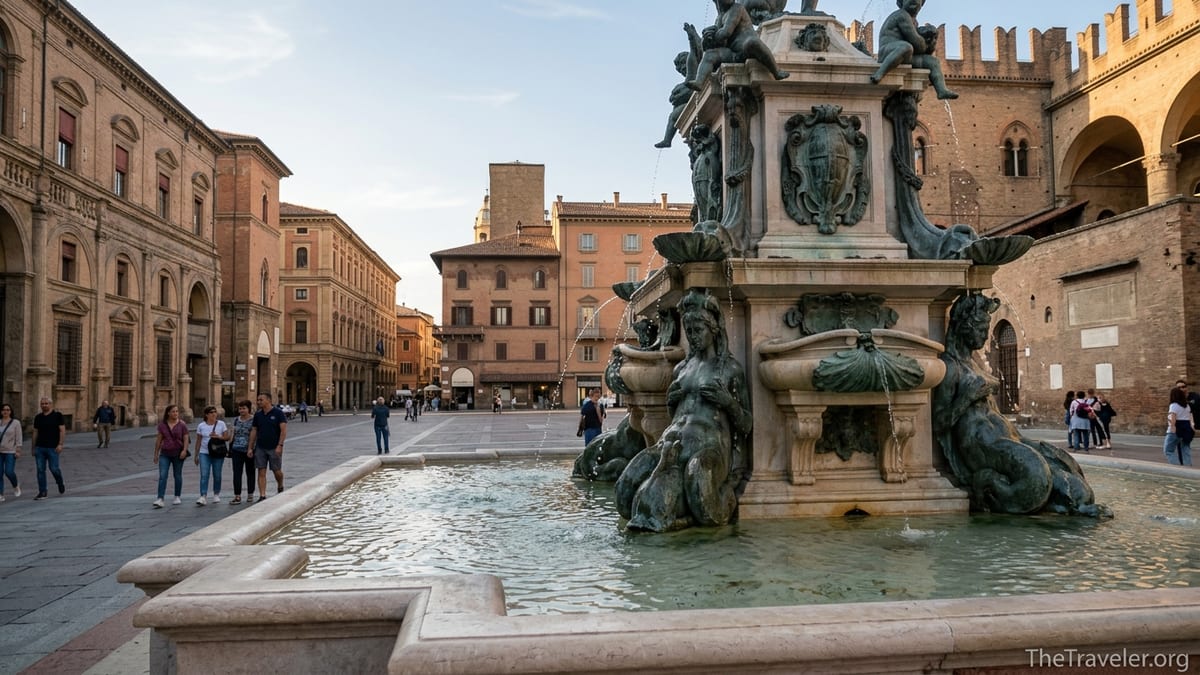
In the heart of Bologna, a few steps from the city’s busy porticoes and café terraces, the Fountain of Neptune rises above the crowds in a swirl of bronze muscles, sea creatures, and spurting water. At first glance it is simply a dramatic Renaissance fountain. Look closer, and you find a carefully staged story about power, faith, and fertility, commissioned by a pope and carved with a mischievous sense of humor. For travelers who pause more than a moment in Piazza del Nettuno, this monument reveals how art, politics, and everyday life have been intertwined here for more than 450 years.
Get the latest updates straight to your inbox!
A Renaissance Giant With a Political Mission
The Fountain of Neptune was created between 1563 and 1566, at a time when Bologna was firmly under papal rule and the Catholic Church was reshaping its image after the Council of Trent. Commissioned by the papal representative Pier Donato Cesi to honor Pope Pius IV, the fountain was part of a broader redesign of the civic center, opening up a new square beside Piazza Maggiore and giving the city a bold new symbol. The official Latin inscriptions on the base proclaim that it was built with public money and for the people, but the message it sends is clear: Bologna belongs to the Papal States, and prosperity flows from Rome’s good governance.
The architectural design came from Tommaso Laureti, a Sicilian architect known for his theatrical handling of water, while the towering bronze Neptune was sculpted by Giambologna, a Flemish artist who was still building his reputation in Italy. Giambologna deliberately made Neptune larger than life, with an outstretched arm that seems to command the square like a stage. Travelers who wander across Piazza del Nettuno today often notice how the god’s gaze and gesture appear to extend beyond the basin to the surrounding palaces, as if he were presiding over the entire civic space.
For visitors, the fountain’s political roots are not just a historical detail. When you stand on the paving stones and look up, you are standing in what was, in the 1560s, a kind of open-air billboard celebrating papal authority. The four bronze plaques around the base list the names of Pope Pius IV, the governor Cesi, Cardinal Carlo Borromeo, and the Senate of Bologna, presenting them as the key pillars of power. Reading these inscriptions in situ, with the Palazzo d’Accursio and Basilica of San Petronio as a backdrop, you can see how the city’s religious and civic institutions were visually bound together.
Neptune as a Stand-In for Papal Power
In classical mythology, Neptune rules the seas; in Bologna, he effectively rules the city. The choice of Neptune was no accident. In Renaissance political language, controlling water meant controlling life, trade, and wealth. Bologna lacked a major natural river, so the construction of canals, cisterns, and fountains was vital for its economy and image. By installing a monumental sea god in the new square, the papal government signaled that it could command these life-giving resources, just as Neptune calmed or stirred the waves.
Giambologna reinforces this idea through the statue’s pose. Neptune’s left arm stretches forward with his palm facing down, a gesture often interpreted as calming the waters. Guides in Bologna sometimes describe this as a metaphor for the Church pacifying the turbulent city, which had a long tradition of communal independence and occasional rebellion. When you visit, notice how this gesture aligns with the flow of people and the former market area around Piazza Maggiore, underlining the sense that order and abundance flow from the figure at the center.
The symbolism reaches far beyond the city. At the corners of the first basin, four cherubs wrestle with dolphins, each group representing one of the great rivers known to Europeans in the 16th century: the Ganges, Nile, Amazon, and Danube. For contemporary viewers this linked Bologna and its papal rulers to a global landscape, suggesting that their power extended, at least symbolically, across the world’s waters. Modern travelers, especially those arriving from intercontinental flights into nearby Bologna Guglielmo Marconi Airport, can appreciate the ambition behind this imagery: a relatively small inland city projecting itself as a node in a worldwide system.
Mermaids, Mother Nature, and Sensual Symbolism
What most visitors remember first, however, are not the cherubs or inscriptions but the four mermaid-like figures at the base. These bronze nymphs, technically Nereids rather than mermaids, sit with sinuous, twisting bodies, each grasping a breast from which water jets into the basin. This openly sensual design caused controversy in its own time and still provokes double-takes from passersby today. During a walking tour, it is common to see families pause here, parents glancing at each other as children giggle at the unexpected anatomy lesson.
The lactating Nereids are not merely provocative for its own sake. In Renaissance iconography, a woman whose breasts pour water or milk often symbolizes Mother Nature, fertility, and abundance. In Bologna’s case, the message is that under papal rule the city will be nourished, its fields irrigated, and its citizens supplied. The water spurting from the Nereids into the fountain basin creates a constant visual reminder of this promised prosperity. If you visit on a hot summer afternoon, when the air in the square can feel heavy, the sound and sparkle of the water add a sensory dimension to that idea of relief and refreshment.
This blend of sacred politics and sensual bodies makes the fountain a textbook example of Mannerist art, a style that favored elongated forms, complex poses, and intellectual games with meaning. Travelers familiar with Florence may notice the contrast between Bologna’s Neptune and the more austere fountains there. Here the Church embraced pagan imagery, even playful eroticism, to communicate messages about power and generosity. It is a reminder that Counter-Reformation Catholicism was not uniformly austere and that public art in this period could be surprisingly bold.
Local Legends, Hidden Jokes, and Student Rituals
Over the centuries, Bolognese residents have surrounded the fountain with stories that add yet another layer of meaning. One popular legend recounts that Giambologna wanted Neptune’s genitals to be larger but was forced by church authorities to reduce them. According to local lore, he compensated by adjusting the statue’s silhouette. If you stand at a specific angle behind the fountain, near the corner of the Biblioteca Salaborsa side, Neptune’s outstretched left hand and thumb line up in such a way that the thumb appears phallic. On busy weekends you can often spot small groups of university students guiding friends to this exact viewing point, laughing as they reveal the optical trick.
The fountain has also become entwined with student superstition. Bologna is home to one of Europe’s oldest universities, and a widely told tradition warns students not to circle the fountain clockwise before they have completed their final exams, or they risk bad luck and failure. Some say Giambologna himself paced obsessively around the base while planning the work, and that his restless circling inspired the superstition. Today, it is not unusual to see nervous undergraduates deliberately avoiding a full loop while their visiting friends and family walk the entire perimeter taking photos.
These rituals might sound like folklore, but they have practical implications for your visit. If you travel with a Bolognese student, you may find them suddenly stopping short rather than finishing a circle around the basin. Guides often incorporate the legend into their tours, turning what could be a quick photo stop into a short performance of local beliefs. Observing how residents interact with the fountain gives visitors insight into how a 16th century monument still shapes everyday behavior.
Daily Life Around the Fountain: From Vegetable Market to Night Meeting Point
In the 16th and 17th centuries, the area around the Fountain of Neptune was not the polished civic stage it appears today. For centuries Piazza Maggiore and Piazza del Nettuno hosted open-air markets, and vegetable sellers are known to have used the fountain’s lower basin to wash their produce, frequently clogging the drains with leaves and soil. City records from the early modern period already mention the need to clear blockages and maintain water pressure, proof that even a masterpiece by Giambologna was not immune to the practical challenges of urban life.
Modern visitors encounter a very different atmosphere. On a typical weekday morning, you might see office workers with takeaway espresso passing the fountain on their way to nearby municipal buildings, while small guided groups cluster at the base to listen to explanations. In the early evening, when the surrounding palaces begin to glow with warm light, the square turns into an informal living room. Couples sit on the steps of nearby buildings, street musicians set up just beyond the splash zone, and the fountain becomes both backdrop and participant in the city’s social life.
If you are planning a trip, timing your visit can change your experience of the symbolism. Arriving at dawn allows you to see the basin almost empty, with municipal cleaning crews hosing down the paving stones and the water jets often just switched on. Late at night, especially in summer, groups of friends gather nearby, taking photos and sometimes testing the patience of local police by perching on the steps closer to the water than regulations allow. The monument’s sensual and monumental character seems to invite daring behavior, which in turn has shaped how authorities manage and protect it.
Restoration, Protection, and Respecting the Monument
Like many outdoor monuments, the Fountain of Neptune has suffered from pollution, weathering, and human misuse over time. It has undergone multiple restoration campaigns, including a major project in the 2010s that involved scaffolding, detailed cleaning, and structural analysis of both the bronze and stone elements. When the fountain was re-unveiled after this work, Bolognese newspapers described the return of its original color contrasts: the warm bronze against the cooler stone, the crisp edges of the Nereids, and the sharper facial features of Neptune himself.
The restoration also coincided with growing concern over tourist behavior at Italian monuments. Incidents elsewhere, such as visitors climbing fountains in Rome or damaging sculptures for selfies, have prompted stricter enforcement in Bologna too. Local police can issue on-the-spot fines to anyone who enters the water, climbs onto the statue, or treats the monument as a playground. Travelers who have seen videos of people wading in famous fountains should be aware that such stunts now carry real financial penalties and risk international headlines.
For conscientious visitors, this context changes how you read the fountain’s symbolism. The same water that once washed vegetables for market sellers is now carefully filtered and monitored, and the steps and basin edges are patrolled to protect the bronze from corrosion and damage. When you stand at the railing or on the surrounding pavement, camera in hand, you become part of an evolving story about how historic works of art are shared and safeguarded in the era of mass tourism. Treating the fountain with respect is not only a matter of local law but also a small act of stewardship toward a piece of global heritage.
Beyond Bologna: The Neptune Symbol Around the World
The impact of Bologna’s Neptune extends far beyond the city’s medieval walls. In 1920, Mario Maserati, one of the founding brothers of the Maserati automobile firm, chose the trident of Giambologna’s Neptune as the company logo, reportedly after a suggestion by a family friend who admired the fountain. Today, when travelers see the Maserati badge on a car grille or showroom window, they are encountering a direct visual echo of the statue in Piazza del Nettuno: a three-pronged symbol of strength, speed, and mastery over forces of nature.
The statue has also been copied and adapted in various parts of the world. Replicas of the entire fountain or just the central figure can be found in places as varied as Laeken near Brussels, coastal California, and the Black Sea city of Batumi. A cast of Neptune stands in Bologna’s Archaeological Museum, while another reproduction greets visitors at the entrance to a maritime museum in Japan. For travelers familiar with these locations, arriving in Bologna can feel like visiting the original scene after seeing only quotes and references elsewhere.
Understanding these global echoes helps frame the fountain’s symbolism in a broader context. Neptune has long been a favored figure for cities with maritime ambitions, from Florence and Naples to distant port towns that adopted classical iconography in the 19th and 20th centuries. Bologna’s choice is distinctive precisely because the city is not a port. By importing the image of a sea god into an inland square, the Papal States projected a kind of metaphorical control over the vast network of rivers, canals, and seas that underpinned commerce and communication across Europe.
The Takeaway
Standing at the center of Bologna’s historic core, the Fountain of Neptune is more than a picturesque photo stop. It is a layered text in bronze and stone, composed to celebrate papal authority, reassure citizens about prosperity, and impress visitors with the city’s sophistication. Its symbolism runs from the grand gestures of global rivers and divine power down to local details: the student who will not walk a full circle, the tour guide showing the optical joke, the municipal worker clearing leaves from the grates.
For travelers, taking time to decode these elements can turn a short pause between coffee and lunch into one of the most memorable moments of a visit to Bologna. By looking closely at Neptune’s outstretched arm, the nursing Nereids, the wrestling cherubs, and the inscriptions carved in stone, you connect not only with Renaissance politics and myth but also with the rhythms of a living city. The fountain’s story is still being written in every glance, superstition, and snapshot that plays out beneath its ever-falling water.
FAQ
Q1. Where is the Fountain of Neptune located in Bologna?
The Fountain of Neptune stands in Piazza del Nettuno, adjacent to Piazza Maggiore in the historic center, surrounded by the main civic and religious buildings.
Q2. Who created the Fountain of Neptune and when?
The fountain was designed in the 1560s by architect Tommaso Laureti, with the bronze statue of Neptune sculpted by Giambologna between 1563 and 1566.
Q3. Why did Bologna choose Neptune as the subject of the fountain?
Neptune symbolized control over water and, by extension, over prosperity and trade, making him an ideal stand-in for papal power in a city dependent on canals and fountains.
Q4. What do the four cherubs with dolphins represent?
The cherubs each hold a dolphin symbolizing one of the major rivers known at the time, evoking the Ganges, Nile, Amazon, and Danube as a sign of global reach.
Q5. Who are the mermaid-like figures at the base and what do they mean?
The mermaid-like figures are Nereids whose lactating breasts pour water, symbolizing Mother Nature, fertility, and the nourishing abundance promised under papal rule.
Q6. Is it true that students avoid walking around the fountain?
Yes, a local superstition says university students who walk a full circle around the fountain before graduating risk failing exams, so many deliberately avoid it.
Q7. Can visitors touch or climb the Fountain of Neptune?
No, touching the bronze figures, climbing the structure, or entering the basin is prohibited, and doing so can result in fines and intervention by local police.
Q8. Has the Fountain of Neptune been restored recently?
Yes, the monument has undergone significant restoration in the 21st century, including cleaning, structural repairs, and renewed water systems to protect it from deterioration.
Q9. How is the Fountain of Neptune connected to Maserati?
The trident held by Neptune inspired the Maserati car logo, chosen in 1920 by Mario Maserati, making the fountain an unlikely icon of Italian automotive design.
Q10. What is the best time of day to visit the Fountain of Neptune?
Early morning offers quieter views and softer light on the bronze, while evening provides a lively atmosphere with illuminated buildings and a bustling square.