


Walk into Florence’s Piazza della Signoria today and it is impossible to miss the pale marble giant rising above a churn of bronze sea creatures. Bartolomeo Ammannati’s Fountain of Neptune, completed in the late sixteenth century for the Medici court, has watched the city change from a ducal capital to a mass tourism hotspot. Once mocked by Florentines and blackened by centuries of grime, the fountain has been meticulously restored and remains a cornerstone of the city’s artistic identity, politics and daily life. Understanding why this controversial monument still matters opens a surprising window onto Florence itself.
Get the latest updates straight to your inbox!
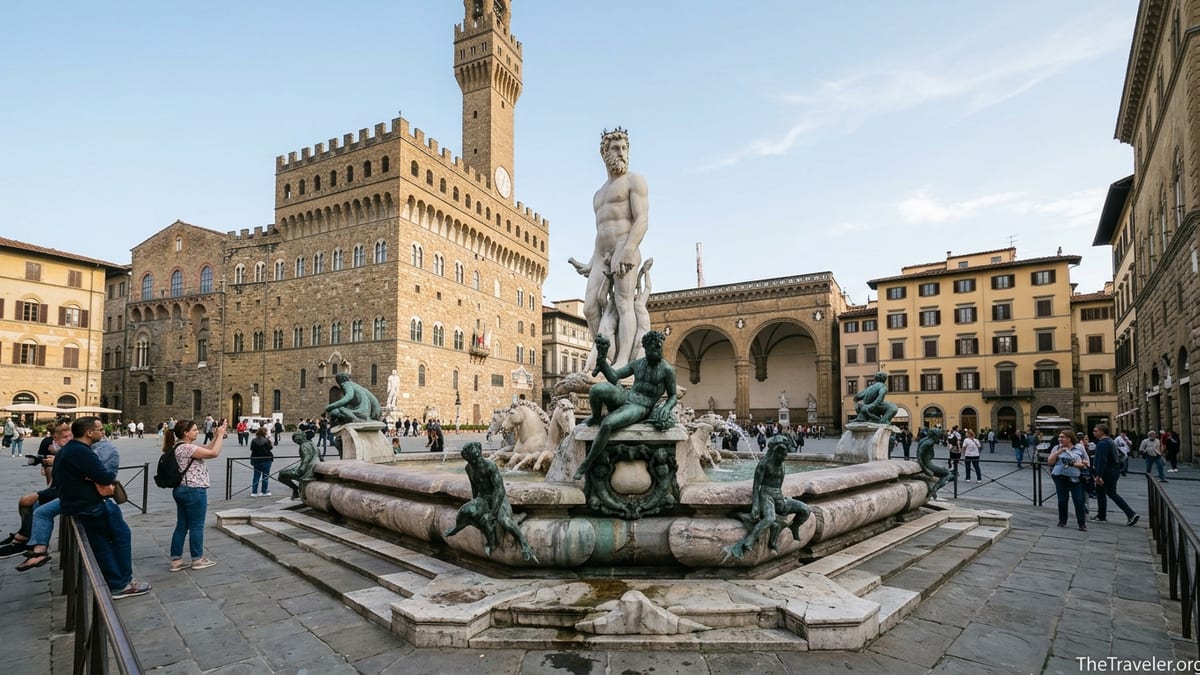
A Medici Power Statement in Stone and Water
The Fountain of Neptune was commissioned by Cosimo I de’ Medici in 1559 for the city’s main civic square, just steps from Palazzo Vecchio. Conceived as a celebration of Cosimo’s new aqueduct and of Florence’s maritime ambitions, it turned the republican heart of the city into a stage for ducal propaganda. The central marble Neptune, whose features echo Cosimo’s own, proclaims Medici control over the waters and, symbolically, over Tuscany’s ports and trade routes. For a visitor standing in the piazza today, it represents not just a mythological figure, but a portrait of power sculpted on a monumental scale.
The work was entrusted to Bartolomeo Ammannati, an architect and sculptor working in a Mannerist idiom, with assistance from artists in Cosimo’s circle. The project was timed to coincide with the lavish wedding celebrations of Cosimo’s heir Francesco I and Joanna of Austria in 1565, when foreign dignitaries arrived in Florence and paraded past the still-in-progress fountain. The Medici intended the work to rival the great papal fountains of Rome and the civic Neptune in Bologna, linking Florence to a broader European language of water monuments and court spectacle.
Standing in front of the fountain, travelers can still read those messages in the details: Medici coats of arms, sea deities drawn from classical iconography, and the choice of white Carrara marble for Neptune, which glows almost theatrically against the darker bronze figures at the base. The entire ensemble reminds visitors that Florence’s artistic history is not only about individual genius, like Michelangelo, but also about carefully choreographed displays of dynastic prestige in public space.
For contemporary Florence, the fountain also acts as a visual anchor in the square, connecting Palazzo Vecchio, the Uffizi courtyard and the Loggia dei Lanzi into a single ceremonial axis. City guides often include it as a key stop on Medici-themed walks, using the monument to explain how a family of bankers reshaped both the skyline and the political narrative of the city.
From Public Criticism to Beloved Icon
Despite its grand ambitions, Ammannati’s Neptune was not warmly received in its own time. Many Florentines criticized the proportions of the central figure, comparing him unfavorably to the nearby copy of Michelangelo’s David and joking that the god looked more like a “white giant made of cheese.” For centuries, the fountain was more often the butt of local humor than a celebrated masterpiece, and it suffered from neglect, pollution, and occasional damage from celebrations and protests in the piazza.
That story of criticism and gradual rehabilitation is precisely what makes the fountain important in Florence’s artistic history. It illustrates how public taste changes and how works once dismissed can become part of a city’s emotional landscape. As art historians reassessed Ammannati’s Mannerist style in the twentieth century, his fountain came to be seen less as a failed imitation of Michelangelo and more as an imaginative, theatrical composition in its own right, with a striking contrast between the static, aloof god and the swirling, sensual marine figures below.
On a practical level, the monument also shows how deeply a work of art can be woven into everyday routines. Florentines meet “by the Biancone,” the nickname for Neptune, as a convenient rendezvous point amid the crowds. Street musicians set up nearby, and guides for small-group city tours often pause across from the fountain to use its long basin as an informal bench while explaining the surrounding buildings. For many residents, the fountain is less an object to be analyzed and more an old acquaintance that has always been there.
When visitors today hear a local refer to Ammannati’s work with affectionate irony, they are witnessing the end result of that historical arc: a controversial piece of Medici propaganda, mellowed by time and shaped by civic memory, becoming part of the city’s shared identity.
A Complex Sculptural Ensemble, Not Just a Single Statue
Many travelers glance at the towering Neptune and move on, missing the depth of the sculptural program at the base. Ammannati’s design created an entire marine world around the central figure: bronze river gods, muscular satyrs, and elegant nymphs sprawled along the edge of the basin, with rearing marble sea horses, shells and masks emerging from the water. These figures were crafted with the help of skilled assistants, including the Flemish-born Giambologna, whose later bronze Mercury and equestrian statues became touchstones of Florentine sculpture.
Up close, the difference between the cool white marble of Neptune and the dark, weathered bronze of the surrounding figures is striking. Travelers who walk all the way around the fountain can see how Ammannati treated each side as a different scene, encouraging viewers to move, circle and discover new angles. This three-dimensional choreography was a departure from the more frontal, statue-like monuments in the piazza and points ahead to the dynamic Baroque fountains of the following century.
For art lovers, the fountain is also a bridge between different moments in Florence’s artistic evolution. Neptune’s idealized body still echoes High Renaissance ideals, while the twisting poses and expressive faces of the minor figures anticipate later, more theatrical styles. Visitors who have just come from the Uffizi or the Bargello can recognize sculptural motifs recurring across the city: the sinuous lines familiar from Giambologna’s Rape of the Sabine Women, or the muscular torsos that recall Michelangelo’s unfinished slaves.
Photographers, too, find unexpected material at the fountain’s edges. Early morning light reveals subtle tool marks in the marble and delicate textures in the bronze: water stains, lichen, patches where past repairs are visible. These imperfections emphasize that the fountain is not a museum object preserved behind glass, but a working piece of urban infrastructure that has aged along with the city around it.
Restoration and Corporate Patronage in the Twenty‑First Century
By the early 2000s, centuries of exposure, pollution and previous patchwork repairs had left the Fountain of Neptune in serious need of conservation. Cracks in the marble, corrosion on the bronze and a failing hydraulic system made it difficult to operate the fountain safely and convincingly. In response, the city of Florence undertook a major restoration project that began in 2017 and concluded in March 2019, funded in large part by the fashion house Salvatore Ferragamo through Italy’s Art Bonus tax incentive for cultural sponsorship.
The work, budgeted at roughly one and a half million euros, involved scaffolding the entire monument, cleaning the marble and bronze surfaces, consolidating weakened areas, and reconstructing portions of the water system to revive the original Renaissance water displays as closely as possible. Conservators used non-invasive diagnostic techniques to map structural issues, while engineers upgraded pumps, filters and lighting to modern standards without altering the fountain’s historic appearance. When the scaffolding finally came down, Florentines saw a Neptune dramatically brighter and more legible than the grey, encrusted figure of previous decades.
For visiting travelers, the restoration has changed the way the piazza feels. Evening lighting now picks out the water jets and the bronze figures with far greater clarity. During the first months after the reopening, guides would often point out before-and-after photos to show just how much grime had been removed. Even today, first-time visitors are sometimes surprised to learn that the fountain was only recently brought back to this condition; older guidebooks and travel blogs written before 2019 may still describe it as dark and deteriorated.
The project’s financing also matters for Florence’s broader artistic ecosystem. Corporate sponsorship of heritage sites can be controversial, but in this case many locals accepted the Ferragamo collaboration as a pragmatic solution to chronic underfunding. The partnership demonstrated that large private brands, whose flagship boutiques cluster just a short walk away on Via de’ Tornabuoni, can take concrete responsibility for the cultural fabric that attracts their clientele in the first place. Travelers curious about how Italy maintains its vast artistic patrimony can look to Neptune’s restoration as a very real example of public–private cooperation in action.
A Living Monument in the Age of Overtourism
Florence’s artistic history does not sit frozen in time. The Fountain of Neptune, like the city’s other iconic works, now exists in the context of mass tourism, social media and the pressures of contemporary urban life. Millions of visitors pass through Piazza della Signoria each year, many stopping to photograph the fountain or use it as a background for wedding shoots and influencer content. Inevitably, this heavy use has brought new challenges.
In September 2023, a 22‑year‑old German tourist climbed onto the monument during the night to take a photo and damaged part of a marble horse’s leg, resulting in repair costs estimated at several thousand euros and a hefty fine. In April 2026, another visitor was charged after attempting to touch the statue in a pre‑wedding dare, again drawing attention to the vulnerability of historic works in crowded city centers. These incidents are not isolated curiosities; they are part of a growing pattern of strain on Italy’s most visited monuments.
The city has responded with a mix of surveillance, fines and public campaigns. Security cameras monitor the piazza, barriers subtly guide foot traffic, and signs in multiple languages remind visitors to respect the artworks. Local newspapers regularly carry stories of fines for climbing or defacing monuments, and tour operators increasingly weave messages about responsible behavior into their commentary. For travelers, this means that approaching the fountain today is not only an aesthetic experience but also a small ethical choice about how to inhabit shared cultural space.
These tensions add a new chapter to Neptune’s long history. The same monument that once served as a symbol of Medici authority now helps define debates about who the city belongs to and how its treasures should be used. When a visitor chooses to admire the fountain from the paved perimeter rather than perching on the marble or dangling a hand into the basin, they are quietly participating in the ongoing story of how Florence negotiates the balance between access and preservation.
Reading the Fountain in the Wider Story of Florentine Art
For anyone exploring Florence with an eye to its artistic evolution, the Fountain of Neptune offers a powerful anchor point. A short walking loop can connect it to other key works that together trace the city’s changing aesthetics and politics. From the fountain, a traveler can look to the replica of David outside Palazzo Vecchio, then walk under the Loggia dei Lanzi to see the muscular, twisting forms of Giambologna’s Rape of the Sabine Women and Cellini’s Perseus with the Head of Medusa. A few minutes away at the Bargello Museum, Giambologna’s original bronzes and earlier Renaissance sculpture help clarify how Ammannati’s ensemble both draws on and diverges from its neighbors.
Within this network, Neptune stands out as a rare case of a monumental, site-specific fountain still functioning more or less in its original civic context. While many Florentine masterpieces now reside inside museums, protected from the weather and from crowds, Ammannati’s work remains rooted in the open piazza, where political rallies, concerts and city festivals still play out around its basin. During events such as the city’s New Year celebrations or local football victories, the fountain appears in news footage and social media feeds, framed by fireworks or cheering crowds.
This continuity has educational value. University programs in art history and conservation regularly use the fountain as a fieldwork case study, examining issues from water management and structural stability to interpretation and signage. In recent years, researchers have even modeled how the monument might respond to extreme events, such as vandalism or accidental explosions, as part of broader efforts to safeguard cultural heritage in unpredictable times. For students and casual visitors alike, Neptune illustrates how historical art interacts with modern risk management and urban planning.
For families or independent travelers, this context can be turned into a more engaging visit. Instead of simply snapping a wide shot, they can pick one section of the fountain to study, then look for echoes of that motif elsewhere in the city: a triton’s curling tail compared with marine details in the Boboli Gardens, or a satyr’s expressive face matched with similar masks on Renaissance palaces. In doing so, they experience the fountain not as an isolated attraction, but as a hub connecting many strands of Florentine visual culture.
The Takeaway
The Fountain of Neptune still matters in Florence’s artistic history because it gathers so many of the city’s themes into one place. It is Medici propaganda in marble and bronze, a Mannerist experiment balancing solemnity and exuberance, a technical feat of Renaissance water engineering, and a living monument that must constantly be cared for, financed and defended. Its journey from local punchline to internationally recognized symbol embodies the changing tides of taste and the power of restoration to alter how we see the past.
For travelers, pausing thoughtfully at the fountain can transform a hurried circuit of Florence’s highlights into a richer, more connected experience. Reading the square through Neptune’s presence links palace politics with street life, old patronage systems with today’s corporate sponsorship, historic aqueducts with modern plumbing, and Renaissance ideals with the realities of mass tourism. The next time you step into Piazza della Signoria and feel yourself pulled toward that gleaming marble figure, remember that you are not just looking at a statue. You are standing at the confluence of five centuries of art, power and public life.
FAQ
Q1. Where exactly is the Fountain of Neptune in Florence?
The Fountain of Neptune stands in Piazza della Signoria, near the northwest corner of Palazzo Vecchio and close to the entrance of the Uffizi courtyard.
Q2. Who created the Fountain of Neptune and when was it completed?
The fountain was designed by Bartolomeo Ammannati with assistants in the mid‑sixteenth century and was unveiled in the 1570s after years of work and delays.
Q3. Why did the Medici rulers commission the Fountain of Neptune?
Cosimo I de’ Medici commissioned the fountain to celebrate a new water supply for Florence and to symbolize his family’s control over the seas and regional trade.
Q4. Why was the Fountain of Neptune criticized in the past?
Many Florentines disliked the proportions of Neptune compared to Michelangelo’s David and mocked the statue, giving it nicknames and questioning Ammannati’s artistic choices.
Q5. Has the Fountain of Neptune been recently restored?
Yes. A major restoration completed in 2019, supported by public funds and private sponsorship, cleaned the marble and bronze and upgraded the water system and lighting.
Q6. Can visitors get close to the fountain or touch it?
Visitors can walk around the fountain but are not allowed to climb or touch the sculptures. Barriers and surveillance help protect the monument from damage.
Q7. What should I look for when I visit the fountain?
Beyond the central Neptune, pay attention to the bronze river gods, satyrs, nymphs and sea horses around the basin, and how the water and light animate the entire ensemble.
Q8. Is there an entry fee to see the Fountain of Neptune?
No. The fountain is in a public square and can be viewed for free at any time, although the surrounding area can be very crowded during peak tourist seasons.
Q9. How long should I plan to spend at the Fountain of Neptune?
Many visitors pause for five to ten minutes, but art enthusiasts may want 20 to 30 minutes to walk around, observe details and photograph the fountain from different angles.
Q10. Why is the Fountain of Neptune important for understanding Florentine art?
The fountain connects Medici politics, Renaissance engineering, Mannerist sculpture and present‑day conservation, making it a key monument for grasping how art and power intersect in Florence.