


Stand in the middle of Florence’s Piazza della Signoria and you are in one of Europe’s greatest open-air sculpture galleries. Stone underfoot, Palazzo Vecchio at your back, Uffizi at your side, and, towering over the crowds, two figures that dominate the scene: the gleaming white Fountain of Neptune and the bronze drama of Perseus with the Head of Medusa. Many visitors photograph both in a hurry and move on. But if you slow down and really look, a question quickly emerges: which of these masterpieces leaves the bigger impact on a traveler seeing Florence for the first time?
Get the latest updates straight to your inbox!
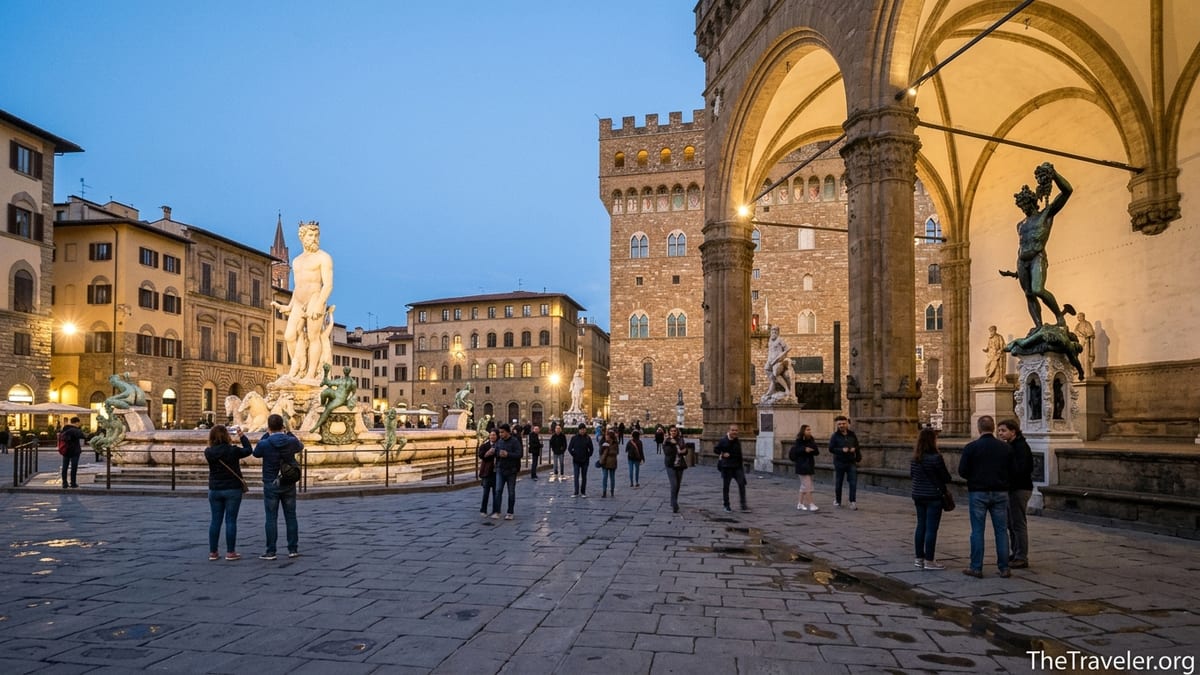
Meeting Florence’s Two Titans
For most travelers, the Fountain of Neptune is the first to appear. Set near the northwest corner of Piazza della Signoria, close to Palazzo Vecchio, the colossal white-marble sea god stands on a high pedestal ringed by bronze sea horses and nymphs. Commissioned in the mid-1500s to celebrate Cosimo I de’ Medici’s naval ambitions, the fountain still feels like a statement of power, catching the Tuscan sun and the flashes of smartphones all day long.
Just a few steps away, but tucked under the arches of the Loggia dei Lanzi, Benvenuto Cellini’s Perseus with the Head of Medusa offers a very different experience. Cast between 1545 and 1554, the over-life-size bronze hero stands with one sandaled foot on Medusa’s limp body, her snakes frozen in mid-twist, while he raises her severed head high. At eye level, you see blood spurting from the neck in carefully detailed streams, and if you circle behind, you can even spot Cellini’s subtle self-portrait worked into the back of Perseus’s helmet.
Both works were created within a few years of each other under the same powerful patron, Cosimo I. Yet they speak different visual languages: Neptune is public, celebratory, and monumental; Perseus is intimate, theatrical, and unsettling. To understand which one strikes modern travelers harder, it helps to look at how each artwork operates on the senses, the emotions, and even the Instagram feed.
First Impressions: Scale, Setting, and the Power of a Crowd
On a busy summer afternoon, the Fountain of Neptune tends to win on sheer visibility. The figure locals nicknamed “Il Biancone,” the big white giant, rises above the square, framed by Palazzo Vecchio and the Uffizi. Children run to the basin’s edge, tour guides raise colored umbrellas nearby, and you will often find a semicircle of visitors jostling for selfies with Neptune over their shoulders. The fountain is a hub of movement; even travelers just passing through the square are pulled toward the sound of water and the sight of marble gleaming in full sun.
Perseus, by contrast, reveals itself more quietly. Because it stands inside the Loggia dei Lanzi, slightly back from the main pedestrian flow, you usually step under the arches before the sculpture fills your view. The change in light matters: going from the bright piazza into the softer shadow of the loggia naturally slows you down. Many visitors who hurried past Neptune find themselves lingering longer here, tracing the bronze reliefs on the pedestal or trying to capture the dramatic diagonal of Perseus’s outstretched arm in a single photograph.
Guided walking tours illustrate the difference in impact. A typical two-hour Florence highlights walk, often priced in the range of 40 to 60 euros per person for a small group, usually pauses briefly at the Fountain of Neptune for context and photos before moving into a deeper discussion under the loggia, where guides can point out details without shouting over the fountain’s noise and the crowds. The way professionals allocate their time hints at which work sustains closer looking.
Artistic Drama vs Civic Monument: How Each Work Speaks
From an artistic standpoint, Perseus is widely regarded as the more daring achievement. Cellini had to master the technical challenge of casting a complex over-life-size bronze figure in one piece, something that still impresses art historians today. Up close, visitors notice the crisp definition of Perseus’s muscles, the refined modeling of Medusa’s face, and the storytelling details on the base, where smaller bronze panels narrate the myth of Perseus and Andromeda. Travelers who might not know much about sculpture often respond instinctively to this level of craft; you can see it in the way people lean in, point out the veins on Perseus’s arms, or zoom their phone cameras in on Medusa’s gaping mouth.
The Fountain of Neptune, on the other hand, functions less as a single virtuoso artwork and more as an urban monument. Designed by Bartolomeo Ammannati with contributions from assistants, it serves as a centerpiece for the square, tying together surrounding buildings and providing a dramatic foreground for photos of Palazzo Vecchio. The marble Neptune himself is imposing but relatively restrained in expression compared to the violent energy of Perseus. Many visitors remember Neptune in relation to the space it occupies: the arc of the basin, the bronze sea creatures at the corners, and the way the fountain anchors one side of the piazza.
For travelers interested in the politics of Renaissance Florence, each piece tells a different story. Neptune symbolizes the city’s aspirations as a maritime power under Medici rule, his trident a statement that Florence, landlocked though it is, claimed influence over the seas. Perseus, meanwhile, can be read as a message about Medici authority cutting down enemies of the regime. Guides often describe how public executions once took place in the very square where Perseus now stands, making the image of a triumphant hero holding a severed head feel pointed rather than purely mythological.
Emotional Impact: Shock, Awe, and the Memory Test
Ask travelers at the end of a day in Florence which work they remember more vividly, and Perseus frequently comes out ahead. The statue’s subject matter is inherently striking: a nude hero holding a freshly severed head, blood still pouring from the corpse at his feet. Visitors sometimes react with a visible flinch when they first notice the gore, then laugh nervously and pull friends closer for a better look. That mix of shock and fascination sticks in the mind long after you have left the square.
Neptune’s impact is more atmospheric than visceral. Travelers tend to recall the fountain as part of a scene: the turquoise reflections in the water on a clear morning, the way street musicians set up nearby in the evening, or the moment a passing thunderstorm made the marble gleam in the rain. It is beautiful, but in a calmer, more distant way. Where Perseus confronts you with mythic violence at eye level, Neptune remains a towering symbol, observed from below.
A useful way to gauge impact is to think about the photos travelers choose to print or frame at home. A wide shot of the piazza with Neptune in the foreground is a classic postcard view, popular for its sense of place. But the images that feel uniquely “your own” as a traveler are often the ones taken under the loggia: Perseus silhouetted against the city lights at dusk, a close-up of Medusa’s head, or the surprisingly modern profile of the hero’s face. These are the details that reappear in travel blogs, social media posts, and personal travel albums, suggesting that Perseus delivers a more individualized emotional hit.
Lighting, Time of Day, and the Traveler’s Experience
The time of day you visit Piazza della Signoria can dramatically shift which artwork feels most powerful. Under full midday sun, Neptune dominates the square. The white marble catches the light, throwing sharp shadows that emphasize his muscular torso and the swirl of the surrounding bronze figures. This is also when the fountain is most crowded, especially in peak months from late spring through early autumn, when cruise excursions and group tours swell through the historic center.
In the early morning, around 7:00 or 8:00, the mood changes. Shop shutters are still down, the square is relatively quiet, and cleaning crews sometimes move through with minimal equipment. At this hour, you can walk right up to the edge of the Neptune basin without jostling anyone and see the play of soft golden light across the water. Perseus, under the loggia, remains in gentler shadow, which suits the subtle modeling of bronze. Serious photography enthusiasts often favor this timeframe, using a wider lens to capture the entire piazza with long, low shadows.
At night, especially after 10:00, Perseus increasingly steals the show. Floodlights mounted in the Loggia dei Lanzi pick out highlights on the bronze, making Medusa’s snakes and Perseus’s helmet glow against the dark background. Tour groups thin out, and travelers linger in small clusters, speaking quietly or sitting on the low stone steps. It is common to see someone put their phone away entirely and simply study the sculpture for a few minutes, something that rarely happens in front of the still-busy fountain earlier in the evening. For many, that quiet nocturnal encounter with Perseus becomes one of their strongest memories of Florence.
Interaction, Photography, and Social Media Appeal
Modern travel experiences are often filtered through a camera lens, and both artworks respond differently to that reality. The Fountain of Neptune excels in wide, cinematic shots. It provides a ready-made foreground for photographs that include the tower of Palazzo Vecchio, the line of the Uffizi colonnade, or even the color of the sky at sunset. Because you can move around the entire fountain, you have multiple vantage points to frame the statue with the surrounding architecture, making it a natural favorite for panoramic images or group photos.
Perseus is more suited to intimate images and detail studies. Smartphone photographers experiment with low angles that capture the underside of Medusa’s head against the arches, or they zoom in on Cellini’s self-portrait hidden in the back of the helmet. Travelers who enjoy posting on social platforms often gravitate toward these distinctive shots; a close crop of Perseus and Medusa can look almost contemporary, with strong diagonals and dramatic contrast between polished bronze skin and dark background. The sculpture’s theatrical pose also invites creative captions and mythological references.
In practical terms, the loggia’s partial shelter helps when weather is less cooperative. On rainy days, Neptune can look washed out and difficult to photograph without water spots on the lens, while Perseus remains more clearly visible under cover, lit by artificial lights. This difference means that regardless of the season, travelers consistently have good opportunities to engage with and document Cellini’s bronze, reinforcing its lasting presence in personal travel narratives.
Conservation, Restoration, and How Close You Can Get
Both Neptune and Perseus have undergone significant restoration in recent decades, and that conservation work shapes the way visitors experience them today. The Fountain of Neptune, damaged over centuries by weather, pollution, and even modern vandalism, has benefited from a major cleaning and structural stabilization. As of the mid-2020s, the marble and bronze figures present a much crisper appearance than many older photographs suggest, with details on the sea horses and surrounding nymphs more legible to the naked eye. Barriers and signage, however, keep visitors at a respectful distance from the main structure.
Perseus has also seen careful attention from conservators, with periodic work to protect the bronze from corrosion and to stabilize the statue in its original outdoor location. In some periods, a high-quality replica has been considered or used elsewhere so that the original can be preserved without removing it from the historical setting of the Loggia dei Lanzi. For travelers, the crucial point is that you can still walk right up to the pedestal, close enough to study the reliefs and surface textures without glass or heavy fencing obscuring the view.
This proximity contributes significantly to the sculpture’s impact. You can examine the subtle differences between the polished surfaces of Perseus’s body and the rougher textures of Medusa’s hair and the rocky base. Children often crouch to look at the relief scenes telling the continuation of the myth, turning the experience into a kind of visual treasure hunt. The fountain, impressive as it is, remains more of a distant spectacle, while Perseus feels like a piece you can truly encounter at human scale.
The Takeaway
In the end, deciding which artwork leaves a bigger impact in Piazza della Signoria depends on what kind of travel experience you value. If your strongest memories come from the feel of a place as a whole, the Fountain of Neptune may stand out. It anchors Florence’s political heart, appears in countless cityscape photos, and reflects centuries of civic pride, restoration, and daily life swirling around its basin.
Yet for many individual travelers, Cellini’s Perseus with the Head of Medusa delivers the more intense and lasting impression. Its dramatic subject, technical brilliance, and close-up accessibility invite a deeper, more personal engagement. You might admire Neptune as you pass through the square, but you are more likely to find yourself standing still under the loggia, tracing the lines of Perseus’s body with your eyes and returning for a second look after dinner.
For a balanced experience, plan time for both. Visit the piazza twice in one day if you can: once in bright daylight to appreciate Neptune’s role in the urban landscape, and once after dark to feel the charged atmosphere around Perseus. The contrast between these two masterpieces will not only give you a richer sense of Florentine art, it will also sharpen your own way of seeing, helping you notice how setting, light, and storytelling shape the impact of public art wherever you travel.
FAQ
Q1. Where exactly are the Fountain of Neptune and Perseus statue located in Piazza della Signoria? Both artworks stand in Piazza della Signoria in central Florence. The Fountain of Neptune is near the northwest corner of the square beside Palazzo Vecchio, while Perseus with the Head of Medusa stands under the arches of the Loggia dei Lanzi along the southern edge of the piazza.
Q2. Is there an entrance fee to see the Fountain of Neptune and the Perseus statue? No, both the Fountain of Neptune and the Perseus statue are in public space and can be viewed for free at any time. You do not need a ticket, and you do not have to enter a museum to see them, although nearby attractions like the Uffizi Gallery and Palazzo Vecchio do charge admission.
Q3. What is the best time of day to visit if I want good photos of both artworks? Early morning offers softer light and fewer crowds for wide shots of Neptune and the whole piazza. Late afternoon gives warm light on the marble fountain, while evening and night are ideal for dramatic photographs of Perseus under the loggia’s artificial lighting.
Q4. How long should I plan to spend in Piazza della Signoria to appreciate these works? Many travelers pass through in 10 or 15 minutes, but allowing at least 30 to 45 minutes lets you circle the Fountain of Neptune, walk under the loggia to study Perseus up close, and absorb how both artworks relate to the surrounding palaces and streets.
Q5. Are guided tours worth it for understanding Neptune and Perseus better? A guided walking tour that includes Piazza della Signoria can be very helpful, especially if you are interested in the political symbolism of both works. Small-group city tours that cover the square typically cost in the range of 40 to 60 euros per person and provide historical context you might otherwise miss.
Q6. Can I get close enough to the sculptures to see fine details? You can walk right up to the base of Perseus under the Loggia dei Lanzi and clearly see the relief panels and surface details. The Fountain of Neptune is surrounded by a protective barrier, so you view it from a few meters away, which is still close enough to appreciate the overall composition but not individual chisel marks.
Q7. Are there any safety or etiquette tips when visiting these artworks?Normal city precautions apply: keep an eye on your belongings in crowded areas, avoid climbing on barriers or statues, and be mindful of others when taking photos. It is also courteous to keep noise levels moderate under the loggia, where many people are quietly observing the sculptures.
Q8. Do the statues look different in various seasons?Yes, seasonal changes affect the atmosphere around both works. In summer, long daylight hours and larger crowds make Neptune feel especially lively, while in winter the earlier nightfall and cooler air can give Perseus a starker, more dramatic presence under the lights.
Q9. Is it better to see these artworks before or after visiting the Uffizi Gallery?Many travelers enjoy seeing Piazza della Signoria before the Uffizi to set the stage for Florence’s art history, then returning afterward to look at Neptune and Perseus again with fresh eyes. Others prefer an evening stroll through the square after the museum, when the crowds thin and the sculptures are beautifully lit.
Q10. If I have limited time, which artwork should I prioritize, Neptune or Perseus?If you can see only one up close, prioritize Perseus under the Loggia dei Lanzi for its dramatic storytelling, technical mastery, and intimate viewing experience. You can still appreciate the Fountain of Neptune in passing as part of the broader piazza scene, even on a very tight schedule.