


Walk any classic route through Florence’s historic center and you will almost inevitably pass through Piazza della Signoria, the city’s open-air sculpture gallery. At its northwest corner rises the Fountain of Neptune, the pale marble sea god locals nickname the “Biancone,” or big white one. But with so much Renaissance art competing for your attention, is this fountain actually worth singling out on your Florence walking tour, or just another photo stop in a crowded square?
Get the latest updates straight to your inbox!
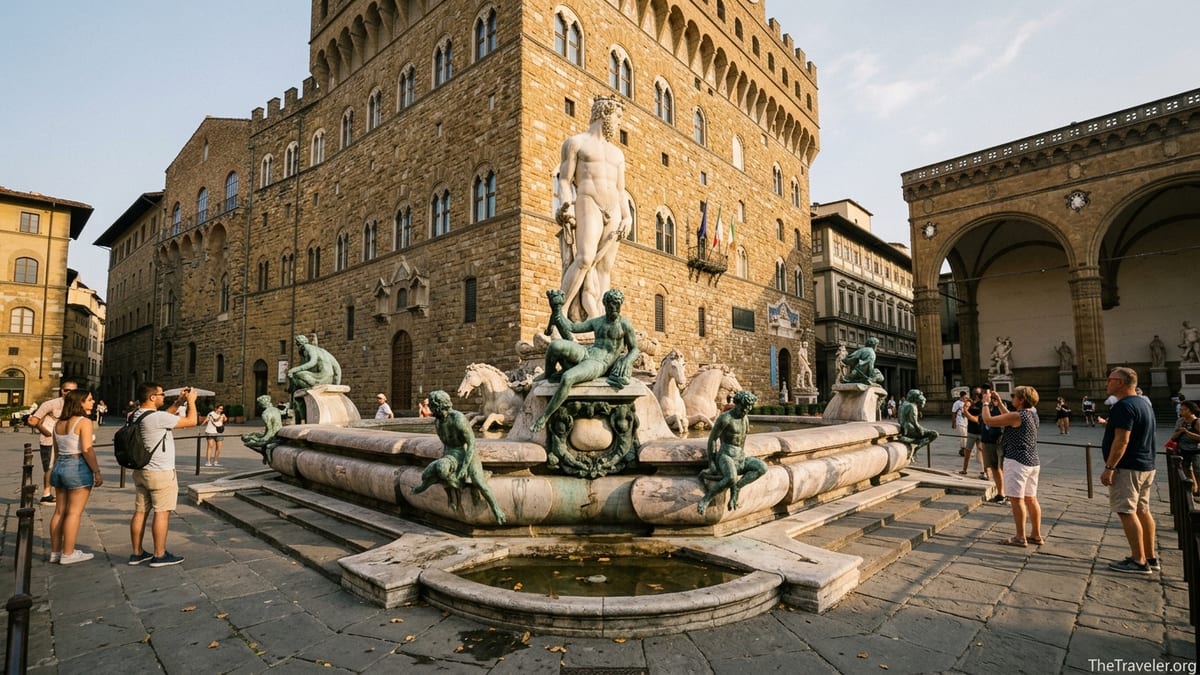
Where You Will Encounter the Fountain on a Florence Walk
Most guided and self-guided walking tours of Florence’s centro storico are built around a compact loop that runs from the Duomo area down to the Arno River. A typical route sold by local operators or international platforms starts near the Cathedral of Santa Maria del Fiore, continues past Orsanmichele, and then opens dramatically into Piazza della Signoria before heading to the Uffizi courtyard and Ponte Vecchio. On a three- to four-hour small-group tour, usually priced around 30 to 50 euros per person, Piazza della Signoria is one of the main set pieces, with the Fountain of Neptune as a prominent stop.
If you decide to explore independently, a common self-guided route of about 3.5 kilometers also runs through Piazza della Signoria around the halfway mark. That means the fountain is a natural place to pause, drink some water, and take stock of the cityscape around you. You do not need a ticket or reservation; the fountain stands in the open square directly in front of Palazzo Vecchio, alongside other major works like the replica of Michelangelo’s David and Cellini’s Perseus under the Loggia dei Lanzi.
Because the square is car-free and lined with cafes, many travelers end up crossing it multiple times in one day while moving between the Uffizi, the riverside, and the Duomo. Even if you do not consciously plan to see the Fountain of Neptune, you are likely to pass it more than once, which raises the question of whether to just glance at it or build a more intentional stop into your walk.
The timing of your tour matters too. Morning departures, especially before 10:00 am, tend to find the fountain surrounded by commuter foot traffic and a manageable number of tour groups. Late afternoon and early evening bring thicker crowds and more street performers. Night walks see the fountain dramatically lit and reflected in the wet stone of the piazza after rain, but also more tightly packed groups, especially in high season from May to September.
Why the Fountain of Neptune Matters Historically
Completed in the 1560s by architect and sculptor Bartolomeo Ammannati, the Fountain of Neptune was commissioned by Cosimo I de’ Medici to celebrate both a new aqueduct and Florence’s ambitions as a maritime power. The central figure of Neptune, standing on a chariot drawn by sea horses, carries the facial features of Cosimo himself, implying the duke’s control over the waters much as he ruled over Tuscany. Around the marble giant, bronze river gods, satyrs, and sea creatures recline at the edge of the basin, creating a dense ensemble typical of late Renaissance, or Mannerist, taste.
Seen in this context, the fountain is not just decorative; it is a piece of political propaganda carved in marble and bronze. For travelers used to the purely mythological fountains of Rome, it can be striking to realize that the sea god here is meant to be a portrait. A guide might point out how Cosimo used public art throughout the city, from this fountain to his equestrian statue a few meters away, to project strength during a period when Florence was asserting itself among European powers.
The fountain also illustrates the way public water features shaped city life. Its commissioning coincided with the opening of a new aqueduct, and for centuries it marked the presence of precious running water in the civic heart of Florence. While today the basin is purely ornamental, the jets and cascades activated after its recent restoration echo the original role of fountains as tangible evidence of technological and political might.
Finally, the Fountain of Neptune is part of a broader sculptural conversation in Piazza della Signoria. Stand between the replica David guarding the entrance to Palazzo Vecchio and Neptune in his chariot, and you can feel how later artists like Ammannati and Giambologna responded to Michelangelo’s example, competing for visual dominance in the same public theater. Understanding that rivalry enriches not only your stop at the fountain but your appreciation of the entire square.
What You Actually See Today: Restoration, Detail and Atmosphere
One of the strongest arguments in favor of stopping at the Fountain of Neptune is how good it looks today compared with a decade ago. A multi-year conservation project, funded in large part by a major Italian fashion house and concluded in 2019, meticulously cleaned the marble, stabilized the bronze statues, and modernized the fountain’s water system. As a result, the surfaces now show far more nuance than in older photos: you can read subtle chisel marks on Neptune’s torso and appreciate the color contrast between the pale Apuan marble and darker Seravezza stone in the basin.
The water effects, too, have been redesigned to follow historical documentation more closely. Jets and cascades now animate the sea horses and tritons, so that on a breezy day fine spray catches the sunlight in brief rainbows. For photographers, that interplay of water and carved stone against the warm-toned facades of Palazzo Vecchio creates one of the square’s most dynamic scenes. Bringing a phone with a decent wide-angle lens or a compact mirrorless camera will let you capture the full ensemble without backing too far into the crowds.
Up close, many visitors are surprised by how theatrical the smaller bronze figures are. River gods lean on overturned urns, satyrs grin mischievously at the passing crowd, and elegant female nymphs twist in complex poses at the rim. Most of these bronzes are attributed to Giambologna, one of the key sculptors of late sixteenth-century Florence, and they reward slow looking. If you stand near one of the corners of the basin for a few minutes, you can trace how their greenish patina shifts under changing daylight, revealing different details in the modeling.
The atmosphere around the fountain changes throughout the day. In the morning, you might see municipal workers inspecting the water system or conservators checking the stone. By midday, tour groups cluster along the safety barriers while children lean in to watch coins glittering on the fountain floor. At sunset, couples linger along the edge, the surrounding buildings glowing a soft terracotta as street musicians play nearby. If your walking tour allows it, pausing at two different times of day provides a surprisingly varied experience of the same monument.
Pros and Cons of Including Neptune on a Tight Florence Itinerary
For many visitors, time in Florence is limited to one or two full days, and every minute spent at one site is a minute not spent somewhere else. On the plus side, the Fountain of Neptune costs nothing to see, sits directly on most walking routes, and does not require queuing. You can absorb its main impact in five minutes, or linger for twenty if you are interested in Renaissance sculpture, all without sacrificing ticketed visits like the Uffizi or Accademia.
Another advantage is that the fountain offers a strong sense of place with relatively little effort. When you stand by the basin you have Palazzo Vecchio’s crenellations above you, the arcades of the Loggia dei Lanzi in your peripheral vision, and a forest of statues around you. If someone asks what Florence felt like, a photo taken here tells a convincing story. It is especially worthwhile if you are traveling with companions who do not want to spend hours inside museums but still want to encounter great art.
There are, of course, downsides. Piazza della Signoria is one of the busiest spaces in Florence, and the area around the fountain can feel chaotic with selfie sticks, megaphones, and flag-waving guides. During peak months, you may need to navigate multiple groups just to reach a clear vantage point. Travelers who are sensitive to crowds or who prefer quieter corners might find the square overwhelming and choose instead to devote more of their walking tour to lesser-known cloisters or neighborhoods across the river in Oltrarno.
It is also fair to say that the Fountain of Neptune does not enjoy universal critical love. Historically, some Florentines considered Ammannati’s Neptune heavy and stiff compared with Michelangelo’s work, and the nickname “Biancone” carries a slightly teasing tone. If your priority is to see the most universally admired masterpieces, you might rank the fountain below Michelangelo’s David, Brunelleschi’s dome, or Masaccio’s frescoes in Santa Maria Novella. However, that very controversy can make it an interesting stop if you enjoy hearing conflicting opinions about art rather than just ticking off a checklist of the “best.”
Practical Tips: Best Time, Safety and How Long to Stay
If you are building a walking tour yourself, aim to reach Piazza della Signoria and the Fountain of Neptune either before 9:30 am or after sunset for the most pleasant experience. Early in the day, shadows are longer, the marble reads as cool and crisp, and you can often get front-row views with only a handful of other visitors. In the evening, the artificial lighting gives the fountain a dramatic glow, and the square feels more theatrical, though also busier in warm months when locals join the paseo through the center.
Safety-wise, the piazza is considered one of the safer parts of Florence, with a constant police and municipal presence, but it is also a textbook environment for petty theft. The density of people, the distraction of sculptures on all sides, and the habit of leaving bags on the ground to take photos all create easy opportunities for pickpockets. Use a crossbody bag worn in front, keep phones and wallets in zipped compartments, and avoid putting backpacks down even for a moment while you photograph the fountain. This is standard city awareness rather than a reason to avoid the area.
Plan to spend around 10 to 20 minutes at the fountain if you are on a flexible schedule. That gives you time to circle the basin, examine the bronze figures, and look back at Neptune in relation to the surrounding architecture. If you are on a guided walk, the guide will probably dedicate about five minutes to explaining the fountain’s symbolism before moving on. You can always return later independently if you feel rushed and want a quieter look.
Weather can subtly shape your experience. In high summer, midday heat reflects off the paving stones, and the area around the fountain can feel particularly exposed. A sun hat and water bottle make even a brief stop more comfortable. In cooler months, light rain adds reflections on the stone that double the visual impact of the illuminated fountain in the evening. On such days the square may be less crowded, letting you appreciate the monument without constantly dodging umbrellas.
How the Fountain Compares to Other Highlights on a Florence Walking Tour
When evaluating whether the Fountain of Neptune is “worth it,” it helps to compare it honestly with the other major sights you are likely to see on the same walk. The Duomo complex offers the city’s most iconic skyline and interior space; the Uffizi provides room after room of canonical paintings; Ponte Vecchio gives you a medieval bridge lined with jewelry shops and river views. Against these, Neptune is a single sculptural ensemble, but it has the advantage of being entirely integrated into Florence’s civic heart and everyday life.
In terms of sculptural impact, the fountain balances nicely with the other works in Piazza della Signoria. The replica David is a direct encounter with one of the world’s most famous figures, even if the original stands indoors at the Accademia. Cellini’s Perseus, visible under the Loggia dei Lanzi, showcases virtuoso bronze casting and an explicit mythological drama. Neptune, by contrast, is more about allegory and political messaging. If you appreciate reading layers of meaning into public monuments, this contrast enriches your tour.
For photography, many visitors end up preferring Neptune to some indoor sites precisely because you can freely move around it, shoot from different angles, and capture candid street scenes in the background. A common real-world scenario: a traveler with only a few hours in Florence does a quick walking loop, takes a classic shot of the Duomo from Piazza del Duomo, then spends several minutes experimenting with shots of Neptune and the surrounding statues before crossing to the river. Those images often become the most evocative memories of their brief visit.
If your interests lean heavily toward painting or church architecture, you may decide to spend the bulk of your limited time indoors and treat the fountain as a background element on your way through the square. On the other hand, if you enjoy city life, urban spaces, and the interaction between locals, tourists, and centuries-old art, then a deliberate stop here is well worth building into your walking tour.
The Takeaway
So is the Fountain of Neptune worth seeing during a Florence walking tour? For most travelers, the answer is yes, with a few caveats. You are almost certain to pass through Piazza della Signoria anyway, and the fountain sits at a literal crossroads of art, politics, and everyday city life. Its recent restoration means you are encountering the monument in unusually good condition, with crisp marble surfaces and revitalized water displays that highlight the skill of Ammannati and his collaborators.
The key is to be intentional about how you experience it. Rather than just snapping a quick photo as you follow a flag through the crowd, pause for a few minutes to walk around the basin, look closely at the bronze river gods and nymphs, and notice how Neptune aligns with Palazzo Vecchio and the other statues. A short, focused stop can transform the fountain from a generic backdrop into a memorable part of your understanding of Florence.
If your schedule is extremely tight or you are especially crowd-averse, you might choose to spend more time in quieter cloisters or along the Arno instead. But for anyone taking even a basic walking tour of the historic center, the Fountain of Neptune earns its place as both a visual spectacle and a window into the city’s Renaissance ambitions. Treated as more than a quick photo op, it can become one of the most vivid scenes you carry home from your day on foot in Florence.
FAQ
Q1. Where exactly is the Fountain of Neptune in Florence?
The Fountain of Neptune stands in Piazza della Signoria, at the northwest corner of the square, directly in front of Palazzo Vecchio and near the Loggia dei Lanzi.
Q2. Is there an entry fee to see the Fountain of Neptune?
No, there is no fee. The fountain is part of the open public space of Piazza della Signoria, so you can see it at any time without a ticket or reservation.
Q3. How long should I plan to spend at the Fountain of Neptune?
Most visitors spend 10 to 20 minutes walking around the basin, taking photos, and listening to a guide. On fast-paced group tours, you may only stop for five minutes.
Q4. What is the best time of day to visit the fountain on a walking tour?
Early morning before about 9:30 am offers softer light and fewer crowds, while evening visits provide atmospheric lighting but generally thicker crowds, especially in summer.
Q5. Is the area around the Fountain of Neptune safe?
The piazza is typically busy and well-policed, but like any crowded tourist area it attracts pickpockets, so keep bags zipped, valuables secure, and avoid setting belongings on the ground.
Q6. Can I get close to the fountain, or is it fenced off?
You can walk all the way around the fountain, but low barriers prevent people from climbing onto the basin. You can still get close enough to see details of the marble and bronze figures.
Q7. Is the Fountain of Neptune lit up at night?
Yes, the fountain and the surrounding buildings in Piazza della Signoria are illuminated after dark, creating a striking scene that many evening walking tours include as a highlight.
Q8. Does every Florence walking tour include the Fountain of Neptune?
Nearly all standard historic-center walking tours stop in Piazza della Signoria and mention the fountain. Only very specialized itineraries that focus on other neighborhoods might skip it.
Q9. Is the original Neptune statue outdoors, or is it a copy?
The large marble Neptune you see in the square is historically documented and has undergone conservation; some smaller original elements have been moved or copied, but the main figure remains outdoors.
Q10. Is the Fountain of Neptune suitable for travelers with limited mobility?
The piazza is flat and paved, and there are no steps required to approach the fountain, so wheelchair users and those with limited mobility can generally access good viewing points without difficulty.