


Below the noisy traffic and laundry-strewn balconies of Naples lies another city, carved into soft volcanic rock. In the northern districts of Capodimonte and Sanità, the catacombs of San Gennaro and San Gaudioso preserve almost 1,800 years of stories about faith, fear, status and survival. Visiting these underground cemeteries is not only a brush with early Christianity, but a way to understand how Naples itself has been shaped by saints, plagues, superstition and, more recently, community activism.
Get the latest updates straight to your inbox!
From Family Tombs to the City’s First Christian Cemetery
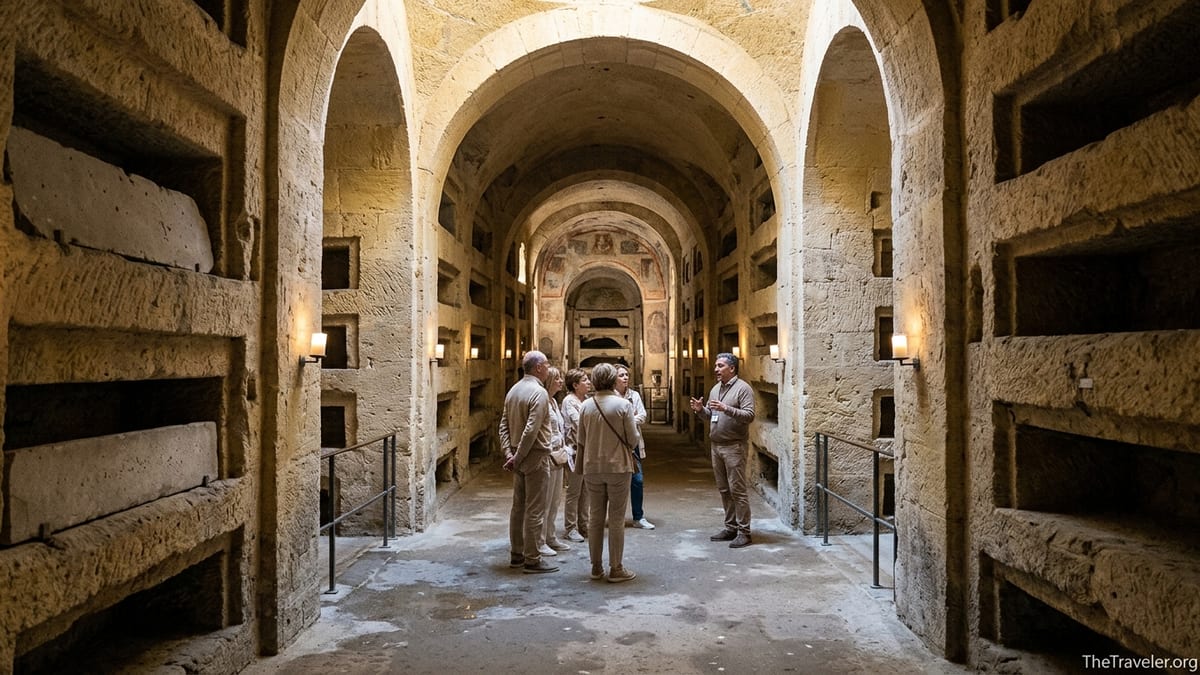
The Catacombs of San Gennaro began in the 2nd century AD as a single family tomb dug into the soft tuff outside ancient Neapolis. Over time, other Christian families expanded the network, cutting horizontal galleries and niches to create a true subterranean cemetery. By late antiquity, this honeycomb of chambers had become the most important Christian burial ground in Naples, spreading across multiple levels beneath what is now the Sanità district and the church of San Gennaro extra Moenia.
San Gennaro, known in English as Saint Januarius, was not the first holy figure to be associated with the site. Earlier, the remains of Saint Agrippinus, Naples’ first patron saint, were placed here, turning the complex into a local pilgrimage destination. Only later, probably in the 4th century, were the relics of San Gennaro transferred to these catacombs, firmly linking his name to the underground cemetery and helping secure his status as the city’s beloved protector.
As Christianity became accepted and then dominant in the Roman Empire, the catacombs shifted from discreet burial place to a semi-public space of devotion. Small underground basilicas were carved out of existing corridors, with apses, altars and frescoes depicting Christ, saints and symbolic motifs such as the fish and anchor. When you walk through today, the sense is less of a secret refuge from persecution and more of a sprawling, sacred suburb where the dead and the living met regularly in prayer.
By the Middle Ages, many bishops of Naples were buried in San Gennaro, and chapels were embellished with mosaics and stucco. Even when the saint’s relics were later moved to the cathedral in the city center, devotion to him continued here. Modern visitors still see a blend of modest loculi, arched family tombs and bishop’s chambers that chart how a small burial site grew into the largest early Christian catacomb complex in southern Italy.
San Gaudioso: African Bishop, Refugees and Macabre Art
The Catacombs of San Gaudioso, a 15- to 20-minute walk from San Gennaro through the Sanità neighborhood, have a more intimate feel and a particularly dramatic story. According to tradition, their name comes from Saint Gaudiosus, a 5th-century bishop from North Africa who was exiled during Vandal persecutions. Shipwrecked near Naples, he found refuge in a community that already used an old Greek quarry here as a burial place. After his death, Gaudiosus was laid to rest in these catacombs alongside other African refugees and early Christians, turning the site into a symbol of migration and faith under pressure.
Like San Gennaro, San Gaudioso began as a late antique Christian cemetery, with narrow passageways, arched niches and simple frescoes. But its most striking features date from much later. In the 17th century, when the basilica of Santa Maria della Sanità was built above the catacombs, Neapolitan nobles and clergy sought prestigious burials here. Dominican friars who managed the site developed a distinctive practice that combined piety, status and a strong reminder of mortality.
Skulls of aristocrats and high-ranking religious were set into the walls of the catacombs, while painters added life-sized bodies beneath them in fresco. A bishop’s skull might be crowned by a painted mitre and robes; a noblewoman’s cranium would rest above a flowing painted gown and jewelry. These “composite” portraits let the deceased retain their social identity and clothing in paint, while their bones remained starkly visible. Standing in front of these images today, many visitors feel they are being silently observed by a gallery of skull-faced ancestors who still insist on being recognized.
After the devastating plague of 1656, the surrounding valley became a huge open-air cemetery, and parts of the underground complex were altered or destroyed to handle mass burials. Later, epidemics such as cholera led to further rearrangement of bones. The result is a layered space where 5th-century refugee burials, Baroque memento mori art and emergency plague interments coexist in a single warren of corridors.
What You Actually See Underground: Layouts, Frescoes and Atmosphere
Most guided tours of San Gennaro start near the modern visitor center beside the basilica. A broad staircase leads down to the upper level, immediately giving a sense of scale. Instead of cramped tunnels, you enter wide corridors and chambers hewn from yellow tuff, high enough for groups to walk comfortably. Light is carefully controlled but not theatrical; you can see the rough tool marks in the stone, the small side niches for individual burials and the arched loculi carved one above another like shelves.
One of the highlights is the underground basilica of Sant’Agrippino, with a semi-circular apse, early Christian altar and fresco fragments dating from around the 4th century. Guides often pause here to point out the simple but powerful imagery: a Christ figure with large eyes, a dove, or a stylized palm. The plaster is cracked, and the colors are faded, but up close you can still make out reds, ochres and soft greens that survived centuries of humidity and neglect.
Deeper in, you encounter the so-called “Bishops’ Corridor,” where painted portraits framed the tombs of Neapolitan bishops. Many of these were defaced or damaged over time, but some faces remain clear enough to distinguish individual features. Visitors who have seen the catacombs of Rome often comment that San Gennaro feels less claustrophobic and more architectural, with a sense of planned space rather than endless narrow tunnels.
San Gaudioso, in contrast, is more intimate and raw. Access is usually through the church of Santa Maria della Sanità, where a trapdoor-like passage or side stair leads into the dim underworld. The first impression is of tighter corridors and lower ceilings, with moist stone close to your shoulders. Lamps highlight the unique skull-and-body frescoes. Guides will sometimes shine a handheld light across the painted garments to reveal details like lace cuffs, bishop’s rings or the folds of a cloak, all surrounding a hollow-eyed skull in the wall above.
Saints, Miracles and the Neapolitan Obsession With the Dead
Understanding these catacombs also means understanding Naples’ intense relationship with its saints and its dead. San Gennaro is at the heart of this. His blood, kept in vials in the cathedral, is said to liquefy three times a year, and while the Vatican does not officially recognize the phenomenon as a miracle, many Neapolitans anxiously watch for it as a sign of protection for the city. When guides in the catacombs speak about the saint’s relics once resting here, they are not just reciting history; they are invoking an ongoing, very local devotion.
For centuries, families visited underground chapels on saints’ feast days, lighting candles and sharing food in honor of their dead relatives. This habit of familiar contact with bones and graves helps explain later practices like the skull paintings at San Gaudioso or the cult of anonymous skulls in other Neapolitan cemeteries. Death in Naples has rarely been hidden away; it is integrated into daily spiritual life.
Travelers notice this in concrete ways. In Sanità, a five-minute walk from the catacombs, florists sell bright plastic wreaths all year round. Small street shrines hold photos of deceased neighbors next to saints’ images. Bars near the Ponte della Sanità serve coffee under framed ex votos, the painted thank-you tablets offered to saints for healings or favors. Visiting San Gennaro and San Gaudioso gives context to these surface rituals. The catacombs are not a Gothic attraction. They are an early chapter in a living story of how Neapolitans negotiate fear, hope and the promise of protection.
The stories of African refugees buried with Gaudiosus, of bishops insisting on underground tombs, and of nobles commissioning their own skull portraits all underline a practical point: burial here was a way of securing assistance in the afterlife and visibility in the memory of the living. For modern visitors, that translates into an unusually candid encounter with how people of different eras imagined death, status and salvation.
From Neglect to Neighborhood Revival
By the 19th and early 20th centuries, both catacombs suffered from neglect, looting and casual dumping. The upper levels of San Gennaro were used as air-raid shelters during the Second World War, and debris, makeshift walls and graffiti obscured many early Christian features. San Gaudioso had been partly walled up and survived mainly as a curiosity under the church, known to locals but rarely visited by outsiders except specialists.
The turnaround began in the early 2000s, when a group of young residents from the Sanità district formed a cooperative to manage and restore the catacombs in partnership with the local diocese and heritage authorities. Instead of outsourcing tours to a national agency, they trained neighborhood guides, cleared rubbish, improved lighting and created safe access routes. A portion of ticket income is reinvested into social projects in Sanità, from youth programs to small-scale urban improvements.
Today, visitors often notice that the guides are in their twenties or thirties and speak candidly about growing up in a district long marked by unemployment and organized crime. Walking with them through San Gennaro or San Gaudioso, you hear how the site’s revival has generated local jobs and a sense of pride. Cafés and small guesthouses have opened in nearby streets, and some of the former Dominican cloister buildings by San Gaudioso now operate as a modest bed and breakfast managed by the same cooperative.
This community dimension shapes the visitor experience in practical ways. Tours are timed to keep groups relatively small, even in high season, partly to protect fragile frescoes and partly to keep the guiding personal. Information panels are multilingual but not overwhelming, because the emphasis is on oral storytelling. If you visit on a weekday morning in shoulder season, you may find your group includes a mix of international tourists and Neapolitans who are finally seeing an underground world they had long passed over.
Planning Your Visit: Tickets, Timing and What to Expect
Most travelers experience both catacombs on a single ticket managed by the neighborhood cooperative. As of mid-2026, adult ticket prices commonly fall in the range of 13 to 15 euros for a guided tour of San Gennaro, with San Gaudioso included either on the same day or within a set validity period. Reduced prices are usually available for children, students and seniors, and kids under a certain age often enter free, but exact thresholds change, so it is wise to check current details when you plan.
Guided visits are mandatory and typically last about one hour per site. At San Gennaro, tours run throughout the day in Italian and at scheduled times in English and sometimes other languages such as French or Spanish, especially from spring through autumn. In July and August, mid-morning and late-afternoon slots can book out, so travelers staying only one day in Naples often reserve ahead through official ticket vendors or by arranging the visit via their hotel concierge.
Reaching the catacombs is straightforward using public transport. Many visitors combine them with the Capodimonte Museum: buses and shuttles that run from the city center toward Capodimonte usually have stops within a short walk of San Gennaro. From there, it is about 10 to 15 minutes on foot downhill through ordinary residential streets to reach Santa Maria della Sanità and the entrance to San Gaudioso. Taxis and ride-hailing services can also be practical, especially for families with young children or travelers who prefer to avoid steep walks.
Underground temperatures stay relatively cool and stable throughout the year, which makes the catacombs a welcome break on hot Neapolitan summer days. Humidity can be high, and floors may be uneven or slightly damp in places. Closed shoes with good grip are strongly recommended, along with a light sweater if you get chilled easily. Photography is usually allowed without flash, but tripods and large bags are discouraged. Because the catacombs are active religious heritage sites, guides often ask visitors to speak quietly and dress in a way that would be acceptable in a church.
Reading the Stone: How to Interpret What You See
Walking through the catacombs with some interpretive tools in mind helps transform the visit from a sequence of “old tunnels” into a coherent story. In San Gennaro, notice first the variety of tomb types. Small rectangular niches cut into the walls were for ordinary individuals, often sealed originally with slabs of marble or terracotta. Larger arched recesses, sometimes with traces of carving or color, were family or group tombs. When your guide points out a particularly large arcosolium with a decorated arch, imagine it as the final resting place of a prominent family whose name has long since vanished.
Pay attention too to the layering. On some walls, you can see newer burials cut into or across earlier ones, a visual clue that the cemetery was in continuous use and constantly adapted. Where frescoes survive, the iconography is often simple but rich in meaning: fish and loaves, the Good Shepherd, or an orant figure with raised hands symbolizing the soul in prayer. Rather than hunting for artistic perfection, look for how these paintings made faith visible in dim, candlelit chambers for believers who had little access to grand basilicas.
In San Gaudioso, interpretation is more psychological. The skulls cemented into niches are not anonymous; many originally had inscriptions indicating names and titles. The painted bodies beneath them emphasize social roles: a lawyer’s robe, a knight’s armor, a nun’s habit. Guides often explain how these images balanced a reminder of mortality with a desire to preserve status. A concrete example they sometimes share is that one of the painters, Giovanni Balducci, reputedly requested burial here in exchange for his work, hoping his own skull-and-body portrait would guarantee both remembrance and spiritual benefits.
Finally, try to imagine the sound and smell of these spaces when they were active cemeteries: priests chanting litanies, wax dripping onto stone, relatives murmuring prayers at particular tombs. The modern lighting and safety measures can make the catacombs feel almost museum-like, but a little historical imagination, guided by the physical evidence, helps restore their original role as places where the boundary between living and dead felt thin.
The Takeaway
Visiting the catacombs of San Gennaro and San Gaudioso is much more than a macabre excursion. It is a journey through how Naples has dealt with death, identity and hope for almost two millennia. From a 2nd-century family tomb to a community-run cultural project, San Gennaro tells a story of continuity and reinvention. San Gaudioso, with its African bishop and skull-painted nobles, adds a darker, more theatrical chapter about exile, plague and the need to be remembered.
For travelers, the experience is compelling because it remains rooted in a real neighborhood. When you emerge from the cool darkness of the catacombs back into the roar of scooters and the smell of frying dough in Sanità, the connection between underground past and street-level present is immediate. You have not only learned about early Christianity and Baroque funerary customs; you have watched how a city still negotiates its fears and aspirations through the stories it tells about its dead.
If you plan a trip to Naples, set aside a morning or afternoon for these underground sites, ideally combined with an unhurried wander through the surrounding streets. Listen carefully to the local guides, ask questions, and let the rough walls, faded frescoes and silent skulls speak. The catacombs are not a spectacle imported for tourism but a deeply local archive of how Neapolitans have faced the one experience all travelers share in the end: mortality.
FAQ
Q1. Do I need to book tickets in advance for the catacombs?
Booking ahead is strongly recommended in high season, especially from late spring to early autumn, as guided tours have limited capacity and popular time slots can fill up.
Q2. Can I visit San Gennaro and San Gaudioso on the same day?
Yes, many visitors see both on the same day. The sites are within walking distance of each other, and combined tickets typically allow entry to both within a defined period.
Q3. Are the catacombs suitable for children?
Many families bring school-age children, who often find the visit fascinating. Very young kids may be unsettled by skulls and bones, and strollers are impractical due to stairs and uneven floors.
Q4. Is photography allowed inside the catacombs?
Photography without flash is usually permitted, but tripods and large professional setups are discouraged. Always follow the specific instructions given by your guide during the tour.
Q5. Are the catacombs accessible for visitors with limited mobility?
Access can be challenging. Stairs, slopes and uneven surfaces are unavoidable, and full wheelchair access is limited, so travelers with mobility concerns should inquire directly before visiting.
Q6. What should I wear when visiting the catacombs?
Wear comfortable closed shoes with good grip and bring a light layer, as it can feel cool underground. Clothing should be respectful, similar to what you would wear in a church.
Q7. How long should I plan for a visit?
A standard guided tour at each site lasts about one hour. Including arrival, ticketing and walking between San Gennaro and San Gaudioso, plan around three hours in total.
Q8. In which language are the tours offered?
Regular tours are offered in Italian, with scheduled tours in English and sometimes other languages. In busier months, English-language departures are more frequent.
Q9. Is it scary or claustrophobic inside?
The spaces in San Gennaro are relatively wide and well lit, which reduces feelings of claustrophobia. San Gaudioso is more intimate, but guides keep groups small and move at a calm pace.
Q10. Why are these catacombs important compared with others in Italy?
San Gennaro and San Gaudioso are among the most significant early Christian cemeteries in southern Italy, combining rare frescoes, unique burial traditions and a contemporary role in reviving the surrounding neighborhood.