


On most people’s first trip to Florence, the Arno River means one thing: the Ponte Vecchio. Yet on a cool late afternoon, I found myself drifting away from the crowds and toward a quieter span a few hundred meters upstream. Crossing Ponte alle Grazie on foot, I began to understand why this unassuming bridge, rebuilt after the Second World War and largely ignored by guidebooks, has quietly become a favorite among Florentines.
Get the latest updates straight to your inbox!
A Bridge Hiding in Plain Sight
Ponte alle Grazie sits just east of the Ponte Vecchio, linking Via de’ Benci and the Santa Croce side of the river with Piazza de’ Mozzi and the Oltrarno. It is the first bridge you meet as you follow the river upstream from the old jewelry bridge, yet many visitors walk past without realizing what they are missing. Where the Ponte Vecchio is a stage set of gold shops and selfie sticks, Ponte alle Grazie is simply a working bridge: five clean stone arches, low walls, buses humming past, and Florentines walking home with groceries from the Conad on nearby Corso Tintori.
Historically, this was one of the city’s key crossings. The original bridge, completed in the 13th century and once known as Ponte di Rubaconte, was older even than the Ponte Vecchio. It survived epic Arno floods over the centuries before being blown up, along with almost every other bridge in Florence except the Ponte Vecchio, by retreating German forces in 1944. The current structure, inaugurated in the 1950s, carries forward that lineage in a quieter, more functional form that locals quickly folded into their daily routines.
Arriving on foot from Piazza Santa Croce, I felt the shift the moment I stepped onto the bridge. The soundscape changed from the echo of tour groups and street musicians to something softer: bicycle bells, snatches of Italian conversations, the rhythm of city buses stopping at Lungarno alle Grazie. It was still unmistakably Florence, but it felt like a Florence that belonged to the people who live here.
Walking the Arno: A Local Artery, Not a Tourist Attraction
Florentines use Ponte alle Grazie the way locals use bridges in any river city: as part of the daily commute. In the early evening, office workers cross toward the Oltrarno for an aperitivo near Piazza Santo Spirito, parents push strollers from the San Niccolò neighborhood back toward Santa Croce, and students from the nearby university buildings pedal slowly across on upright city bikes. For them, this bridge is a practical connector between neighborhoods, not a monument to be photographed from every angle.
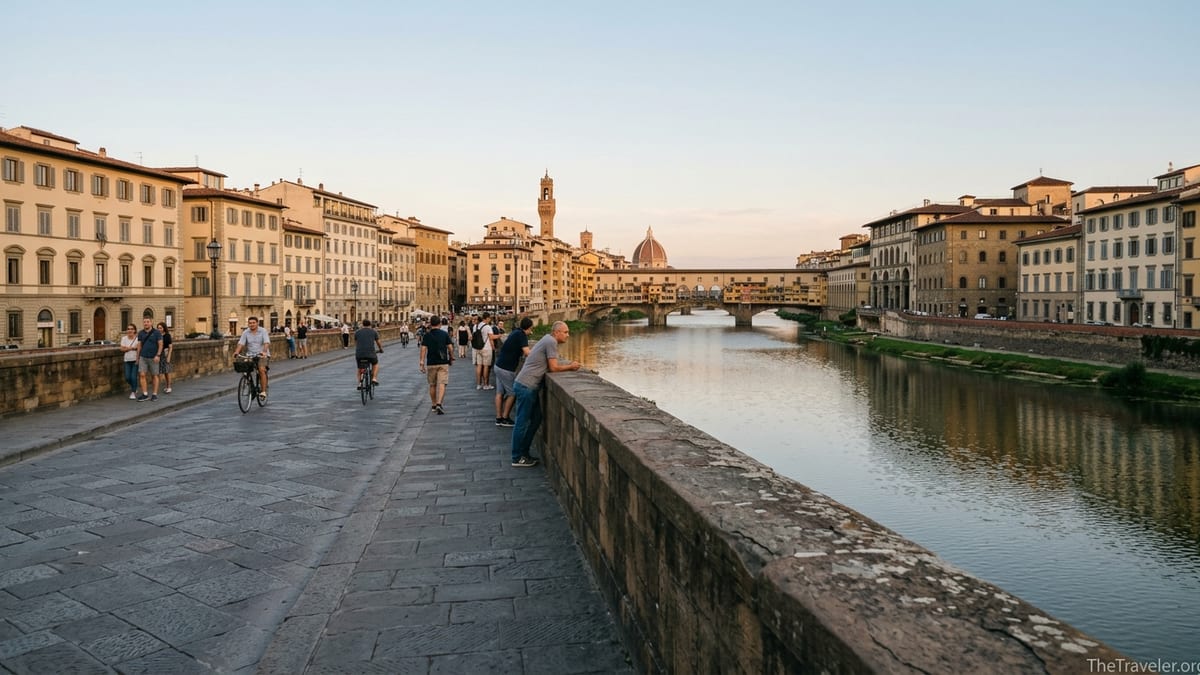
The walk itself is short, perhaps two or three minutes at a relaxed pace, but it invites lingering. On the upstream side, the view opens toward the low weir at San Niccolò, where rowers from the local canoe and rowing clubs cut narrow wakes through the Arno’s usually placid surface. On the downstream side, the city’s most iconic scene appears in profile: the Ponte Vecchio framed between riverbanks lined with historic palazzi, and, in the distance, the dome of the Duomo catching late light. Locals know that this is one of the best free viewpoints in the city, yet it rarely feels crowded.
Along the Lungarno, the city has steadily improved pedestrian and cycling access, and Ponte alle Grazie is part of that network. In practice, this means that if you are staying near Piazza del Duomo or Santa Croce, it is easy to reach the bridge on foot in under ten minutes, then continue along the river toward the green slopes of Piazzale Michelangelo or wander into the artisan streets of the Oltrarno. The bridge is not the destination so much as the hinge that makes a more local-feeling route possible.
History in the Stones: From Medieval Miracle Bridge to Modern Lifeline
To understand why locals feel attached to Ponte alle Grazie, it helps to know what stood here before. The medieval bridge that once occupied this spot was a marvel of its time: built in stone in the 1200s with nine arches, lined with houses, workshops, and religious structures. There was even a revered image of the Madonna that gave the bridge its enduring name, as Florentines came here to pray for “grazie,” or favors and protections, especially from the Arno’s destructive floods.
Over the centuries, the medieval bridge evolved with the city. Some arches were filled in to expand nearby piazzas, and flood defenses along the river, the lungarni, reshaped its footprint. Yet it remained a central artery and a place where ordinary life unfolded: monks crossing between convents, merchants hauling goods from one bank to the other, children darting between doorways. By the early twentieth century, photographs show a dense, almost village-like bridge, very different from the streamlined arc you see today.
When German troops blew up the bridge in 1944, they severed not only a physical crossing but also a thread of community memory. The decision to rebuild after the war was practical the city needed the connection but also symbolic. The modern bridge, completed in the 1950s, reduced the arches from nine to five and stripped away the houses and chapels. What remained was a leaner, more flood-resilient structure that could handle bus and car traffic yet still sit relatively low and harmonious within Florence’s historic skyline.
Locals sometimes talk wistfully about the lost medieval bridge, but they also appreciate the current one’s understated grace. The stone piers rise directly from the water without massive embankments, keeping the river close. The simple lines do not compete with the Ponte Vecchio or the Duomo. For many Florentines, Ponte alle Grazie is a reminder that the city’s identity is not frozen in the Renaissance; it keeps adapting to new realities while respecting its past.
Views You Cannot Get from the Ponte Vecchio
As I paused midway across Ponte alle Grazie, I noticed something that never happens on the Ponte Vecchio: I could set my bag down on the low stone wall, lean my elbows on the cool surface, and stand still without being jostled. That little pocket of personal space transformed the view. From here, the Ponte Vecchio is not a postcard you fight through a crowd to capture; it becomes an element in a broader cityscape that also includes the Uffizi’s long facade, the crenellated tower of Palazzo Vecchio, and the faint line of hills beyond.
Turn the other way, and the mood shifts. Upstream, the Arno widens and relaxes. On the left bank, the Lungarno Serristori curves gently toward the residential blocks of San Niccolò, with their shutters and laundry lines. On the right bank, beneath the embankment of Lungarno Diaz, narrow staircases lead down to occasional river-level paths, where you might see a fisherman or a couple sharing a quiet moment far below the bustle of the street. At golden hour, when the sandstone buildings catch the low sun, the water can turn a muted copper, and Ponte alle Grazie feels like a private balcony over the city.
Because the bridge carries regular bus routes, you will also share it with the everyday rituals that rarely appear in tourism campaigns. I watched a teenager in a Fiorentina jersey drop his skateboard and push off the moment the light turned green, a nonna in a quilted jacket guiding her grandson by the hand and pointing out the Ponte Vecchio downstream, and a nurse in scrubs cycling home, her backpack slung low. For travelers willing to slow down, these small vignettes are as memorable as any museum visit.
Crossing from Santa Croce to the Oltrarno: A Walk to Savor
My walk began near the Basilica of Santa Croce, where the streets narrow into a grid of wine bars, stationery shops, and small grocery stores. From there, I followed Corso Tintori toward the Arno, passing a tabacchi selling bus tickets and phone top-ups, and a gelateria doing brisk business in pistachio and stracciatella. Prices here feel more grounded than around the Duomo; an espresso at the counter typically costs around one to one and a half euros, and a generous scoop of gelato is often under three.
At the river, Lungarno alle Grazie opens up, and the bridge rises in front of you. Crossing to the south bank, traffic hums along but does not overwhelm the space. The sidewalks are wide enough for couples to stroll side by side, and low stone walls invite you to stop whenever a particular angle of light or reflection pulls you in. Halfway across, I fell into step behind two friends speaking in rapid Florentine Italian, gesturing toward the looming bulk of the Uffizi as if gossiping about an old neighbor.
Reaching the Oltrarno side, the bridge delivers you almost directly into Piazza de’ Mozzi, a small, slightly worn square anchored by palazzi with deep rust-colored facades. From here, you can wander up Via de’ Bardi toward the foot of the Ponte Vecchio, or slip east into the cobbled lanes that climb toward San Niccolò and, eventually, the steps that lead to Piazzale Michelangelo. This is a route locals favor on weekend evenings: cross Ponte alle Grazie at sunset, zigzag uphill through San Niccolò, then watch the city lights come on from the terrace above before ambling back down for a late dinner.
For visitors, following this same path turns a simple river crossing into a miniature urban hike through several distinct Florentine atmospheres: the literary and student air of Santa Croce, the working rhythm of Lungarno alle Grazie, the residential calm of San Niccolò, and the grand panorama from Piazzale Michelangelo. At the center of it all, unobtrusive but essential, is Ponte alle Grazie.
The Subtle Comforts Locals Appreciate
What makes Ponte alle Grazie beloved by locals is not a single dramatic feature but a combination of small, practical comforts. Unlike the Ponte Vecchio, which is closed to vehicles but crowded with shops and tourists, Ponte alle Grazie keeps its sidewalks clear. There are no market stalls or aggressive souvenir sellers; instead, you are more likely to see a dog walker pausing to let their terrier sniff the balustrade or a runner stopping to stretch against the stone wall.
The bridge’s proximity to everyday services also matters. On the Santa Croce side, a short detour into the side streets brings you to neighborhood bakeries and alimentari where residents pick up bread, milk, and fresh produce. On the Oltrarno side, it is a short walk to small independent cafes where a cappuccino and a pastry still feel like part of a local morning routine rather than a packaged “breakfast experience.” If you cross the bridge before 9 a.m., you will share it mostly with people on their way to work or school, not tour groups.
Safety and visibility also play a role in local affection. Ponte alle Grazie is open and well lit at night, without the enclosed shopfronts that can make other bridges feel claustrophobic after dark. Streetlights reflect off the Arno, and traffic, while constant, moves at a moderate pace because the bridge feeds into city-center streets with strict speed limits. For many residents who live or work near Santa Croce or San Niccolò, this feels like the most straightforward, no-drama way to cross the river after dusk.
There is also an emotional undercurrent. Many Florentines alive today grew up hearing stories from grandparents about the wartime destruction of the city’s bridges and the long process of reconstruction. Crossing Ponte alle Grazie, with its clean lines and mid-twentieth-century engineering, can feel like a quiet tribute to resilience. It is a place where grief, memory, and everyday life have been layered into something stable and reassuring.
How Travelers Can Experience the Bridge Like a Local
Visiting Ponte alle Grazie is easy to fold into any central Florence itinerary. If you are coming from the Duomo, walk ten to fifteen minutes southeast toward Santa Croce, then follow signs to the river. You will know you are close when the streets open up and you see buses turning along Lungarno alle Grazie. Rather than using the bridge only once as a shortcut, consider crossing it at different times of day to understand how its atmosphere changes.
Early morning, around 7:30 or 8:00, brings joggers and commuters. This is the moment to grab a quick espresso at a neighborhood bar near Corso Tintori, then walk to the middle of the bridge while the city is still stretching awake. Late afternoon, an hour before sunset, is ideal for photography: the downstream view toward the Ponte Vecchio glows with soft light, and the upstream hills deepen in color. After dark, the reflections of headlights and street lamps turn the river into a ribbon of broken light, and you can often hear the distant murmur of conversations drifting up from riverside benches.
To lean into the local experience, pair your crossing with small rituals. Pick up a takeaway slice of schiacciata farcita, the Florentine flatbread sandwich, from a bakery in Santa Croce, then eat it while sitting on the low wall, watching the water move beneath you. Or, if you are returning from a dinner in the Oltrarno, choose Ponte alle Grazie instead of the Ponte Vecchio for your walk home. The extra five or ten minutes you spend in a quieter pocket of the city will likely be among the most peaceful of your trip.
Public transport can also bring you here. Several urban bus routes run along or near Lungarno alle Grazie and the adjacent streets, and using them once or twice during your stay can give you a better sense of how locals navigate the city. Even if you arrive by taxi from the station or airport, asking to be dropped near Santa Croce and then walking to Ponte alle Grazie on your first evening is a gentle way to orient yourself to Florence’s scale and rhythm.
The Takeaway
My walk across Ponte alle Grazie did not deliver a single cinematic moment. Instead, it offered a series of unhurried impressions: the easy cadence of conversational Italian on the wind, a cyclist pausing to take a phone call while balanced with one foot on the curb, the steady upstream pull of the Arno beyond the clamor of the city center. It was in these ordinary scenes that the bridge’s quiet appeal revealed itself.
Travelers often come to Florence in search of its greatest hits, and they should. The Ponte Vecchio, the Duomo, the Uffizi, and Santa Croce all deserve the attention they receive. Yet to understand why locals love their city, it helps to spend time in the spaces that support daily life without demanding a spotlight. Ponte alle Grazie is one of those places: practical, gently beautiful, and woven into the routines that make Florence more than an open-air museum.
Next time you find yourself following the crowd toward the jewelry shops on the Ponte Vecchio, glance upstream. Take the small detour to Ponte alle Grazie, walk it slowly from bank to bank, and let the city’s quieter stories rise from the water and stone. Chances are, by the time you reach the other side, you will understand why so many Florentines would not trade this unassuming bridge for anything.
FAQ
Q1. Where exactly is Ponte alle Grazie in Florence?
Ponte alle Grazie is the first bridge upstream from the Ponte Vecchio, linking the Santa Croce side of the Arno with the Oltrarno near Piazza de’ Mozzi and the San Niccolò neighborhood.
Q2. How long does it take to walk across Ponte alle Grazie?
At a relaxed pace, it takes only two to three minutes to cross, though most people linger in the middle to enjoy the views of the Ponte Vecchio and the upstream hills.
Q3. Is Ponte alle Grazie pedestrian only?
No, Ponte alle Grazie carries both vehicles and pedestrians. There are sidewalks on both sides, and locals regularly walk, jog, and cycle across it.
Q4. What is the best time of day to visit Ponte alle Grazie?
Late afternoon and sunset are particularly beautiful for photography, while early morning offers a quieter, more local feel with commuters and joggers.
Q5. How is Ponte alle Grazie different from the Ponte Vecchio?
Ponte Vecchio is a medieval bridge lined with shops and filled with tourists, while Ponte alle Grazie is a simpler modern bridge used mainly by locals for daily travel and open views.
Q6. Can I see the Ponte Vecchio from Ponte alle Grazie?
Yes, the downstream view from Ponte alle Grazie frames the Ponte Vecchio along with the Uffizi and the historic riverfront, making it one of the best vantage points in Florence.
Q7. Is the area around Ponte alle Grazie safe at night?
The bridge and surrounding streets are generally well lit and busy with local traffic, and many residents use it after dark to walk between Santa Croce and the Oltrarno.
Q8. How can I include Ponte alle Grazie in a walking itinerary?
A popular route starts at Santa Croce, crosses Ponte alle Grazie to Piazza de’ Mozzi, then continues into the Oltrarno or uphill toward San Niccolò and Piazzale Michelangelo.
Q9. Are there cafes or shops near Ponte alle Grazie?
Yes, on the Santa Croce side you will find neighborhood cafes, bakeries, and small grocery stores, while the Oltrarno side offers local bars and restaurants within a short walk.
Q10. Why do locals prefer Ponte alle Grazie to other bridges?
Locals appreciate its practical location, open views, relative calm compared with the Ponte Vecchio, and its role as a reliable everyday crossing woven into their routines.