


Most people come to Santa Maria della Sanità for one headline reason: the catacombs of San Gaudioso beneath its floor. They descend into the dark, take a guided tour, snap a few photos of skulls and mosaics, then hurry back toward the historic center. Yet this basilica and its rione hold far more than an atmospheric underground cemetery. If you slow down, look up, and linger, you discover a layered world of hidden images, neighborhood rituals, and small human details that almost every hurried visitor misses.
Get the latest updates straight to your inbox!
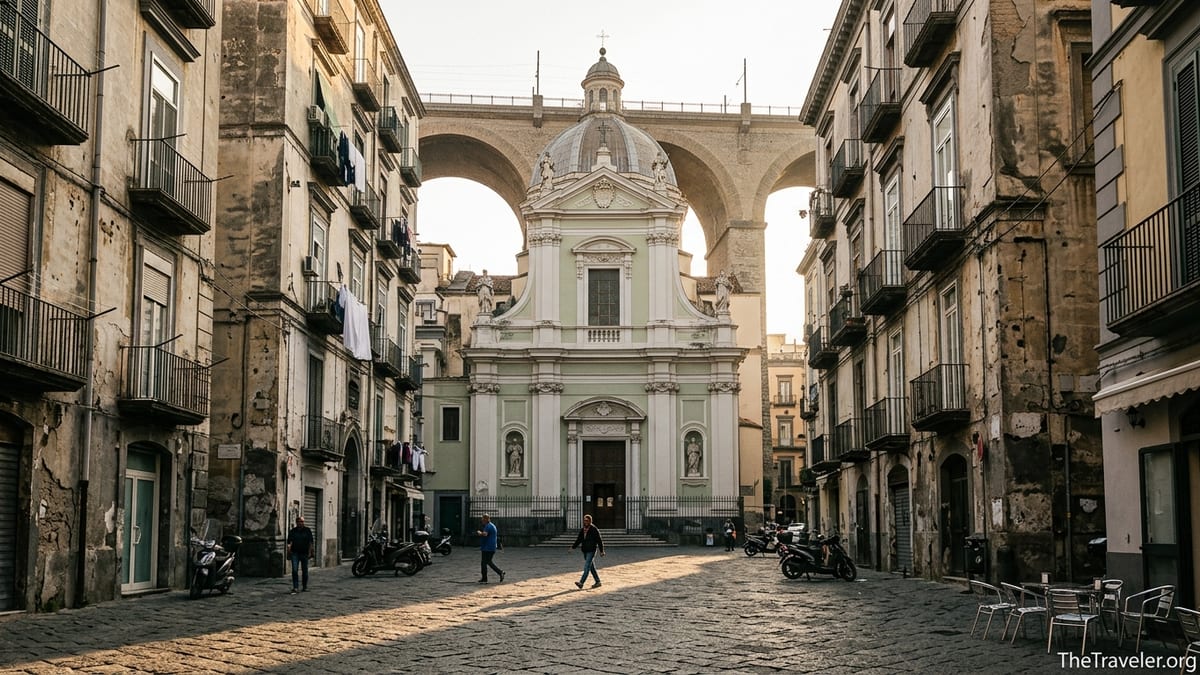
The Basilica Built on a Void
Standing in Piazza Sanità, most visitors see only a compact Baroque church at the end of a busy valley of traffic and laundry lines. What they rarely realize is that Santa Maria della Sanità is quite literally suspended above a much older sacred space. The basilica, completed in the early 1600s, was built over an early Christian rock-cut chapel and the catacombs of San Gaudioso. To solve the problem of building on hollow ground, the architect Giuseppe Nuvolo raised the entire presbytery on a high platform, creating the dramatic staircase and elevated altar that feel unusual compared with other Neapolitan churches.
When you walk in, pause near the entrance and look toward the altar. The steep flight of steps and high balustrade are not just Baroque theater; they are engineering, bridging centuries of worship layered on top of each other. A side door near the front leads down toward the catacombs, but even if you do not take a tour, you can feel that the church is hovering over something older. It is worth asking a guide or sacristan to point out where the original rock chapel lay below; once you know, the whole geometry of the interior makes new sense.
Another detail most visitors miss is the way light is designed to break this vertical distance. Small, high windows set into the drum of the dome pour light directly onto the elevated altar, leaving the lower nave in softer shadow. On a clear morning, when sun from Via Sanità threads through the façade windows, you can stand by the entrance and see beams of light striking the altar steps while the pews remain dim. It is a quiet reminder that the basilica is both bridge and beacon above an underground city of the dead.
If you have time, walk outside and step back toward the beginning of the piazza. From here, the unusual bulk of the raised choir and dome is easier to read. The church does not sit neatly on the square like many Italian basilicas; instead, it seems to rise out of the valley, a sign of how the Sanità neighborhood grew around an ancient ravine riddled with caves and tombs.
The Oldest Madonna in Naples Hiding in Plain Sight
Guidebooks often mention that Santa Maria della Sanità is dedicated to "Our Lady of Health" but skip over one of the church’s most remarkable treasures: an early Christian icon of the Virgin and Child believed to be among the oldest Marian images in Naples. The small panel, venerated since late antiquity, is tucked into the first chapel on the right as you enter. Many visitors walk straight past it on their way to the catacomb ticket desk, mistaking the chapel for just another side altar.
Step close to the icon and you notice how different it is from the Baroque paintings and statues around it. The faces are more stylized, with large, solemn eyes and simple lines, closer in feeling to an Eastern icon than to the dramatic, fleshy Madonnas of later centuries. The surface is darkened by centuries of candle smoke, and the gold has faded to a quiet glow rather than a glittering shine. Even if you know little about art history, the contrast is striking: this modest painting has survived invasions, plagues, and earthquakes while fashions in art changed all around it.
The icon’s location tells a story that most casual visitors never hear. It is not above the main altar but in a side space that lines up roughly with the ancient underground chapel. Locals will sometimes explain that devotion to this Madonna predates the basilica itself, which is why her image is almost at ground level, close to the older strata of the site. When neighborhood women come in briefly during the day, you often see them head directly to this chapel, kiss their fingers, and touch the glass of the icon before hurrying back out to their errands, a gesture that easily escapes a tourist’s notice.
Practical detail: the chapel is usually open throughout basilica visiting hours, and you do not need a catacomb ticket to approach the icon. If you want a more contemplative moment, aim to visit around lunchtime on a weekday when school groups have thinned and the church is quiet. Stand a meter or two back, let your eyes adjust to the low light, and you begin to see traces of older repainting and the gentle irregularities of the wooden panel, signs of its long life.
The Big Monk and the Neighborhood’s Living Devotions
To many Neapolitans, this church is not primarily "Santa Maria della Sanità" but "San Vincenzo" or even more affectionately "’O Monacone": the Big Monk. The nickname refers to the large wooden statue of Saint Vincent Ferrer, a 15th-century Dominican preacher whose cult became deeply rooted in this working-class valley. The statue stands to the left of the main altar, carved with an almost theatrical presence, holding a flame and gazing down over the nave. Visitors often photograph the dome and side chapels but fail to understand why candles and ex-votos cluster so thickly around this larger-than-life friar.
Look closely at the base of the statue and the surrounding walls. You will often notice small metal hearts, hand-written notes, ultrasound images, or photographs of babies and elderly relatives. These are personal thank-you offerings from locals who believe the saint interceded in their illnesses, exams, or job searches. On certain feast days, families still bring small cakes or envelopes with modest donations, and a neighborhood committee organizes processions where a copy of the statue is carried through Via Sanità under strings of lights. If you stay in the area in late April or early May, ask at the parish office about upcoming celebrations; these processions are rarely advertised in English but give powerful insight into everyday faith in Naples.
Most outsiders do not realize that devotion to the Big Monk has a social as well as spiritual dimension. Nearby, social cooperatives run by young residents manage the catacomb tours and a small guesthouse in the old Dominican cloister. When you buy a combined ticket for San Gaudioso and the larger San Gennaro catacombs, part of what you pay supports youth employment projects, after-school programs, and street art initiatives in the rione. The volunteers who guide you underground often grew up within sight of the basilica dome; for them, San Vincenzo is a kind of protector of the neighborhood’s dignity, not just a figure in a niche.
If you are lucky, you might notice a small group of local women quietly dusting statues or arranging flowers near the Big Monk in the late afternoon. They swap news in Neapolitan dialect, laugh, argue about where to place the lilies, and occasionally fall silent for a brief prayer. There is no formal tour explaining this, yet moments like these reveal more about why this church matters than any panel or brochure.
The Catacombs’ Strange Posture of Death
Down in the Catacombs of San Gaudioso, everyone expects skulls and bones, but very few visitors understand the unsettling artistry that makes this place unique in Naples. Beyond the early Christian graves and sixth-century mosaic of Saint Gaudiosus, the most haunting features date from the 17th century, when wealthy Neapolitans reused the ancient cemetery in a very theatrical way. Instead of simple burials, they commissioned artisans to embed their skulls into the walls and paint full-length fresco bodies beneath them, dressed in the fashion of the time and holding the tools or symbols of their profession.
Your guide will pause in front of one of these figures: perhaps a lawyer in a long black robe, a noblewoman wrapped in a stiff dress, or a doctor indicated by surgical tools. Look carefully at the join between bone and paint. The skull is real, while the body is only an image, like a permanent portrait pinned to the rock. This practice, invented in Naples and used here and in a few other sites, turns the catacombs into a gallery of the dead who insist on being remembered with their social rank intact. Many visitors snap quick photos and move on without realizing how specifically Neapolitan this ritual is, or how it reflects a city obsessed with both death and status.
Even stranger is a detail that guides mention but that most people do not fully picture. To create these wall burials, the bodies were first placed in special niches called "scolatoi," where the soft tissues would drain away over months, leaving only the skeleton. Relatives would then choose a wall position for the skull and commission the painted body. You can sometimes glimpse the openings of these niches in side corridors, low in the rock. They look unremarkable, but they are physical traces of a very different relationship with death than most visitors are used to.
Practically speaking, guided visits to San Gaudioso usually last around 45 minutes, with mixed-language groups and a set route. If you want time to study the painted figures and early Christian frescoes, consider staying a bit behind your group for a moment or two, then rejoining. Photos are typically allowed without flash, but ask your guide to be sure. The ground is slightly uneven and can be damp, so closed shoes with good grip are far more comfortable than sandals.
The Sanità Bridge and a Valley Divided
When travelers talk about Sanità, they often mention street markets, scooters, and murals but rarely see how geography has shaped the neighborhood’s identity. The valley where Santa Maria della Sanità stands was once on the road out of Naples toward Capodimonte. In the early 1800s, the Bourbon king Joachim Murat ordered the construction of a massive stone bridge above the valley to speed traffic toward the royal palace, effectively allowing the wealthy to cross over Sanità without ever entering it.
Walk a couple of minutes from the basilica toward Via Sanità and look up. You will see the arches of the Ponte della Sanità overhead, carrying modern cars along a busy avenue. Below, the church dome peeks between arches, and daily life pulses in the market stalls. For local activists, the bridge is a powerful symbol: it brought noise and pollution, but it also reinforced the sense that the neighborhood was something to pass over, not through. That feeling of abandonment partly explains why the revival driven by the catacomb cooperatives and cultural projects around the basilica has become such a point of pride.
Most visitors never realize how recent this revival is. As late as the early 2000s, many Neapolitans who did not live here avoided Sanità, associating it with poverty and crime. Today, alongside the basilica, you find a growing cluster of cafés, artisan workshops, and small B&Bs. A former monastic wing of the complex now houses a guesthouse known locally as a "Casa del Monacone," where a handful of rooms look onto a quiet courtyard. Staying there or in one of the nearby family-run bed-and-breakfasts puts you in the middle of the neighborhood’s transformation, a very different experience from sleeping in a chain hotel near the seafront.
If you have half a day, trace a simple route to understand the geography: start at Piazza Sanità in front of the basilica, walk under the ponte toward the narrow Via Santa Maria Antesaecula, and continue until you see plaques and murals dedicated to Totò, the beloved comic actor born here in 1898. Then loop back toward the church. Along the way, notice how the basilica dome acts as a constant visual anchor, tying together market chaos, 19th-century infrastructure, and deep antiquity beneath your feet.
Quiet Corners and Overlooked Artworks in the Upper Church
Even visitors who explore the catacombs often treat the basilica itself as a waiting room. They gather in the central nave, glance at the dome, then drift toward the ticket desk. Yet Santa Maria della Sanità rewards anyone who takes twenty extra minutes to wander slowly from chapel to chapel. One easily missed detail lies in the pavement and the low balustrades. Because the ground here was once uneven and riddled with cavities, the floor subtly rises and falls as you move, a reminder that you are walking over carved tufa rather than a solid foundation.
On the right side of the nave near the entrance, there is usually a modest stand with candles and a donation box. Look beyond it, and you will see fresco remnants and framed panels salvaged from older phases of the site: fragments of saints, decorative borders, and Latin inscriptions that link the current building to its predecessors. They are not spectacular enough to make postcards, but they quietly document how the basilica has been patched, repaired, and reimagined over four centuries.
Another corner most people miss is the choir area behind the high altar. Access can vary depending on liturgical schedules, but if the side passage is open and visitors are allowed, step behind the altar and look up into the drum of the dome. Here, the fresco decoration and the play of light are easier to appreciate than from the nave. You can see cracks, small water stains, and older retouching, traces of Naples’s relentless humidity and seismic tremors. These imperfections give the basilica a lived-in quality distinct from the polished Baroque of more touristed churches in the historic center.
Ask the staff if any temporary exhibitions or small concerts are scheduled in the complex while you are in town. In recent years, classical string quartets, contemporary art installations, and community theater pieces have occasionally taken place in side halls or the cloister. These events, often promoted only in Italian on local posters, show a living church that functions as cultural hub as much as religious monument.
Everyday Life Around the Basilica
It is tempting to treat Santa Maria della Sanità as an isolated attraction, a dot on a map connected to the catacombs. In reality, the basilica is woven into a dense web of everyday life that starts as soon as you step outside its doors. The small bar at the corner of Piazza Sanità does brisk business in morning espresso and cornetti for workers heading into the center, while older men stand under the church façade debating football scores. Fruit and vegetable stands line Via Sanità, with prices typically lower than in the more touristy markets near Spaccanapoli; you might see crates of tomatoes or peaches stacked almost to the height of a parked scooter.
Most visitors leave by heading straight back toward the historic center, but it is worth circling the piazza slowly. On one side, a low wall marks the edge of a small raised terrace where children kick a ball in the late afternoon. From here, you get one of the best views of the basilica façade framed by old apartment buildings, with laundry hung like banners. At certain times of day, you might see a bride and groom emerging from the church after a local wedding, horns blaring as friends and family escort them away in a caravan of cars.
Security-wise, Sanità today feels more relaxed than its reputation suggests, especially during daylight when markets are open and tours are running. Petty theft is always possible in any crowded Neapolitan street, so keep bags zipped and phones secure, but do not let old stereotypes keep you from exploring. Spending money in local cafés, bakeries, and artisan shops directly supports the families whose lives are anchored to the basilica dome. Something as simple as choosing a neighborhood trattoria for lunch after your catacomb visit can help spread the benefits of tourism beyond the usual areas.
Consider timing your visit to avoid the heaviest tourist crowds at the catacombs, usually mid-morning on weekends. An early visit around opening time or a late-afternoon slot gives you more breathing room both underground and in the church, and let you see locals using the space in a more natural way: schoolchildren being collected at the piazza, parishioners arriving for evening mass, or neighbors pausing on the church steps to chat.
The Takeaway
Santa Maria della Sanità is far more than the sum of its catacombs. It is a basilica raised above an ancient hollow, a home to one of Naples’s oldest Marian icons, a stage for the towering Big Monk, and a kind of civic heart for a valley long overshadowed by a bridge. Most visitors notice only the dramatic highlights: skulls in the walls, the bold dome, the rush of scooters outside. But spend a little longer, and the quieter stories emerge: a woman’s quick sign of the cross before the old icon, a guide’s pride in explaining how catacomb tourism funds youth projects, the way light pools on cracked frescoes behind the altar.
If your trip to Naples has room for nuance beyond the classic routes, give this church and its rione a full morning or afternoon rather than a rushed hour. Take the time to notice the engineering under your feet, the survival of fragile images through centuries of upheaval, and the resilience of a neighborhood reclaiming its history. In doing so, you will come away not just with photographs of underground galleries, but with a deeper sense of how Naples layers life and death, sacred and everyday, on the same small patch of earth.
FAQ
Q1. Do I need a separate ticket to visit Santa Maria della Sanità and the Catacombs of San Gaudioso?
Access to the upper basilica is generally free, while the Catacombs of San Gaudioso require a paid guided tour ticket, often sold in combination with the San Gennaro catacombs.
Q2. How much time should I plan for a visit?
Allow at least 90 minutes if you want to see both the basilica and the catacombs without rushing, and closer to two hours if you enjoy studying artworks and wandering the neighborhood.
Q3. Is the area around Santa Maria della Sanità safe for visitors?
During the day the Sanità district is lively and feels reasonably safe, especially around the basilica and main streets, though normal big-city precautions against pickpockets still apply.
Q4. Can I visit the church without taking a catacomb tour?
Yes, you can enter and explore the basilica independently during its opening hours, even if you decide not to descend into the catacombs.
Q5. Are tours of the Catacombs of San Gaudioso available in English?
Yes, English-language tours are typically available at set times or with multilingual guides; it is wise to check current schedules and consider reserving in advance during busy seasons.
Q6. What should I wear for a visit to the basilica and catacombs?
Dress modestly with covered shoulders and knees out of respect for the church, and wear comfortable closed shoes suitable for slightly uneven, sometimes damp floors underground.
Q7. When is the best time of day to visit to avoid crowds?
Early morning and late afternoon on weekdays tend to be quieter, with fewer tour groups in the catacombs and a more relaxed atmosphere in the basilica.
Q8. Is photography allowed inside the church and catacombs?
Non-flash photography is usually permitted in the basilica and, under certain rules, in the catacombs, but always confirm with staff or your guide before taking pictures.
Q9. Can people with limited mobility visit the site?
The upper church is more accessible, though there may be some steps; access to the catacombs involves stairs and uneven ground and can be challenging for those with mobility issues.
Q10. Are there cafés or places to eat near Santa Maria della Sanità?
Yes, the streets around Piazza Sanità have several small cafés, bakeries, and simple trattorias where you can stop for coffee, snacks, or a full meal before or after your visit.