


In the shadow of Naples’ Capodimonte hill, the basilica of Santa Maria della Sanità rises like a pale baroque lantern above one of the city’s liveliest working-class districts. Built over ancient Christian catacombs and shaped by seventeenth century architects and Dominican friars, it is far more than a neighborhood church. Santa Maria della Sanità is a layered monument where underground tombs, baroque marble, local devotion and contemporary community projects meet in a single, unforgettable visit.
Get the latest updates straight to your inbox!
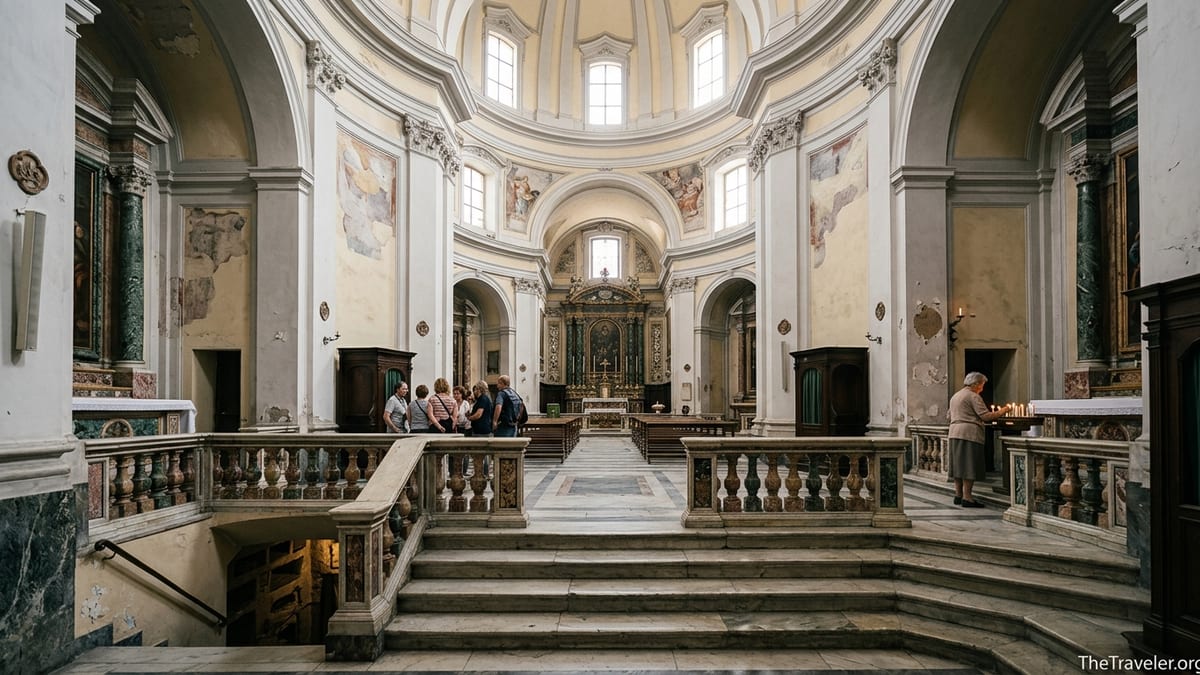
From Roman Necropolis to Baroque Basilica
Long before the dome of Santa Maria della Sanità appeared on the skyline, this corner of Naples was a valley outside the city walls, used as a burial ground. As early as the third and fourth centuries, Christians carved underground galleries here, now known as the Catacombs of San Gaudioso, to bury bishops and members of the community in loculi along the tufa walls. When travelers walk down the modern stairway from the basilica into the catacombs today, they are tracing a route that has been associated with death, memory and hope for over 1,500 years.
The turning point came in the fifth century, when Gaudioso, a North African bishop exiled by the Vandals, was buried in this necropolis. His tomb became a focus of devotion, and a small rupestrian chapel dedicated to him and other exiled bishops developed on the site. Over time, the valley acquired a reputation for healing and protection, intertwined with veneration of an early Marian icon that would later give the church its name, Santa Maria della Sanità, or Saint Mary of Health.
By the late sixteenth century, as Naples expanded beyond its medieval walls, the Dominicans saw an opportunity to anchor this marginal valley with a monumental church. Around 1602 they commissioned a new sanctuary above the ancient burial ground, carefully aligning the new high altar with the underground shrine of San Gaudioso. For visitors today, that vertical connection is key to understanding the site: the basilica is not an isolated baroque showpiece, but a deliberate architectural crown placed on top of one of southern Italy’s most significant early Christian cemeteries.
The Dominican project also had a strategic dimension. By formalizing devotion to Our Lady of Health and San Gaudioso in a grand new basilica, the order helped draw pilgrims and charitable donations to the valley. In practice, this transformed the surrounding Rione Sanità from a marginal burial zone into a developing urban quarter that would later be crossed by major roads and the dramatic nineteenth century iron bridge still visible beside the church.
A Baroque Plan with a Southern Twist
Step inside Santa Maria della Sanità and the first surprise is the plan. Instead of the classic Latin cross, the church is organized around a central Greek cross with rounded arms and a compact dome. It is a layout influenced by Counter Reformation ideas about visibility and acoustics: from almost any point in the nave, worshippers can see the high altar and hear the preacher. For a modern traveler standing near the entrance, the effect is intimate rather than overwhelming, especially compared with vast Neapolitan churches such as the Gothic Santa Chiara.
The dome itself is relatively low and broad, a practical adaptation to the unstable tufa and the need to keep weight under control above the catacombs. Outside, it is tiled in pale yellow and green, typical of Neapolitan majolica, catching the light on sunny mornings. Photographers often choose the viewpoint from the nearby Sanità bridge, looking back toward the dome as local buses and scooters churn across the iron span, underlining the way the basilica anchors a busy traffic junction as much as a spiritual one.
Inside, the architecture is articulated by thick piers and curved cornices rather than heavy gilding. While Rome’s baroque churches are often drenched in ornament, Santa Maria della Sanità is more restrained. Whitewashed walls, light gray stone ribs and limited stucco keep the focus on specific altars and artworks. This relative sobriety is one reason local guides like to recommend the church as a good “first baroque” for travelers who might otherwise feel overwhelmed by decoration elsewhere in Naples.
At street level, the church façade is set slightly back from Piazza Sanità, with a short flight of steps leading to its portal. The piazza itself functions as the Rione’s living room: early in the morning, market vans unload crates of fruit and vegetables near the church railings, and it is not uncommon to see neighbors exchanging gossip just a few meters from the entrance, underlining how the basilica and daily life are woven tightly together.
Polychrome Marble and Spiraling Stairs: Reading the Baroque Interior
The most theatrical feature of Santa Maria della Sanità is the high altar complex. Elevated above the main floor and reached by a pair of curving staircases, it creates a kind of stage set behind the crossing. The steps and balustrades are sheathed in polychrome marble in soft greens, reds and yellows, inlaid in complex patterns. Architects and art historians often point to this ensemble as an especially pure expression of Neapolitan baroque taste, where movement, color and hierarchy are all communicated through stone.
For visitors, the practical experience is just as striking as the theory. During quieter hours, guides sometimes allow small groups to climb one of the staircases. From the upper platform, the view down over the Greek cross plan reveals how the church’s geometry converges on the altar, with side chapels like small eddies around a central current. It is an ideal vantage point for photography, though tripods are usually not allowed, so a fast lens or a smartphone with good low light performance is helpful.
Along the sides of the nave, the chapels house paintings and sculptures by seventeenth and eighteenth century artists active in Naples. One chapel is dominated by the ancient icon of the Virgin, venerated here at least since late antiquity and now framed by baroque marble. Others display works attributed to painters such as Luca Giordano, Andrea Vaccaro and Agostino Beltrano, whose canvas of San Raimondo de Peñafort illustrates the Dominican identity of the complex. The mix of local and international saints, Spanish, Neapolitan and North African references reflects the cosmopolitan nature of early modern Naples under Spanish rule.
Materials also tell a specifically Neapolitan story. The dark gray stone used for bases and steps is piperno, a hard volcanic rock quarried around the city and visible in many palaces and churches. In Santa Maria della Sanità, its cool tone underlines the luminous effect of the polychrome marbles. Travelers who pay attention here will start recognizing piperno blocks in nearby streets and courtyards, gaining an eye for how local geology shaped Naples’ baroque fabric.
The Catacombs of San Gaudioso Below
No visit to Santa Maria della Sanità is complete without going underground. From a side door near the entrance, visitors descend a modern staircase into the Catacombs of San Gaudioso, managed today by a local cooperative. Standard guided tours, often led by young residents of the Rione Sanità, typically last around one hour and are offered in several languages throughout the day. Tickets are sold in a small office just off the piazza, and combined tickets with the larger Catacombs of San Gennaro are also commonly available, allowing travelers to explore two major early Christian sites in the same weekend.
In the upper level of the catacombs, rows of arcosolia and niches are carved into the tufa, some still bearing faded frescoes of saints, symbols like anchors and fish, and geometric motifs dating back to late antiquity. Near the presumed tomb of San Gaudioso, mosaics and painted inscriptions evoke a time when Christian communities expressed faith in a simple visual language, centuries before the baroque marble upstairs. Guides often pause here to explain burial customs and the shift from pagan necropoleis to Christian commemorative spaces.
The lower galleries illustrate a very different, and distinctly Neapolitan, chapter. In the seventeenth century, local nobles reused parts of the catacombs for a macabre but fashionable form of burial. Skulls were set into the walls while painted bodies in contemporary dress were added beneath, creating a hybrid portrait that asserted status even in death. Many of these composite images survive, and seeing them after walking through the elegant basilica above gives travelers a vivid sense of how baroque Naples linked devotion, identity and mortality.
Conditions in the catacombs are cool and slightly humid, with relatively low light. Comfortable closed shoes are recommended, as some sections of the floor can be uneven. Photography without flash is usually permitted, though visitors are asked to avoid blocking narrow passages. In high season, booking online in advance is advisable, as group sizes are limited for conservation reasons and same day slots can sell out, particularly on weekends and public holidays.
Rione Sanità: The Neighborhood Around the Basilica
Santa Maria della Sanità is the heart of the Rione Sanità, a dense, characterful neighborhood that grew up in the valley between the historic center and the royal park of Capodimonte. Until the seventeenth century this was largely open countryside dotted with tombs and villas; later, as Naples expanded, it became a gateway district, bisected in the nineteenth century by a monumental bridge that literally leaps over the rooftops. The basilica stands almost under this bridge, so close that its dome seems to press against the iron structure in some viewpoints.
Today, the area is known for its tight grid of streets, informal markets and small artisan workshops. Within a five minute walk of the basilica, travelers can find family run bakeries selling still warm taralli, small cafes serving espresso at the counter for about one euro, and tiny trattorias where lunch menus built around pasta and seasonal vegetables rarely exceed modest prices. It is not an area dominated by chain hotels or luxury boutiques; instead, a growing number of guesthouses and B&Bs occupy converted apartments in historic buildings, giving visitors the chance to stay within earshot of the church bells.
Recent years have seen a concerted effort to use the basilica and catacombs as engines of local regeneration. Youth cooperatives manage ticketing, guiding and cultural events, which in turn help fund restoration projects and social initiatives. Travelers who join a guided tour are directly supporting these efforts. It is common to hear guides mention how revenues have contributed to reopening neglected courtyards, financing training for local staff, or securing conservation work on delicate frescoes.
For many visitors, walking from the more polished streets around the National Archaeological Museum up into Rione Sanità is an essential part of the experience. The transition from monumental boulevards to narrow alleyways, with laundry hanging over the roadway and scooters weaving through, can be intense but is also deeply characteristic of Naples. As always in busy urban districts, keeping a close eye on belongings and using common sense is recommended, but the atmosphere around the basilica during the day is generally lively and welcoming.
How to Experience Its Baroque Heritage Today
To appreciate the full story of Santa Maria della Sanità, it is worth planning at least half a day in the area. Many travelers start with a late morning visit to the basilica, taking advantage of the natural light that filters through the dome. Entry to the church itself is usually free, though donations are encouraged, especially during ongoing restoration campaigns. Modest clothing that covers shoulders and knees is expected, and visitors are asked to remain quiet during services, which are typically held in the early morning and evening.
A guided tour of the Catacombs of San Gaudioso can then be timed for late morning or early afternoon. Tickets are typically priced to be accessible, especially compared with major European museums, and concessions for students and children are often available. English language tours are common, but schedules can vary by season, so checking times in advance is sensible. Travelers who enjoy structured itineraries may book combined packages that include both San Gaudioso and the larger San Gennaro catacombs on the same day, linked by shuttle or a short taxi ride.
After emerging from the underground galleries, a slow loop through the surrounding streets helps connect the heritage site to everyday Naples. A practical sequence might include a coffee in Piazza Sanità, a stroll up Via Sanità to admire late baroque palaces with worn piperno portals, and, for those with energy, a climb toward the Capodimonte Museum through the atmospheric Vergini and Materdei quarters. From certain staircases and overlooks, the dome of Santa Maria della Sanità appears framed by apartment blocks, giving photographers the chance to capture how the church is embedded in the modern city.
Those interested in sacred music may seek out evening concerts occasionally held in the basilica, when local ensembles perform baroque works in the resonant central space. Tickets for such events are usually modestly priced and sold through local cultural associations or at the church itself. Sitting under the dome while strings and voices fill the Greek cross plan can be a powerful way to experience the church as its seventeenth century designers intended, as both a visual and acoustic instrument of devotion.
The Takeaway
Santa Maria della Sanità is not just one more baroque church on a long Italian checklist. It is a rare example of a site where late antique catacombs, Counter Reformation architecture and twenty first century community life coexist in a single, compact space. By climbing the marble staircases to the high altar and then descending to the rock cut tombs below, travelers trace a vertical journey through Naples’ history, from the age of early Christianity to the optimistic baroque and on into the present day.
For visitors willing to venture beyond the most familiar postcard views, the basilica and its surrounding Rione offer a concentrated introduction to the city’s contrasts: solemnity and street noise, artistic refinement and everyday improvisation, long memories and current experiments in social renewal. The story behind Santa Maria della Sanità and its baroque heritage is therefore not only about style and decoration, but about how architecture can anchor a neighborhood, shape identities and continue to generate opportunities centuries after the first stone was laid.
Whether you come for the art, the archaeology or the atmosphere, plan to linger. Allow time to sit in the nave and watch shafts of light move across the polychrome marble, to listen to the echo of footsteps in the catacombs, and to share a coffee with locals in the piazza outside. In doing so, you will experience Santa Maria della Sanità not as a static monument, but as a living baroque story still being written in the heart of Naples.
FAQ
Q1. Where exactly is Santa Maria della Sanità located in Naples?
Santa Maria della Sanità stands on Piazza Sanità in the Rione Sanità district, north of the historic center and below the Capodimonte hill, a short ride or a 20 to 25 minute walk from the National Archaeological Museum area.
Q2. Do I need a ticket to visit the basilica itself?
Entry to the basilica is generally free, although donations are encouraged to support maintenance and restoration. Separate tickets are required for the guided tours of the Catacombs of San Gaudioso beneath the church.
Q3. How long should I plan for a visit including the catacombs?
Most travelers should allow at least two to three hours. The guided tour of the catacombs typically lasts around one hour, and you will want extra time to explore the church interior and stroll around Piazza Sanità.
Q4. Is Santa Maria della Sanità suitable for children?
Yes, many families visit with children, who are often fascinated by the underground passages and frescoes. Some younger visitors may find the skulls and burials in the catacombs unsettling, so parents may wish to prepare them in advance.
Q5. What should I wear when visiting the church and catacombs?
Modest dress is recommended, with shoulders and knees covered inside the basilica. Comfortable closed shoes are advisable for the catacombs, where floors can be uneven and slightly damp in places.
Q6. Are guided tours available in English?
Yes, English language tours of the Catacombs of San Gaudioso are regularly offered, especially in the main tourist seasons. Schedules can vary, so it is best to check times in advance or inquire at the ticket office on Piazza Sanità.
Q7. Can I take photographs inside the church and catacombs?
Photography without flash is usually permitted inside the basilica and in many parts of the catacombs, but tripods are typically not allowed and visitors are asked to be discreet, especially during religious services.
Q8. Is the site accessible for visitors with limited mobility?
The basilica entrance includes steps but can often be reached with assistance, while the catacombs involve stairways and uneven ground, which may be challenging for visitors with reduced mobility. It is advisable to contact the organizers in advance to discuss specific needs.
Q9. When is the best time of day to visit?
Late morning and early afternoon are popular, with good natural light in the basilica. If you prefer a quieter experience, consider visiting on a weekday outside major religious feasts and avoiding the busiest weekend hours.
Q10. What other sights can I combine with a visit to Santa Maria della Sanità?
Many travelers pair Santa Maria della Sanità and the Catacombs of San Gaudioso with the larger Catacombs of San Gennaro or a walk up to the Capodimonte Museum and park, creating a full day focused on Naples’ art, history and panoramic views.