


In a city overflowing with churches and layered history, few places capture the spirit of Naples as completely as Santa Maria della Sanità. This 17th century basilica rises over early Christian catacombs in the working class Rione Sanità district, weaving together Greek and Roman burial grounds, Baroque art, Dominican devotion and the gritty energy of a neighborhood that is reinventing itself. For travelers willing to step beyond the historic center, Santa Maria della Sanità offers one of Naples’ most powerful encounters with the city’s past and present in a single visit.
Get the latest updates straight to your inbox!
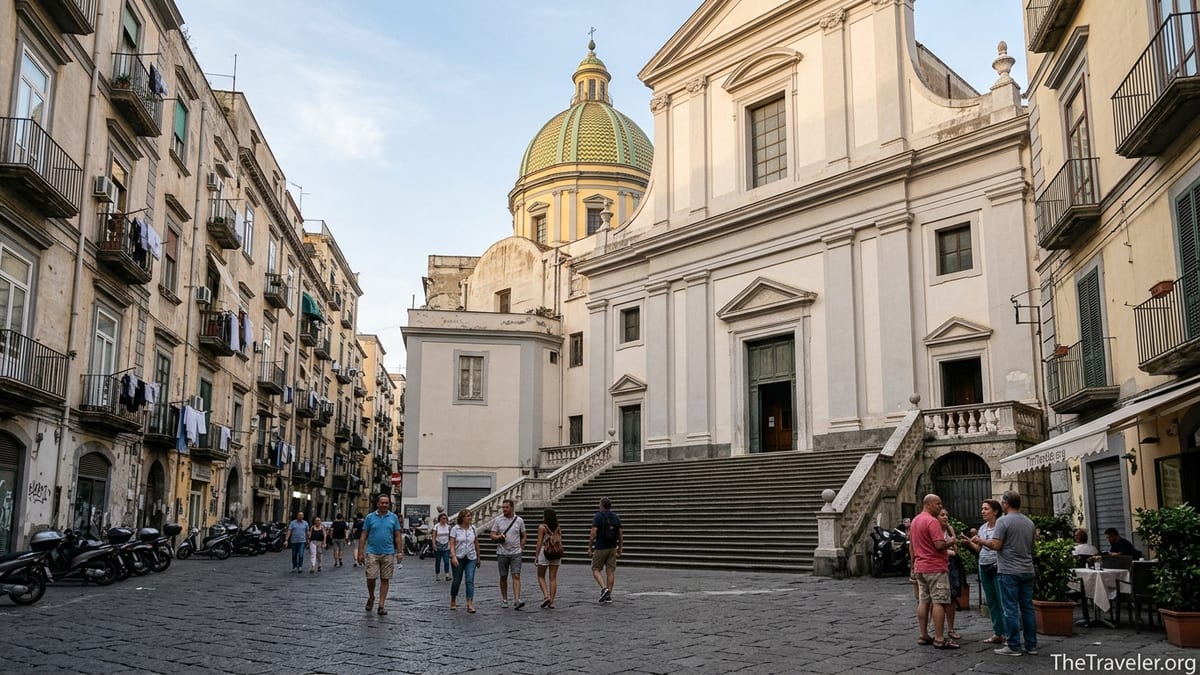
Where and What Is Santa Maria della Sanità?
Santa Maria della Sanità is a Baroque basilica in northern Naples, just beyond the official historic center, in the densely populated Rione Sanità district. The church stands on a small piazza near the junction of Via Sanità and Via Santa Teresa degli Scalzi, under the soaring Ponte della Sanità bridge. For many visitors, simply arriving here is part of the experience: you emerge from a bus or taxi into a noisy square packed with scooters, produce stalls and neighborhood cafés, then look up to see the oversized dome of the basilica dominating the scene.
The basilica was built in the early 17th century over a much older Christian burial site known as the Catacombs of San Gaudioso. The name “Sanità” refers to health and healing, tied to an ancient icon of the Virgin that locals believed had protective powers. Today, both the church and the underground catacombs are open to visitors, usually accessed via combined guided tours that last about an hour. Tickets are typically in the range of 9 to 12 euros per adult, often with discounts for students and children, and can be purchased at the basilica entrance or through local cultural associations that manage the site.
Most visitors reach Santa Maria della Sanità from central Naples by walking up from the National Archaeological Museum area or by taking a short taxi ride, which usually costs around 10 to 15 euros from popular areas like Piazza del Plebiscito depending on traffic. Public buses along Via Santa Teresa degli Scalzi also connect the district to the center and the Capodimonte area, making it relatively easy to include the basilica and catacombs in a half day itinerary that might also take in the nearby Catacombs of San Gennaro.
Layers of History: From Greek Necropolis to Baroque Basilica
The importance of Santa Maria della Sanità begins long before the first stone of the Baroque church was laid. In antiquity this area outside the city walls was a necropolis, a burial zone for Greek and later Roman Naples. Between the 4th and 5th centuries, Christians began to carve underground galleries and chambers into the soft tuff rock, creating what would become the Catacombs of San Gaudioso. These were used for burials of early Christian communities, including bishops and prominent citizens, and formed part of a broader landscape of underground cemeteries that extended across northern Naples.
According to tradition, the site became closely associated with Saint Gaudiosus, a North African bishop who washed up in Naples after a shipwreck in the mid 5th century. He is believed to have founded a monastery here and to have been buried in the catacombs, turning the area into a place of pilgrimage. Over time, the underground complex expanded with more burial chambers and frescoes. The entire Rione Sanità area, however, remained largely uninhabited for centuries due to frequent mudslides from the Capodimonte hill, and the catacombs slowly fell into obscurity.
Urbanization arrived in the late 16th and early 17th centuries, when the area began to be built up and religious orders showed renewed interest in the old Christian sites. It was then that the Dominicans constructed the Basilica of Santa Maria della Sanità directly above the catacombs, around the preexisting small church linked to the saint. This decision, typical of Naples, literally built a new sacred space on top of an older one, preserving the underground complex while creating a grand Baroque landmark visible across the neighborhood.
By choosing this spot, the Dominicans anchored the new district spiritually and socially. The basilica became a point of reference for local residents and a symbol of the church’s power and presence in a growing quarter of Naples. When you visit today and descend from the luminous dome into the dim catacombs, you are retracing a vertical journey through at least fifteen centuries of Neapolitan religious life in just a few steps.
Inside the Basilica: Baroque Drama and a Beloved Icon
Santa Maria della Sanità may be most famous for what lies beneath it, but the church interior is worth a visit in its own right. From the piazza, a staircase leads up to the entrance and into a surprisingly airy space dominated by a tall dome painted in lively colors. The floor plan is centralized rather than the long Latin cross seen in many churches, so you immediately feel encircled by side chapels, altars and galleries that rise in tiers. On a typical weekday morning you might find a few locals praying quietly or lighting candles, while groups of students led by local guides gather near the main altar before their catacomb visit.
The basilica is richly decorated with marble inlays, stucco work and paintings from Naples’ Baroque period. Artists such as Andrea Vaccaro and Luca Giordano, important names in 17th century Neapolitan painting, contributed canvases that depict saints and episodes from Christian history. Although many travelers compare churches across Italy, this one feels particularly bound to its neighborhood: the art is not just museum quality, it is part of an active parish where baptisms, funerals and feast-day celebrations are still held.
One of the most important elements is the ancient icon of the Virgin, known as Santa Maria della Sanità, kept today in a side chapel near the front of the church. Believed to date back to late antiquity and originally painted in the catacomb complex, this is considered one of the oldest Marian images in Naples and has been venerated for centuries as a source of protection and healing. Locals sometimes visit the church simply to pay their respects to this icon, especially on personal anniversaries or during times of illness.
Travelers often arrive focused on the catacombs and are surprised by how long they linger in the upper church. The play of light under the dome, the smell of incense lingering after Mass and the sound of scooters drifting in from the piazza all combine into a very Neapolitan atmosphere. If you have time, sitting for a few minutes in a side pew before or after your underground tour allows you to see how residents actually use this space, not just admire it as a historical monument.
The Catacombs of San Gaudioso: Underground Naples Revealed
Direct access to the Catacombs of San Gaudioso lies within the basilica, usually reached via a staircase from the nave or presbytery area, guided by staff from the local association that manages the site. Tours are typically compulsory, both for safety and to protect the fragile environment, and are offered in Italian and in other languages such as English and Spanish at set times. Groups are often limited in size and the underground temperature stays relatively cool and damp, so bringing a light jacket and comfortable shoes is advisable even in summer.
Once below, you enter a network of galleries, arched tomb niches and small chambers carved into the volcanic tuff. Unlike the more extensive Catacombs of San Gennaro, San Gaudioso is compact and retains a particularly intimate feel. Guides explain how early Christian burials worked, pointing out arcosolia, or arched tombs, and faint frescoes depicting saints and symbols. Of special interest is the tomb associated with Saint Gaudiosus himself, which features early mosaic decoration, and a series of later, more macabre Baroque additions where skulls of nobles were mounted into the walls with painted bodies.
This combination of late antique and early modern funerary practices is one reason the site is considered so important. You see evidence not only of the first centuries of Christianity in Naples but also of how 17th century Neapolitans reinterpreted death, status and memory. For instance, a guided tour might pause by a wall where stylized skeletons in noble dress are painted below real skulls, representing a once common burial custom that visually separated the head, considered the seat of identity, from the rest of the body.
From a traveler’s perspective, San Gaudioso provides an atmospheric counterpart to the busier and more famous catacombs up the hill. Visits generally last 45 to 60 minutes, and combined tickets with other catacomb sites are sometimes available, allowing you to compare different underground complexes in a single day. Because access is from within the basilica, time slots can fill, especially on weekends and during spring and autumn holiday periods. Booking ahead or arriving early in the day, before lunch, increases your chances of joining an English language tour without a long wait.
Rione Sanità Today: Community, Challenges and Revival
Understanding why Santa Maria della Sanità matters also means understanding the district that surrounds it. Rione Sanità historically developed as a working class neighborhood, physically separated from the historic center by steep streets and the later construction of the Ponte della Sanità overhead. For decades it suffered from lack of investment, unemployment and the presence of organized crime, which gave the area a reputation that discouraged many visitors despite its architectural beauty.
In recent years, however, Rione Sanità has become a widely cited example of grassroots cultural regeneration in Italy. Local cooperatives, community groups and the parish itself have used the basilica and catacombs as anchors for new employment and social projects. Young residents have been trained as tour guides, ticket staff and cultural mediators, and revenue from visits helps fund neighborhood initiatives. When you join a catacomb tour, there is a good chance your guide grew up a few blocks away and can speak personally about how the area has changed.
Walk a few minutes from the basilica and you will find artisan workshops, small cafés and pastry shops that benefit from the increased foot traffic. A traveler might stop for an espresso and sfogliatella at a local bakery on Via Sanità or try a simple lunch of fried pizza and seasonal vegetables at a family run trattoria nearby. Prices here are often significantly lower than in Naples’ more touristic streets: a coffee at the counter may cost around 1.20 euros, and a generous plate of pasta at a neighborhood restaurant might be 8 to 10 euros, offering good value for visitors willing to explore.
Safety is a common question for travelers. The area can feel chaotic, with dense traffic and street life, and like any big city neighborhood it is wise to be cautious with valuables. That said, the increased presence of visitors, local guides and community patrols during the day has improved the sense of security compared with a decade ago. Many independent travelers and organized walking tours now include Rione Sanità on their itineraries, especially in daylight hours, precisely because it offers such an authentic snapshot of Naples beyond the postcard views of the seafront.
Art, Architecture and Everyday Devotion
Santa Maria della Sanità is important not only as a historical monument but as a living church where art, architecture and daily devotion intertwine. The basilica’s dome, visible from many angles in the district, acts as a kind of compass point for residents navigating the tight grid of streets below. Inside, chapels house statues and paintings that are still central to annual processions and feast days, when local confraternities carry images through the streets accompanied by marching bands and fireworks.
Travelers who happen to visit during a local festival may see the square in front of the church filled with temporary stalls selling sweets, candles and religious objects. Families gather on the basilica steps, children run in and out, and the church bells punctuate the noise from the market. These events reveal how the basilica functions as a civic as well as a religious center, echoing its historical role as a stabilizing institution in a neighborhood that has weathered poverty, emigration and social change.
Architecturally, the church offers a compact lesson in Neapolitan Baroque design. The centralized plan, dynamic dome and theatrical use of light are characteristic of the period, while the raised presbytery and crypt below reflect the need to integrate the earlier catacombs. Restorations in recent decades have worked to stabilize the structure and conserve wall paintings both above and below ground, so visitors can appreciate details like marble altarpieces and fragmentary frescoes that might otherwise have been lost to humidity and pollution.
For art lovers, combining a visit to Santa Maria della Sanità with other nearby Baroque churches, such as those along Via Santa Teresa degli Scalzi or in the historic center, allows for comparisons between styles and patronage. Yet even for those without specialized interest, the basilica’s mixture of grandeur and wear, polished marble and peeling paint, speaks directly to Naples’ broader aesthetic: beautiful, layered and never completely finished.
Planning Your Visit: Practical Tips for Travelers
Visiting Santa Maria della Sanità and the Catacombs of San Gaudioso is relatively straightforward, but a bit of planning will make the experience smoother. Opening hours can vary slightly by season and day of the week, but the site is generally open most mornings and afternoons, with a midday break. Because the catacombs are accessible only on guided tours, it is sensible to check the latest schedules before you go or inquire at your hotel. Many travelers choose to book combined tickets that include both San Gaudioso and the larger Catacombs of San Gennaro on the same day.
To reach the basilica, you can walk from the National Archaeological Museum in about 15 to 20 minutes, following a route that climbs gradually through lively streets. Those uncomfortable with steep walks or heavy traffic often prefer to take a taxi, especially in hot weather or when traveling with children. Local public buses also connect the area with the museum and the Capodimonte Museum and Park, making it easy to combine underground history with art and green space in one outing.
Inside the catacombs, the ground is uneven and can be damp, so closed shoes with good grip are strongly recommended. The underground temperature remains relatively cool, which is pleasant in summer but can feel chilly in winter or on rainy days; a light sweater or jacket is a good idea. Photography policies may change, but visitors are often allowed to take pictures without flash in certain sections; always ask your guide first to avoid damaging delicate frescoes.
Because Rione Sanità is a residential neighborhood, visitors should be mindful of local rhythms. Early afternoons can be quieter as shops close for rest, while late mornings and early evenings are busiest. Buying a coffee, pastry or small souvenir locally is a simple way to support the community projects that have helped open the basilica and catacombs to international tourism. Many guides will be happy to recommend a nearby bar for a caffè or a gelateria where you can pause after your tour and watch everyday life unfold around the church steps.
The Takeaway
Santa Maria della Sanità is far more than a picturesque Baroque church on the edge of Naples’ historic center. It is a vertical slice through the city’s history, stacking a Greek and Roman necropolis, early Christian catacombs, a 17th century basilica and a 21st century community revival in a single place. For travelers, visiting the basilica and the Catacombs of San Gaudioso offers not only an evocative encounter with underground Naples but also a chance to see how heritage, faith and local initiative can reshape a once marginalized neighborhood.
Standing in the dim light of the catacombs, then emerging into the bright, busy piazza outside the church, you experience in miniature the contrasts that define Naples itself: ancient and modern, solemn and exuberant, fragile and resilient. Including Santa Maria della Sanità in your itinerary means stepping beyond the city’s most famous sights and into a living story of survival and renewal, guided in many cases by local residents whose own lives are intertwined with the basilica’s stones.
FAQ
Q1. What exactly is Santa Maria della Sanità in Naples?
Santa Maria della Sanità is a 17th century Baroque basilica built above the early Christian Catacombs of San Gaudioso in the Rione Sanità district of Naples.
Q2. Why is Santa Maria della Sanità considered so important?
It is important because it combines ancient catacombs, a major Baroque church, one of Naples’ oldest Marian icons and a central role in the cultural revival of Rione Sanità.
Q3. How do I get to Santa Maria della Sanità from central Naples?
You can walk from the National Archaeological Museum in about 15 to 20 minutes, take a taxi from popular areas like Piazza del Plebiscito, or use local buses along Via Santa Teresa degli Scalzi.
Q4. Can I visit the catacombs under the church?
Yes. The Catacombs of San Gaudioso are accessed from inside the basilica on guided tours that usually last around 45 to 60 minutes and are available in multiple languages.
Q5. How much time should I plan for a visit?
Allow at least one and a half to two hours to see both the basilica and the catacombs at a relaxed pace, plus extra time if you want to explore the surrounding neighborhood.
Q6. Is Rione Sanità safe for travelers?
Rione Sanità has a complex history but is now a key cultural destination. By visiting in daylight, staying on main streets and using normal city awareness, most travelers find it welcoming and lively.
Q7. Do I need to book tickets in advance?
Advance booking is recommended in busy seasons, especially if you want an English tour or to combine San Gaudioso with other catacomb sites, but walk up visits are often possible on quieter days.
Q8. What should I wear when visiting the basilica and catacombs?
Wear modest clothing suitable for a church, with shoulders covered, and choose closed shoes with good grip for the damp and uneven floors in the catacombs. A light jacket is useful underground.
Q9. Are children allowed on the catacomb tours?
Yes, children are generally welcome and many guides adapt explanations for younger visitors, though parents should be aware that some may find the skulls and burial imagery unsettling.
Q10. Can I combine Santa Maria della Sanità with other sights nearby?
Many travelers pair it with the Catacombs of San Gennaro and the Capodimonte Museum and Park, creating a full day that mixes underground history, art and green space in northern Naples.