


Walk through the narrow streets of the Sanità district in Naples and Baroque history does not sit politely behind velvet ropes. It spills from shrines on street corners, echoes from balcony radios, and suddenly opens into the luminous interior of Santa Maria della Sanità, a basilica built directly above ancient catacombs. Stepping inside this church, with its theatrical dome and worn marble floor, is one of the most vivid ways to feel that Naples’s Baroque past is not a chapter in a textbook but a layer of the city that locals still move through every day.
Get the latest updates straight to your inbox!
From Chaotic Street to Baroque Sanctuary
The transition into Santa Maria della Sanità begins before you touch the door. You approach through the Sanità neighborhood, a dense, working-class quarter once outside the city walls and long associated with both poverty and fierce local pride. Scooters weave around fruit stalls, vendors call out prices for paper cones of fried cuoppo, and laundry hangs above Via Sanità like improvised flags. The church façade suddenly anchors the small piazza, its pale stone and curved lines a reminder that this was once a showcase of early seventeenth century architecture by Giuseppe Nuvolo.
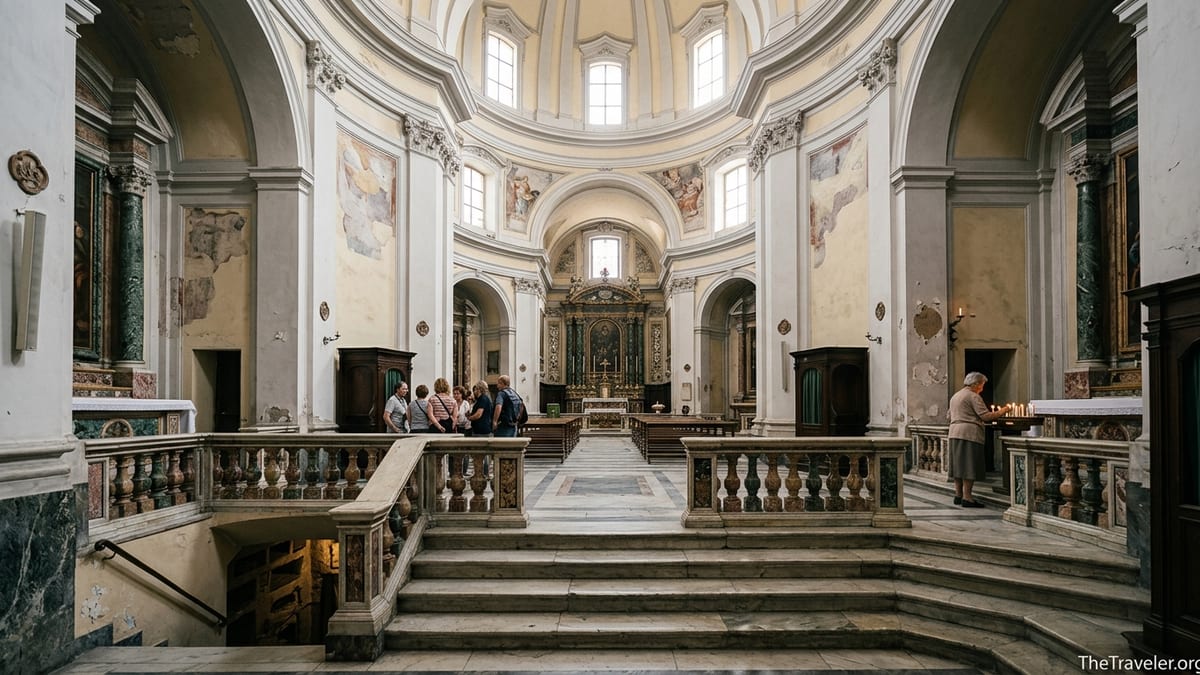
Push open the heavy wooden doors and the noise of traffic recedes in an instant. The basilica unfolds in a Greek-cross plan, an unusual layout in Naples at the time it was built between about 1602 and 1613, with arms of equal length radiating from beneath a central dome. Standing at the threshold, you can see how the Baroque taste for drama and movement is not only in gilded cherubs or swirling stucco but in the way the whole space pulls your eye upward and inward. The tiled floor creaks underfoot, visibly worn along the aisles where generations of parishioners have walked the same lines.
For many visitors, this sudden shift from clamorous street to orchestrated sacred space is the moment when Baroque Naples becomes tangible. You are not entering a museum emptied of its original meaning, but a parish church where baptisms, funerals, and weekday masses still happen alongside guided tours. Elderly locals slip into side chapels to light candles while a small group of visitors listens to a guide describe fresco cycles from the seventeenth century. The layering of everyday life and historic fabric is exactly what gives this place its charge.
Unlike more monumental sites closer to the historic center, such as the cathedral of San Gennaro, Santa Maria della Sanità feels like a neighborhood living room. Children race in and out after school, a volunteer from the local parish office rearranges plastic chairs for an evening meeting, and a guide from the cooperative that manages the catacombs sells tickets from a simple wooden desk near the entrance. The church is not curated for perfection, and that roughness is part of what makes it feel honest.
Reading the Baroque Details up Close
Once your eyes adapt to the filtered light beneath the dome, smaller Baroque details begin to stand out. The church was designed at a time when Naples was under Spanish rule, and its interior reflects that mix of local devotion and imperial taste. Polychrome marble in deep green and ocher traces geometric patterns along the balustrades. Cherub heads peer from cornices where plaster has flaked slightly, revealing the labor that went into this decorative skin. Rather than a polished, spotless Baroque jewel, Santa Maria della Sanità wears its age in a way that helps you imagine how the church might have looked when newly finished, filled with smoke from oil lamps and wax candles.
On the right-hand side as you enter, the icon of San Vincenzo Ferrer, known locally as O’ Monacone, draws a steady trickle of worshippers. The painting, darkened over centuries, is less visually striking than the grand altarpieces you may see in museums, but in practice it commands more attention. People slip folded notes and small offerings near the image, touch the frame lightly, or pause in brief, wordless prayers. This lived devotion animates the Baroque environment more powerfully than any explanatory panel could.
Look closely at the main altar and side chapels and you will see the Baroque Naples of art history books, but in situ. Marble inlays frame altarpieces attributed to artists working in the early seventeenth century. Fresco fragments in the pendentives of the dome hint at once rich cycles of painted angels and prophets. The use of light is deliberate: windows in the drum of the dome let in oblique shafts of brightness that fall not on the congregation but on the altars and the icon, turning liturgical focus into a subtle form of stage lighting.
For travelers used to renovated basilicas in Rome or Florence, the imperfections here can be surprising. Bits of wiring for modern lighting run along old stucco, plastic chairs mingle with carved wooden pews, and some gilding has clearly not been refreshed in decades. Yet these incongruities give you a more honest sense of how Baroque churches function in contemporary Naples. Rather than being preserved as frozen monuments, they are continually adapted, patched, and reused by communities that rarely have funds for perfect restoration.
The Catacombs Beneath: Meeting Naples Underground
One of the most striking aspects of Santa Maria della Sanità is that it rests directly on top of the Catacombs of San Gaudioso, an early Christian burial complex dating back to around the fourth and fifth centuries. Access to the catacombs is through the basilica itself, where a small ticket counter run by a local social cooperative sells timed-entry tours, often for a price comparable to a simple restaurant meal in the neighborhood. The cooperative model is important: part of the income supports community projects, making a visit here a direct contribution to the district rather than a purely commercial transaction.
Descending the stone stairs from the bright church into the underground corridors, you feel the temperature drop and the air thicken. Guides, often young people from the neighborhood, carry small flashlights to highlight details that would otherwise disappear in the half-light. Wall niches still show traces of frescoes, and in some sections you can see the striking, almost unsettling Baroque practice of reusing the ancient catacombs in the seventeenth century by creating tombs where skulls were inserted into wall paintings of aristocratic bodies. These composite images of real bones and painted costumes are a blunt reminder of how Neapolitans historically negotiated status, mortality, and faith.
Unlike the more extensive Catacombs of San Gennaro farther uphill, San Gaudioso is compact enough that you can grasp its layout within a single visit. Passageways open into small underground chapels, including one dedicated to San Gaudioso himself, a bishop exiled from North Africa whose cult helped spark the burial site’s development. Your guide might point out early Christian symbols such as fish or anchors carved into the rock, or the outlines of tombs reserved for different social classes. The layering here is chronological and social at once, from late Roman times to the Baroque elite who sought to be buried in a fashion that expressed both piety and prestige.
Coming back up into the basilica, blinking at the sudden light under the dome, you literally walk through centuries of Neapolitan history in a matter of minutes. That physical movement, from subterranean burial galleries to a bustling parish, compresses time in a way that no museum display could. It also makes aspects of Baroque piety that might seem foreign on the page, such as intense devotion to relics and a vivid relationship to death, feel more logical in context. In a city built over its own dead, where earthquakes and epidemics were recurrent, it is less surprising that Baroque art embraced skulls, tears, and ecstasy as central motifs.
Sanità Today: Baroque Heritage in a Working Neighborhood
To understand how real Baroque Naples feels here, you have to step back outside the church and spend time in the streets around it. The Sanità district, historically a marginal zone just beyond the old walls, developed in the early modern period as a burial area and then as a dense residential quarter. Today it remains one of the most socially complex parts of Naples, grappling with unemployment and underinvestment even as it attracts more visitors every year drawn by its churches, catacombs, and strong neighborhood identity.
Walk a few minutes from the basilica and you see how this Baroque heritage occupies the same space as modest apartment blocks, family-run bars selling espresso for around one euro, and small grocery shops with crates of tomatoes and peaches spilling onto the sidewalk. Murals commissioned in recent years brighten blank walls, some depicting the faces of local cultural figures or stylized saints, an echo of the sacred imagery you have just seen inside Santa Maria della Sanità. It is possible to buy a slice of pizza fritta from a window counter, then turn a corner and find another church with a richly decorated interior but a peeling exterior façade.
Local initiatives have tried to weave the area’s Baroque and early Christian heritage into sustainable tourism. The same cooperative that manages the catacombs often collaborates with neighborhood associations to organize walking tours that link Santa Maria della Sanità with nearby sites such as the Ponte della Sanità bridge and other minor churches. These tours usually keep group sizes small and are led by residents who fold in stories about their grandparents, changes in the district, and the practical realities of living where history is always underfoot.
At the same time, Sanità is not a theme park. Visitors will notice that sidewalks can be narrow, traffic rules flexible, and buildings visibly in need of maintenance. Safety perceptions vary; some travelers report feeling entirely comfortable during daytime visits, while others, particularly solo visitors, prefer to stay more central and come here on guided tours. Being aware of your surroundings, avoiding flashy displays of valuables, and treating the neighborhood with the same respect you would in any busy urban area are simple ways to keep the experience focused on discovery rather than worry.
Making Baroque Naples Personal
Part of what makes Santa Maria della Sanità so affecting is how it invites a personal reading of Baroque Naples. Instead of confronting you with a neatly labeled highlight, it places you in the middle of overlapping stories. On a weekday morning, you might see a group of schoolchildren from the neighborhood gathering in the pews as a teacher explains a fresco showing the Virgin Mary. Their notebooks, sneakers, and smartphone flashes sit comfortably in front of altars conceived in the era of Spanish viceroys.
Travelers who are used to consuming heritage through grand, polished attractions may initially find this mix confusing. Yet it can be deeply freeing. You can sit under the dome for a few minutes and simply listen: to the murmur of prayers, the faint sound of a scooter passing outside, the click of a guide’s voice echoing up from the catacomb stairwell. In that acoustic blend, Baroque Naples ceases to be a style defined by volutes and cornices and becomes a way of organizing space, spectacle, and community that still resonates.
Many visitors pair a stop here with more famous Baroque sights such as the chapel of Sansevero in the historic center, where the sculpture of the Veiled Christ is meticulously spotlighted and carefully controlled. Experiencing both within the same day can sharpen the contrast. While Sansevero impresses through perfection and theatricality in a controlled setting, Santa Maria della Sanità moves you through friction, its beauty filtered through everyday use and partial decay. Together they give a fuller picture of how Baroque patronage and popular devotion coexisted in this city.
If you are particularly interested in photography, this church rewards a slower approach. The interplay of natural light through the dome and side windows changes over the course of the day, sometimes turning a dusty beam into a spotlight on a forgotten side altar. Capturing a local elderly woman praying or a guide waiting at the catacomb staircase, always with discretion and respect, can yield images that speak more loudly than any wide shot of the interior alone.
Practical Tips for Visiting Santa Maria della Sanità
Reaching Santa Maria della Sanità from central Naples is relatively straightforward. Many visitors take the metro to stops near the historic center and walk from there, or use buses that run along Via Santa Teresa degli Scalzi and descend into the district. Travel times can vary with traffic, so it is wise to allow extra time if you have a timed catacomb tour reserved. Some travelers prefer to join small-group tours that include transportation, especially if they are less comfortable navigating dense neighborhoods on their own.
Opening hours for the basilica itself tend to follow a typical parish rhythm, with the church open in the morning and late afternoon, sometimes closing mid-day. The catacombs operate with set tour times, often in Italian and at least one other language, which you can usually reserve in advance, especially during busy seasons such as spring and early autumn. Prices are generally modest compared with major European monuments, and combination tickets that include both San Gaudioso and the larger San Gennaro catacombs uphill are often available, making it possible to devote half a day to Naples underground.
Dress sensibly for both the church and the catacombs. Modest clothing that covers shoulders and knees is appreciated in a functioning place of worship, and sturdy shoes will make navigating stone steps and slightly damp corridors more comfortable. The underground temperature is cooler than the street, which can be a relief in summer but may feel chilly during winter, so a light layer is useful. Photography rules can vary; flash is usually not allowed in the catacombs to protect the fragile frescoes, and within the basilica it is courteous to avoid photographing people at prayer without permission.
As in much of Naples, a few basic urban travel habits go a long way. Keep phones and cameras secure, particularly when outside in the surrounding streets where scooters and pedestrians share limited space. Avoid blocking church entrances or pathways with bags or tripods. If you are uncertain about the neighborhood after dark, visit during the morning or early afternoon and combine the basilica with a stop for lunch at a nearby trattoria serving simple local dishes such as pasta with ragù napoletano or a classic margherita pizza.
The Takeaway
Stepping inside Santa Maria della Sanità is one of the most effective ways to feel that Baroque Naples is not just an aesthetic but a lived condition. The basilica’s early seventeenth century design, its layered decorative program, and the catacombs of San Gaudioso beneath it offer a compact journey through fifteen centuries of faith and art. Yet it is the interplay with the Sanità neighborhood outside, with its scooters, markets, and community projects, that transforms this from a standard heritage visit into an encounter with a city that refuses to separate its past from its present.
Spend an hour here and the clichés about Naples as only chaotic or only dangerous begin to blur. You see instead a place where grand architecture and fragile social fabric coexist, where Baroque domes shelter local meetings and youth-led tours, and where early Christian burial chambers are maintained not by distant institutions but by residents who live above them. For travelers willing to look beyond polished postcard views, Santa Maria della Sanità offers a deeply grounded, specific, and memorable portal into the real Baroque heart of Naples.
FAQ
Q1. Where is Santa Maria della Sanità located in Naples?
Santa Maria della Sanità stands in the Sanità district north of the historic center, close to the point where Via Sanità meets Via Santa Teresa degli Scalzi, in a densely populated residential neighborhood.
Q2. Do I need a ticket to enter the basilica?
Entrance to the basilica itself is usually free as it is an active parish church, but there is a paid ticket for the guided tours of the Catacombs of San Gaudioso located beneath the building.
Q3. How much time should I plan for a visit?
Most travelers find that around 60 to 90 minutes is enough to explore the basilica interior and join a standard catacomb tour, longer if you like to sit quietly or photograph details in the church.
Q4. Is the Sanità neighborhood safe for visitors?
The Sanità district is lively and can feel intense, but many visitors explore it safely during daylight by staying aware of their surroundings, avoiding obvious displays of valuables, and sometimes joining organized tours if they prefer extra reassurance.
Q5. Can I visit the catacombs without a guide?
The Catacombs of San Gaudioso are generally accessible only on guided tours managed by a local cooperative, both to protect the site and to provide visitors with context about its history and iconography.
Q6. Are there services in languages other than Italian?
While regular religious services are primarily in Italian, many catacomb tours are offered in at least one additional language, often English, especially in busier travel seasons; it is advisable to check times in advance.
Q7. What should I wear when visiting?
Wear modest clothing that covers shoulders and knees out of respect for the church, and choose comfortable, closed shoes suitable for walking on worn marble floors and descending the stone steps into the cooler, sometimes damp catacombs.
Q8. Can I take photos inside Santa Maria della Sanità?
Photography without flash is generally tolerated in the basilica, provided you avoid disturbing worshippers, while in the catacombs flash is usually prohibited and some areas may have additional restrictions to protect delicate frescoes.
Q9. Is Santa Maria della Sanità suitable for children?
Many families visit with children, who are often intrigued by the catacombs and the dramatic interior, though parents should be prepared for low light, uneven steps, and the potentially unsettling presence of human remains underground.
Q10. How does Santa Maria della Sanità compare with the Catacombs of San Gennaro?
The Catacombs of San Gaudioso under Santa Maria della Sanità are smaller and more intimate than the extensive San Gennaro complex uphill, offering a denser overlap of early Christian, Baroque, and contemporary neighborhood life in a single visit.