


More news on this day
Air travelers across the United States are facing another turbulent day as live tracking data shows 2,103 flights delayed and 106 cancelled, disrupting operations at airports in Georgia, Texas, Pennsylvania, New Jersey, Maryland, Massachusetts and a growing list of other states, with impacts rippling across networks operated by American and regional affiliates PSA, Horizon, Piedmont, SkyWest, low cost carrier Frontier and additional airlines.
Get the latest news straight to your inbox!
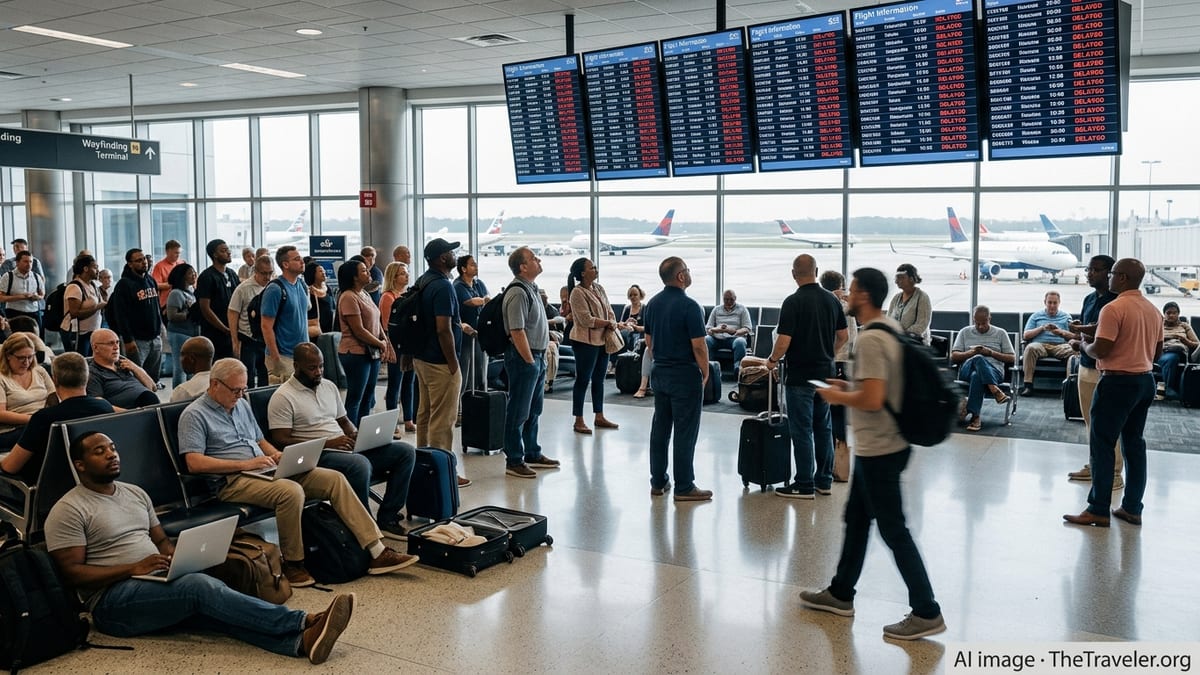
Weather, Congestion And Network Strain Combine
Publicly available tracking data and recent operational summaries indicate that the latest wave of disruptions stems from a familiar mix of drivers: unsettled late spring weather, air traffic flow restrictions around major hubs and knock on effects from tightly scheduled fleets. Storm systems moving across the South and up the Eastern Seaboard in recent weeks have already produced several days of elevated delay and cancellation counts, leaving airlines with limited margin when new bottlenecks appear.
Airports in Georgia and Texas, including the country’s busiest hub in Atlanta and large connecting complexes around Dallas and Houston, are particularly sensitive to these conditions. When departure rates are reduced or ground stops are issued, banks of connecting flights fall out of sync, cascading into missed connections and aircraft out of position for subsequent legs. Reports from earlier disruptions this season show that once daily cancellation and delay figures surpass a few thousand, it can take at least one full operating day for schedules to stabilize.
In the Northeast, constraints at airports in Pennsylvania, New Jersey and Massachusetts add another layer of complexity. These facilities sit at the heart of dense, interlocking route maps linking short haul business markets with long haul domestic and international services. Even modest slowdowns at Philadelphia, Newark, Boston or smaller regional fields can quickly ripple into Maryland and other Mid Atlantic states, compounding the system wide stress now visible in nationwide statistics.
Industry data from recent months highlights how this environment amplifies small operational hiccups. With airlines running high load factors and limited spare capacity, a weather related ground delay in one region can leave crews and aircraft unavailable in another several hours later. The result is the pattern seen today, where a mix of moderate weather and lingering congestion still yields more than 2,100 delays and over 100 cancellations across the national network.
Major Carriers And Regional Feeders Feel The Impact
Travel disruptions today are not limited to a single airline or business model. Statistical snapshots and carrier specific tracking show that large legacy airlines, notably American, sit at the center of the pattern, supported by a web of regional partners such as PSA Airlines, Horizon Air, Piedmont Airlines and SkyWest Airlines. These regional operators fly many of the shorter segments that feed passengers into and out of big hubs, meaning a disruption on a small jet can jeopardize connections onto larger mainline flights.
Publicly available performance summaries from previous months underscore how sensitive these operators are to network wide stress. When a hub like Dallas or Philadelphia experiences a temporary reduction in arrival or departure capacity, regional feeders are often first to see schedule adjustments as airlines prioritize long haul or high demand routes. This can translate into clusters of cancellations or rolling delays on routes that link secondary cities in states such as Georgia, Pennsylvania, Maryland and Massachusetts.
Low cost carrier Frontier is also visible in today’s disruption picture. Data from earlier in the year shows that point to point operators can face particular challenges during widespread weather and congestion events. Because these carriers often operate tight aircraft rotations with minimal slack time, a delay on a morning departure from one state can cascade into schedule slippage across multiple states by evening, especially when air traffic control programs slow traffic into busy coastal and Sun Belt airports.
Across the industry, the interconnected nature of U.S. airline operations means that no carrier is entirely insulated when nationwide disruption thresholds are reached. While some airlines may record fewer cancellations, they can still see substantial delays as they work within flow control programs, ground delay initiatives and reroutes imposed at key hubs serving Georgia, Texas, Pennsylvania, New Jersey, Maryland and Massachusetts.
Airports Across Multiple States Grapple With Backlogs
Airport level updates and historical disruption trackers illustrate how today’s figures translate on the ground in affected states. In Georgia, Atlanta’s role as a central connection point for both domestic and international traffic magnifies any interruption. Queues at security checkpoints and rebooking counters tend to lengthen quickly when multiple departure banks are pushed back, and aircraft arriving behind schedule can face further holds while gates free up, compounding delays.
In Texas, major facilities around Dallas and Houston are dealing with a combination of weather related volume management and knock on congestion from earlier storms this season. Published coverage of recent events showed long lines forming at customer service desks as travelers sought alternative routings through less affected hubs in the Midwest and West, a pattern likely to repeat as airlines juggle today’s 2,103 delayed flights across their networks.
Further north, airports in Pennsylvania and New Jersey are contending with their own set of limitations. Philadelphia, Newark and other regional fields have finite runway and taxiway capacity, and when air traffic managers slow arrival flows for safety reasons, departures also tend to back up. This can lead to aircraft sitting in departure queues awaiting takeoff clearance or being held at gates while connecting passengers from late inbound flights attempt to make tight connections.
Maryland and Massachusetts, with key airports serving the Baltimore Washington area and Boston respectively, are feeling secondary effects as well. Flights arriving from already constrained hubs in the South and Midwest arrive off schedule, compressing turnaround windows and creating gate conflicts. Even when local weather is relatively benign, the inbound disruption combined with regional airspace congestion can keep delay figures elevated throughout much of the day.
What Travelers Can Expect In The Coming Hours
Based on patterns observed in similar nationwide disruptions earlier this year, travelers can expect elevated delays to persist even if weather conditions begin to improve. When more than 2,000 flights are reported delayed on a single day, airlines often require several schedule cycles to reposition aircraft and crews, clear maintenance backlogs and restore buffers built into timetables. This recovery process can extend well into the evening and, on occasion, into the following day.
Operational analyses from previous multi day events suggest that the initial cancellation and delay wave is often followed by a second phase characterized by rolling, shorter delays as carriers work to normalize rotations. During this phase, passengers may see relatively frequent schedule adjustments of 15 to 60 minutes rather than outright cancellations, particularly on routes connecting larger hubs in Texas and Georgia with Northeast destinations in Pennsylvania, New Jersey, Maryland and Massachusetts.
Travelers connecting through hubs dominated by American and its regional affiliates PSA, Piedmont and Envoy, or through airports where SkyWest and Horizon operate substantial schedules on behalf of multiple brands, may experience particular sensitivity to any further weather or airspace restrictions. If additional thunderstorms or low visibility conditions develop during peak hours, even modest flow reductions could quickly add to the day’s disruption totals.
Observers tracking the situation note that one of the defining characteristics of the current air travel environment is how quickly conditions can deteriorate once a series of modest constraints align. High passenger demand, full flights, constrained staffing and crowded airspace mean that the margin for error is thin. The figures logged today across Georgia, Texas, Pennsylvania, New Jersey, Maryland, Massachusetts and other states illustrate how even short lived weather or traffic control restrictions can translate into thousands of delayed journeys nationwide.
Longer Term Questions Over System Resilience
While today’s disruption is being driven in large part by transient weather systems and localized airspace constraints, it also adds to an ongoing conversation about the resilience of the U.S. air travel network. Analysts reviewing federal on time performance datasets have pointed to persistent pressure points in key hubs, rising average delay durations and the growing role of regional affiliates in sustaining connectivity to smaller communities.
Statistics compiled over recent years show that carriers such as American, Frontier, SkyWest, PSA, Horizon and Piedmont operate in an environment where extreme weather, aging infrastructure and strong travel demand frequently intersect. When severe storms or winter systems move through corridors that include Georgia, Texas, Pennsylvania, New Jersey, Maryland and Massachusetts, existing vulnerabilities in scheduling and resource allocation can become more visible to the traveling public.
There is also increasing scrutiny of how delay and cancellation information is communicated to passengers during large scale events. Consumer advocates argue that clear, timely updates and transparent rebooking options are essential when daily disruption counts reach the levels recorded today. Airlines have promoted the use of mobile apps, text alerts and proactive rebooking tools, but reports from recent storms suggest that digital systems and call centers can still become strained when thousands of flights are affected in a short window.
As the summer travel season approaches, the pattern evident in the latest figures will likely inform how airlines and airports prepare for peak demand periods. Capacity planning, crew availability, air traffic control staffing and infrastructure upgrades at critical hubs in Georgia, Texas, the Mid Atlantic and New England will all play a role in determining whether similar days of widespread disruption become less frequent or remain a recurring feature of the U.S. travel landscape.