


More news on this day
Thousands of air travelers faced hours of disruption on Sunday as more than 400 flights were delayed or cancelled across London’s main airports, leaving terminals packed, rebooking options limited and many passengers stuck far from their intended destinations.
Get the latest news straight to your inbox!
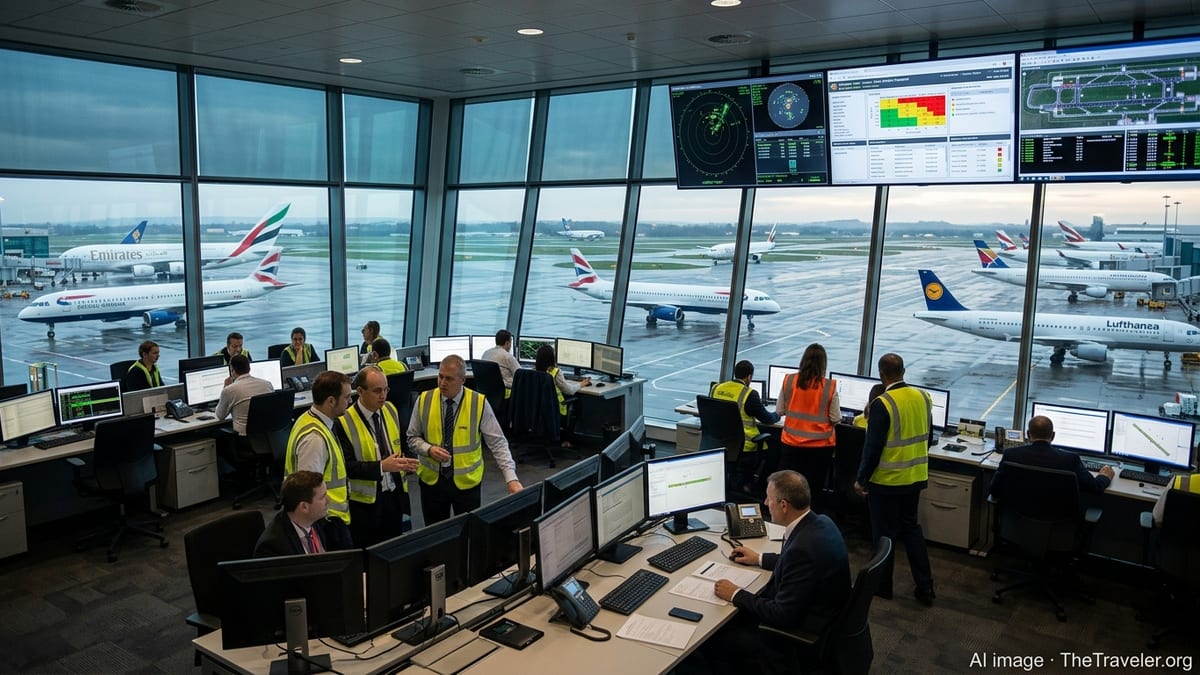
Major London Hubs See Operations Severely Disrupted
Publicly available aviation tracking data indicates that at least 401 flights were delayed and 61 cancelled across London’s airport system, with disruption centered on Heathrow and London City. The figures cover arrivals and departures across a single day of operations, pointing to one of the most severe bouts of same-day disruption seen in the capital this year.
Reports indicate that the wave of delays and cancellations affected a mix of full service and regional carriers, including British Airways, American Airlines, KLM and Helvetic Airways. With London serving as a key long haul and European connection point, disruption at these hubs quickly spilled over to other airports in Europe and North America as missed connections cascaded through airline networks.
Terminal concourses at affected airports were reported to be crowded as passengers waited for updates, queued to speak with airline staff and searched for alternative travel options. Some travelers arriving into London found that their onward connections had already been cancelled or significantly delayed, forcing unexpected overnight stays.
The scale of the disruption mirrors broader turbulence in European aviation in recent months, where large clusters of delays and cancellations have become more common when technical, staffing or weather issues coincide with already tight schedules.
Ripple Effects Across European and Global Networks
Recent coverage of European aviation performance highlights how problems in London can rapidly reverberate through the wider air travel system. Earlier reporting on regional disruption has documented days with more than 1,400 delays and hundreds of cancellations across the continent, underlining the fragility of interconnected timetables when a major hub encounters trouble.
London’s airports serve as primary gateways linking Europe with North America, the Middle East, Africa and Asia. When flights are delayed or grounded in the capital, aircraft and crews may be left out of position for subsequent rotations, increasing the risk of secondary cancellations in cities far from the original disruption. This network effect can leave passengers stranded not only in London but also at secondary hubs where replacement aircraft and available seats are scarce.
Publicly available data from previous disruption events shows that short haul feeders into London are particularly vulnerable. If an early morning European arrival arrives late, the same aircraft may miss its departure slot for a long haul service, delaying onward journeys for hundreds of passengers and pressuring airlines to consolidate services or move travelers onto already busy later departures.
Airlines operating through London have been working in recent months to improve schedule resilience, but congested airspace, staffing constraints and high seasonal demand continue to make it challenging to absorb sudden shocks to the system.
Passenger Experience: Long Queues and Limited Rebooking Options
Accounts shared through news outlets and social media indicate that passengers at London Heathrow and London City encountered long lines at check in, customer service desks and security, particularly as disruption peaked. For many travelers, the most immediate challenge was obtaining reliable information about whether their flight would operate, be substantially delayed or be cancelled outright.
With more than 400 flights affected in a single day, rebooking capacity quickly became constrained, especially on popular European and transatlantic routes. Reports indicate that some passengers were offered itineraries departing a day or more later, while others were advised to consider alternative airports or modes of transport for regional journeys.
Crowded seating areas and overnight stays in terminals have been a recurring feature of recent disruption episodes across Europe, and Sunday’s events in London appeared to follow a similar pattern. Families with children, elderly travelers and those connecting from long haul flights were among the groups facing particular difficulties in securing suitable accommodation and timely onward travel.
In past episodes of mass disruption on the continent, some airports have opened additional rest areas and distributed basic refreshments to stranded passengers. Observers noted that the London disruptions again highlighted the importance of clear announcements and consistent information channels when thousands of travelers are competing for limited assistance.
Rights, Compensation and What Travelers Can Do
Under UK and European air passenger regulations, travelers whose flights are delayed or cancelled from London airports may be entitled to assistance such as meals, refreshments and hotel accommodation when an overnight stay is required. In certain circumstances, passengers can also claim financial compensation, depending on the cause of the disruption, the length of the delay and the distance of the flight.
Travel experts routinely advise affected passengers to retain boarding passes, booking confirmations and any written notifications received from airlines, as these documents can be important when seeking refunds or compensation after the event. Passengers are also encouraged to monitor airline apps and airport departure boards for real time updates, as schedules can change repeatedly during major disruption.
Recent guidance published by consumer groups stresses that if a flight is cancelled, travelers should be offered a choice between a refund and re-routing at the earliest available opportunity, including on alternative airlines where applicable. However, implementation of these rules can vary in practice, particularly when call centers and airport service desks are under heavy pressure.
In light of the latest disruption in London, industry observers suggest that travelers build extra time into itineraries that involve tight connections through major hubs, and consider travel insurance policies that specifically address delays and cancellations. As European aviation continues to face intermittent shocks from weather, technical issues and airspace constraints, resilience at London’s airports remains a central concern for both airlines and passengers.
Another Sign of a Fragile Travel System
Sunday’s disruption at London airports follows a series of recent events in which thousands of passengers across Europe have been stranded by large clusters of delays and cancellations. Previous episodes have involved air traffic control problems, IT outages, staffing shortages and adverse weather, illustrating how many different factors can trigger similar outcomes for travelers.
Industry reports describe a system that is operating close to capacity on peak days, with limited slack to recover when something goes wrong. When more than 400 flights in and out of London are disrupted in a matter of hours, aircraft rotations, crew duty limits and available gates all come under strain, increasing the likelihood that problems will continue into subsequent days.
For now, the events in London stand as another reminder that even as global travel demand remains strong, reliability is not guaranteed. The experience of thousands of stranded passengers underscores the continuing challenge for airlines, airports and regulators seeking to balance efficiency with resilience in one of the world’s busiest aviation markets.