


Landing at Tocumen International Airport and heading into Panama City by metro is one of the cheapest and often fastest options, but only if you know how the Line 2 airport branch works. With a little preparation you can glide from arrivals to downtown stations like Iglesia del Carmen or Albrook for a fraction of what a taxi or ride‑hailing service would cost, while avoiding the most common mistakes that catch first‑time visitors.
Get the latest updates straight to your inbox!
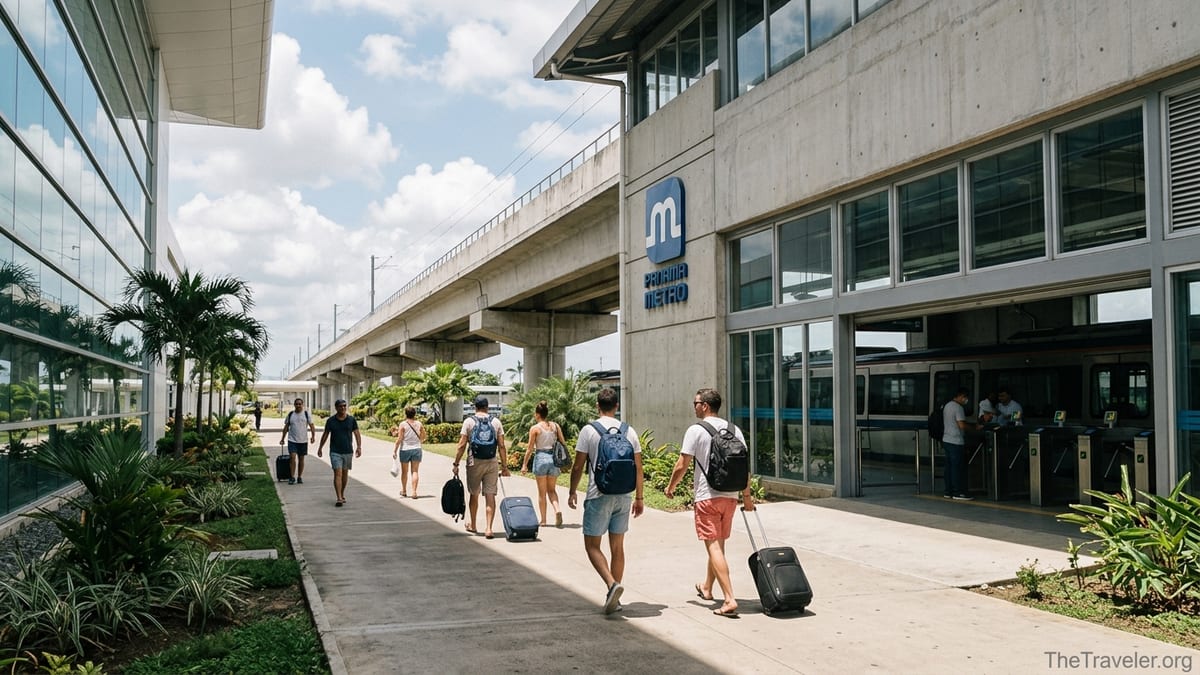
Understanding the Tocumen Airport Metro Connection
Tocumen International Airport is linked to the Panama Metro through the Aeropuerto station on the Line 2 branch. The elevated station sits between Terminal 1 and Terminal 2, roughly a 5 to 10 minute walk depending on which terminal you arrive in and how much luggage you are carrying. Signs inside the terminals point to “Metro” and “Estación Aeropuerto,” and you emerge at ground level before going up escalators to the platforms.
The airport connection is technically a short branch of Line 2 that runs between Aeropuerto and Corredor Sur. From Corredor Sur, regular Line 2 trains continue west toward San Miguelito, where you can connect to Line 1 for the main business and hotel areas. In practice, most visitors simply board at Aeropuerto, ride to Corredor Sur, stay on the same train or follow staff instructions, then continue on Line 2 to San Miguelito without leaving the paid area.
For a typical journey into the city, you will take Line 2 from Aeropuerto in the direction of San Miguelito, then either stay on Line 2 for eastern neighborhoods like Brisas del Golf or transfer at San Miguelito to Line 1 for central stops such as Via Argentina, Iglesia del Carmen, El Carmen and Albrook. This combination makes it easy to reach areas where many hotels are clustered, including El Cangrejo and the banking district along Via España.
The metro is fully integrated with Panama’s broader public transport system and uses the US dollar as currency. That means prices are easy to understand for most visitors, and you avoid the small‑denomination currency stress that can come with airport buses or informal taxis. For solo travelers and couples, the metro is usually far cheaper than taxis from Tocumen, which often run to 25 or 35 US dollars into the city, depending on traffic and negotiation.
Fares, Tickets and How to Pay from the Airport
Panama Metro has kept fares deliberately simple. Riding only on Line 2, including the airport branch, generally costs about 0.50 US dollars per trip for most riders. If your journey combines both Line 2 and Line 1, the total deducted from your balance is usually under 1 US dollar each way for a full ride across the network. This means that a return trip from the airport to central Panama City can cost around what you might tip a taxi driver for handling your bags.
At Aeropuerto station you have two main ways to pay: a rechargeable metro card or contactless bank cards and digital wallets. Metro cards are sold from vending machines and staffed windows at the station for a small one‑time cost, typically a couple of dollars, to which you then add riding credit. As a practical example, many visitors load 5 US dollars on a new card, which is enough for several airport–city–airport trips if you are traveling alone. You tap the card on the reader at the fare gate when entering and again when exiting; the correct amount is automatically deducted.
Contactless bank card payment has become increasingly common, and in Panama you can generally tap a contactless Visa, Mastercard or enabled smartphone wallet directly at the gate instead of using a separate metro card. This is convenient if you do not plan to ride often, but note that each traveler needs their own card or device because you must tap separately for every person. The fare per journey is comparable to the standard metro fare, although banks may add small foreign transaction charges depending on your account.
Metro ticket machines at Aeropuerto accept small‑denomination banknotes and coins, but they are not designed to break large bills from currency exchanges or ATMs. A frequent real‑world issue is arriving with only 50‑dollar bills from an airport ATM and finding the machines will not accept them. To avoid this, try to get smaller bills when changing money or buying something small inside the terminal before heading to the station, or plan to pay with a contactless card or phone instead of cash.
From Aeropuerto to San Miguelito and the Rest of the City
Once you have your ticket or have tapped your card, reaching the city center is straightforward. From the airport platform, board the Line 2 train heading toward Corredor Sur and San Miguelito. The airport branch is short, so within minutes you reach Corredor Sur, where the train joins the main Line 2 route. Announcements and platform screens indicate the final destination and next stations, and you can also follow the line map above the doors to track progress.
The key hub on Line 2 for most visitors is San Miguelito, where it connects with Line 1 via a long but well‑signed overhead walkway. If you are traveling to downtown areas like Via Argentina, Iglesia del Carmen or 5 de Mayo, you will leave your Line 2 train at San Miguelito, follow the signs for Linea 1, walk across the enclosed skybridge and then descend to the Line 1 platforms. You remain inside the paid zone the entire time, so there is no need to tap out and in again.
From San Miguelito on Line 1, trains run west toward Albrook, passing through a string of central stations. For example, if your hotel is around El Cangrejo, you might get off at Via Argentina. If you are heading for the historic quarter, Casco Antiguo, you can ride Line 1 to 5 de Mayo and then either walk or take a short taxi ride. If your destination is the Albrook bus terminal or the small domestic airport at Albrook, simply stay on Line 1 until the final stop at Albrook station, then follow the signs for the bus or airport terminals.
In terms of travel time, the Aeropuerto to San Miguelito segment usually takes around 25 to 30 minutes, and San Miguelito to Albrook on Line 1 adds another 20 to 25 minutes, not counting waiting and transfer time. During peak commuting hours, the trains can be crowded, particularly between San Miguelito and the city center, but frequencies are high and many visitors still find the ride faster than sitting in traffic on the Corredor Sur expressway in a taxi.
Luggage, Station Layout and Practical Onboard Tips
Panama Metro trains and stations, including Aeropuerto, are designed mainly for daily commuters, but they work reasonably well for travelers with typical suitcases. Platforms are level with train floors, and most stations have elevators and escalators alongside stairs. At Aeropuerto and San Miguelito you will find wide gates suitable for luggage, similar to those used for people with wheelchairs or strollers; metro staff can open them if they are not already active.
There is no formal luggage limit on the metro, but oversized items can be awkward during busy periods. Two medium wheeled suitcases per person is usually manageable; bringing large surfboards or multiple extra‑large bags may attract attention and make boarding difficult. Inside the train, there are no dedicated luggage racks as you might see in an airport express service. Instead, travelers typically stand near the doors holding their bags, or place smaller bags between their legs while holding onto handrails.
For comfort and safety, avoid boarding in the very middle cars during rush hours, as these tend to be the most crowded. If the train is busy, try moving along the platform toward the front or back to find slightly more space. When boarding with bags, let other passengers off first and then step inside, turning your suitcase sideways so it occupies as little floor space as possible. Keep backpacks either on your front or on the floor between your feet, especially in crowded sections between San Miguelito and the downtown stations.
A practical example: a couple arriving on an evening flight with two checked bags and two backpacks can comfortably ride the metro as long as they avoid the heaviest commuter windows around 7 to 9 in the morning and 5 to 7 in the evening. They can walk the short distance from Terminal 2 to Aeropuerto station, tap a contactless card, ride Line 2 to San Miguelito, change to Line 1, and step off at Via Argentina. From there, it is usually a five to ten minute walk along tree‑lined streets to mid‑range hotels in El Cangrejo, without ever needing a taxi.
Operating Hours, Frequency and When the Metro Makes Sense
Panama Metro typically begins operating early in the morning and continues until late evening, with first trains around 5:00 a.m. and last departures close to 10:00 or 11:00 p.m., depending on the day and line. The airport branch of Line 2 follows the main Line 2 schedule, so service to and from Aeropuerto is usually available throughout the core operating day. Trains run more frequently during peak commuting hours and slightly less often late at night or on Sundays.
For many flight schedules, this means you can comfortably use the metro to reach early evening departures and late‑morning arrivals. For example, if you land around 3:00 p.m., you can normally clear immigration and customs, walk to the station, and be on a Line 2 train well before rush hour. If you have a morning departure around 10:00 a.m., leaving a central hotel by metro around 7:30 or 8:00 a.m. usually provides ample time, even with one transfer at San Miguelito and a walk from Aeropuerto to your terminal.
However, the metro becomes less suitable for very late‑night arrivals or extremely early‑morning departures. If your flight lands close to midnight or you need to be at the airport at 4:00 a.m., the metro may not be running or will be operating at minimal frequency, and a taxi or ride‑hailing service could be the safer choice. It is sensible to confirm operating hours for your specific date once you are in Panama, either by checking station notices or asking staff at any metro station.
Another factor is group size. For solo travelers and couples, the metro’s low fare makes it an obvious money‑saver. For families of four or more, the total metro cost starts to approach the price of a single taxi, especially if your hotel is not within easy walking distance of a station and you would need to add a short cab ride at the end. In those cases, the metro still offers a good backup option during heavy road traffic, but convenience may tip the balance toward door‑to‑door car transport.
Common Tourist Mistakes on the Panama Metro
The most frequent mistake first‑time visitors make is assuming the airport station sits directly under the terminal doors, as in some cities, and then being surprised by the short but real walk between arrivals and Aeropuerto station. With humidity and luggage, that five to ten minute walk can feel longer than expected. Planning for it and wearing light clothing and comfortable shoes helps, especially if you have to cross between Terminal 1 and Terminal 2 before following signs to the metro.
Another widespread error is boarding the right line in the wrong direction. On both Line 1 and Line 2, trains run in two directions with different final stations. From the airport, you must always take Line 2 toward Corredor Sur and San Miguelito, not toward the airport branch terminus. Similarly, when returning from the city, you should be sure to board Line 2 trains whose destination indicates Corredor Sur and Aeropuerto, not just Nuevo Tocumen. Taking a moment to read the platform signs and checking the route map can save you a lot of backtracking.
Fare and ticket issues also trip people up. Arriving with only high‑denomination cash can make buying a metro card unnecessarily complicated, as ticket machines may reject large bills and station staff might not have enough change. Travelers sometimes try to share one metro card among several people by passing it back through the barrier, which can lead to confusion at the gates and is discouraged by staff. It is more efficient for each traveler to have their own card or use their own contactless payment method.
Finally, some visitors treat the metro like a private airport transfer and spread luggage across the floor or block doors, especially during quieter periods. This becomes a problem when more passengers board at busy interchange stations like San Miguelito. To avoid complaints or confrontations, always keep bags close and be ready to move them aside quickly when people need to get past you. Remember that this is primarily a commuter system; blending in with local habits will make your ride smoother and more pleasant.
Safety, Security and Cultural Etiquette
By regional standards, Panama’s metro system is considered relatively safe, particularly during daylight and early evening hours. Stations are equipped with security cameras, uniformed metro staff and often additional security personnel. However, as with any busy urban transport system, petty theft can occur if you are inattentive, especially in crowded sections between major stations. Keeping your phone out of back pockets, using bags that close securely and wearing valuables underneath clothing are sensible precautions.
On the platforms and inside trains, you will notice clear markings for priority seating near the doors, reserved for pregnant people, older passengers and riders with disabilities. Giving up your seat when needed is not just polite but expected. Locals are generally tolerant of travelers with luggage, but they appreciate when visitors make an effort to stand to the side of doors, let others exit first and keep conversation volumes moderate.
One cultural detail that surprises some visitors is the formality of security staff. Bag checks at station entrances are not common for every passenger, but you may occasionally be asked to open a backpack or large suitcase for a quick inspection, especially at major hubs or during special events. This is usually routine and brief. Remaining patient and cooperative keeps the process fast and avoids delays for everyone around you.
Language can also play a role. Most metro signage is in Spanish, sometimes with English translations at key tourist points like Aeropuerto and Albrook. Many staff members know basic English, but you will have smoother interactions if you can say simple phrases such as “hacia San Miguelito” or “para Albrook.” Having your destination station name written down on your phone or a piece of paper also helps if pronunciation is tricky.
The Takeaway
Using the metro from Tocumen International Airport is one of the smartest ways to start or end a trip to Panama City. The Line 2 airport branch connects Aeropuerto station with the core network at Corredor Sur and San Miguelito, opening up direct links to central Line 1 hubs like Via Argentina, Iglesia del Carmen, 5 de Mayo and Albrook for less than the cost of a coffee at the terminal. With light luggage and a bit of route awareness, most visitors find the ride straightforward and efficient.
Success comes down to a few key points: know which direction your Line 2 train should be going, be ready for the short walk between your terminal and Aeropuerto station, carry smaller bills or a contactless card for payment, and stay aware of your belongings in crowds. Avoid peak‑hour crushes if you are carrying multiple suitcases, and consider taxis or ride‑hailing services if you have very early or late flights when the metro is not running frequently.
For many travelers, the metro is more than just a cheap ride. It offers a first glimpse of daily life in Panama City, from students heading to class near ITSE station to office workers commuting from suburbs like Nuevo Tocumen. Learning to navigate Line 2, the San Miguelito transfer and the broader network turns what might have been an expensive, anonymous taxi ride into a grounded, local experience.
FAQ
Q1. Can I take the metro from Tocumen Airport directly to downtown Panama City?
Yes. From Aeropuerto station on Line 2 you ride toward San Miguelito, then transfer to Line 1 for central stops such as Via Argentina, Iglesia del Carmen or 5 de Mayo.
Q2. How much does a typical metro trip from the airport to the city cost?
A single trip that uses only Line 2 is usually around 0.50 US dollars, and a journey combining Line 2 and Line 1 typically stays under 1 US dollar per person.
Q3. Where exactly is the Aeropuerto metro station in relation to the terminals?
The station is located between Terminal 1 and Terminal 2. It is an elevated structure reached by a short signposted walk of about 5 to 10 minutes from either terminal building.
Q4. Do I need a special ticket or card to use the airport metro branch?
No special ticket is required. You can use a standard rechargeable metro card or pay directly with a contactless bank card or compatible smartphone wallet at the fare gates.
Q5. Is it safe to ride the metro with luggage from Tocumen Airport?
Generally yes. The system is considered relatively safe, especially during the day, but you should keep bags close, avoid displaying valuables and stay alert in crowded cars.
Q6. What is the best way to reach Casco Antiguo using the metro from the airport?
From Aeropuerto take Line 2 to San Miguelito, change to Line 1 toward Albrook, get off at 5 de Mayo and then either walk or take a short taxi ride to Casco Antiguo.
Q7. Can I use the metro for very early‑morning or late‑night flights?
It depends on your exact flight time. The metro usually operates roughly from early morning to late evening, so for flights around midnight or before dawn, a taxi is often more reliable.
Q8. Is the metro cheaper than taking a taxi from Tocumen Airport?
Yes. While a taxi into the city commonly costs tens of dollars, a metro journey from the airport to central stations typically costs under 1 US dollar per person.
Q9. Are there elevators and wide gates for travelers with heavy bags?
Most stations, including Aeropuerto and San Miguelito, have elevators, escalators and wider access gates suitable for suitcases, strollers and wheelchairs.
Q10. Can several people share one metro card when traveling together?
Each person should ideally have their own card or contactless payment method. Trying to share one card through the gates often causes delays and confusion at station entrances.