


For many travelers, the big decision at Topkapı Palace is not whether to go at all, but whether to pay extra to enter the Harem. The former nerve center of the Ottoman Empire already has a hefty ticket price for foreign visitors, and the Harem used to come on top of that. In 2026, prices and rules have shifted again, and confusion at the ticket booths is common. This guide explains how Harem access works now, what you really see inside, and in which situations the extra cost or time is genuinely worth it.
Get the latest updates straight to your inbox!
How Topkapı Palace and Harem Tickets Work in 2026
Topkapı Palace is administered as a national palace museum, and foreign visitors pay a higher rate than Turkish citizens and residents. In practice, you now buy a combined ticket that covers the main palace courtyards and core collections, the Harem apartments, and Hagia Irene. As of mid 2026, the official combined ticket for foreigners is published around the equivalent of several dozen euros, with prices fluctuating as the Turkish lira moves and seasonal adjustments are made. On the ground that typically looks like a combined Topkapı plus Harem plus Hagia Irene ticket in the 50 to 70 euro range when bought through official channels or reputable resellers that bundle audio guides or guiding.
Until recently, the Harem was a physically separate, add on area with its own ticket checkpoint. Many older blog posts still describe it this way. You will still see tour descriptions online that talk about a “Harem supplement” or “extra Harem ticket.” In reality, from 2024 onward, the museum has gradually shifted to a single combined palace ticket that allows access to the Harem during its open hours. Some third party sites continue to present the prices as a base palace fee plus a Harem fee, but at the turnstiles you will usually pass through one main security and ticket check, then scan again at the Harem entrance using the same combined ticket.
For visitors, what matters is how that structure appears in your budget. A simple palace ticket without extras bought in person is the cheapest option, but foreign travelers often end up paying a bit more by buying online combinations that include a Harem visit and audio guide or guided small group tour. A common pattern is a basic combined entry around the raw face value, and guided products starting around 50 to 90 US dollars per adult that promise skip the line organization and commentary in English. The key is to check whether “Harem included” is explicitly mentioned, because not every “Topkapı Palace” product adds this section automatically.
What You Actually See Inside the Harem
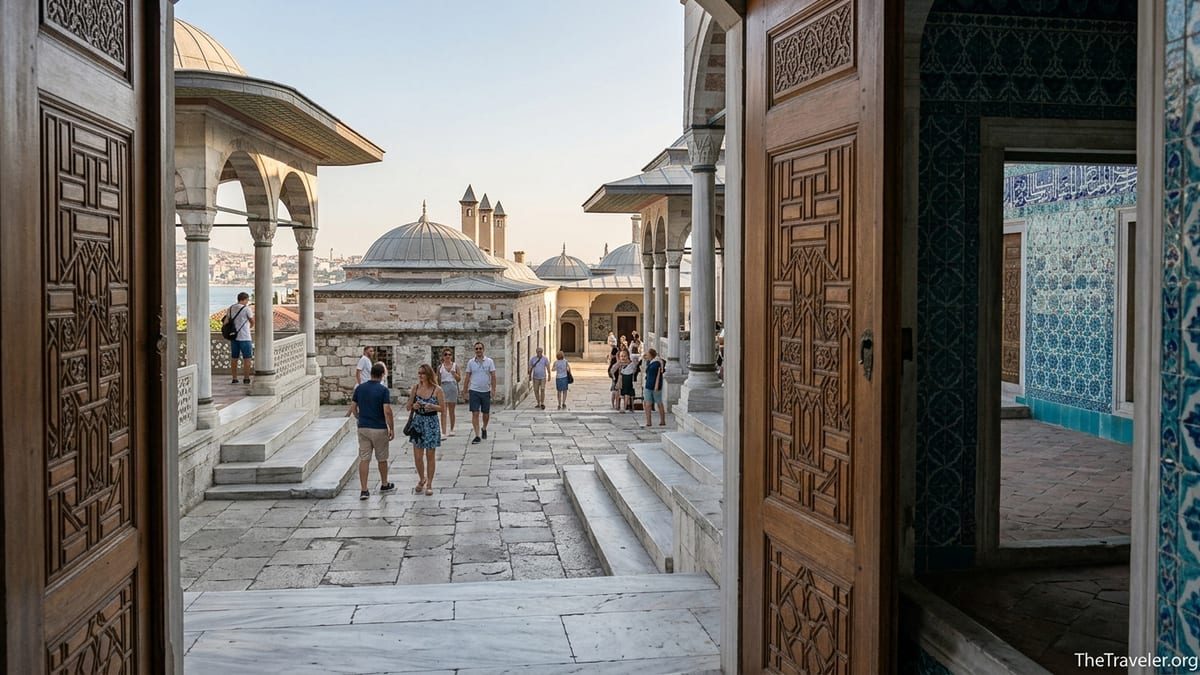
The word “Harem” often conjures vague images of secluded women and royal intrigue. At Topkapı, you are walking through a self contained residential and political world. The route typically begins at the Carriages Courtyard and passes into a sequence of intimate, richly decorated spaces that feel very different from the open, official courtyards of the main palace. Here you step through narrow corridors, tiled chambers, and dark passageways that once housed the sultan’s mother, wives, concubines, princes, and the eunuchs who guarded them.
Among the standout interiors are the Apartments of the Queen Mother, with walls covered in İznik tiles in shades of cobalt, turquoise, and emerald, and gilded wooden ceilings that catch the low light. Further along, travelers encounter the Imperial Hall, a grand reception chamber reshaped in the 18th century with Baroque touches and a monumental wall fountain. This room was the setting for family ceremonies and intimate audiences, and it gives a rare sense of how the dynasty staged its private power away from the public throne room and council hall in the main palace.
Another powerful stop is the Courtyard of the Concubines and Princes, which recent restorations have brought more fully to life. Visitors in 2026 report new exhibits and signage in this area, including displays that explain how young women were educated and how princes grew up in this hidden complex. Instead of an empty series of rooms, you now find period furnishings, textiles, and interpretive panels that make it easier to imagine daily routines, from lessons and musical training to strict ceremonial protocols.
By the time you exit, typically near the Golden Road passage, you have traced a compact but intricate path that layers architecture, decoration, and family politics. For many travelers, these interiors feel more atmospheric than the relatively bare administrative courtyards, especially on quiet weekdays or late afternoons when the light slants across tiled walls and worn marble thresholds.
How Much Extra Does the Harem Really Cost?
Because ticketing has moved toward combined products, the cost question is less about a separate Harem ticket and more about whether you spring for a bundle that explicitly includes Harem access or a guided Harem tour. At the museum ticket windows near the first courtyard, prices are posted in Turkish lira, but many short stay visitors instinctively convert into euros or dollars. In 2026 that mental conversion can be jarring: a foreign traveler might find that the combined ticket for palace, Harem, and Hagia Irene easily approaches or surpasses the cost of a decent budget hotel night in Istanbul.
To make the choice more concrete, consider two real world scenarios. A backpacker traveling on 60 to 70 euros per day might weigh the combined ticket against an entire day’s food and public transport. Even when the Harem is nominally “included,” older pricing structures and online descriptions can make it feel like paying a hefty premium just to add one more interior section. By contrast, a short city break visitor staying in a midrange hotel in Sultanahmet and already paying 150 to 200 euros per night is more likely to see the combined palace and Harem cost as simply the flagship attraction of their stay.
Third party products complicate the picture. For example, a guided “Topkapı Palace and Harem with skip the line entry” offered by a well known Istanbul ticket company might be advertised in the 55 to 75 US dollar range per adult. That usually folds in the underlying combined ticket plus the services of a licensed guide for 60 to 90 minutes, sometimes with an audio guide app you can keep using afterward. If you tried to reconstruct the same experience by buying a raw ticket at the gate, renting an audio guide, and arranging a private guide separately, the total could easily match or surpass the bundled price. In that sense, the “extra cost” of the Harem is less about a strict surcharge and more about choosing how curated and time efficient you want the visit to be.
A useful benchmark is to compare Topkapı with other major European and Middle Eastern sites. Travelers who routinely pay 25 to 35 euros to visit monumental complexes such as the Alhambra in Granada or the Vatican Museums in Rome often find that Topkapı’s combined ticket feels steep but not completely out of line, especially given its size and status. The key is to go in with realistic expectations about both the cost and the amount of time you will need to justify it.
Who Will Find the Harem Worth It (and Who Might Not)
Whether the Harem is “worth it” depends less on the absolute price and more on your interests, tolerance for crowds, and how much time you have in Istanbul. If you are drawn to social history, gender and power, or the lives of specific figures like Hürrem Sultan, Kösem Sultan, or the Valide Sultans, the Harem is the heart of Topkapı rather than a side room. The interpretive panels, restored rooms, and tighter circulation add up to a narrative that is easier to follow than the sometimes overwhelming collections of weapons, manuscripts, and religious relics in the main palace.
Art and architecture enthusiasts also tend to rank the Harem as essential. The layering of 16th century tilework, later Baroque and Rococo renovations, and modest service corridors offers a kind of three dimensional textbook of Ottoman interior design. Photographers appreciate the filtered natural light, textures of painted wood and glazed ceramic, and the interplay of shadows in narrow staircases and arches. For these visitors, skipping the Harem can feel like seeing only the skeleton of the palace without its living organs.
On the other hand, some travelers leave the Harem underwhelmed. Common feedback from short attention span visitors and families with young children is that the space feels like “more rooms” after already spending a couple of hours in the palace. Many of the chambers are relatively empty or sparsely furnished, and interpretive text is still heavily focused on historical context rather than immersive storytelling. If you mainly want a quick overview, a few panoramic views over the Bosphorus, and a sense of where the sultans ruled, you may feel that the time and added fatigue of the Harem route are not essential.
Time poor visitors in particular should think carefully. Someone squeezing Topkapı into a two hour slot between a Bosphorus cruise and a flight may be better off focusing on the outer courtyards, the Imperial Council chamber, the treasury, and the panoramic terraces. The Harem route, once entered, is largely one way and can add 45 to 90 minutes of walking and queuing, especially at bottlenecks like the Imperial Hall or the Queen Mother’s rooms. If you are already feeling museum fatigue from the Archaeology Museums or the mosaics of the Great Palace, the marginal value of adding the Harem can drop quickly.
Planning Your Visit: Timing, Crowds, and Practical Tips
Topkapı Palace operates with seasonal hours that shift between summer and winter, and the Harem follows the same general opening pattern but may close slightly earlier than the main courtyards on some days for security and conservation reasons. In 2026, this often means a last entry in the late afternoon, with ticket sales cut off before the posted closing time. It is important not to leave the Harem until the very end of your visit if you are arriving after lunch, as staff can begin to steer visitors away from the Harem entrance corridor when closing time approaches.
To make the most of your ticket, aim to arrive close to opening on a weekday. Travelers who reach the outer gate soon after it opens typically report walking straight into the Harem with minimal waiting, then looping back out to the more spacious outer courtyards as tour buses begin to arrive. By late morning on high season days, lines can build at the security screening and ticket check, and the rooms inside the Harem can become congested, especially narrow passageways and thresholds between major chambers where groups pause for explanations.
Dress considerations are fairly simple. There is no special dress code unique to the Harem beyond the general standards of modest clothing for the palace and the nearby Holy Relics section, but practical shoes are crucial. Floors can be uneven, with raised thresholds and worn stone steps that become slippery in wet weather. In summer, the interior can be warm and airless, so carrying a small bottle of water and taking advantage of shade in the courtyards can make the difference between an engaging visit and a tiring slog.
Photography is permitted in much of the palace and the Harem, but flash is often restricted to protect delicate surfaces. A lightweight camera or phone can capture evocative shots of tiled alcoves, stained glass windows, and the layering of roofs and chimneys from the inner courtyards. Tripods are generally not allowed, and professional gear may attract extra scrutiny. To keep the flow moving, it is polite to take your photos quickly and step aside rather than lingering in doorways or narrow corridors for extended compositions.
Guided Harem Tours vs Exploring on Your Own
One major factor in whether the Harem feels worth the extra expense is whether you explore it independently, with an audio guide, or as part of a guided tour. Visiting on your own with wall texts and a printed or digital map is the cheapest option. You are free to linger where you like, backtrack slightly, or simply move at your own pace. This suits repeat visitors, confident history buffs, or travelers who prefer quiet observation over structured commentary.
An audio guide, whether rented at the site or included as a download with a ticket, can add context at a relatively low extra cost. Many products sold online in 2026, especially through local ticket agencies, bundle a combined palace and Harem entry with an app based audio tour you activate as you walk. This setup is attractive for independent travelers who want storytelling and clear directions but do not enjoy standing in groups. The trade off is that you must manage your own pacing and resist the temptation to skip ahead when the rooms become crowded.
Licensed guided tours are the most expensive but can dramatically change how you experience the Harem. A typical small group tour that covers both the main palace highlights and the Harem might last around two to three hours, with 45 to 60 minutes spent inside the Harem apartments. Guides often bring the space alive with specific anecdotes: how young concubines were recruited from across the empire, the power struggles between sultans’ mothers and wives, or famous scandals involving favorites and eunuchs. In practice, this layer of human drama can transform a series of tiled rooms into a vivid story.
Whether that premium is worth paying depends on your budget and learning style. For a couple traveling once in a lifetime to Istanbul and allocating a significant portion of their sightseeing budget to a single day around Sultanahmet, choosing a guided Harem tour is often a smart splurge. For long term travelers or repeat visitors, buying the combined ticket and wandering independently on a quiet afternoon can be more rewarding than moving at the speed of a group.
The Takeaway
So is the Topkapı Palace Harem worth the extra ticket cost or bundled premium in 2026? For most travelers with a genuine interest in Ottoman history, court life, or architecture, the answer is yes. The Harem is where the palace becomes personal: where you see not only how sultans ruled, but how they and their families actually lived. The apartments of the Queen Mother, the Imperial Hall, the Concubines’ Courtyard, and the intimate corridors between them offer a kind of narrative cohesion that some visitors find lacking in the more formal museum sections.
However, that does not mean the Harem is essential for every visitor. If you are very short on time, traveling with young children who tire quickly in museums, or simply not particularly interested in the domestic side of imperial history, you may be better served by focusing on Topkapı’s open courtyards, terraces over the Bosphorus, and a handful of major collections. In that case, consider whether the premium of a guided Harem experience would be better invested elsewhere, perhaps in a food tour, Bosphorus cruise, or visit to another palace such as Dolmabahçe.
The most important step is to make your decision consciously. Check whether your chosen ticket or tour explicitly includes the Harem, match the cost to your own daily budget rather than abstract numbers, and plan your visit so you have enough time and energy to appreciate what you pay for. Treated as the emotional and historical core of Topkapı rather than an afterthought, the Harem can become one of the most memorable parts of an Istanbul journey.
FAQ
Q1. Is the Topkapı Palace Harem still a separate paid section in 2026?
The museum has moved toward a single combined ticket that covers the main palace, Harem, and Hagia Irene. Some older sources still describe the Harem as a separate paid area, and third party tour descriptions sometimes talk about a Harem “add on,” but in practice most foreign visitors now enter with one combined ticket that is scanned at both the main gate and the Harem entrance.
Q2. How much extra should I budget for the Harem compared to the main palace?
Instead of a clear cut surcharge, you now mostly choose between cheaper in person combined tickets and higher priced online bundles that include the Harem plus extras like audio guides or guided tours. Expect the total cost for a foreign adult to feel comparable to other major European heritage sites, with guided Topkapı plus Harem experiences commonly landing around the price of a nice dinner for two in Istanbul.
Q3. How much time do I need to visit the Harem properly?
Most travelers should allow at least 45 minutes to an hour inside the Harem itself, in addition to the two or more hours you might spend in the rest of the palace. If you enjoy reading panels, taking photos, or listening to detailed audio or live commentary, plan for a full half day at Topkapı rather than trying to squeeze everything, including the Harem, into a rushed two hour stop.
Q4. Can I visit the Harem without seeing the rest of Topkapı Palace?
In current practice, the Harem is treated as part of the combined palace complex. You pass through the main security and courtyards before reaching the Harem entrance, and tickets are structured around the entire site rather than a standalone Harem visit. Some specialized tours might focus mainly on the Harem section, but they still require standard palace entry.
Q5. Is the Harem suitable for children and families?
Families with older children and teenagers who are curious about history often find the Harem engaging, especially with a good guide who can pitch stories at their level. For very young children, the narrow corridors, crowds, and lack of hands on displays can be tiring, and strollers are awkward in some sections due to steps and thresholds.
Q6. Are there parts of the Harem that are off limits or under restoration?
Yes, conservation work is ongoing, and some rooms or side corridors may be closed at any given time. Travelers in recent seasons have reported new exhibitions opening in the Concubines’ Courtyard while other smaller chambers remained behind barriers. Expect that you will see a curated route rather than every single room in the historic complex.
Q7. Do I need a guide specifically for the Harem?
You can visit the Harem independently, and many travelers enjoy exploring with only the posted signs and an audio guide. However, a knowledgeable guide can add a lot of value by connecting the physical spaces to particular historical figures and events, which helps make the cost feel more justified. Whether that is worth paying for depends on your budget and how much you enjoy structured storytelling.
Q8. When is the best time of day to visit the Harem to avoid crowds?
Early morning on weekdays is generally the calmest period. If you enter soon after opening, you can often walk into the Harem with minimal waiting and enjoy the rooms before large tour groups arrive. Late afternoon can also be quieter, but you must watch the clock carefully because staff may restrict new entries as closing time approaches.
Q9. Is the Harem accessible for visitors with limited mobility?
The Harem includes stairs, uneven stone floors, and narrow passageways with high thresholds, which can be challenging for visitors with mobility impairments. Some sections may be partially accessible, but a completely step free route through the Harem is not guaranteed, and wheelchair users may find the main courtyards and terraces of Topkapı easier to navigate than the inner apartments.
Q10. If I have to choose between the Harem and another Istanbul attraction, what should I compare it with?
If you are deciding between paying for the Harem or for another major attraction, useful comparisons include Dolmabahçe Palace, a Bosphorus cruise, or a guided food tour. The Harem offers deep insight into imperial family life and architecture, while alternatives might emphasize 19th century opulence, city views, or contemporary culture. Weigh which experience best matches your interests and limited time rather than defaulting to the Harem simply because it is bundled with Topkapı.