


Topkapı Palace sits on the tip of Istanbul’s Historic Peninsula, looking out over the Bosphorus where Europe and Asia almost touch. In a city crowded with icons, from Hagia Sophia to the Blue Mosque and Galata Tower, this former seat of the Ottoman sultans offers something different. It is not just a single monument but an entire walled world of courtyards, tiled chambers, royal kitchens and secretive harem corridors that once governed a vast empire. For travelers today, that layered mix of power, ceremony and daily life is what makes Topkapı Palace stand out among Istanbul’s landmark sights.
Get the latest updates straight to your inbox!
A Royal City Within the City
Where Hagia Sophia and the Blue Mosque are dominated by towering domes, Topkapı Palace impresses through sheer breadth. Laid out across a headland between the Golden Horn and the Bosphorus, the complex once housed up to several thousand people, from sultans and princes to cooks, scribes and janissaries. Walking through its four main courtyards, visitors experience the gradual shift from public power to guarded privacy, something you do not feel in the same way inside a single monument like Galata Tower or the Basilica Cistern.
The sequence begins at the Imperial Gate on Sultanahmet’s main axis. After a quick security check, travelers step into the First Courtyard, a green space that once held stables, workshops and the hospital of the palace. Many modern visitors who try to see Hagia Sophia, the Blue Mosque and Topkapı in a single rushed day underestimate how large this complex really is. Even with a focused route, most recent guides suggest allowing at least three to four hours if you include the harem, treasury and the main exhibition rooms.
Beyond the ornate Gate of Salutation, the Second Courtyard opens with the tall chimneys of the palace kitchens to one side and the Imperial Council Chamber on the other. Unlike Dolmabahçe Palace, which follows a European neoclassical plan along a single waterfront facade, Topkapı feels more like a series of linked gardens and pavilions. Visitors move outside between each section, pausing under plane trees or by fountains before entering another tiled hall or gallery. In summer, this layout means you are constantly stepping between shade and sun, which can be a welcome break from the darker interiors of other Istanbul museums.
As you walk deeper into the palace, the spaces narrow, the doors get smaller and the decoration becomes more intimate. The Third and Fourth Courtyards are where the sultan’s private apartments, the Audience Chamber and the tulip-planted terraces once formed the physical heart of the empire. This progression from wide parade ground to secluded garden city is one of the features that makes Topkapı feel more like a living organism than a static monument.
History of Power That Still Shapes Istanbul
Topkapı Palace was commissioned shortly after the Ottoman conquest of Constantinople in 1453, when Sultan Mehmed II chose the ancient acropolis of the Byzantine city as his new seat. For nearly four centuries it remained the main administrative and ceremonial center of the empire. While Hagia Sophia was converted into a mosque and later a museum, and Galata Tower served as a lookout and later a museum piece, Topkapı functioned as the empire’s working brain and household at the same time.
The decisions taken here affected lands stretching from Budapest to Baghdad. In the Divan Chamber just off the Second Courtyard, grand viziers and ministers met beneath painted domes to debate taxation, warfare and diplomacy, while the sultan listened unseen behind a grilled window. Travelers today can still stand under the same dome and see the raised throne platform where ambassadors once presented gifts in hope of favorable treaties. That sense of proximate political history, rather than just religious or architectural heritage, is something distinctive among Istanbul’s landmarks.
Over time, the Ottoman court grew more elaborate, and parts of governance gradually shifted to newer palaces along the Bosphorus such as Dolmabahçe in the 19th century. Yet Topkapı was never abandoned. The sultans continued to use its pavilions, gardens and harem, and after the founding of the Turkish Republic it was transformed into one of the country’s first major museums. Today it forms part of the Historic Areas of Istanbul recognized by UNESCO, alongside monuments like the Hippodrome, Hagia Sophia and the city walls, underscoring how central it remains to the story of the city.
For visitors comparing sites, this deep continuity matters. Hagia Sophia presents the layered religious history of Byzantium and Islam. The Blue Mosque showcases classical Ottoman mosque architecture at its height. Topkapı, by contrast, allows you to trace how rulers actually lived and made decisions over the course of centuries. The preserved audience halls, council chambers and residential gardens make it easier to imagine the rhythms of imperial life than in almost any other building in the city.
Architecture That Turns Etiquette into Space
Architecturally, Topkapı Palace does not seek to overwhelm with a single grand facade. Instead, it uses repeated thresholds, courtyards and pavilions to turn court etiquette into physical space. Each gate marked a change in status. Janissaries and officials thronged the Second Courtyard, while only selected dignitaries could enter the Third Courtyard to approach the Audience Chamber. Daily visitors still intuit this hierarchy as they show tickets, pass turnstiles and step through successively smaller doors.
The palace’s buildings blend early Ottoman style with influences from Persia, the Balkans and later European tastes. In the Harem, travelers walk past rooms lined with İznik tiles in deep cobalt, turquoise and coral red, their floral and calligraphic designs echoing patterns seen in the Blue Mosque but in a domestic setting. Wooden lattice screens, stained glass windows and painted ceilings filter light so that even at busy times the interiors feel hushed and slightly removed from the crowds outside.
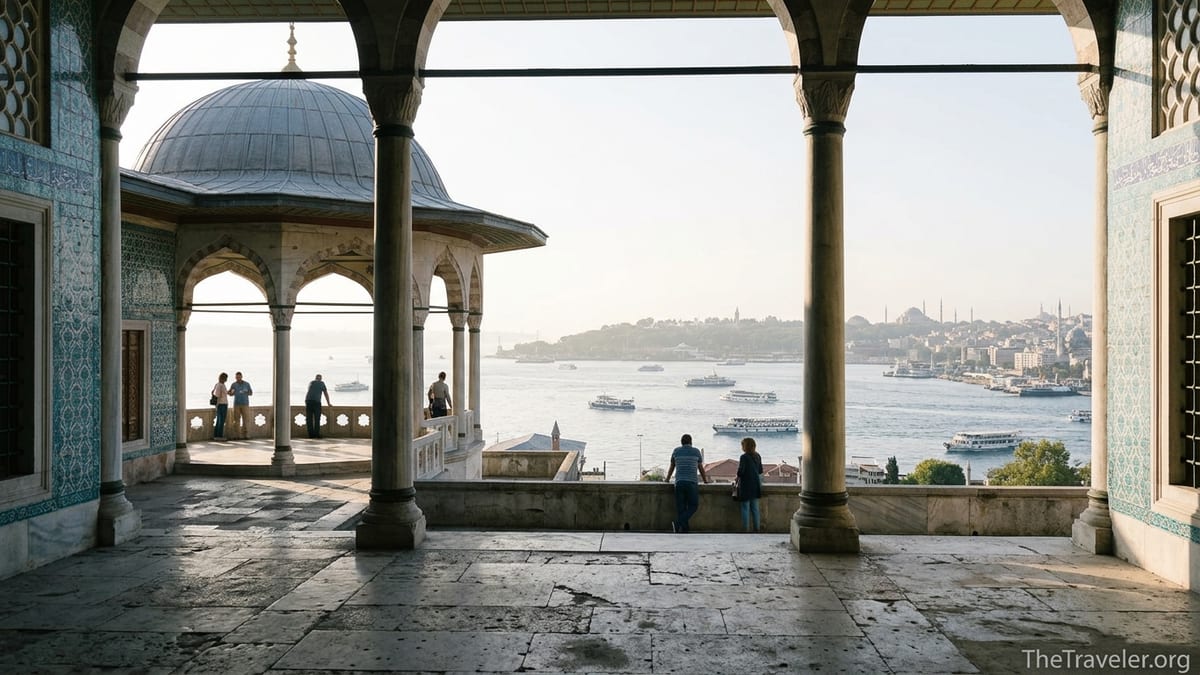
One of the joys of visiting Topkapı compared with more vertical landmarks such as Galata Tower is the variety of vantage points. In the Fourth Courtyard, marble colonnades frame views across the Bosphorus and the Golden Horn, while small kiosks like the Baghdad Pavilion and Revan Pavilion sit above terraced gardens. Travelers often find themselves lingering on these balconies, watching ferries dart between Eminönü and Üsküdar or tracing the silhouettes of mosques on the Asian shore. It is a rare Istanbul attraction where the architecture and the panorama constantly interact.
Restoration is ongoing in many sections, and visitors sometimes encounter roped-off rooms or scaffolding, especially in more delicate tiled interiors. Recent travelers report that previously closed areas in parts of the Harem and concubines’ quarters have reopened, widening the route through these intimate spaces. While this can slightly change the flow from year to year, it also means repeat visitors often discover new details or viewpoints each time they return.
The Harem and Daily Life Behind the Walls
No part of Topkapı Palace captures the imagination quite like the Harem. Located behind the Imperial Council building, this labyrinth of corridors, courtyards and apartments housed the sultan’s mother, wives, concubines and children, along with attendants and the elite corps of black eunuchs who guarded the inner family. In contrast to the open monumental spaces around Hagia Sophia or Sultanahmet Square, the Harem compresses life into a dense sequence of doorways and thresholds.
Visitors today follow a signposted route that might start at the Courtyard of the Black Eunuchs before passing into the apartments of the Valide Sultan, the sultan’s mother and one of the most powerful figures in the empire. The tile work here is among the finest in the palace, combining floral İznik panels with gilded wooden ceilings and marble fireplaces. Many travelers are struck by how relatively small some of these famous rooms are in person, compared with their dramatic portrayals in television dramas about the Ottoman court.
Further inside, the Corridor of the Concubines and the princes’ quarters reveal a more everyday side of court life. Modest-sized rooms with built-in cupboards, low seating platforms and small private baths suggest a world of education, rivalry and boredom as much as romance or intrigue. Seen alongside the more formal spaces of the palace, these chambers provide a much fuller picture of how imperial households functioned than most other Istanbul landmarks can offer.
Because the Harem’s circulation is narrow and atmospheric, it can feel crowded at peak times. Practical reports from recent years recommend visiting either early in the morning shortly after opening or later in the afternoon to experience the echoing corridors with fewer tour groups. A combined ticket typically covers both the main palace and the Harem, and guided tours that focus specifically on this section can help visitors make sense of the complex social hierarchy that once governed life behind these doors.
Treasures, Sacred Relics and Stories You Can Stand In
Beyond its architecture, Topkapı Palace is home to some of the most talked-about objects in Turkey’s museum collections. In the Treasury rooms, travelers queue to see items like the Topkapı Dagger, set with emeralds and wrapped in stories of attempted theft and Cold War intrigue, and the enormous Spoonmaker’s Diamond, a pear-shaped stone that has entered local legend. These pieces offer the kind of direct, glittering encounter with royal luxury that sets Topkapı apart from landmarks where the focus is primarily structural or devotional.
Another area that makes the palace exceptional among Istanbul’s sites is the Pavilion of the Holy Relics. Here, visitors file past display cases said to contain items associated with prophets and early Islamic history, while Qur’an recitation plays softly in the background. Regardless of personal beliefs, many travelers describe this room as unexpectedly moving. It is not simply another museum gallery but a space where devotion, heritage and national identity intersect, in contrast to the more neutral curatorial tone found in many European palaces.
Elsewhere, manuscript rooms and costume displays trace how Ottoman calligraphy, textiles and ceremonial dress evolved. In contrast to Dolmabahçe Palace, where most furnishings are European-style and fixed in period rooms, Topkapı presents objects in a more thematic way, allowing visitors to compare armor, robes or ceremonial standards across centuries. Temporary exhibitions periodically highlight specific themes such as royal kitchens, scientific instruments or court festivals, giving repeat visitors new reasons to return.
The combination of political spaces, private living quarters, sacred relics and artistic collections within a single complex is rare among Istanbul’s headline sights. Hagia Sophia and the Blue Mosque each offer powerful but more focused experiences. Topkapı Palace instead invites travelers to piece together overlapping stories of faith, power and daily life, using objects and spaces as clues in a much larger narrative.
Views, Atmosphere and Practical Visiting Experience
In practical terms, Topkapı Palace also stands out for the quality of its setting and the rhythm of a visit. Perched at the tip of Sarayburnu, the palace’s gardens and terraces offer sweeping views over the Bosphorus, the Golden Horn and the Sea of Marmara. While Galata Tower is better known as a dedicated viewpoint, the panoramas from Topkapı feel more connected to the historical landscape: you look down on the shipping lanes and neighborhoods the sultans themselves once observed.
Visiting patterns differ from other major landmarks nearby. Hagia Sophia, now functioning again as a mosque, has tighter controls around prayer times and a different ticketing model for upper galleries and museums. The Blue Mosque is free to enter but closes during daily prayers. Topkapı Palace, by contrast, operates as a museum with set opening hours, ticket checks at the main gate and controlled entry to certain sections. Recent visitor reports suggest that a full visit, including the Harem, typically takes four to five hours if you move at a comfortable pace and allow time for short breaks in the courtyards.
Ticket prices for foreign visitors have risen in recent years, and combined tickets that include the Harem and nearby Hagia Irene now represent noticeably better value than buying separate entries. Travelers who plan to visit several museums in Istanbul often consider the Museum Pass Istanbul, which covers Topkapı Palace among other sites and can pay off if you also plan to see the Archaeology Museums, Galata Tower and other included attractions within a few days. Guided tours with skip-the-line entry are widely available on site and from reputable agencies, and can help first-time visitors navigate the sometimes confusing layout.
The on-the-ground experience is also shaped by crowds and weather. In high season, late morning and midday bring coach groups into the courtyards, making some areas feel busy. Early morning slots shortly after opening, or late afternoons when the light softens over the Bosphorus, tend to be more relaxed. Because much of the route is at least partly outdoors, spring and autumn visits often feel more comfortable than the peak heat of July and August, when shade in the gardens and regular water breaks become especially important.
How Topkapı Compares With Other Istanbul Icons
Travelers planning only a short stay in Istanbul often wonder whether Topkapı Palace should take priority over other big names like Hagia Sophia, the Blue Mosque, Dolmabahçe Palace or Galata Tower. The answer depends on what you hope to experience, but understanding how Topkapı differs from its peers can clarify the choice. Hagia Sophia offers the drama of a single monumental space that has shifted between church, mosque and museum. Stepping inside its vast, dimly lit nave can feel almost overwhelming in its scale and symbolism.
The Blue Mosque, standing opposite Hagia Sophia across Sultanahmet Square, provides a more focused look at classical Ottoman mosque design, with its cascade of domes and carefully balanced interior lighting. Galata Tower is, above all, a viewpoint. After an elevator and stair climb, visitors step out onto a circular balcony for an all-around panorama of the city’s hills and waterways. Dolmabahçe Palace, another popular choice, represents the late Ottoman desire to emulate European courts, with crystal chandeliers, grand staircases and a symmetrical waterfront facade on the Bosphorus.
Topkapı Palace, by contrast, feels less like a single showpiece and more like a walk through layers of imperial life. You do not simply stand in one awe-inspiring hall and then leave. Instead, you move through kitchens that once prepared meals for thousands, sit briefly in courtyards where soldiers awaited announcements, and peer into small rooms where princes studied or concubines waited for news. This combination of indoor and outdoor spaces makes the palace particularly rewarding for travelers who enjoy wandering and discovering details, rather than checking off a single viewpoint or interior.
For many visitors, the ideal approach is to weave Topkapı into a broader day in the old city. A common pattern is to visit Hagia Sophia or the Blue Mosque early, then spend late morning and early afternoon at Topkapı, with the Basilica Cistern or the Grand Bazaar reserved for later in the day. Because all of these sites cluster within walking distance around Sultanahmet, staying in a nearby hotel or using the tram to Sultanahmet or Gülhane stops can simplify logistics and reduce transit time between landmarks.
The Takeaway
What makes Topkapı Palace special among Istanbul’s landmarks is not just its age or its collections, but the way it gathers so many strands of the city’s story into a single, walkable complex. Within its walls, travelers can stand in rooms where imperial decrees were decided, walk through corridors where palace intrigues unfolded and look out from terraces across waterways that still carry ferries and cargo ships every day.
Compared with the concentrated religious power of Hagia Sophia, the serene symmetry of the Blue Mosque, the vertical drama of Galata Tower or the European opulence of Dolmabahçe, Topkapı offers a broader, more layered encounter with the Ottoman past. Its courtyards, harem, treasury and relics create a mosaic of experiences that together explain why Istanbul once stood at the center of a vast empire. For visitors who give the palace enough time and attention, it often becomes the place where distant history feels closest, turning a list of famous sites into a more coherent understanding of the city itself.
FAQ
Q1. How much time should I plan for a visit to Topkapı Palace?
Most travelers find that three to four hours is the minimum for the main palace and Harem, while five hours or more allows a slower pace with breaks in the courtyards and time for the treasury and terrace views.
Q2. Is Topkapı Palace suitable for children and families?
Yes, families often enjoy the open courtyards, gardens and sea views, and older children tend to be interested in the armor, weapons and glittering treasury objects, though the Harem’s narrow corridors can feel crowded with strollers.
Q3. Do I need a guided tour, or can I visit Topkapı on my own?
Independent visits are perfectly possible with on-site signs and audio guides, but many travelers feel a small-group or private guide adds valuable context, especially in the Harem and council areas where stories are not always obvious from the displays.
Q4. What is the best time of day to visit Topkapı Palace?
Early morning shortly after opening or late afternoon are usually the most pleasant, with softer light over the Bosphorus and fewer large tour groups in the courtyards and Harem corridors.
Q5. How does Topkapı Palace differ from Dolmabahçe Palace?
Topkapı is an earlier, more sprawling complex built around courtyards and gardens, while Dolmabahçe is a later European-style palace with ornate ballrooms and formal waterfront facades, offering a very different impression of Ottoman life.
Q6. Are there dress code requirements for visiting Topkapı Palace?
Unlike mosques, Topkapı Palace operates as a museum, so there is no strict religious dress code, but visitors are expected to dress respectfully, with shoulders and knees covered enough for comfort and local norms.
Q7. Can I buy food and drinks inside Topkapı Palace?
Yes, there are cafes and kiosks inside the complex where you can buy snacks, simple meals and drinks, often with pleasant terrace views, though prices are typically higher than in nearby streets outside the palace walls.
Q8. Is Topkapı Palace accessible for visitors with limited mobility?
The palace grounds include uneven stone paving, slopes and some staircases, but many main courtyards and exhibition areas are reachable with care, and visitors with mobility concerns may want to focus on the first three courtyards and larger halls.
Q9. What should I prioritize if I only have a short time at Topkapı?
If your time is limited, focus on the Second and Third Courtyards, the Audience Chamber, the Harem and one of the main treasury or relic sections, which together give a compact but rich picture of imperial life.
Q10. Is Topkapı Palace included in Istanbul museum passes?
Yes, most current museum pass schemes for Istanbul include entry to Topkapı Palace, making them cost effective if you also plan to visit other major museums and historic sites within a few days.