


Topkapı Palace is one of those places that lives in your imagination long before you step through its gates. You picture sweeping Bosphorus views, glittering tiles and the quiet weight of centuries of Ottoman history. What you probably do not picture is trying to decode ticket options at 9 a.m., shuffling in security lines, or discovering too late that the Harem is not included in the basic ticket. After multiple visits and plenty of trial and error, here is what I genuinely wish I had known before visiting Topkapı Palace in Istanbul.
Get the latest updates straight to your inbox!
Understanding Tickets, Passes and the Extra Cost of the Harem
The first surprise for many visitors is that there is not just “one” Topkapı ticket. As of 2026, you generally pay a base ticket for the main palace complex and an additional fee if you want to enter the Harem apartments and, on some combinations, Hagia Irene within the same complex. The combined price can feel steep by Turkish standards, especially if you compare it with neighborhood mosques that are free to enter. What matters most is not the exact lira amount, which changes frequently due to inflation, but realizing in advance that the headline palace price you saw in an old guidebook probably does not include the Harem.
If you only buy the basic palace ticket at the main gate, you will be able to explore the courtyards, many pavilions and the main museum sections, but you will walk right past the entrance to the Harem and see a separate ticket booth and line. I once watched a couple who thought they had “seen Topkapı” realize, just as they were leaving, that the famous tiled Harem rooms and the sultans’ private space were behind a turnstile they had not entered. They did not have the time or energy to go back, and left disappointed. If the Harem is important to you, decide before you walk in that you will budget time and money for it, and buy the combined ticket or upgrade when you first pass the Harem kiosk instead of dithering later.
Many travelers arrive clutching an Istanbul Museum Pass or a broader Türkiye museum pass, assuming it will unlock everything. In practice, the official Museum Pass Istanbul has historically covered entry to Topkapı Palace itself, but not always the separate Harem ticket, and it does not replace guided-tour “skip the line” products sold by private companies. It is also worth knowing that some other star attractions around Sultanahmet, like the Basilica Cistern, may not be covered by the same pass. If your short itinerary focuses mainly on Hagia Sophia, the cistern and Topkapı, buying everything a la carte can sometimes be cheaper than an all-in pass. Check the latest inclusion list right before you travel and do the math for your own schedule rather than assuming a pass automatically equals savings.
Finally, do not confuse “skip the line” guided tickets with skipping security. Officially, every visitor must pass through security screening, and no tour can magically bypass that first bottleneck at the outer gate. What guided tickets often skip is the second line at the ticket window inside the courtyard. That can still save you half an hour or more on a busy summer morning, but you should temper your expectations. Even with the right ticket in hand, you will still queue at the metal detectors with everyone else.
Timing Your Visit: When Crowds, Light and Heat Matter
I wish I had known on my first trip that Topkapı Palace operates with slightly different hours depending on the season and that it usually closes on Tuesdays. Many travelers land in Istanbul, schedule Topkapı for the “next day,” and then realize too late that the palace is closed that particular day of the week. Because holiday schedules and restoration-related closures can change, it is wise to check the official visiting information for your exact dates and avoid leaving your only possible palace day to chance.
Within a given day, timing can dramatically change your experience. In high season, bus tours tend to arrive between roughly 9:30 a.m. and noon. On a warm May morning, I watched three large groups pour through the Imperial Gate while a line for tickets snaked back across the First Courtyard. By contrast, visitors who entered right at opening time had the Second Courtyard almost to themselves for the first forty minutes. If you can be at the security line before opening, you buy yourself a pocket of quiet that makes the architectural details and birdsong in the gardens far more vivid.
Heat is another factor that is easy to underestimate when you are planning from home. Much of Topkapı is outdoors or semi-outdoors, and Istanbul’s summer humidity can turn the stone courtyards into heat traps by early afternoon. One August, I made the mistake of starting my visit at 1 p.m., and by the time I reached the Harem the tiled interiors felt stuffy rather than serene. If you are visiting from late spring through early autumn, aim to tour intensively from opening time until late morning, take a break for lunch under shade in nearby Gülhane Park or back in Sultanahmet, and then only return to open-air areas if the weather is still bearable.
Light matters too, especially if photography is important to you. The Bosphorus views from the Fourth Courtyard and the Baghdad Kiosk are exquisite in the softer light of early morning or late afternoon. Midday sun can blow out the sky in your photos and mute the subtle greens and blues of the tiles. One of my favorite visits started at opening with the Harem and Treasury, then lingered over tea in the palace café facing the water just as the late-morning haze lifted and ferries crisscrossed the strait.
Navigating the Layout: A Strategy That Actually Feels Logical
On paper, Topkapı Palace is arranged in a series of courtyards that become progressively more private as you move inward. In reality, it is easy to walk in circles, miss entire wings and arrive at the Treasury already drained. I wish I had understood the broad layout ahead of time and chosen a route based on my priorities, rather than following whichever tour group happened to be in front of me.
The most efficient way for many first-time visitors is to move in a loose “S” shape through the complex. After passing the security check and the outer Imperial Gate, you enter the First Courtyard, which feels more like a park than a palace. Head straight to the ticket control to enter the Second Courtyard, where you will see the Divan, the Tower of Justice and former kitchens. If the Harem is a must for you, consider doing it first, when your energy is high and crowds are still manageable. The Harem entrance is on the right-hand side as you face the ornate Gate of Felicity leading to the Third Courtyard, and it is easy to overshoot if you are not looking for it.
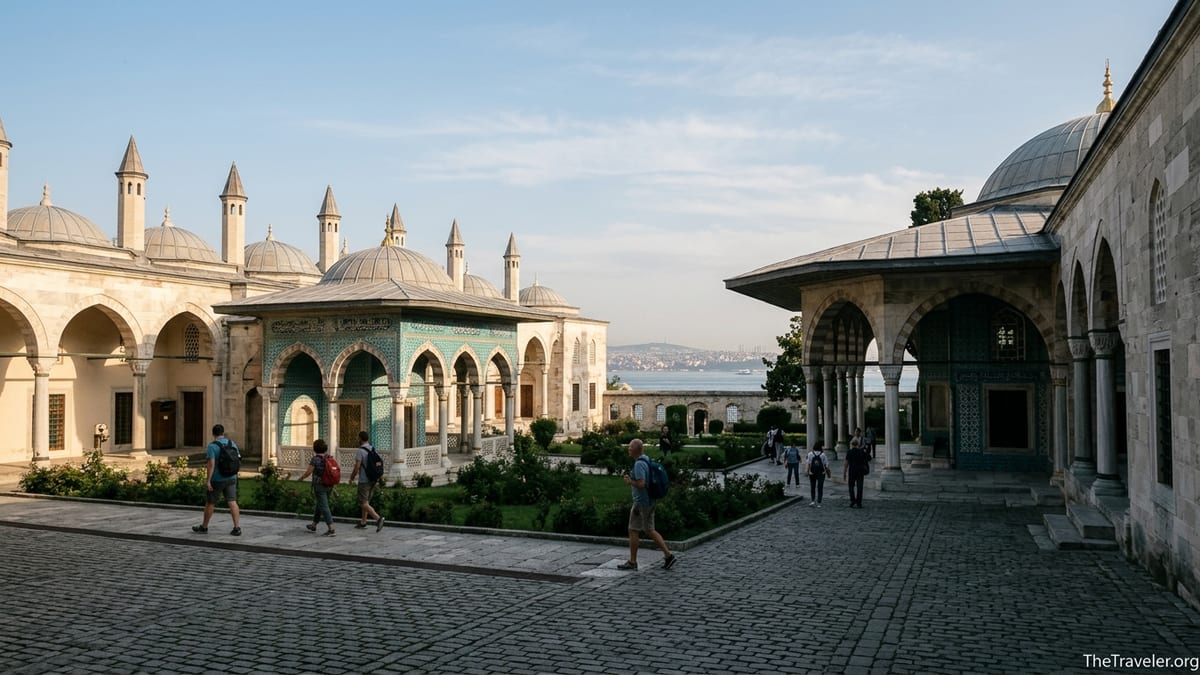
Once you emerge from the Harem, continue into the Third Courtyard through the Gate of Felicity. Here you will find the Audience Chamber, several smaller collections and, further in, the Treasury rooms that hold some of the palace’s most famous jeweled objects. I have learned to tackle the Treasury earlier rather than later, because the queues to enter each small room tend to build by midday and the crush can become uncomfortable. After the Treasury, drift outward toward the gardens and pavilions of the Fourth Courtyard, which frame some of the best views over the Bosphorus and the Asian side of Istanbul.
There is no single correct sequence for exploring Topkapı, but committing to a basic route before you arrive can save you from backtracking across cobblestones multiple times. Think about your own priorities. If Ottoman political history fascinates you, plan to linger longer in the Divan and Audience Chamber. If tilework and architecture are your main draw, you might focus on the Harem, the Baghdad Kiosk and the Revan Pavilion. Remember that the palace area is larger than it first appears on a map; pacing yourself is as important here as in a full-day hike.
What the Official Signs Do Not Tell You: Dress, Security and Conduct
Topkapı Palace is a museum, but it is also home to the Pavilion of the Holy Relics, a space that holds objects revered by many Muslims. There is no strict dress code for the open courtyards, yet I wish I had known in advance that modest clothing is strongly encouraged, and sometimes requested, in the Holy Relics area. On a recent visit, attendants at the entrance gently reminded visitors to cover bare shoulders and very short shorts before entering, offering shawls where needed. Packing a light scarf or cardigan and choosing knee-length or longer clothing means you will not be improvising with improvised wraps in the middle of your visit.
Security is thorough but generally orderly. Every visitor and bag passes through screening at the entrance, similar to an airport but a bit less intense. Pocketknives and obvious weapons are not allowed, and very large suitcases are not practical on the cobblestones anyway. One traveler I spoke with had tried to come directly from the airport with a full-size suitcase; guards directed her to a nearby luggage storage service outside the complex instead. If you are in transit through Istanbul, it is worth arranging baggage storage at the airport or at a left-luggage office in the city before heading to the palace.
Inside, photography is allowed in most outdoor areas and many rooms, but not everywhere. In the Holy Relics section, for example, photography may be restricted or discouraged, and flash is often banned around delicate textiles and manuscripts. I have seen staff remind visitors to put cameras away or lower voices in these spaces. You will enjoy your visit more if you treat certain rooms less like a tourist attraction and more like a place of quiet reflection or worship, especially when you see people reciting verses or standing silently in prayer near the relics.
Finally, be prepared for practical limits that are rarely highlighted in brochures. Restrooms are available but can involve a bit of a walk from certain corners of the complex, and lines build quickly during peak hours. Food and drink options within the palace grounds are convenient but priced for a captive audience; a simple sandwich and tea can cost significantly more than the same items on a side street in the nearby Sirkeci or Cağaloğlu neighborhoods. Carry a refillable water bottle and a small snack, and plan to have a proper meal before or after your visit rather than relying solely on the palace café.
Guides, Audio Guides and How Much Context You Really Need
Topkapı Palace is visually overwhelming, but without context it can also blur into “more tiles, more rooms.” I wish I had not tried to save money on my first visit by skipping any form of guiding. The palace does offer an official audio guide app that you can download in advance, and there are also third-party audio tours available for smartphones. These usually cover the main courtyards, the Harem and key highlight rooms such as the Audience Chamber and Treasury. If you prefer to move at your own pace and hit pause whenever a courtyard bench tempts you, a good audio guide is a strong compromise between a book and a live guide.
Live guided tours, whether booked privately or as part of a small group, tend to focus on a curated set of stories rather than every single object in every room. A good guide can help you imagine the ceremonial processions through the Second Courtyard, explain why the Harem was as much a political institution as a domestic space, and point out small details you might otherwise miss, like the soundproofing of certain doors or the way winter stoves are tucked into tiled walls. On one visit, my guide paused at an unassuming doorway to describe the ritual of the sultan’s morning council, and suddenly the adjacent chamber felt alive rather than static.
The trade-off with guided tours is speed and flexibility. Group tours often move faster than a thoughtful visitor might prefer, pausing briefly in front of highlight displays and then continuing so they can finish in two to three hours. If you know you like to read labels closely, photograph details or sit quietly looking out over the gardens, you may prefer to use a guide for just part of your visit and then wander independently. In recent years, some travelers have chosen a hybrid approach: booking a short guided tour that includes skip-the-ticket-line entry and Harem commentary, then staying on in the palace on their own after the official tour ends.
Whatever you choose, the key is to avoid going in completely cold. Spending even half an hour the night before reading about the Ottoman court or watching a reputable documentary will pay off in how much richer the experience feels. Topkapı is not a palace of a single spectacular hall like Versailles; it is a web of spaces whose meaning unfolds as you piece together how power, faith and daily life intertwined within its walls.
Managing Expectations: What Topkapı Is and Is Not
Perhaps the most important thing I wish I had known is that Topkapı Palace is not a conventional European-style palace full of grand ballrooms and uniform symmetry. It is more like a sprawling, inward-looking campus of courtyards, low-slung pavilions and gardens that evolved over centuries. Some first-time visitors arrive expecting something closer to Dolmabahçe Palace’s chandeliered halls and leave mildly underwhelmed because Topkapı feels less immediately “palatial” in a Western sense. Understanding what it is can prevent this mismatch.
Topkapı was the heart of an empire, not just a royal residence. You will see treasury rooms full of jeweled objects and ceremonial weapons, but also utilitarian kitchens with huge cauldrons, administrative chambers where crucial decisions were made and modest sleeping quarters tucked behind elaborately tiled walls. Much of its power lies in what you imagine happening in these spaces: envoys waiting anxiously for an audience, scribes drafting decrees, palace staff moving swiftly along colonnades out of sight.
You should also expect a living, evolving site rather than a perfectly polished stage set. Portions of the palace are frequently under restoration. On one visit, some of the most photogenic Harem rooms were closed for conservation; on another, scaffolding partly obscured one side of the kitchens. While this can be disappointing for photographers, it is also the reason so many delicate tiles, wooden ceilings and painted surfaces still exist at all. Build a little flexibility into your expectations so that a closed room does not overshadow the many others that are open.
Finally, accept that Topkapı today is a very popular attraction. You will not have it entirely to yourself, especially in peak season. There will be selfie sticks, school groups and tour leaders with flags. The trick is to find your own quieter moments within that reality: waiting an extra beat in a side courtyard after a group moves on, ducking into a less famous pavilion, or visiting in the shoulder seasons of early spring and late autumn when the air is cooler and the crowds slightly thinner. When you catch a glimpse of the Bosphorus through a lattice window in near silence, it becomes easier to see why this hilltop was once the center of the world for the sultans who ruled from here.
Practical Tips for Comfort, Accessibility and Nearby Sights
Comfort at Topkapı starts with your feet. The palace grounds are paved largely with cobblestones and uneven stone paths, which can be hard work in flimsy sandals or brand-new shoes. On my first visit I wore thin-soled sneakers and felt every ridge by midday; on subsequent trips, slightly more cushioned walking shoes made all the difference. If you rely on a stroller or wheelchair, be aware that the terrain and occasional ramps can be challenging. Some travelers with mobility issues have found it helpful to rent a lightweight wheelchair or even an electric one in Istanbul and to focus their visit on the more accessible courtyards rather than trying to see every corner.
Weather is another practical consideration you feel acutely on the day. In winter, the palace hill is exposed to wind and can feel much colder than sheltered streets nearby. In summer, shade can be scarce in the outer courtyards during midday. A compact umbrella works double duty as rain cover and sunshade. Light layers are useful, because many interior rooms can feel stuffy even when the air outside is cool. Topkapı is not the place to test out heavy new gear; aim instead for comfortable, breathable clothing that will keep you focused on the palace rather than your discomfort.
Because Topkapı sits within the historic peninsula, it combines easily with several other major sights. The Hagia Sophia, Blue Mosque and Basilica Cistern are all within comfortable walking distance. What I wish I had done earlier in my travels was to pair Topkapı with the Istanbul Archaeology Museums, located just downhill near Gülhane Park. The archaeology complex houses remarkable sarcophagi, ancient Near Eastern artifacts and classical sculptures that give powerful context to Istanbul’s pre-Ottoman past. Seeing both on the same day helps you understand how the Ottomans built their capital atop layers of earlier empires.
After your visit, consider taking a breather in Gülhane Park, which was once part of the palace grounds. Locals stroll here, children play under plane trees and small cafés serve tea and simple snacks at far gentler prices than inside the palace walls. Sitting on a park bench looking back up at the palace hill, you gain a different perspective on the complex you have just navigated and on the centuries of life that have pulsed around it.
The Takeaway
Topkapı Palace rewards the traveler who arrives prepared. Understanding that the Harem requires a separate ticket, that official museum passes have limits, and that you cannot skip security lines no matter what a salesperson promises will keep your expectations realistic. Planning your timing around closure days, tour-bus rhythms and the heat of the day can turn a potentially exhausting slog into a memorable half-day that still leaves you energy to enjoy the rest of Istanbul.
Equally important is adjusting your mental picture of what a palace can be. Topkapı is a world of courtyards, pavilions and intimate rooms rather than a single grand hall. Its power lies in accumulation: the repetitive pattern of tiles, the echo of footsteps under colonnades, the slow revelation of views over the Bosphorus. With even a bit of historical context from an audio guide or live guide, these spaces transform from pretty backdrops into stages where the politics, faith and daily intrigues of an empire once played out.
If you treat your visit not as a box to tick but as a slow walk through the heart of Ottoman Istanbul, small inconveniences like lines or closed rooms recede. You remember instead the coolness of stone under your hand, the unexpected quiet of a side garden, or a call to prayer drifting up from the city below. Those are the moments when Topkapı Palace feels less like a museum and more like a living chapter in the story of the city.
FAQ
Q1. How much time should I budget for a visit to Topkapı Palace?
Most visitors are comfortable with about three to four hours, including the Harem. If you explore slowly, use an audio guide and take a break for tea with a Bosphorus view, you may want closer to half a day.
Q2. Is the Harem really worth the extra ticket?
For many travelers, yes. The Harem contains some of the most intricate tilework and evocative rooms in the palace. If you are interested in Ottoman social history or architecture, the extra cost and time are usually well justified.
Q3. Can I use an Istanbul Museum Pass to enter Topkapı Palace?
The official Museum Pass Istanbul has typically included entry to Topkapı Palace itself, but the Harem often requires an additional ticket. Because inclusions change, you should always check the latest details close to your travel dates.
Q4. Are there specific days when Topkapı Palace is closed?
Topkapı Palace is commonly closed on Tuesdays and may have special hours or closures around major public holidays or state events. Verify current opening days and hours on an official information source before planning your visit.
Q5. What should I wear to visit Topkapı Palace?
Comfortable, modest clothing is best. Shoulders and knees should be covered if you plan to enter the Holy Relics section, and sturdy walking shoes are important for the cobblestone courtyards.
Q6. Is Topkapı Palace suitable for travelers with limited mobility?
Parts of the palace are accessible, but cobblestones, slopes and occasional steps can be challenging. Visitors with mobility issues often focus on the main courtyards and may benefit from a wheelchair or assistance.
Q7. Can I take photos everywhere inside Topkapı Palace?
You can take photos in most outdoor areas and many interior rooms, but flash is often prohibited and photography may be restricted in sensitive sections such as the Holy Relics. Always follow posted signs and staff instructions.
Q8. Is it better to visit Topkapı Palace in the morning or afternoon?
Morning visits, especially right after opening, are usually quieter and cooler, with softer light over the Bosphorus. By late morning and early afternoon, crowds and heat tend to increase significantly in peak season.
Q9. Do I need a guide to enjoy Topkapı Palace?
You can visit independently, but some form of guidance, whether a live guide or a well-made audio guide, greatly enriches the experience and helps you understand the significance of what you are seeing.
Q10. Can I combine a visit to Topkapı Palace with other nearby attractions in one day?
Yes. Many travelers pair Topkapı with the Hagia Sophia, Blue Mosque or the Istanbul Archaeology Museums, all within walking distance. Just be mindful of museum fatigue and give yourself time to rest between major sites.