


If you are landing at Toronto Pearson International Airport and heading downtown, the Union Pearson Express (UP Express) is usually the fastest and most stress-free option. This guide explains exactly how to use the train between Pearson and Union Station in 2026, including where to find the station in Terminal 1, how to connect from Terminal 3, current ticket and PRESTO options, travel time, luggage tips and the most common mistakes first-time visitors make.
Get the latest updates straight to your inbox!
What the UP Express Is and When It Makes Sense
The Union Pearson Express is a dedicated airport rail link running between Toronto Pearson International Airport and Union Station in downtown Toronto. Trains cover the full distance in about 28 minutes, with intermediate stops at Weston, Mount Dennis and Bloor. In typical traffic, that is usually faster and more predictable than taxis or ride-hailing services, which can take anywhere from 35 minutes to well over an hour in rush hour or bad weather.
UP Express operates from early morning to late at night, with trains generally every 15 minutes during most of the day. There may be occasional schedule changes for track work or holidays, but as a visitor you can usually assume you will not wait long. Many travelers who land at Pearson around 5 p.m. on a weekday choose UP Express specifically to avoid sitting in Highway 401 and Gardiner Expressway congestion.
The train makes the most sense if your hotel or apartment is in or near downtown, particularly around Union Station, the Financial District, Entertainment District, Harbourfront, or connected neighborhoods like the St. Lawrence Market area or the CN Tower / Rogers Centre cluster. For example, someone staying at a major hotel near Front Street or on King Street West can be off the train at Union and walking to their lobby within 10 to 15 minutes.
On the other hand, if you are staying in the suburbs or in an area that is not well connected to downtown transit, it may be more convenient to combine UP Express with the subway or a rideshare from Union, or skip the train and go directly by taxi from Pearson. This guide focuses on how to use the train effectively when downtown is your main destination or transit hub.
Finding the UP Express at Pearson: Terminal 1 & Terminal 3
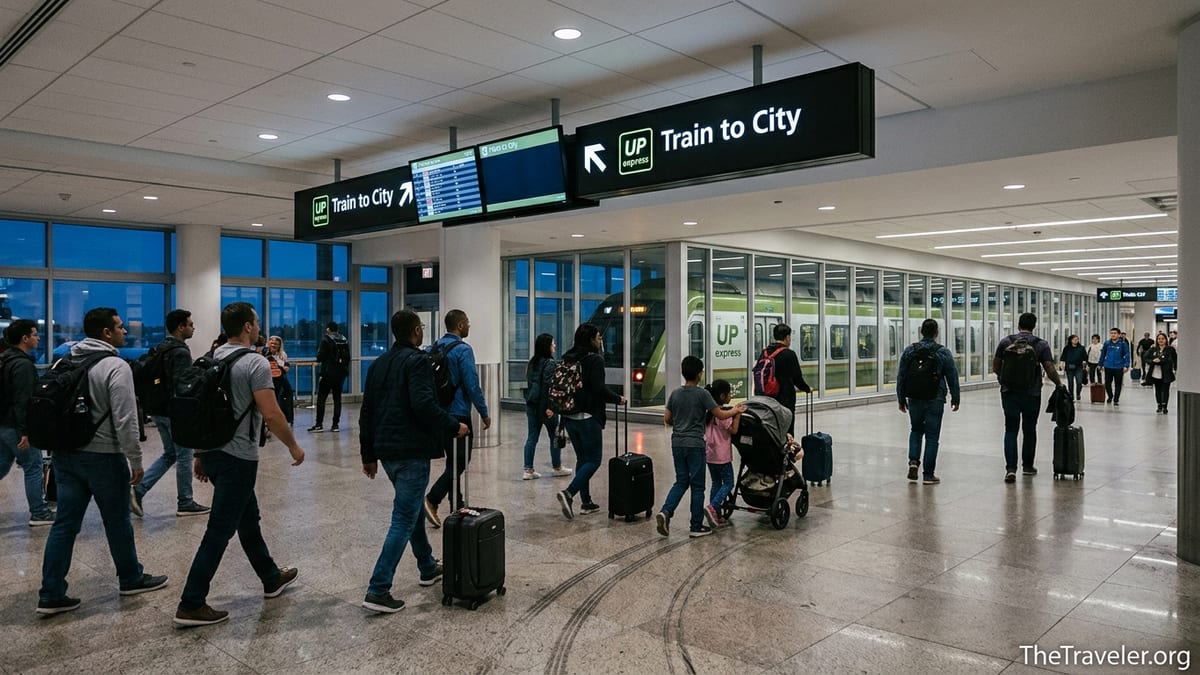
The UP Express station is located in Terminal 1 at Pearson, connected to the main terminal building by a short enclosed walkway. As soon as you exit customs or the domestic arrivals area, follow the overhead signs that read “Train to City.” These signs are consistent and appear every few meters, so if you keep following them you will end up at the correct place even if you are tired after a long flight.
From the Terminal 1 international arrivals hall, the walk to the UP Express station typically takes about 5 to 10 minutes at a normal pace with luggage. The route is step-free: moving walkways, elevators and escalators make it straightforward for travelers with suitcases, strollers or mobility aids. Once you reach the station, you will find a small concourse with ticket machines, customer service staff during core hours, fare gates and the platform.
If you are arriving or departing from Terminal 3, you will not find the train in your own terminal. Instead, you take the free Terminal Link shuttle train to Terminal 1. Terminal Link is a separate automated people mover that connects Terminal 1, Terminal 3 and some parking and hotel facilities. Just follow the green “Terminal Link” signs in Terminal 3, ride to Terminal 1, and then follow the “Train to City” signs from there. Most people need about 10 to 15 minutes from Terminal 3 arrivals to reach the UP Express platform, including the short Terminal Link ride.
Travelers sometimes worry they might accidentally board the wrong train, but at Pearson that is unlikely. The UP Express platform is clearly branded with the UP Express name and signage, and announcements on the platform will refer specifically to trains to Union Station. If you are uncertain, you can simply ask any airport or UP Express staff member to confirm you are in the right place.
From Union Station to the City: Orientation and Connections
On the downtown end of the route, the UP Express arrives at Union Station, Toronto’s main rail and transit hub. The UP Express platforms are on the west side of the station complex, directly connected to the main concourse. When you step off the train, you will pass fare gates and then enter a bright hall with ticket machines, elevators and clear signs pointing toward “Union Station,” “Subway,” “Streetcars,” and “PATH” (the underground pedestrian network).
Union Station is the gateway to much of downtown Toronto. The city’s primary subway interchange is directly beneath the station, providing access to Line 1 (the north-south Yonge–University line) and, via a short walk, Line 2 Bloor–Danforth. Streetcars and buses serving major downtown corridors such as King Street, Queen Street and the waterfront depart from nearby stops on Front Street and along neighbouring streets. Many office towers and hotels, including several large international brands around Front Street West and the Financial District, are reachable entirely indoors via the PATH system.
If you are connecting to an intercity train or bus, Union Station is also the hub for VIA Rail long-distance services and regional GO Transit trains and buses. UP Express platforms are only a few minutes’ walk from the main VIA Rail concourse and the GO Transit platforms. This makes UP Express particularly convenient if, for example, you are flying into Pearson and then continuing by train to cities such as Ottawa, Montreal or Kingston, or to regional destinations like Hamilton, Kitchener or Oshawa.
First-time visitors often underestimate the size of Union Station and the number of exits. To avoid confusion, take a moment after leaving the UP Express gates to find a map or ask staff which exit is closest to your hotel address. For instance, travelers heading to the Entertainment District often look for exits toward Front Street and Simcoe Street, while those going to the Financial District may prefer the PATH entrances leading toward Bay Street and Wellington Street.
Tickets, PRESTO and Contactless Payments Explained
UP Express now supports several ways to pay for your ride: traditional UP Express tickets, PRESTO cards, and contactless payment with credit or debit cards or compatible mobile wallets. Ticket machines at Pearson and Union sell paper tickets and some discounted options, while staff at the customer service counters can assist if you are unsure which fare is best for your situation. Many travelers, however, prefer to simply tap with a card or phone at the fare gates.
PRESTO is the regional smart card system used on most transit throughout the Greater Toronto and Hamilton Area, including UP Express, GO Transit and the Toronto Transit Commission (TTC). If you intend to use public transit beyond the airport train, it can be worth purchasing a physical PRESTO card or setting up a digital PRESTO card in a mobile wallet. Typical adult UP Express fares from Pearson to Union using PRESTO are lower than paying the standard cash or paper ticket price, and post-secondary students and youth with the correct fare type set on their card can receive significant discounts compared with the full adult fare.
If you do not have a PRESTO card, you can still receive similar pricing by tapping a contactless credit or debit card, or a card loaded in a phone or watch, on the UP Express fare readers. The key rule is that you must tap the same card or device when you start and end your journey. For example, if you tap in with a physical Visa card at Pearson, you need to tap out with that same physical card at Union; tapping with your phone’s mobile wallet instead would count as a separate payment method.
For some travelers, especially occasional visitors, the simplest option is to use contactless payment directly on the fare gates and skip buying a separate transit card. A frequent business traveler, by contrast, might prefer a physical PRESTO card with automatic reload set up, both for UP Express and for daily TTC rides within Toronto. The key is to choose a method that you can consistently tap with and that has enough balance or credit available for your trips.
How to Tap On, Tap Off and Avoid Fare Surprises
UP Express uses a proof-of-payment system, which means you are expected to have a valid fare and to be able to show it if requested. When using PRESTO or contactless payment, your “ticket” is the successful tap entry stored on your card or device. You must tap on at the beginning of your trip and tap off at the end, at the clearly marked PRESTO or fare devices at each station.
At Pearson, tap devices are located before the fare gates leading to the platform. You tap once, wait for the confirmation beep and visual indicator, then pass through the gates. At Union, tap devices are either integrated with the gates or placed just before them. When you arrive at your destination, you must tap off. If you forget to tap off, the system will typically charge a maximum fare based on the longest possible trip from the station where you tapped on, which can be more expensive than the fare you actually should have paid.
One common mistake involves mixing payment methods. For example, a traveler might tap on at Pearson with a plastic MasterCard, then try to tap off at Union with the same card stored in their phone wallet. The system treats these as two separate cards, so it does not register a proper tap off, and the traveler may be charged a higher fare or appear to have no valid proof of payment during an inspection. To avoid this, choose one physical card or one device for the entire journey.
Another error occurs when visitors are holding both a loaded PRESTO card and a contactless bank card in the same wallet or phone case. If they wave the whole wallet at the reader, it may read the wrong card. This can result in charges on an unexpected card and confusion about balances. The safest practice is to remove the specific card you want to use from your wallet and hold it flat against the reader, or to use only your phone or only your watch instead of both.
Travel Time, Frequency and What to Expect On Board
In normal conditions, the UP Express journey between Pearson and Union takes about 28 minutes end to end. Trains are designed to run frequently and reliably, typically every 15 minutes during most daytime periods and early evenings. Early morning or late-night service can be slightly less frequent, and there may be occasional temporary adjustments for maintenance weekends or special events, but the line is intended to offer a near turn-up-and-go service for airport travelers.
On board, trains have comfortable seating with a mix of forward and backward-facing seats, overhead luggage racks and designated areas for larger suitcases. The interior is more spacious and quieter than a typical metro or commuter train, with wide doors to allow easy boarding with bags. Many travelers use the ride to check email, review hotel details or simply rest after a long flight.
Most UP Express trains are equipped with power outlets or charging points, air conditioning or heating appropriate to the season, and information screens that show the next stop and approximate time to arrival. Announcements are clear and bilingual, and there is plenty of space near the doors for passengers with mobility devices or strollers. Compared with sitting in a taxi in traffic, the ride feels smooth and predictable, which is especially appreciated during Toronto’s winter months when road conditions can rapidly deteriorate.
Because the route has only a few stops, dwell times at each station are relatively short. If you are traveling with multiple large suitcases, it is a good idea to have your bags ready to move off the train a minute or two before arrival at your stop, especially at Union Station where more passengers may be boarding or alighting. This helps avoid a last-minute scramble in the aisles and keeps the service running on schedule.
Luggage, Accessibility and Family Travel
UP Express is set up to handle typical airport luggage without extra fees. You can bring carry-on bags, checked suitcases and personal items on board, as long as you can manage them yourself and they do not block aisles or doors. Overhead racks are suitable for smaller roller bags and backpacks, while larger checked suitcases can be placed on the floor in designated luggage areas near the doors or beside your seat if space allows.
Because the train connects directly to Pearson’s terminals, many passengers bring items like strollers, child car seats, sports equipment or musical instruments. In most cases, these are allowed as long as they can be safely stored and moved. For example, a family arriving from Europe with two young children might wheel a stroller and two medium suitcases onto the train, park the stroller folded in a luggage area, and keep the children seated together for the 28-minute ride without issue.
The service is designed to be accessible for passengers with reduced mobility. Stations have elevators and ramps, and train doors and interiors are configured to accommodate wheelchairs and mobility aids. If you need additional time to board or exit, it is sensible to wait near the doors and signal to staff if you require assistance. Many travelers using mobility devices prefer UP Express to taxis because the boarding process at the station can be more predictable than arranging an accessible vehicle at the curb.
For families, UP Express can be less stressful than transporting children by car after a long flight. There are no seat belts or car seats required on the train, and children can sit next to parents or guardians easily. Parents often appreciate that the train offers a defined, short travel time; a parent can confidently promise a tired child that they will be “at the hotel in about half an hour” and be accurate in most cases.
Common Mistakes and How to Avoid Them
Several recurring mistakes affect visitors using UP Express for the first time, but they are easy to avoid with a bit of advance knowledge. The most frequent error is forgetting to tap off when using PRESTO or contactless payment. As noted earlier, failing to tap off can result in being charged a maximum fare instead of the correct amount. To prevent this, make a habit of looking for the tap devices as soon as you leave the train and tapping before you walk away from the platform area.
Another common issue is assuming that your PRESTO or contactless payment on UP Express automatically provides free or discounted transfers to the Toronto subway (TTC). While there are regional fare integration programs in place, UP Express is treated differently than many local services, and you should not assume you can switch from UP Express to the TTC subway at Union without paying a separate TTC fare. To illustrate, a traveler might tap their PRESTO card on UP Express at Pearson, ride to Union, and then try to walk straight onto the subway platform expecting a free transfer. In practice, they will still need to pass through TTC fare gates and pay the regular TTC fare for that part of their journey.
Some visitors also mix up the different trains at Pearson. The Terminal Link people mover between Terminal 1 and Terminal 3 is free and separate from UP Express, which is a paid service into the city. A traveler in a hurry might see the Terminal Link platform in Terminal 3, jump on without reading the signs carefully, and then realize they have only moved between terminals rather than started their journey downtown. The fix is simple: always check that you are following signs specifically labeled “Train to City” before expecting to arrive at Union Station.
Finally, travelers occasionally underestimate the walking time within Pearson and Union Station. If you book a train ticket with a very tight connection to a long-distance rail service or a timed event, remember that you may need 10 to 15 minutes to get from your gate to the UP Express platform at Pearson, and another 5 to 10 minutes to navigate Union Station to your next platform or exit, especially during busy periods. Building in a comfortable buffer can reduce stress and ensure that a delay at security or baggage claim does not cause a missed connection downtown.
The Takeaway
UP Express offers one of the most efficient and predictable ways to travel between Toronto Pearson International Airport and downtown Toronto. With a consistent travel time of around 28 minutes, frequent departures and direct connections to Union Station’s local and regional transit, it is particularly well suited to visitors whose final destination is in or near the downtown core.
By understanding a few key details in advance, you can make the experience almost effortless: know that the station is in Terminal 1, remember to take the free Terminal Link from Terminal 3 if needed, decide whether you will pay with a PRESTO card or contactless bank card, and always tap on and tap off at the fare devices. Add in simple habits like keeping your chosen card separate in your wallet, giving yourself a modest time buffer for airport walking distances, and checking signs carefully for “Train to City,” and you will likely find the journey straightforward even after a long international flight.
For business travelers heading straight to downtown meetings, families starting a Canadian vacation or students arriving for a semester in Toronto, the UP Express is designed to be an accessible, luggage-friendly and time-efficient link between the airport and the city. Used properly, it can turn what might have been a stressful first step into Toronto into a smooth, predictable and even relaxing ride.
FAQ
Q1. How long does the UP Express take from Pearson to Union Station?
The full journey between Toronto Pearson Airport and Union Station usually takes about 28 minutes in normal operating conditions.
Q2. How often do UP Express trains run?
Trains typically run every 15 minutes for most of the day, with slightly different frequencies early in the morning or late at night depending on the schedule.
Q3. Where is the UP Express station at Pearson Airport?
The UP Express station is in Terminal 1, connected to the terminal building by a short indoor walkway and clearly signed as “Train to City.”
Q4. How do I get to UP Express from Terminal 3?
From Terminal 3, take the free Terminal Link shuttle train to Terminal 1, then follow the “Train to City” signs to the UP Express station.
Q5. Can I pay for UP Express with a PRESTO card?
Yes. You can tap a physical PRESTO card or a digital PRESTO card in a mobile wallet at the station fare devices, usually at a lower fare than standard cash tickets.
Q6. Can I just tap my credit or debit card instead of buying a ticket?
Yes. You can tap a contactless credit or debit card, or the same card in your phone or watch, as long as you use the same payment method to tap on and tap off.
Q7. Do I need to tap off when I get off the train?
Yes. When using PRESTO or contactless payment, you need to tap off at your destination station; otherwise, you may be charged a higher maximum fare.
Q8. Is luggage allowed on the UP Express?
Yes. You can bring typical airport luggage, including carry-on bags and checked suitcases, as long as they do not block doors or aisles and you can handle them yourself.
Q9. Is the UP Express accessible for wheelchairs and strollers?
Yes. Stations have elevators and ramps, and trains are designed to accommodate wheelchairs, mobility aids and strollers with level or near-level boarding.
Q10. Does a UP Express fare include a free transfer to the Toronto subway?
No. UP Express fares do not automatically include Toronto subway (TTC) rides; you generally need to pay a separate TTC fare when you enter the subway system.