


Toronto Pearson International Airport sits about 25 kilometres west of downtown Toronto, which means that how you choose to travel after landing can make a real difference to your time, budget and stress levels. From a fast dedicated airport train to budget buses, metered taxis, rideshares, limos and pre-booked drivers, there is no single best option for everyone. It depends on where you are staying, how much luggage you have, your arrival time, and how comfortable you are using local transit. This guide breaks down the main choices with real-world examples so you can step off the plane with a plan.
Get the latest updates straight to your inbox!
Understanding Your Route From Pearson to Downtown
Toronto Pearson International Airport (code YYZ) is located in Mississauga, west of Toronto’s core. Downtown for visitors usually means the area around Union Station, the Financial District, the Entertainment District, and the waterfront, plus nearby neighbourhoods like King West, Queen West, Yorkville and the Distillery District. Travel time into this area can vary from about 25 minutes by train in light crowds to over an hour by car in peak traffic.
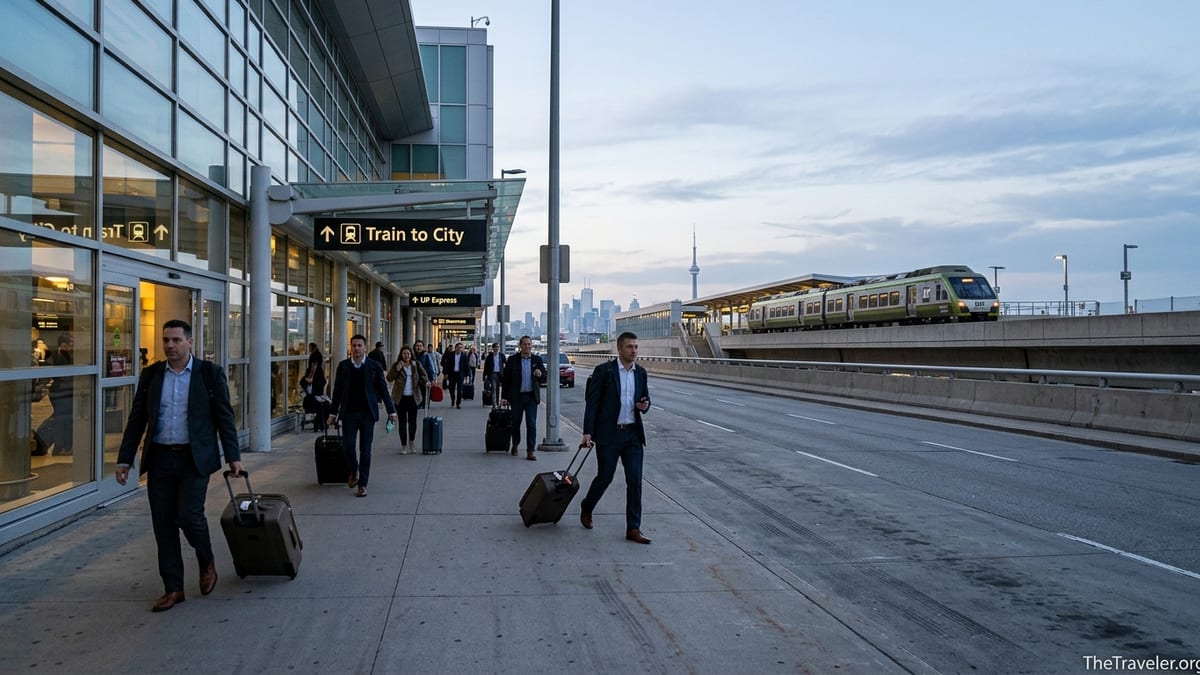
Most international flights arrive at Terminal 1 or Terminal 3. A free elevated shuttle called the Terminal Link connects the two terminals around the clock, so you can easily reach any transport option even if it departs from the other terminal. The Union Pearson Express train station is physically attached to Terminal 1, while taxis, rideshares and limos pick up at designated curbs outside both terminals.
Traffic on Highway 427 and the Gardiner Expressway is a major factor for car-based transfers. Morning rush hour into downtown typically runs around 7:00 to 9:30, while the evening rush out of downtown to the airport is roughly 4:00 to 7:00. If you land at 8:00 on a weekday, a taxi or Uber to a hotel near Union Station might take 45 to 60 minutes, while the UP Express train remains consistently around 25 to 30 minutes once you reach the platform.
When planning, it helps to think door to door rather than just airport to downtown. A traveler staying steps from Union Station at the Fairmont Royal York may strongly favour the train. Someone booked at the Chelsea Hotel near Yonge and Gerrard might accept a short subway or streetcar ride from Union. A family headed to a rental in Liberty Village might find a taxi or Uber directly from Pearson to be simpler than juggling transfers with luggage and kids.
UP Express: Fastest Link to Union Station
The Union Pearson Express, usually shortened to UP Express, is the dedicated airport rail link between Pearson Terminal 1 and Union Station in downtown. Trains typically run every 15 minutes most of the day, and the trip to Union takes about 25 to 28 minutes. Because the route is on a dedicated rail corridor, the travel time is far less vulnerable to highway traffic than taxis or rideshares.
Fares change periodically, but as of mid-2026 an adult one way from Pearson to Union is in the low teens in Canadian dollars, with a small discount if you tap a contactless credit or debit card or a local transit card instead of buying a paper ticket. Children under 12 usually ride free, which can make the UP Express surprisingly economical for families with young kids. For example, two adults and two children under 12 traveling from Terminal 1 to Union often pay roughly what a single adult taxi passenger might tip alone on a congested day.
Using the train is straightforward in practice. From international arrivals in Terminal 1, follow the overhead signs marked for “Train to City.” You ride an escalator or elevator up to the UP Express concourse, buy or tap for your ticket at the machines or fare gates, and walk directly onto the platform. Travelers arriving at Terminal 3 take the free Terminal Link train to Terminal 1, then transfer upstairs to the UP Express. Even with this connection, many first-time visitors report being on the train within 20 to 30 minutes of clearing customs when lines are light.
UP Express is especially convenient if your hotel is near Union Station or on the Line 1 or Line 2 subway corridors. Guests at the Westin Harbour Castle, the Delta Toronto and the InterContinental Toronto Centre can walk from Union in about 10 minutes or less. Visitors bound for Yorkville or the Bloor Street shopping area can connect to Line 1 at Union and ride north to Bloor, Museum or St George, or exit one stop west at Bloor GO / Dundas West on UP Express and transfer there. Business travelers with meetings in the Financial District often choose the train specifically to avoid the uncertainty of Gardiner traffic.
Taxi: Simple Door-to-Door, Especially With Luggage
Licensed airport taxis line up just outside the arrivals level at both terminals. There is usually a dispatcher at a booth who will direct you to the next available car and can confirm a typical price range to your destination. Vehicles are standard sedans with space for two large suitcases in the trunk and some carry-on in the back seat. For bigger groups or more luggage, airport minivans are also available from the same rank.
Instead of a strict flat fare schedule for every downtown address, most travelers now see consistent meter ranges to the core. For a typical weekday evening ride from Pearson to a hotel near Union Station or the Metro Toronto Convention Centre, visitors regularly report paying roughly between 65 and 80 Canadian dollars before tip, depending on traffic and route. At 11:00 at night when traffic is lighter, that same trip can drop closer to the lower end of that range.
The main advantage of a taxi is that it is fully door to door. A solo traveler staying at a boutique hotel on a side street in the Entertainment District can step into a cab at Terminal 1 and step out directly at the hotel’s front door without managing luggage on escalators, platforms or subway stairs. For people with mobility issues or heavy equipment, such as musicians carrying instruments to a show on Queen Street West, that simplicity often outweighs the cost savings of public transit.
There are downsides. Travel time can swing significantly in rush hour or during special events such as a Blue Jays game, a major concert at Scotiabank Arena, or road closures for festivals. It is not unusual for the drive to stretch beyond an hour if there are incidents on the highways. Taxis are also usually metered, which means you will not know the exact final price when you get in. If this uncertainty bothers you, an airport limo service that posts flat rates or a pre-booked ride might feel more comfortable.
Uber and Lyft: Flexible but Price-Sensitive
Rideshare services such as Uber and Lyft are widely available at Toronto Pearson and have designated pickup zones at both terminals, separate from the regular taxi line. After collecting your bags, you request a ride in the app, select your terminal and door as the pickup point, and you will be guided to a signposted rideshare lot. This can take a few extra minutes compared with walking directly into the taxi rank, but many travelers like seeing the estimated fare upfront in the app.
In normal conditions and outside peak surges, an UberX or equivalent from Pearson to a downtown hotel near Union Station might be quoted in the range of 45 to 70 Canadian dollars, often undercutting a metered taxi. However, demand-based pricing can change that quickly. If you land at 5:30 on a winter weekday in heavy snow or arrive during a popular concert night, surge multipliers can push the estimate above what a traditional cab might charge for the same journey. Experienced travelers sometimes open both a taxi fare estimator and their rideshare app to compare before committing.
Rideshares can be a strong value for couples or small groups staying outside the immediate Union Station area. For instance, a group of three friends booked at a loft near Trinity Bellwoods Park can ride directly there from Pearson in a single UberX for not much more than the cost of three individual UP Express tickets plus a streetcar transfer. Similarly, families staying in condo-heavy neighbourhoods like CityPlace or Fort York often choose rideshare simply because it eliminates extra moves with strollers and checked bags.
On the other hand, riders should factor in potential wait times. During very busy periods or late at night in winter, you might face a 10 to 15 minute wait for your driver to reach the pickup zone. If you are arriving jet lagged from overseas and are not comfortable using your phone data immediately on landing, the predictability of the taxi queue or UP Express may appeal more. It is also worth remembering that Canadian law requires proper child restraints; rideshare drivers are not obliged to carry car seats, so families with toddlers may be better served by an airport limo or private transfer that includes seats on request.
Airport Limo and Private Transfers: Comfort and Certainty
For travelers who prioritize comfort and predictability, pre-booked airport limo services and private transfers are a popular option. These services typically use black sedans, SUVs or vans, with drivers waiting at the curb or sometimes inside the terminal with a sign. Many operators publish flat rates from Pearson to downtown zones, so you know the cost before landing. As of 2026, a pre-arranged sedan from Pearson to a downtown hotel often falls somewhere around 90 to 120 Canadian dollars, with SUVs and vans costing more.
Private transfers are particularly attractive to business travelers on tight schedules, families with lots of luggage, and anyone arriving late at night who does not want to navigate public transit. For example, a family of five arriving from Europe with four large suitcases might book a private van that includes a booster seat and child seat, pay a flat fee, and enjoy a direct journey to a rented townhouse in Leslieville. Compared with buying multiple UP Express tickets, then transferring to a streetcar while juggling kids and bags, the door-to-door aspect can feel worth the premium.
Some services allow you to add extras such as a meet-and-greet inside the terminal, assistance with baggage, or a short grocery stop en route to your accommodation. Hotels in the core, particularly higher-end properties like the Shangri-La, St. Regis or Ritz-Carlton, often recommend preferred limo partners and can arrange transfers as part of your booking. This is helpful if your corporate travel department needs an invoice or if you prefer to charge everything through the hotel.
The main drawbacks are cost and the need to plan ahead. While you can sometimes book an airport limo last minute after landing, cars may be scarce during major events or busy holiday periods. If your flight is significantly delayed, you should check the operator’s policy on waiting time charges. And if you are staying right next to Union Station during the day and traveling light, the UP Express is almost always faster and far cheaper than a chauffeured car.
TTC Buses and Subway: The Cheapest Option
For budget-conscious travelers or those who enjoy using local transit, Toronto’s public transportation system offers the lowest-cost route between Pearson and downtown. The key service is the 900 Airport Express bus, which runs from Pearson to Kipling subway station on Line 2 Bloor–Danforth. From there, you can connect across the subway network to reach downtown and other neighbourhoods. The entire journey is covered by a single standard city transit fare, which is notably lower than even the cheapest private alternatives.
In practice, a rider might board the 900 Airport Express at Terminal 1, ride about 20 to 25 minutes to Kipling station depending on traffic, tap through to the subway, then ride Line 2 east for around 25 minutes to St George or Bloor–Yonge. From there, they can transfer southbound on Line 1 to Union, King or Queen. In total, the trip from Pearson to Union might take about 60 to 75 minutes, longer at rush hour but at a fraction of the cost of a taxi or rideshare.
Overnight, when the subway is closed, other TTC routes and overnight buses maintain links between Pearson and the city, although connections can be slower and more complicated. Locals who live in west-end neighbourhoods like Bloor West Village, The Junction or Roncesvalles often use a mix of the 900 Airport Express and regular buses or streetcars to reach home after late flights, accepting the extra time in exchange for saving 50 to 70 dollars compared with a taxi.
TTC is best suited to travellers comfortable navigating transit maps and managing their luggage on buses and trains. If you are a solo backpacker staying in a hostel near Kensington Market, taking the 900 bus and subway can be an economical and authentically local way to start your trip. Conversely, arriving with two large checked bags and a toddler stroller on a snowy evening, you may decide that the savings are not worth the hassle of hauling everything through several transfers.
Choosing the Best Option by Hotel Area
Where you are staying in Toronto is just as important as your budget when choosing a transfer. For hotels directly around Union Station and the Financial District, such as the Fairmont Royal York, Marriott City Centre, Delta Toronto, InterContinental Toronto Centre and the new generation of high-rise condo hotels near Bremner Boulevard, the UP Express is usually the clear winner during daytime hours. You can walk from Union to most of these properties in about 5 to 10 minutes, and in bad weather the underground PATH network provides an almost entirely indoor route.
For the Entertainment District and King West, which include hotels like the Hyatt Regency Toronto, the Bisha, the King Blue and various boutique properties along King Street, both the UP Express plus a short streetcar or taxi ride and a direct taxi or Uber from Pearson are viable. During the afternoon rush, many visitors still prefer taking the train to avoid unpredictable highway congestion, then grabbing a short cab ride from Union. Late at night when traffic is light, a rideshare straight from the airport might be faster and only modestly more expensive.
Travelers staying in midtown or uptown, such as around Yonge and Bloor, Yorkville, or the Eglinton corridor, can combine UP Express with Line 1 or Line 2, or use TTC’s 900 Airport Express and subway combination. A guest at the Park Hyatt or Four Seasons in Yorkville, for instance, can ride UP Express to Union, then take Line 1 northbound to Museum, St George, Bay or Bloor–Yonge depending on the walking route. A budget traveler staying near St Clair West might save more by taking the 900 Airport Express to Kipling, crossing by subway, then up Line 1 to St Clair West.
Neighbourhoods that are not directly on the subway, such as Liberty Village, Leslieville, or parts of Queen West, tilt the calculus toward car-based options. A solo visitor to Liberty Village might still prefer UP Express to Union and a streetcar or short Uber from there, but a group of four headed to an Airbnb near Queen and Ossington will often find that splitting a rideshare or taxi from Pearson is both simpler and cost-competitive. When in doubt, plug your accommodation address into both a transit planning app and a rideshare fare estimator and compare not just price and time, but also the number of transfers involved.
Luggage, Mobility and Travel Style Considerations
The amount and type of luggage you are carrying can quickly tip the balance among transfer options. A minimalist traveler with a single carry-on rolling bag can move easily onto the UP Express, then through the subway or PATH network. By contrast, two adults each with a large checked suitcase, a carry-on and a personal item may find escalators, moving walkways and crowded platforms considerably less appealing, especially after a long overnight flight.
Families and travelers with mobility challenges should also pay close attention to elevator access and walking distances. While both Pearson and Union Station are wheelchair accessible, some downtown subway stations still have limited elevator coverage, and streetcar stops can involve curbside boarding. In these cases, a direct taxi, Uber, or private transfer that delivers you straight to your hotel lobby reduces the risk of struggling with stairs or uneven sidewalks.
Your personal comfort level with unfamiliar transit systems matters too. Some visitors enjoy figuring out routes and treat the UP Express and TTC combination as part of experiencing the city. Others find it stressful and would rather pay more to be driven. For example, a first-time visitor from a smaller town in Europe arriving alone late at night might book an airport limo to the Hilton Toronto and sleep in the back seat, while a frequent urban traveler from New York might happily hop on UP Express and be downtown within half an hour.
Finally, think about your return journey when choosing how to get into the city. If your outbound flight leaves Pearson in the late afternoon, you may want to avoid relying solely on a taxi in rush hour and instead plan to take the UP Express back from Union. Conversely, if you have a very early morning departure and are staying slightly outside downtown, scheduling a private transfer or Uber pickup from your accommodation could save you from handling baggage on the subway at dawn.
The Takeaway
No single transfer option from Toronto Pearson Airport to downtown Toronto is perfect for everyone. The UP Express offers the most predictable travel time and excellent value for solo travelers, couples and families with young children staying near Union Station or along key subway lines. Taxis and rideshares trade higher and more variable costs for door-to-door simplicity, particularly attractive when you are jet lagged, carrying heavy bags, or staying in neighbourhoods that are not directly connected to the subway.
Airport limos and private transfers add another level of comfort and certainty, with flat rates and meet-and-greet services that suit business travelers, large families and anyone with mobility needs. Meanwhile, the TTC’s 900 Airport Express bus and subway network represent the best budget option, ideal for confident transit users willing to accept a longer journey and a couple of transfers in exchange for saving a substantial amount of money.
The right choice for you depends on a mix of time, cost, hotel location, luggage, and how you prefer to travel. Before you land, look up a rough UP Express fare, open a rideshare app for a sample quote, check how close your hotel is to Union Station, and consider how much you want to think about logistics after a long flight. With a small amount of planning, getting from Pearson into downtown Toronto can be straightforward, predictable and even an enjoyable first glimpse of the city.
FAQ
Q1. What is the fastest way to get from Toronto Pearson Airport to downtown?
The fastest and most reliable option for most travelers is the UP Express train from Pearson Terminal 1 to Union Station, which usually takes about 25 to 28 minutes once you are on board.
Q2. How much does a taxi from Pearson to downtown Toronto cost?
Typical metered taxi fares from Pearson to hotels near Union Station or the Financial District often fall in the range of roughly 65 to 80 Canadian dollars before tip, depending on traffic.
Q3. Is Uber or Lyft cheaper than a taxi from the airport?
Outside of surge pricing, an UberX or similar rideshare from Pearson to downtown can be somewhat cheaper than a taxi, but during peak times or bad weather the dynamic pricing can push costs above a regular cab.
Q4. What is the cheapest way to reach downtown from Pearson?
The lowest cost option is to use Toronto’s public transit, typically the 900 Airport Express bus from Pearson to Kipling station followed by the subway into downtown, all covered by a single standard transit fare.
Q5. Is the UP Express a good choice for families with kids?
Yes, the UP Express is popular with families, especially because children under a certain age usually ride free and trains have space for strollers and luggage, making it both affordable and convenient.
Q6. Which option is best if my hotel is right by Union Station?
If you are staying at or near Union Station, such as at the Fairmont Royal York or a nearby condo hotel, the UP Express is usually the best choice, offering a short, direct walk from the platform to your accommodation.
Q7. Should I pre-book an airport limo or private transfer?
Pre-booking a limo or private transfer is worthwhile if you have a lot of luggage, are traveling with small children, arrive very late at night, or simply want a fixed price and a driver waiting specifically for you.
Q8. How long does it take to reach downtown by TTC bus and subway?
Using the 900 Airport Express plus the subway, most travelers should expect a journey of about 60 to 75 minutes from Pearson to Union Station, longer during heavier traffic on the bus portion.
Q9. What is the best option if I have mobility issues or heavy bags?
For significant mobility challenges or very heavy luggage, a door-to-door taxi, Uber, or private transfer is usually more comfortable, as it avoids station transfers, escalators and crowded platforms.
Q10. Is public transit safe to use at night from Pearson to downtown?
Toronto’s public transit system is generally considered safe, including in the evening, but late at night service is less frequent and involves more waiting and transfers, so some travelers prefer taxis or rideshares after very late arrivals.