


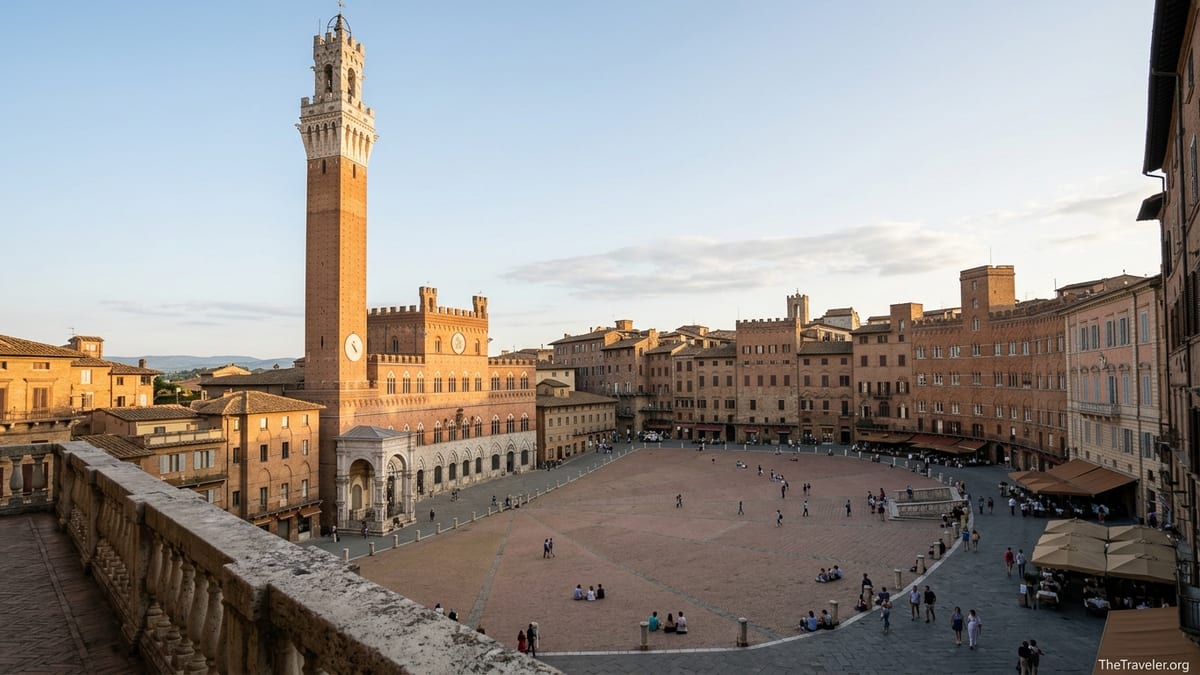
The Torre del Mangia is the brick spear that defines Siena’s skyline, soaring above the fan-shaped Piazza del Campo. Climbing its nearly 400 steps is one of the great experiences in Tuscany, but it is also one that rewards a bit of planning. This guide gathers the latest information on tickets, opening hours, what to expect from the climb and the views, plus practical visitor tips drawn from how travelers are actually experiencing the tower today.
Get the latest updates straight to your inbox!
Why the Torre del Mangia Matters in Siena
The Torre del Mangia is not just a tall medieval tower; it is the civic symbol of Siena. Attached to the Palazzo Pubblico on Piazza del Campo, it was built in the 14th century to rival the height of Siena’s cathedral, a deliberate statement that civic power was as important as religious authority in the city. Rising to about 87 to 88 meters above the Piazza (just over 100 meters including the lightning rod), it remains one of the tallest historic towers in Italy.
The tower’s curious name comes from its first bell ringer, Giovanni di Balduccio. His reputation for squandering his wages earned him the nickname “Mangiaguadagni,” roughly “profit eater,” which locals shortened to “Mangia.” Even after a mechanical clock replaced him in the 14th century, the name stuck, and today both the tower and the great bell are still known by that distinctive title.
For visitors, the Torre del Mangia offers something rare: a fully immersive medieval setting combined with an almost perfect 360-degree panorama. From the top platform you can see the red-tiled roofs of Siena, the striped Duomo, and the rolling Tuscan countryside stretching towards Chianti and the Crete Senesi. Unlike many towers enclosed by modern glass, Siena has kept this experience relatively authentic, which is part of the climb’s enduring appeal.
The tower also plays a central role in the life of the city. Its massive bell, known as the Campanone or Sunto, still rings for major civic occasions and during the Palio horse race, when Piazza del Campo fills with thousands of spectators. Even if you are not in town for the Palio, it is worth pausing in the square to listen when the bell is rung and imagine how its sound once ordered the rhythm of daily life in medieval Siena.
Tickets, Prices and How to Buy
The Torre del Mangia is managed together with the Museo Civico inside the Palazzo Pubblico, and ticketing is more old-fashioned than for many Italian landmarks. As of mid-2026, standard adult admission to the tower alone is approximately 10 euros, with a family ticket around 25 euros for two adults plus children over a certain age. Prices can change with municipal decisions, so treat these figures as indicative and verify on-site once in Siena.
Tickets that include the Torre del Mangia are currently sold in person only at the Palazzo Pubblico ticket office in Piazza del Campo or at a small visitor point known locally as “Dear Guests.” This means you cannot reliably book timed entry to the tower online in advance in the same way you might for the Florence Duomo climb or the Leaning Tower of Pisa. Travelers who arrive in Siena expecting a QR code on their phone are often surprised to find they must queue at a traditional ticket counter instead.
In practice, this system affects how you plan your day. On a typical spring or autumn weekday, you might walk up to the Palazzo Pubblico around 10:30 in the morning and find that the next available climb is at 11:15 or 11:30. Staff will assign you to the next time slot and sell you a printed ticket with the departure time. On a busy August weekend, however, climbers have reported that late-morning time slots sell out, forcing visitors who show up at noon to choose between a late-afternoon climb or missing out entirely.
There are often combined tickets that include the Museo Civico and the Torre del Mangia together, offering better value if you plan to do both. For example, a couple visiting Siena for one day might buy a joint ticket shortly after arrival, spend an hour in the frescoed halls of the Museo Civico (notably the Sala dei Nove with Ambrogio Lorenzetti’s “Good Government” frescoes), then line up at the base of the tower for their scheduled climb. Ask at the ticket desk which combination makes most financial sense for your group on the day you visit.
Opening Hours and Best Times to Climb
Opening hours shift seasonally, so it is worth understanding the general pattern before you plan your itinerary. In the cooler months from roughly November to February, the Torre del Mangia typically opens in the late morning, closes for a short midday break, then reopens for a limited afternoon window, with last admission in mid-afternoon. The tower is usually closed on Christmas Day and may have reduced hours around certain holidays and during bad weather.
From March through October, hours are usually extended, with morning and afternoon opening and last admission often around early evening. In practical terms, this means you can plan a late-afternoon or early-evening climb in late spring or summer, which many visitors find more comfortable given the Tuscan heat. Keep in mind that the ticket office closes before the last climb; if last admission to the tower is at about 6:15 pm, ticket sales may stop at that same time.
The best time to climb for both comfort and photography is typically either early morning soon after opening or late in the day. In July and August, Piazza del Campo can be fiercely hot at midday and the interior of the staircase, while shaded, still feels warm and airless. Travelers who have climbed around noon in high summer often describe reaching the top flushed and sweaty, which can make it harder to really enjoy the view.
If your schedule allows, aim for a late-afternoon climb between about 4 pm and the last slot of the day. At that hour the light over the city softens, the terracotta roofs glow, and the surrounding hills take on a hazy blue-green. An example itinerary for a summer day could be: arrive from Florence late morning, have lunch near Piazza del Campo, visit the Duomo in mid-afternoon, then do the tower climb around 5:30 pm before an aperitivo overlooking the square.
What the Climb Is Really Like
The ascent of the Torre del Mangia is a physical experience as much as a sightseeing one. You will climb roughly 400 narrow stone steps in a spiral and straight-run configuration inside a confined medieval shaft. There is no elevator. For healthy adults used to walking, this is achievable but can be a workout, particularly in summer. Many visitors compare it to a slightly longer version of the climb up Florence’s Giotto’s Campanile or a more enclosed version of climbing the Guinigi Tower in Lucca.
The staircase is relatively narrow, and passing other visitors in the opposite direction can require a bit of negotiation at wider landings. The municipality manages this with timed groups, so you move up in a controlled flow rather than in a constant stream. In practice, you will likely pause several times on landings while the group spreads out, which doubles as an opportunity to catch your breath. The interior is lit but still feels dim and enclosed, with rough brick and stone surfaces that give a strong sense of age.
At the top, you step out onto an open viewing platform surrounded by a protective railing. It is high enough that many people with mild heights anxiety are still comfortable, but you are undoubtedly very exposed. On a clear day you can trace the line of the medieval city walls, spot the black-and-white stripes of the cathedral’s bell tower, and look out to the patchwork of olive groves, vineyards, and wheat fields beyond. Photographers often bring a mid-range zoom lens, since wide-angle shots capture the sweep of the Piazza while a tighter frame picks out details like the shell-shaped paving below.
The total time for the experience is usually around 30 minutes at the top plus the climb and descent, so plan for about 45 to 60 minutes in total from the moment your time slot is called. If you are visiting with children, consider how they handle confined spaces and long staircases. Older kids and teenagers often enjoy the challenge and the bragging rights that come with reaching the top, while younger children may tire quickly or be unnerved by the height.
Views, Photography and Nearby Landmarks
One of the pleasures of the Torre del Mangia is how clearly it orients you within Siena. Looking straight down, Piazza del Campo appears exactly like the stone shell seen on postcards, with its nine sections of brick paving radiating outwards from the Palazzo Pubblico. You can trace the slight slope of the square that naturally channels rainwater away and imagine the thunder of hooves on Palio days when sand is laid down over the stones.
From the top platform, pivoting clockwise, you can pick out several key landmarks. To the northwest, the cathedral complex rises in ivory and dark greenish-black stone, its striped bell tower and dome easily visible. Further out, the Basilica of San Domenico sits on its hill, and beyond that the Tuscan hills roll toward Chianti. To the south, you see the more arid tones of the Crete Senesi, a landscape of eroded clay ridges and scattered farmhouses. On particularly clear days, some visitors report being able to distinguish the silhouettes of distant Apennine peaks.
Photographically, the tower offers both sweeping panoramas and intimate details. Early-morning light tends to emphasize textures, picking out the brickwork of the rooftops, while late-afternoon and early-evening light washes the city in warm tones. Serious photographers often bring a camera body with a wide lens in the 16–24 mm range to capture the full curve of the Piazza, along with a standard lens for more natural perspectives. Smartphone cameras perform well, but you may find that using the panoramic mode carefully gives the most satisfying sense of the city’s layout.
Many visitors pair the tower climb with a visit inside the Palazzo Pubblico itself. Before or after your ascent, you can step into the Museo Civico to see the fresco cycles that once guided Siena’s civic leaders, or simply sit in Piazza del Campo with a coffee from one of the bars along the perimeter. Watching another group of climbers appear at the top of the tower while you relax at ground level gives you a good sense of the height you just conquered.
Practical Tips for a Smooth Visit
A successful visit to the Torre del Mangia starts with footwear and timing. Wear closed, comfortable shoes with good grip; the stone steps are slightly worn from centuries of foot traffic and can feel slippery if your soles are smooth. Avoid sandals with loose straps or high heels. Aim to arrive at the Palazzo Pubblico ticket office early in the day in high season, especially if you are on a tight schedule and must catch an afternoon train or bus out of Siena.
There are strict limits on what you can carry up the staircase. Large backpacks, suitcases, and bulky camera bags are typically not allowed during the climb. Travelers coming on a day trip from Florence or Rome with luggage should plan to store bags at a left-luggage facility near Siena’s train or bus station before heading into the historic center. Inside the Palazzo Pubblico there may be limited space at the ticket area, but you should not rely on being able to leave large bags there.
The climb is not suitable for everyone. People with serious heart or respiratory issues, severe vertigo, claustrophobia, or significant mobility challenges are generally advised to skip it. There is no accessible alternative to reach the top platform. However, Siena offers several other excellent viewpoints that require much less exertion. For example, Piazzale San Domenico near the Basilica of San Domenico and the Medicean Fortress park both provide broad, mostly level vantage points over the historic center and are accessible without climbing hundreds of steps.
In terms of crowds, expect peak demand on weekends, during Italian public holidays, and in the weeks around the Palio races in July and August. On those days, queuing times for tickets and waiting for your time slot can lengthen significantly. If you are staying overnight in Siena, consider planning your climb for early morning on a weekday; you will share the stairwell with fewer people and enjoy a calmer experience at the top.
Pairing the Tower with the Rest of Siena
The Torre del Mangia can anchor a half-day or full-day visit to Siena. A typical approach for day-trippers from Florence is to arrive by late morning, walk up from the train or bus station to Piazza del Campo, buy tickets for a mid-afternoon tower climb, then spend the intervening time exploring the Museo Civico and having lunch on or near the square. After the climb, visitors often continue to the cathedral complex, including the Duomo, Baptistery, and, when open, the panoramic walkway of the Duomo’s “Facciatone.”
Those staying at least one night in Siena can adopt a slower rhythm. You might climb the tower in the late afternoon on arrival day, then spend the evening lingering over dinner in one of the streets radiating from the Piazza. The next morning, you could explore quieter corners of the city such as the Contrada dell’Oca or the alleys behind the Basilica of San Francesco. Some hotels and guesthouses, including several near the historic center, advertise rooms with partial views of the tower, allowing you to admire it again at dawn or in the blue hour after sunset.
Combining the tower climb with regional excursions also works well. For instance, travelers who rent a car for a day to explore the Crete Senesi or nearby hill towns like Monteriggioni or San Gimignano might spend the first or last hours of that day in Siena, timing their tower visit around the drive. If you are relying on public transport, check bus and train schedules carefully; climbing the tower right before your departure can leave you rushing out of the city’s steep streets to reach the station in time.
Whatever pattern you choose, treat the Torre del Mangia as a focal point but not the entirety of your visit. Part of its magic lies in seeing it from different angles as you wander Siena’s streets: framed between narrow lanes, rising behind a quiet neighborhood square, or glowing orange in the evening light as you return from dinner.
The Takeaway
Climbing the Torre del Mangia is one of those experiences that can reshape how you remember a city. From ground level, Siena already feels like a perfectly preserved medieval stage set; from the top of the tower, it becomes a living landscape, with terracotta rooftops, bell towers, and distant hills all unfolding at once. The practicalities are straightforward if you understand that tickets are bought in person, slots can sell out on busy days, and the climb requires a reasonable level of fitness.
Plan your visit by choosing the right time of day, wearing proper shoes, and giving yourself some flexibility around ticketing. Pair the tower with the Palazzo Pubblico, the cathedral complex, and time spent simply sitting in Piazza del Campo watching daily life unfold. With that approach, the Torre del Mangia becomes not just a viewpoint but the centerpiece of a richly textured day in one of Italy’s most atmospheric cities.
FAQ
Q1. How many steps are there in the Torre del Mangia?
The tower has roughly 400 steps. They are stone, fairly narrow, and arranged in a mix of spiral and straight flights inside a confined medieval staircase.
Q2. How long does it take to climb the Torre del Mangia?
Most visitors spend about 10 to 15 minutes climbing up, a similar time coming down, and around 20 to 30 minutes at the top, so plan roughly 45 to 60 minutes total.
Q3. Can I buy tickets for the Torre del Mangia online in advance?
At present, tickets that include the Torre del Mangia are generally sold only in person at the Palazzo Pubblico ticket office or a local visitor point on the day of your visit.
Q4. How much does it cost to visit the Torre del Mangia?
As of mid-2026, expect to pay around 10 euros for a standard adult ticket and about 25 euros for a family ticket, although exact prices can change.
Q5. Is the Torre del Mangia climb suitable for children?
Older children and teenagers usually manage the climb well and enjoy the views. Very young children may struggle with the number of steps and the height at the top.
Q6. Is the Torre del Mangia accessible for visitors with mobility issues?
No, there is no elevator and the only way to the top is via the staircase. Visitors with mobility issues may prefer alternative viewpoints like Piazzale San Domenico or the Medicean Fortress.
Q7. What is the best time of day to climb the tower?
Early morning and late afternoon are ideal for cooler temperatures and softer light. Midday in summer can be very hot and the climb feels more strenuous.
Q8. Are bags and backpacks allowed on the climb?
Small bags are usually permitted, but large backpacks, suitcases, and bulky camera bags are typically not allowed on the staircase for safety and space reasons.
Q9. What happens if it rains or the weather is bad?
In light rain the tower may remain open, but in strong wind, storms, or other unsafe conditions access to the top can be temporarily suspended or closed.
Q10. Can I visit the Museo Civico and the Torre del Mangia with a single ticket?
Often there are combined tickets that include both the Museo Civico and the tower, which can save money and time. Ask at the Palazzo Pubblico ticket office on the day you visit.