


Rising above Siena’s shell shaped Piazza del Campo, the Torre del Mangia is both a time capsule of medieval civic pride and one of Tuscany’s most rewarding viewpoints. Climbing its narrow staircase is a physical effort, but the sweeping views of terracotta rooftops, striped cathedral and rolling Tuscan hills make it a highlight of any visit to Siena. Here is how to experience the tower at its best, whether you are drawn by history, architecture or simply the promise of an unforgettable panorama.
Get the latest updates straight to your inbox!
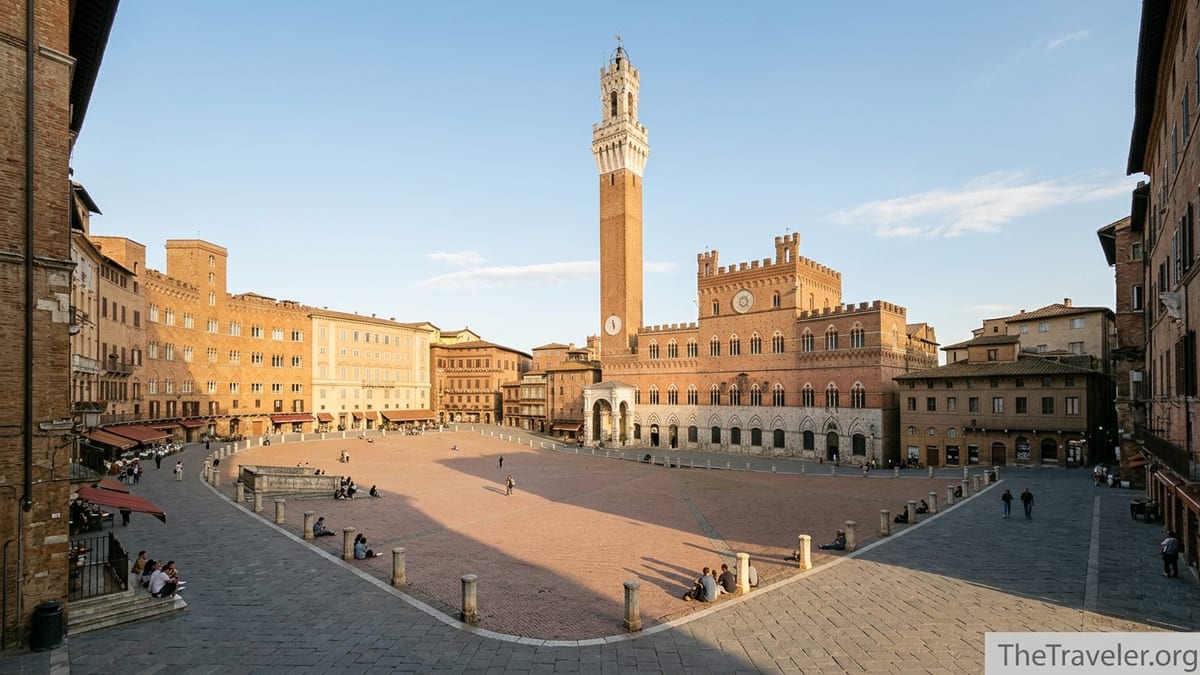
Understanding the Torre del Mangia’s Place in Siena
The Torre del Mangia is the civic tower of Palazzo Pubblico, Siena’s red brick town hall that anchors Piazza del Campo. Built in the 14th century alongside the rise of the powerful Sienese commune, the tower was conceived as a secular answer to the city’s cathedral bell tower. Local guides still point out that its height, around 87 meters above the square and about 102 meters including the lightning rod, was deliberately set to be comparable to the Duomo’s campanile, a symbolic statement that civic authority and religious power should stand side by side.
The tower’s nickname, “Mangia,” comes from its first bell ringer, Giovanni di Balduccio, known as Mangiaguadagni or “the one who eats his earnings” because of his reputation for squandering his pay. Over time the name attached itself to the tower, and later even to the mechanical figure that replaced him and continued to strike the hours over the Campo. Knowing the story adds color when you are standing beneath the belfry listening to the chime roll out across the rooftops.
Architecturally, the Torre del Mangia is a study in Sienese elegance. Its lower body is brick, rising in a slender square shaft with internal stone steps, and its crown is a pale travertine structure with double battlements that echo Siena’s distinctive black and white civic colors. When you look up from the paving of Piazza del Campo, the contrast between the warm brick and cool stone frames the sky, a vertical counterpoint to the horizontal sweep of the piazza’s shell shaped paving.
For many visitors, understanding this interplay of symbolism and design changes how they experience the climb. Instead of just ticking off another viewpoint, you are stepping inside what was once one of Italy’s tallest secular towers and a carefully calibrated expression of a medieval city’s ambitions.
Planning Your Visit: Tickets, Opening Times and Practicalities
The Torre del Mangia is managed together with the Museo Civico inside Palazzo Pubblico, and access is tightly controlled for safety. Capacity at the top is limited, typically to a small group at a time, and entry slots are staggered. As of mid 2026, standard adult tickets to climb the tower are in the region of 10 euros, with reduced prices for children and possible combined tickets that include the Civic Museum or other city attractions. Families who plan to visit the museum as well as climb the tower often find a combined pass offers better value than buying separate tickets.
Tickets are usually bought at the Palazzo Pubblico ticket office on the ground floor off Piazza del Campo. On busier days, especially weekends from May through September and in the days around the Palio horse races in July and August, it is common to be given a timed entry slot and asked to return at that time. Travelers who show up late morning in high season often report waiting an hour or more for their slot, so if you have only one day in Siena it is wise to head straight for the ticket office soon after it opens.
Typical opening hours run from mid morning until late afternoon, though the precise schedule may change by season and the tower can close in adverse weather such as high winds or thunderstorms. If you are planning a spring or autumn trip and hope to catch soft late afternoon light from the top, it is worth checking the current hours on the official Siena civic museum information pages shortly before your visit, because closing times can shift earlier in the shoulder months.
Remember that the climb involves close to 400 steps on a narrow internal staircase with no lift. Visitor information on site and on local tourism portals strongly advises that those with serious mobility issues, heart or respiratory conditions, or significant vertigo should reconsider. Bags may have to be left in lockers or carried carefully, and large backpacks are often discouraged. These details might seem small, but planning for them makes the experience smoother, especially if you are traveling with children or carrying camera equipment.
Timing Your Climb for the Best Light and Fewer Crowds
When you climb the Torre del Mangia can make the difference between a serene, almost contemplative experience and a congested shuffle up a busy staircase. Local guides and recent visitors often recommend targeting the first climb of the day or one of the last available slots when the weather cooperates. Early morning, around opening time, tends to be quieter, with fewer tour groups in Piazza del Campo and gentler temperatures in the warmer months. The low light of the morning picks out the textures of the brick facades and the patterned paving of the Campo below.
If your schedule allows for flexibility, watching the forecast for clear afternoons and booking a later slot can reward you with golden hour views. On clear days from late spring to early autumn, the sun drops behind the Tuscan hills in a way that warms the terracotta rooftops and throws the Duomo’s green and white marble into relief. Keep in mind that on some days the last entry may be late afternoon rather than true sunset, especially outside the peak season, so ask at the ticket office what time the final ascent will actually be.
Midday, particularly between 11:00 and 14:00 in July and August, is often the busiest period. Day trippers from Florence and coach tours tend to arrive then, and queues can snake across part of Piazza del Campo. Climbing in the heat of midday can also be tiring, since the narrow staircase traps warm air. If you only have that window available, bring water, wear light clothing and expect a slower, more crowded ascent and descent.
Winter and early spring visitors encounter a different pattern. Shorter daylight hours and cooler temperatures mean the tower can feel bracing rather than hot, and occasional closures for wind or rain are more likely. The reward, on clear days, is a crisp, almost crystalline view with fewer tourists. Standing at the top with only a handful of other visitors as the bells mark the hour, with the countryside washed in pale winter light, can be as memorable as any summer sunset.
Making the Ascent: What the Climb is Really Like
The climb inside the Torre del Mangia is part of the experience, not just a necessary effort to reach the view. After passing through the base of the tower from the courtyard of Palazzo Pubblico, you enter a sequence of stone and brick staircases that wind their way up through the hollow shaft. The steps are relatively steep and narrow, and at several points you will pass through tight landings or short passages where visitors ascending and descending need to negotiate space. Most people with average fitness manage the climb in around 10 to 15 minutes, with brief pauses to catch their breath.
The staircase itself offers glimpses into the tower’s construction. Rough stone blocks, patches of old brick, and small openings in the walls remind you that this is not a modern viewing platform but a 14th century structure. In some sections the steps have been reinforced with metal, and railings added, but the feeling remains of climbing through an authentic medieval interior. If you are sensitive to heights or enclosed spaces, it may help to focus on the immediate steps in front of you rather than looking down the stairwell.
Parents often ask whether the climb is suitable for children. Experiences vary, but many families with school age children complete it without difficulty by taking it slowly and letting faster climbers pass. Very young children may tire quickly or feel uneasy in the narrower sections, and pushchairs are not permitted. Practical footwear with good grip is essential; this is not the place for smooth soled sandals or high heels. In summer, the air inside the shaft can feel warm and still, so a small bottle of water and a pause in the shaded courtyard before and after the climb are advisable.
At the top, you emerge onto a relatively small viewing platform surrounded by protective railings. Because access is controlled, numbers are limited, but it can still feel compact when everyone leans toward the same side for photos. Staff typically monitor the time each group spends at the summit, gently signaling when it is time to start the descent so that the next timed group can make the climb.
The Panorama: Reading the City and the Tuscan Landscape
It is only when you step onto the top platform of the Torre del Mangia that the shape of Siena fully reveals itself. Directly below, Piazza del Campo curves in its characteristic shell form, divided into nine sections that recall the medieval government of the Nine. From this height, you can see how the palazzi ring the square in a continuous reddish collar, with the white marble Fonte Gaia fountain a bright accent near the upper side of the piazza.
Looking north and west, the striped Duomo with its dark green and white marble stands out among the terracotta roofs. On clear days the intricate facade and the octagonal dome are visible enough that you can trace the outlines of the nave and attached structures. Travelers who have visited the cathedral’s own viewpoints often enjoy comparing the perspectives: from the Torre del Mangia you see the Duomo as part of a dense urban fabric, while from the Duomo’s viewpoints the civic tower itself dominates the skyline.
Beyond the compact medieval core, the view opens to the gentle hills of the Sienese countryside. To the south and east you can pick out the patchwork of fields, vineyards and olive groves that lead toward the Crete Senesi, with their pale clay ridges, and on exceptionally clear days some visitors report seeing as far as the distant outline of Monte Amiata. The contrast between the ordered geometry of the city and the flowing curves of the landscape is one of the reasons photographers and painters have long favored this viewpoint.
It is worth taking a few minutes at the top not just to take photographs but to orient yourself. Many visitors like to spot their hotel roof, the route they walked in that morning, or the roads leading out toward San Gimignano and the Chianti region. If you are carrying a small map or using an offline map app on your phone, you can trace Siena’s three main ridges and the gates in the old city walls. This transforms the panorama from a beautiful backdrop into a mental map that will enrich the rest of your time in the city.
Combining the Tower with Palazzo Pubblico and Piazza del Campo
Experiencing the Torre del Mangia in isolation would be a missed opportunity. The tower is inseparable from Palazzo Pubblico and Piazza del Campo, and planning your visit to include these spaces gives you a fuller sense of Siena’s civic life, past and present. Many travelers buy a combined ticket that includes the climb and entry to the Museo Civico directly below, then spend an hour or more exploring the frescoed rooms before or after ascending the tower.
Inside the Museo Civico, halls such as the Sala del Mappamondo and Sala dei Nove showcase political fresco cycles that explain why the tower was built with such pride. Sitting for a few minutes in front of the famous allegories of good and bad government, then later looking down on the same city from the tower, can be a powerful way to connect art, politics and the everyday lives of Sienese citizens across centuries.
After your climb, lingering in Piazza del Campo allows you to appreciate how the tower shapes the space at ground level. The sloping paving invites you to sit along the outer ring, gelato or coffee in hand, and look up at the Palazzo Pubblico and its slender campanile. Street level cafes along the edge of the square, while often priced a little higher than backstreet alternatives, offer a front row seat to watch the tower catch the changing light. Travelers on a budget can simply buy a slice of pizza or a pastry from a nearby bakery and sit directly on the warm bricks of the Campo, an experience as authentically Sienese as any formal terrace.
Timing also matters here. Late afternoon, after the main rush of day trippers, is an atmospheric moment to see the piazza gradually empty while the tower shifts from sunlit to silhouette. If you have climbed earlier in the day, walking across the Campo in the evening and glancing up at the tower where you stood hours before can provide a satisfying sense of completion.
Practical Tips for a Safer, More Enjoyable Experience
A climb of nearly 400 narrow steps is manageable for most visitors, but a few practical preparations can make it significantly more comfortable. Comfortable, closed footwear with good grip is essential, particularly if the stair treads are slightly worn or if you are visiting on a rainy day when soles might be damp. Avoid carrying bulky backpacks, as you may be asked to store them and they can be awkward in the tighter segments of the staircase.
Hydration is important, especially from late spring through early autumn. While you cannot generally eat or drink on the staircase itself, having water before and after the climb helps, and reusable bottles can be refilled at public drinking fountains around the historic center. In the hotter months, a light shirt and breathable fabrics make the climb more pleasant; in winter, a windproof layer for the top platform is useful because the exposed height can feel colder than the streets below.
Photography enthusiasts should think about gear and timing together. The platform can be busy, and space is limited, so a compact camera or a smartphone is typically more practical than a large tripod and multiple lenses. A moderate wide angle setting is ideal for capturing both the piazza directly below and the hills in the distance. If you plan to take portraits, be prepared to work quickly when your side of the platform opens up, and consider visiting in the softer light of morning or late afternoon, which is kinder to both architecture and human faces than the overhead glare of midday.
Finally, keep an eye on local events. On or around the days of the Palio, Siena’s famous horse race, the city can be exceptionally busy, and access rules or opening times for the tower may be adjusted. In peak months, arriving with some flexibility in your schedule, rather than banking on a precise time slot before onward travel, reduces stress if weather or crowding causes delays or temporary closures.
The Takeaway
Climbing the Torre del Mangia is not simply about bagging another viewpoint. It is a way to step inside Siena’s history, to feel the city’s medieval heartbeat in the tight stone staircases and to see how the shell of Piazza del Campo and the striped Duomo nestle within a landscape of vineyards and low hills. With some planning around tickets and timing, the ascent is within reach of most travelers and rewards the effort many times over.
Combining the tower with a visit to Palazzo Pubblico and unhurried time in Piazza del Campo turns a single climb into a richer experience of Siena’s civic story. Whether you choose the clarity of a winter day or the long light of a summer evening, standing at the top of the Torre del Mangia with the bells above and the city at your feet is one of those rare travel moments that feels both intensely present and deeply connected to the past.
FAQ
Q1. How many steps are there in the Torre del Mangia, and how fit do I need to be?
The climb involves close to 400 fairly steep, narrow steps. Most people with average fitness can manage it in about 10 to 15 minutes, taking short breaks if needed.
Q2. What does it cost to climb the Torre del Mangia?
As of 2026, adult tickets are typically around 10 euros, with reduced prices for children and occasional combined tickets that include the Civic Museum or other attractions.
Q3. Do I need to book a time slot in advance?
In busy periods you are usually given a timed entry when you buy your ticket at Palazzo Pubblico. Advance online options may be available in some seasons, but many visitors simply purchase on the day and accept a waiting time.
Q4. What is the best time of day to climb for views and fewer crowds?
Early morning around opening time is often the quietest, while late afternoon on clear days offers warm, flattering light. Midday in high season can be crowded and hot inside the staircase.
Q5. Is the climb suitable for children?
Many families with school age children complete the climb without problems by going slowly. Very young children may struggle with the height and narrow stairs, and pushchairs are not allowed.
Q6. Can people with mobility issues or vertigo climb the tower?
The tower has no lift, only narrow staircases, and the ascent can feel exposed at the top. Those with significant mobility difficulties, serious heart or breathing conditions, or strong vertigo are generally advised not to climb.
Q7. Are there facilities at the top, like toilets or a café?
No. The top platform is small and open to the elements, with only protective railings. Toilets and any refreshment options are at ground level in or near Palazzo Pubblico.
Q8. Can I take photos from the top, and what kind of camera works best?
Photography is allowed, and the views are one of the main reasons to climb. A smartphone or compact camera with a moderate wide angle is usually ideal, given the limited space on the platform.
Q9. What happens if the weather is bad on the day of my visit?
In strong wind, heavy rain or storms, the tower may close temporarily for safety. Staff at the ticket office will advise you, and you may be offered a different time or a refund depending on conditions.
Q10. Can I visit Palazzo Pubblico and the museum without climbing the tower?
Yes. The Civic Museum inside Palazzo Pubblico has its own ticketing, and you can explore the frescoed halls and learn about Siena’s history even if you decide not to climb the Torre del Mangia.