


From the moment you step into Siena’s fan-shaped Piazza del Campo, your eye is pulled upwards to the slender brick silhouette of Torre del Mangia. For many visitors, the obvious question arises: is it really worth tackling hundreds of narrow steps, paying for a ticket and carving out precious time from a short Tuscan itinerary just to reach the top? The answer is not the same for everyone, and understanding what the climb involves in real, practical terms will help you decide whether Torre del Mangia deserves a place on your Siena must-do list.
Get the latest updates straight to your inbox!
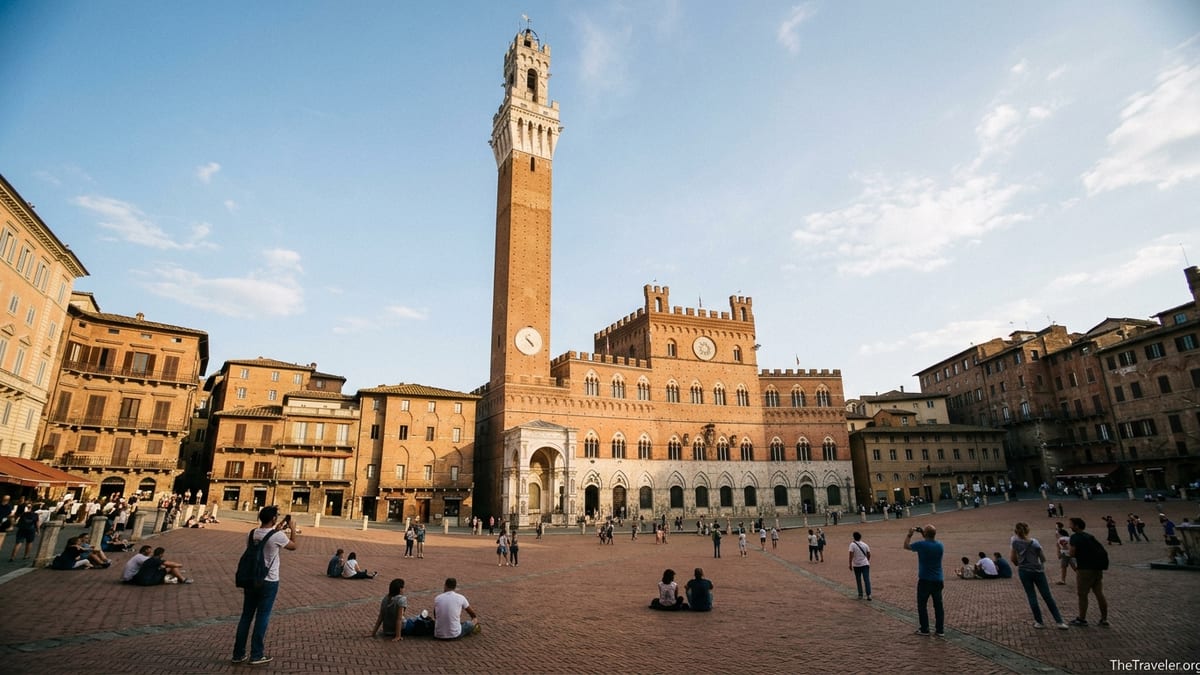
What Torre del Mangia Actually Is
Torre del Mangia is the 87 meter civic tower that rises from Palazzo Pubblico, Siena’s historic town hall, on the lower edge of Piazza del Campo. Built in the 14th century as a statement of the city’s secular power, it was deliberately designed to match the height of Siena’s cathedral bell tower, a symbolic balance between church and civic government that still defines the skyline today. The tower anchors the city’s most famous square, which is also the arena for the Palio horse races held in July and August.
Visitors experience Torre del Mangia today primarily as a viewpoint. The only way up is a staircase of roughly 400 steps that spirals through ever narrower stone and brick passages before emerging at a small open terrace near the belfry. There is no elevator and no alternative route, so the climb itself is as much a part of the experience as the view from the top. For many, the memory of ducking through low arches, gripping the worn handrail and hearing the muffled sounds of the Campo fall away is as vivid as any photograph.
The tower is managed by the municipality of Siena and access is controlled. Only a limited number of people are allowed at the top at any one time, typically in timed groups that move in a one way flow: you climb up, spend a short window at the top, then descend so the next group can enter. Understanding this system and the physical nature of the stairwell is key to deciding whether the visit fits your travel style, fitness level and schedule.
In practice, the climb is short but intense. Most people spend 10 to 15 minutes ascending at a steady pace, a similar time at the top, and another 10 minutes descending. If you picture something like a steady walk up to a sixth or seventh floor in an old European building, then add medieval stonework, tighter spaces and fewer landings, you will have a realistic sense of what is involved.
The Experience of the Climb: Effort, Height and Safety
The Torre del Mangia climb is often described as “not technically difficult” but “surprisingly demanding.” There are around 400 steps, almost all of them steep, narrow and slightly irregular. Handrails are present for most of the route, but the steps are worn smooth in places. Anyone comfortable walking uphill for 15 to 20 minutes and able to manage regular staircases without knee or balance problems generally copes well, but the climb is not ideal if you struggle with stairs in everyday life.
For context, if you have climbed similar European towers such as Florence’s Giotto’s Campanile or the Leaning Tower of Pisa, Torre del Mangia feels comparable in effort, with perhaps slightly tighter spaces in parts. Travelers often report pausing briefly on the internal landings to catch their breath, particularly in summer when the stairwell can feel warm and airless. There is no air conditioning and minimal ventilation, so bringing a small bottle of water and avoiding the midday heat is sensible.
Height and exposure are usually less intimidating than visitors expect. The viewing terrace is protected by sturdy railings and brickwork, and while there are open views, you are not standing at the edge of a sheer drop. However, the combination of height, the narrow staircase and the knowledge that you are high above the Campo can trigger discomfort for anyone with vertigo or a strong fear of heights. If you feel uneasy on high bridges or glass elevators, you may find the mental side of the climb harder than the physical side.
Safety rules are strict but straightforward. Bags are often restricted to small daypacks that you can keep close to the body, and very large backpacks or suitcases are not permitted on the stairs. Children must be accompanied by adults, and very young kids who cannot manage standard stairs alone may be refused access even in a carrier, depending on the staff’s judgment on the day. There are no toilets along the route, so it is wise to use facilities in or near Palazzo Pubblico before you start your timed entrance.
The View from the Top: What You Actually See
The reward for the climb is one of the most complete city and countryside panoramas in Tuscany. From the terrace you look straight down into Piazza del Campo, reading its shell-shaped paving and the nine wedge like segments of brick and travertine that fan out towards the palazzo. At busy times this bird’s eye view is a spectacle in itself, full of people sunbathing on the sloping bricks, café tables clustered along the perimeter, and, on summer evenings, concerts or public events unfolding below.
Beyond the Campo, the sweep of Siena’s terracotta rooftops and medieval lanes stretches in every direction. To one side, the striped marble of the Duomo and its dome rise from the dense tangle of stone houses. In clear weather, the line of the Tuscan hills is visible on the horizon, patchworked with vineyards, olive groves and cypress lined roads leading towards the Chianti countryside and the Crete Senesi. Photographers with a wide angle lens on a DSLR or mirrorless camera can capture both the square below and the countryside beyond in a single frame, while smartphone users will still come away with dramatic shots, especially using panorama mode.
The quality of the view depends on the time of day and season. In midsummer, the harsh midday sun can flatten the red brick and wash out distant hills with haze. Early morning and late afternoon often offer softer light and longer shadows that reveal the texture of the roofs and the curvature of the Campo. In winter, the air is usually clearer, so even on overcast days the rolling countryside stands out sharply, though wind can make the terrace feel raw and exposed. Many visitors find that the best compromise is a late afternoon slot that transitions into golden hour, when Siena glows warm and the streets far below start to light up for the evening.
Most groups are given a limited amount of time at the top, typically around 10 to 15 minutes. That is enough to walk slowly around the terrace, take in the 360 degree panorama and capture photographs without feeling rushed, as long as you do not spend the entire time at a single corner. If you travel with a tripod or large camera bag, remember that space is tight and fellow visitors will be moving around you, so a compact setup like a small mirrorless camera or simply a phone often works better in practice.
Tickets, Opening Hours and Practical Logistics
As of 2025, a standard adult ticket to climb Torre del Mangia costs around 10 euros, with optional combination tickets available that include the adjacent Museo Civico inside Palazzo Pubblico for approximately 15 euros per person. Family passes and broader passes that bundle several Siena attractions are sometimes offered, and prices can change seasonally, so it is wise to check the latest information shortly before your visit using official Siena tourism channels or at the on site ticket office.
Tickets are usually sold on the day only, at the ticket office inside Palazzo Pubblico at the base of the tower. Visitor reports and local guides consistently note that advance online reservations for Torre del Mangia are not normally available, which means you should build a little flexibility into your schedule. Lines typically start forming in the late morning, and slots can sell out by early afternoon in peak months, especially on weekends and around the Palio dates of July 2 and August 16 when the entire square is busier than usual.
Official opening hours have varied slightly over time, but in recent seasons the tower has generally been open from late morning to mid afternoon in winter, and for longer stretches in spring and summer, with a break in the early afternoon. There is also a weather clause: in heavy rain, high wind, or storms, access can be suspended for safety reasons, sometimes at short notice. Travelers who planned their whole Siena day around the climb occasionally report arriving to find the tower temporarily closed, so the safest approach is to treat Torre del Mangia as a highlight to enjoy if conditions and timing line up, rather than as the only reason to come into the historic center.
To make logistics smoother, many visitors head straight to the ticket office soon after arriving in Siena, particularly if they are day tripping from Florence by bus. A typical pattern is to arrive at the Piazza del Campo by late morning, buy a ticket for a midday or early afternoon climb, then spend the waiting time exploring the Museo Civico or enjoying a coffee under the loggias that ring the square. Doing this helps you avoid a situation where you finish a leisurely lunch only to discover that the last available time slot has just sold out.
Who Will Find the Climb Worthwhile (and Who Might Skip It)
For many travelers, Torre del Mangia is a clear highlight of Siena and well worth the effort. If you love city viewpoints, enjoy photographing skylines, or like to understand the layout of a historic center from above before wandering its streets, the tower delivers exactly what you are hoping for. Couples on a short Tuscan break often describe the climb as one of their most romantic memories, with the shared sense of achievement at the top and the feeling of being suspended over the rooftops as church bells ring around them.
History enthusiasts also tend to value the visit. Seeing how the tower rises above the Palazzo Pubblico and the Campo gives a tangible sense of how Siena’s medieval government projected power and order in a dense urban fabric. When you combine the climb with a visit to the frescoed council chambers in the Museo Civico, particularly the famous Allegory of Good and Bad Government, the relationship between the city’s ideals and its built environment becomes surprisingly vivid.
Families with older children or teenagers frequently enjoy turning the climb into a small adventure, counting steps, looking for carved details in the stonework and rewarding themselves with gelato back in the square afterward. However, for families with toddlers, very young children or anyone who may panic in tight spaces, the experience can be stressful rather than fun. The staircases are too narrow for strollers, and carrying a wriggling child up and down steep steps can be risky. In such cases, enjoying the Campo at ground level and perhaps visiting the Duomo’s panoramic terrace instead can be a better choice.
Travelers with significant mobility issues, breathing difficulties, heart conditions or severe vertigo are the group for whom the climb is least advisable. There are no intermediate exits or benches along the route, and once you have committed to a timed slot, you cannot easily reverse direction without disrupting others. For these visitors, Siena still offers plenty of rewarding viewpoints at lower heights, from the gentle slope of the Campo itself to cafés with elevated terraces or the quieter views from streets on the western edge of the old town that open onto the surrounding countryside.
How Torre del Mangia Compares to Other Siena and Tuscany Views
When deciding whether Torre del Mangia is worth your time, it helps to compare it with other viewpoints you might include in a broader Tuscany itinerary. Within Siena itself, the main alternative is the panoramic route offered by the cathedral complex, where a separate ticket gives access to elevated walkways and terraces around the Duomo. That view places you closer to the cathedral’s striped façade and dome, with the town spreading below, but it does not look directly down into Piazza del Campo in the same dramatic way as the civic tower.
Elsewhere in Tuscany, iconic viewpoints include the dome of Florence’s cathedral, Giotto’s bell tower beside it, and the tower of San Gimignano, often called the town of fine towers. All of these involve stair climbs of varying difficulty and offer expansive vistas of red roofed towns surrounded by hills. Travelers who have sampled several of these often say that Torre del Mangia feels more intimate and less dominated by distant mountain ranges than, say, Florence’s dome, but more theatrically focused on a single square than San Gimignano’s towers, where the view is more about the town as a whole than any one space.
The decision can also be practical. If your wider trip already includes climbs up multiple towers and domes, you may feel “view fatigue” and decide to admire Siena’s tower from the pavement instead. On the other hand, if this is your only hill town stop, or if you are traveling with someone who has never climbed a medieval tower before, the experience at Torre del Mangia can be particularly memorable because it compresses so many archetypal Tuscan elements into one short visit: terracotta, stone, bells, vineyards and a lively piazza all visible in a single sweep.
Cost is another factor. For a solo traveler, 10 euros may feel like a modest splurge for a standout view. For a family of four, especially when combined tickets are involved, the price can start to approach the cost of a sit down meal in a mid range trattoria on the Campo. Some visitors choose to allocate that money instead to a long lunch with a view of the tower, a vineyard tour in the nearby countryside, or a guided walking tour through Siena’s contrade districts, which can be equally rewarding in different ways.
Tips to Make the Climb More Enjoyable
If you decide that Torre del Mangia is worth including in your Siena visit, a few simple strategies can make the experience smoother and more enjoyable. First, aim for an early or late time slot rather than the hottest part of the afternoon. On a typical summer day, climbing between 10:00 and 11:00 in the morning, or after 16:00, usually means slightly cooler temperatures and less intense sun at the top. These times can still be popular, but the stairwell itself will feel more comfortable than in mid afternoon when the heat has built up.
Wear comfortable footwear with good grip, not smooth soled sandals or heels. The steps are slightly uneven and can feel slippery under thin leather soles. Even in warm weather, lightweight closed shoes or sturdy walking sandals with straps are a better match for the stone and brick. Keep your hands free as much as possible; a small crossbody bag is easier than a tote, as you may want one hand on the rail and one on the wall at certain points.
Pack light for the climb itself. A small water bottle, phone or camera and perhaps a folding windbreaker for cooler seasons are usually all you need. Larger bags can be an obstacle for you and others on the narrow stairs. If you are traveling with a full daypack, consider leaving it at your accommodation or in a secure locker at a nearby parking facility before entering the historic center, so you are not negotiating the tight staircases with bulky gear.
Finally, treat the tower as part of a relaxed half day in Siena rather than a rushed checkbox. Many travelers find that combining the climb with time simply sitting on the Campo bricks people watching, visiting the museum, and wandering the narrow streets that radiate from the square creates a richer memory than squeezing the tower into a tight schedule between bus connections. Allowing yourself room for delays, weather changes or sold out time slots will make it easier to enjoy the climb if and when it happens.
The Takeaway
So, is Torre del Mangia worth climbing during your visit to Siena? For travelers who are reasonably fit, comfortable with heights, and excited by sweeping views and historic urban design, the answer is usually yes. The combination of a dramatic medieval square, a purposeful civic tower and a 360 degree panorama over rooftops and Tuscan hills makes the experience distinctive, even in a region full of viewpoints and bell towers.
However, it is not essential for everyone. If you dislike confined spaces, are traveling with very young children, or know that steep staircases leave you exhausted or in pain, you are unlikely to find the short time at the top worth the physical and mental effort. Likewise, if your budget or schedule is tight, you may reasonably decide to allocate your time and euros to a leisurely lunch on the Campo, a guided stroll through Siena’s contrade, or a countryside excursion instead.
Perhaps the most useful way to think about Torre del Mangia is as a bonus rather than a requirement. Siena’s magic lies as much in the curves of its streets, the sound of its bells and the life of its main square as in any single viewpoint. If your day aligns with good weather, available tickets and enough energy for 400 steps, the climb can become one of your trip’s standout memories. If it does not, you will still come away with a strong sense of the city’s character simply by spending unhurried time at ground level in the shadow of the tower.
FAQ
Q1. How many steps are there in Torre del Mangia and how hard is the climb?
The climb involves roughly 400 narrow, fairly steep steps. Most reasonably fit visitors manage it in 10 to 15 minutes of steady effort each way, but it can feel demanding if you are not used to stairs or if you visit during the summer heat.
Q2. How much does it cost to climb Torre del Mangia?
As of 2025, tickets to climb the tower cost around 10 euros per adult, with combination tickets including the Civic Museum priced a bit higher. Prices can change, so check current rates at the ticket office when you arrive.
Q3. Do I need to book Torre del Mangia tickets in advance?
In recent seasons, tickets have generally been sold in person on the day rather than through advance online booking. It is wise to go to the ticket office earlier in the day to secure a time slot, especially in peak summer months and on weekends.
Q4. What are the usual opening hours for the tower?
Opening hours vary by season, but the tower typically opens from late morning into the afternoon, with longer hours in spring and summer and shorter ones in winter. Access can be suspended in bad weather, so it is sensible to confirm the day’s schedule once you are in Siena.
Q5. Is the climb suitable for children?
Older children and teenagers who are comfortable on stairs often enjoy the climb, especially if you turn it into a small adventure. It is less suitable for toddlers and very young children, as the steps are narrow and steep, strollers are not allowed, and carrying a small child up and down can be challenging and unsafe.
Q6. Can I climb Torre del Mangia if I have a fear of heights or claustrophobia?
If your fear is mild, you might manage the climb by going slowly and focusing on the steps rather than the height. However, the staircase is enclosed and fairly tight, and the viewing terrace is high above the square, so anyone with strong vertigo or claustrophobia may find the experience uncomfortable and may prefer to skip it.
Q7. What should I wear to climb the tower?
Wear comfortable, secure footwear with good grip, such as walking shoes or strapped sandals, and avoid heels or very smooth soles. In warmer months, light clothing is fine, but consider bringing a small bottle of water. In cooler seasons, a windproof layer is helpful at the top where it can feel exposed.
Q8. When is the best time of day to climb Torre del Mangia?
Early to mid morning or late afternoon usually offer the best balance of more comfortable temperatures and attractive light for photos. Midday in summer can be hot and bright, which makes the stairwell stuffy and the light a bit harsh for photography.
Q9. Is it possible to visit during the Palio horse race?
During the days around the Palio races in early July and mid August, Piazza del Campo is extremely busy and preparations may affect access and opening hours. While it is sometimes still possible to climb, it can be more crowded and less predictable, so it is important to check locally if you plan to visit at that time.
Q10. If I skip the tower, are there other good viewpoints in Siena?
Yes. The cathedral complex offers elevated terraces and walkways with excellent views over the city, and several streets and small squares on higher ground around the historic center open onto the countryside. Even simply sitting on the sloping bricks of Piazza del Campo with the tower overhead gives a powerful sense of Siena’s setting without any climb.