


From 26 October 2026, almost one kilometre of London’s Oxford Street has become permanently traffic free, transforming one of Europe’s busiest shopping streets into a wide pedestrian boulevard. For visitors, the change brings a calmer atmosphere and more space to walk, but it also means new routes for buses, slightly different ways to use the Underground, and a street that will keep evolving as redevelopment continues.
Get the latest updates straight to your inbox!
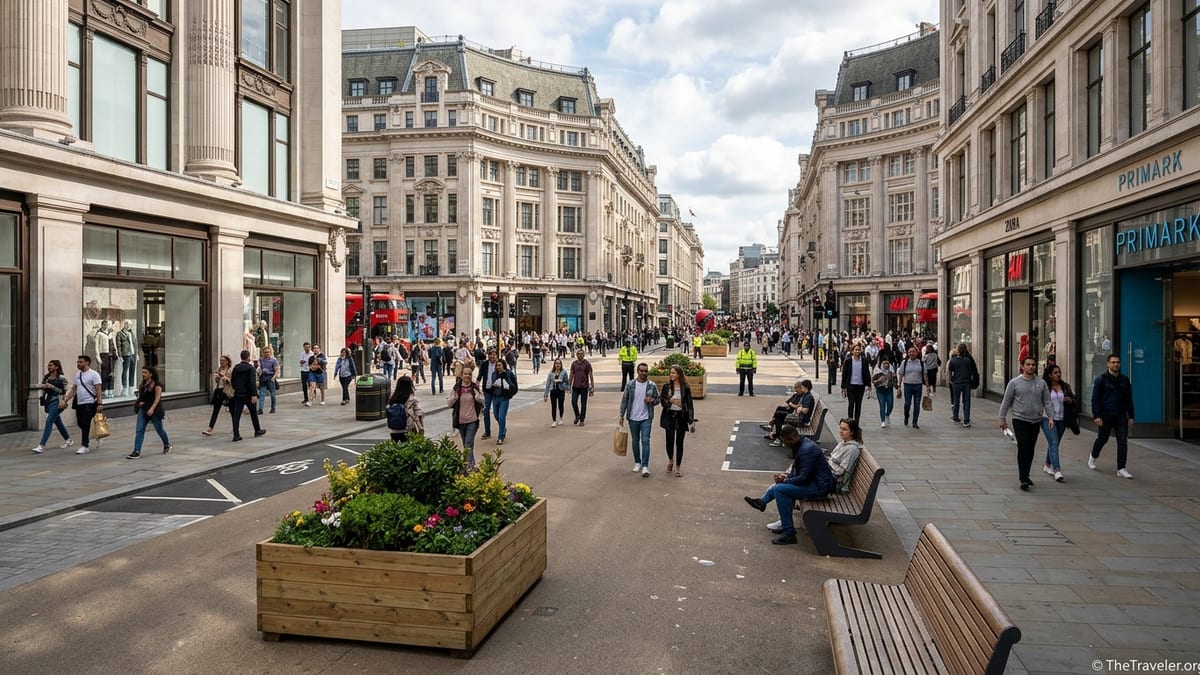
Understanding the New Pedestrian Zone
The first phase of Oxford Street’s pedestrianisation covers the section between Orchard Street, by Selfridges and the western edge of the main shopping drag, and Great Portland Street, just east of Oxford Circus. This stretch is now closed to buses, taxis, private cars and cyclists, creating a largely uninterrupted corridor for people on foot. The traffic free distance is close to one kilometre, which in practice means that most of the flagship shops between Marble Arch and slightly east of Oxford Circus now face directly onto a pedestrian plaza rather than a busy road.
The change is described by City Hall and Transport for London as a “transitional” scheme that will lead into a longer term redesign of the street. In the first months, visitors will see temporary features such as planters, benches, painted surface treatments and stewardship staff directing people at key crossings. The basic rule is straightforward for a visitor on foot: you can walk along the carriageway itself in addition to the pavements, but you still need to obey traffic lights and look out for vehicles where side streets cross the main route.
Although this is marketed as traffic free, some north-south roads that cross Oxford Street, such as those linking Marylebone to Soho, remain open to vehicles. At these junctions there are normal traffic signals and pedestrian crossings. In practice, walking the length of the new zone feels similar to a continental pedestrian shopping street like Nanjing Road in Shanghai or the Ramblas in Barcelona, with the occasional pause at crossing points but no continuous flow of buses or taxis cutting through the crowds.
The removal of traffic significantly lowers noise levels along the central spine of Oxford Street and reduces the diesel smell that previously defined the area. Early visitor reports describe being able to stop outside Selfridges or near Oxford Circus to take photos without the pressure of buses pulling in behind you. This calmer environment is one of the main benefits for tourists who come to browse, shop or simply people watch.
How Bus Access Has Changed
For decades, red double decker buses were part of Oxford Street’s identity, with routes such as the 7, 25, 55, 73, 94, 98 and 390 streaming along the full length of the road. Ahead of the traffic free launch, Transport for London diverted the remaining services away from the pedestrianised section, mostly onto Wigmore Street to the north and Holles Street, Henrietta Place and other surrounding roads. A set of changes came into force over the weekend of 24 to 26 October, with the last night buses running the full length of Oxford Street in the early hours of 25 October.
Bus routes that once ran directly along Oxford Street now use parallel streets but still stop within a short walk of the shops. For example, route 98 between Willesden and Holborn, long associated with Oxford Street, has been sent via Wigmore Street between Marble Arch and Oxford Circus, with stops a couple of minutes’ walk from Selfridges and the western department stores. Route 139, which links West Hampstead and Waterloo, has also been diverted off the traffic free section and now serves stops on Wigmore Street and nearby side roads rather than the former stops on Oxford Street itself.
Other routes have seen shorter term changes or partial withdrawals in the West End to simplify movements around the new pedestrian zone. The 94, which historically linked central Oxford Street with west London, no longer serves the Marble Arch to Piccadilly Circus section, meaning visitors heading from Notting Hill or Shepherd’s Bush into the West End will typically alight north of Oxford Street and walk a few minutes to the shops. Meanwhile, routes that still approach Marble Arch or Tottenham Court Road, such as the 7 or 55, now set passengers down on the perimeter of the pedestrian area.
For most visitors the practical implication is that you should plan to leave the bus one or two blocks away from where you might have done previously and complete the final leg on foot. Stops that once had “Oxford Street” in their names may now refer to Wigmore Street or Holles Street instead, although on-bus announcements and maps make clear that these still serve Oxford Street shops. If you rely on buses for step free access, it is worth checking Transport for London’s journey planner on the day of travel, as specific stop names and set down points around the pedestrian zone can change during construction phases.
Using the Underground and Elizabeth Line
While buses no longer run along the main stretch of Oxford Street, the Tube and Elizabeth line remain the backbone of how most visitors arrive. Four key stations frame the traffic free zone: Marble Arch at the western end, Bond Street roughly in the middle, Oxford Circus towards the east of the new zone and Tottenham Court Road slightly further east. All of these are within a few minutes’ walk of the pedestrianised section and are signed from street level.
Bond Street, served by the Central and Jubilee lines and the Elizabeth line, is now arguably the most convenient station for stepping straight into the heart of the traffic free area. The western entrances near Selfridges bring you out within a block of Orchard Street. Many visitors coming from Heathrow on the Elizabeth line or from Canary Wharf on the Jubilee or Elizabeth lines are choosing Bond Street as their default stop for Oxford Street shopping, then walking either west towards Marble Arch or east towards Oxford Circus.
Oxford Circus, at the junction of the Central, Victoria and Bakerloo lines, remains one of London’s busiest stations and sits just inside the eastern half of the pedestrian zone. At peak shopping times, especially in the run up to Christmas, staff sometimes manage one-way flows through some entrances and ticket halls to avoid overcrowding. If you want a slightly calmer arrival, it can make sense to get off one stop early at Bond Street when coming from the west or at Tottenham Court Road when arriving from the east, then walk five to ten minutes along the, now much quieter, surface route.
Marble Arch and Tottenham Court Road bookend the wider Oxford Street district and can be good alternatives for visitors staying in nearby hotels. Marble Arch connects with the Central line and is close to Hyde Park, making it an easy entry point if you are combining a park stroll with some shopping. Tottenham Court Road, on the Central and Northern lines and the Elizabeth line, sits at the edge of Soho and the theatre district. From there you walk a short distance along the eastern part of Oxford Street, which still has some traffic but benefits indirectly from reduced through flows in the central section.
Shopping and Street Life on a Traffic Free Oxford Street
In retail terms, the brands are largely the same as before pedestrianisation, but the way visitors experience them has shifted. On the western side, Selfridges remains a major draw, with shoppers now able to spill further into the former carriageway space during busy periods. Moving east, global fashion and lifestyle chains such as Zara, Primark, Uniqlo, H&M and Nike line both sides of the street, joined by technology stores like the large Apple store near Oxford Circus. Without buses dominating the kerbside, store fronts are more visible and it is easier to see window displays from a distance.
Pop up kiosks and seasonal stalls are expected to become more common along the pedestrianised strip, particularly in the run up to Christmas. In previous years, temporary huts selling mulled wine, roasted chestnuts or Christmas ornaments had to contend with narrow pavements and bus stops; now, the space released from the road allows wider aisles and seating areas. Visitors may find informal café seating from nearby coffee shops migrated into the open air, especially near side streets leading into Mayfair or Soho where food and drink options are concentrated.
The absence of moving traffic makes it more appealing to slow down and explore side streets that many shoppers previously missed. From the north side of Oxford Street, short walks lead into Marylebone and Fitzrovia, where smaller boutiques, galleries and cafés offer a contrast to the big chains. From the south side, tiny cut throughs lead into Mayfair’s luxury arcades or Soho’s bars and independent shops. For example, a visitor might emerge from Bond Street station, browse Selfridges, then wander south into St Christopher’s Place for lunch at one of its small bistros before looping back onto Oxford Street further east.
Prices along Oxford Street remain at central London levels. A takeaway latte at a branded coffee chain typically costs around three to four pounds, a fast fashion T shirt from a mainstream brand might start from under ten pounds, while a meal in a casual chain restaurant just off the main drag might come to fifteen to twenty pounds per person excluding drinks. The key difference in the new layout is not the pricing but the comfort of browsing: with more space and less noise, visitors report staying longer and making more spontaneous stops rather than rushing from one flagship store to the next.
Accessibility, Safety and Wayfinding
A core aim of the traffic free scheme is to make Oxford Street easier to use for people with mobility needs, families with children and those who find heavy traffic stressful. Over time, the plan is to raise the former carriageway to pavement level to create a single step free surface from building to building along the pedestrianised section. In the initial phase, there are still kerb edges in places, but additional ramps, dropped kerbs and wider crossing points have been installed so that wheelchair users and people with pushchairs can move between pavements and the central area more easily.
Many of the Underground stations serving Oxford Street still have limited step free access, although Bond Street and Tottenham Court Road have step free routes from street to platform on some lines through lifts installed as part of the Elizabeth line works. Visitors who need step free access and want to reach the traffic free section can, for example, exit at Bond Street’s step free Elizabeth line entrance, then continue at pavement level along Oxford Street where temporary ramps bridge any height differences created by the old road layout. Taxi drop off is now focused on streets running parallel to the pedestrian zone, with signed routes leading from set down points into the main shopping area.
In terms of personal safety, the more spacious layouts reduce some of the jostling and bottlenecks that previously made the street feel overwhelming and sometimes created opportunities for pickpocketing. London’s police and the mayor’s office have suggested that dispersing crowds across the full width of the street should make it easier to spot suspicious behaviour. Visitor reports from the first week of the scheme describe a noticeably calmer atmosphere, although popular advice such as keeping bags closed, avoiding displaying phones at the very edge of crowds and using bank cards or digital wallets rather than large amounts of cash continues to apply.
Wayfinding in the new zone relies on a combination of existing “Legible London” map totems and temporary signs highlighting the boundaries of the pedestrianised area. These show walking times to nearby Tube and Elizabeth line stations, museums and parks. For instance, a sign near Oxford Circus might indicate a ten minute walk to the British Museum via Tottenham Court Road, or a five minute stroll to Soho Square. Visitors who previously oriented themselves by bus routes and stop names should now look more to landmarks and station exits. Large department stores such as Selfridges, John Lewis and House of Fraser (where still trading) remain useful reference points when agreeing meeting spots.
What to Expect During Redevelopment Works
The current traffic free layout is only the first chapter in a multi year redevelopment of Oxford Street led by Transport for London and the Oxford Street Development Corporation. Over the coming months and years, visitors can expect periods of construction as the temporary features are replaced with permanent paving, trees, lighting columns and seating. The aim, according to official statements, is to create a single level boulevard with high quality stone surfacing, more greenery and dedicated spaces for public art and events.
For travellers, this means the street will not be static. Sections of the pedestrianised zone may occasionally be fenced off or narrowed while utility works take place or foundations are laid for new street furniture. Noise from daytime construction will be present at times, although authorities normally try to avoid the heaviest works in the peak Christmas trading period. It is sensible to allow a little extra time to move between major stores in case you encounter diversions around small work sites, and to follow the directions of stewards who are often present at busy junctions during these phases.
One of the most visible future changes will be the introduction of more trees and planting along the traffic free stretch. Early design images show wide planting beds and rows of new street trees intended to soften the hard surfaces and provide shade in summer. There is also discussion of creating flexible event spaces for performances, pop up markets and cultural festivals, building on the existing tradition of Oxford Street Christmas lights by introducing activities throughout the year. Visitors arriving in late 2026 and 2027 are likely to see an evolving landscape in which some sections already have new paving and planting while others still reflect the more utilitarian first phase.
Behind the scenes, the city and local business groups are closely monitoring how traffic patterns change on surrounding streets, including Wigmore Street and Marylebone Road, and may fine tune access rules as data comes in. This could lead to minor adjustments in how delivery vehicles reach shops, what times service vehicles can enter side streets and where exactly bus stops are located on the perimeter. Travellers planning repeat visits should check recent information from official sources before relying on memories from previous trips, especially for early morning deliveries or late night departures when rules for vehicles can differ from daytime arrangements.
Planning Your Visit: Practical Tips
When planning a day on the new traffic free Oxford Street, it is helpful to think in segments. Many visitors start at Marble Arch for a walk east past Selfridges and into the heart of the shopping area, or alternatively begin at Oxford Circus or Tottenham Court Road and work west. Because there is no traffic, walking the full kilometre from Orchard Street to Great Portland Street typically takes around 12 to 15 minutes at a gentle pace without stops, although most people take significantly longer as they dip into shops, cafés and side streets.
Arriving between mid morning and early afternoon tends to provide the best balance of atmosphere and space. Early on weekday mornings the street can feel relatively quiet, while late afternoon, particularly on Saturdays and in December, remains extremely busy. If you dislike crowds, consider visiting on a weekday outside school holidays, starting at around 10:00 when most shops have opened but before heavy footfall builds. Families with children often find it easier to navigate pushchairs and excited youngsters without the constant worry of buses passing within a metre or two of the kerb.
Because vehicles are now diverted, air quality along the pedestrian stretch is expected to improve compared with the previous layout, though nearby streets carrying redirected traffic may still feel congested at times. If you are sensitive to pollution, it can help to stay within the central pedestrian corridor rather than hugging the edges of the zone near side streets with moving traffic. Visitors who tire easily can make use of the increased seating, whether official benches or seating areas in front of cafés, to rest and people watch before continuing.
Finally, remember that the transformation of Oxford Street is still in motion. Map apps and digital journey planners are being updated, but printed guidebooks and older online articles may show a very different streetscape filled with buses and narrow pavements. When in doubt, follow on street signs, listen to public address announcements at stations, and do not hesitate to ask stewards or shop staff to confirm the best routes to the Tube or to specific landmarks. Experiencing Oxford Street in its new, largely car free form can be one of the more striking contrasts for returning visitors to London, and planning ahead will help you make the most of the change.
Conclusion: A New Chapter for London’s High Street
The pedestrianisation of nearly one kilometre of Oxford Street marks a significant shift in how London imagines the heart of its retail district. For visitors, the removal of buses and other through traffic turns what was once a noisy, congested thoroughfare into a broad promenade that is easier to navigate, linger on and photograph. The core attractions that draw people here, from department stores and fashion chains to side street cafés and West End theatres, remain, but they are now framed by a more human scale environment.
At the same time, the project is very much a work in progress, with bus routes newly realigned, Underground stations adapting to shifting passenger flows and the street itself awaiting more permanent landscaping and design. Travellers who understand the new layout, use nearby stations such as Bond Street and Oxford Circus intelligently, and allow for a short walk from re-routed bus stops should find the transition straightforward. Those returning to Oxford Street after several years away may be surprised at how quickly they adjust to a version of the street where people, not vehicles, are the main presence.
As redevelopment continues, Oxford Street is likely to become not just a place to shop, but a civic space that hosts events, seasonal markets and informal gatherings in the middle of London’s West End. For now, it already offers a different experience: a long, open boulevard where visitors from around the world can stroll between some of the city’s most recognisable stores without the constant backdrop of engine noise. For many travellers, that alone will justify adding the newly traffic free Oxford Street back onto their London itinerary.