


Trapani and Palermo are the two main contenders for a base in western Sicily. Both connect you to beaches, ancient sites and island escapes, yet they deliver very different experiences on the ground. Choosing well matters, especially if you rely on public transport and want to see the Egadi Islands, Erice and Segesta without a car.
Get the latest updates straight to your inbox!
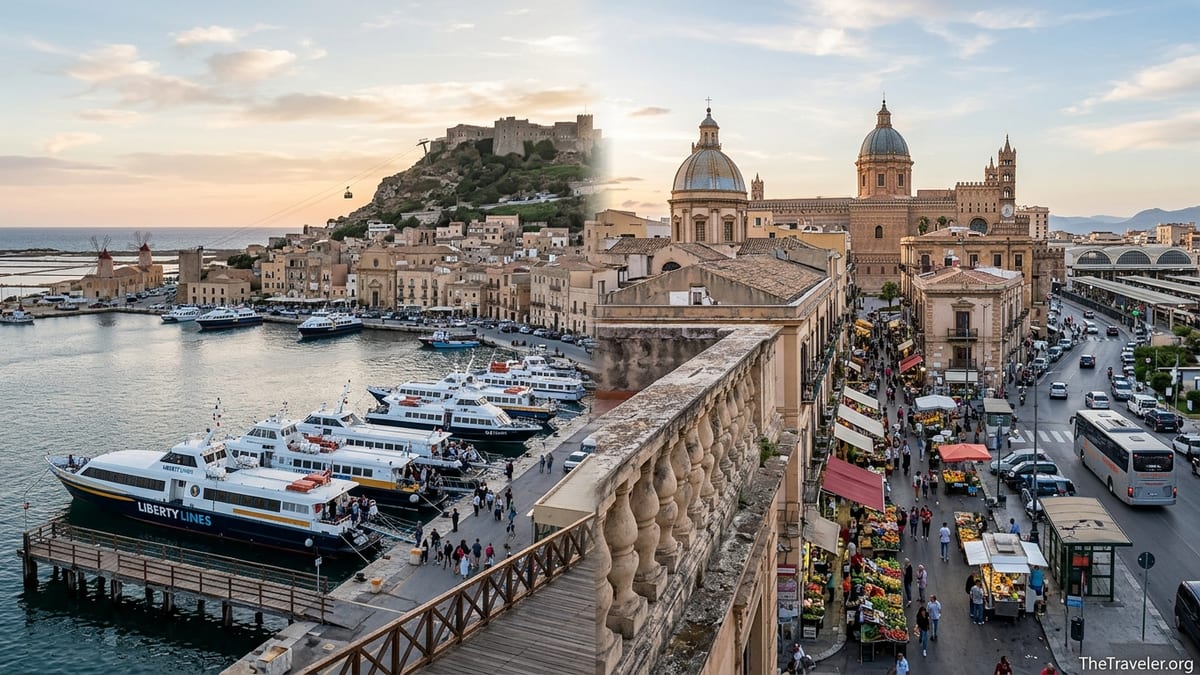
Trapani or Palermo as a Base: The Core Verdict
If your priority is the Egadi Islands and Erice, Trapani is usually the more practical base. Fast hydrofoils to Favignana, Levanzo and Marettimo leave from Trapani’s port throughout the day in season, with crossing times of about 30 minutes to Favignana and frequent early morning and evening departures. That makes day trips and flexible returns realistic even if the weather forces timetable changes. Staying a five to ten minute walk from the quay means you can adapt plans at the last minute.
Palermo, by contrast, is the better choice if you want a larger historic city, more varied nightlife and stronger regional connections across Sicily. The city’s Centro Storico, Kalsa and Politeama districts offer layers of Arab-Norman, Baroque and Liberty architecture, major museums and theatres, plus a wide spectrum of restaurants and bars that stay busy well into the night. Palermo also sits on the main rail and long distance bus axes to Catania, Messina and Agrigento, and has the island’s busiest airport with frequent low cost and network flights.
In practical terms this means many travelers start in Palermo for big city culture and onward Sicily connections, then move to Trapani for three or four nights focused on the Egadi Islands, Erice and the salt pans. The two cities are roughly 100 kilometers apart, with direct buses usually taking 1 hour 15 to 1 hour 40 minutes depending on stops and traffic, which makes combining them in a single trip straightforward.
For visitors relying entirely on public transport, the choice often comes down to what you want most from western Sicily. If clear water, island hopping and compact streets are your priority, build around Trapani. If your picture of Sicily centers on street markets, monumental churches and urban energy, Palermo deserves more of your nights.
Getting Between Palermo, Trapani and the Airports
Despite being relatively close together, Palermo and Trapani are linked more efficiently by bus than by train at the time of writing in late 2026. The direct rail line between Palermo and Trapani via Milo was closed after a landslide in 2013 and is undergoing reconstruction and electrification, with full reopening not expected before around 2028 according to publicly available planning documents. As a result, current Trenitalia journeys usually route via Mazara or require awkward changes and can take three hours or more, which is slower and less convenient than the bus for most travelers.
Intercity buses operated by companies such as Segesta and Autoservizi Salemi typically run several times per day between Palermo and Trapani. Recent schedules show common journey times around 1 hour 15 to 1 hour 40 minutes, with some faster limited stop runs reported near 1 hour. One example shared by recent travelers quoted a round trip for two around the low thirties in euros, which aligns with one way fares often in the 9 to 14 euro range depending on how far in advance you buy and the operator. Evening departures around 20:30 or later make same day arrivals from flights into Palermo or Trapani airport workable for many itineraries.
From Palermo city to Palermo Falcone Borsellino Airport, frequent trains operate on the metropolitan line. Standard services take roughly 50 to 60 minutes from Palermo Centrale, while a faster semi express branded Genio Express has been introduced that can reduce the travel time to around 34 minutes between Palermo Centrale or Notarbartolo and the airport. The base fare published in recent information is about 6.50 euros each way. In addition, shuttle buses run between the airport and several points in Palermo, taking roughly the same time but giving a direct ride if you stay near Politeama or the port.
Reaching Trapani from Palermo airport is more involved without a car. The most straightforward option for many travelers is a long distance bus, for example Autoservizi Salemi, which runs from Palermo airport or city to Trapani with evening departures that can arrive shortly before midnight. Journey times are usually around 1 hour 30 to 2 hours depending on the route and traffic. Alternatively, renting a car at the airport and driving the A29 motorway west to Trapani takes about 1 hour 15 in normal conditions. Trapani’s own Birgi airport, which handles carriers such as Ryanair, lies south of the city and is linked by local buses taking about 30 to 40 minutes into Trapani or longer if you continue toward Palermo.
Egadi Islands from Trapani and Palermo
The Egadi Islands are the main reason many travelers consider staying in Trapani. Liberty Lines hydrofoils run year round between Trapani and Favignana, with onward links to Levanzo and Marettimo. Current summer timetables indicate sailings from early morning through late evening on the Trapani to Favignana route, with up to around 20 to 25 departures per day at peak. Crossing times are commonly quoted at about 30 minutes between Trapani and Favignana, around 25 to 35 minutes to Levanzo and 60 to 70 minutes to Marettimo depending on the service.
Example ticket data collected by island specific travel resources in 2026 gives a one way adult fare Trapani to Favignana on a Liberty Lines hydrofoil at roughly 12 to 13 euros, excluding port taxes and any optional surcharges for large luggage. Other operators such as Blu Lines and Egadi Lines run fast boats and mini cruise style services, often quoting round trip prices around 20 euros or more for Trapani to Favignana, sometimes plus a separate marine protected area fee of about 5 euros per person. Car ferries also operate for residents and permitted vehicles, but these are less relevant for short stay visitors who are strongly discouraged or even restricted from bringing cars to Favignana in mid summer.
Seasonality and weather play a large role. From roughly June to September, frequency on the Trapani to Egadi routes is very high, and it is entirely realistic to leave Trapani after breakfast, rent a bicycle or electric scooter on Favignana, swim at Cala Rossa or Lido Burrone, and still catch an evening hydrofoil back. Outside high season, services are fewer, especially to Marettimo, and strong winds or swell can lead to last minute cancellations. Staying in Trapani gives you the best chance to react, as you can walk down to the port, switch to a different departure or switch days without building in a long inland transfer.
By comparison, visiting the Egadi Islands from Palermo is possible but less practical as a day trip. You first need to reach Trapani or Marsala early in the morning by bus or car, then connect with a hydrofoil. Even if you catch one of the earlier intercity buses, total travel time from a hotel in Palermo’s historic center to a beach on Favignana can easily exceed three and a half to four hours each way. As a result, most visitors who want to explore the islands while based in Palermo either accept a very long day or choose to spend at least one night in Favignana or Trapani.
Erice, Segesta and Day Trips without a Car
Erice, set on a hill directly above Trapani, is among the most rewarding short excursions in western Sicily. The Funivia Trapani Erice cable car links a lower station in the modern part of Trapani with the upper station just outside the medieval walls. The ride takes roughly 10 minutes and climbs more than 700 meters, giving wide views over the salt pans and the Egadi Islands. Recent ticket information suggests adult one way fares a little over 6 euros and returns in the 9 to 10 euro bracket, with discounts for children and passes sometimes available through local tourist products. Operating hours typically extend from morning until late evening in high season, but there are scheduled winter closures for maintenance and occasional shutdowns in strong winds, so travelers should check local postings on arrival.
The lower cable car station is reachable by local Trapani buses or a modest taxi ride from the historic center and port, making Erice one of the easiest independent day trips in Sicily without a car. When the cable car is not operating, either for weather or maintenance, road access remains with regular buses, excursion coaches and taxis zigzagging up the switchbacks. However, the ride by road takes longer and is less pleasant than the aerial route, so if Erice is important to you it is worth building some flexibility into your Trapani stay.
Segesta, with its Doric temple and hilltop theatre, sits inland between Trapani and Palermo. From Trapani, regional buses run to the Segesta archaeological area and nearby Calatafimi, often with schedules structured around late morning arrivals and mid afternoon returns in peak season. From Palermo, there is a long tradition of bus excursions, and more recently a dedicated service operated by firms like Tarantola & Cuffaro has been advertised, with departures from areas near Piazza Politeama in late morning and returns mid afternoon. Real world reports from 2026 mention a roughly 8:55 departure from Palermo and a return around 15:30, suitable for an unhurried visit but leaving limited time if delays occur.
Other day trips vary in practicality. From Trapani, San Vito Lo Capo and the Zingaro coast are accessible by intercity bus in about 1 hour 15 to 1 hour 30 in each direction in summer, though schedules can be sparse midday and crowded on weekends. Scopello and Castellammare del Golfo are harder without a car, as they tend to require a bus change and an uphill walk or local taxi. From Palermo, Monreale is one of the easiest excursions, with frequent city buses taking 30 to 40 minutes from the center, while Mondello beach is similarly reachable on local buses in roughly 30 minutes from Politeama, though summer crowding, heat and traffic can lengthen the trip.
City Atmosphere, Beaches and Neighborhoods
Trapani is compact, maritime and relatively low rise. The historic center sits on a long spit of land, with the sea on both sides and a promenade that runs west toward the Ligny Tower. The waterfront near the old town is atmospheric and good for evening strolls, sunsets and casual aperitivi, although the narrow strip of sand here is small and better suited to sunbathing than full beach days. For wider sandy beaches, visitors often head to the eastern side of town or to nearby stretches like Lido Paradiso, where shallow water and basic facilities make swimming easier in summer.
Just south of Trapani, the salt pans and windmills around Nubia and through to Marsala form one of the area’s most distinctive landscapes. Shallow evaporation basins, often tinged pink in late summer, are visible from the road and from viewpoints along the coast. Small visitor centers explain traditional salt production, and simple cafes offer sunset views across the flats to the distant Egadi Islands. These areas are easily reached by car in 15 to 30 minutes from Trapani and are also accessible on organized excursions and some seasonal shuttle buses, although independent travel by public transport can be patchy.
Palermo, in contrast, feels like a much larger Mediterranean capital. Its historic core is dense, noisy and architecturally rich. The Quattro Canti crossroads, the Palermo Cathedral, the Norman Palace with the Palatine Chapel and the churches of La Martorana and San Cataldo all sit within walking distance of one another. Traditional markets such as Ballarò and Vucciria continue to function as working produce markets by day, while also drawing visitors in the evenings with street food stalls, bars and informal outdoor seating. This energy is a major draw but comes with traffic, noise and occasional congestion even late at night.
Mondello, Palermo’s main city beach, lies in a separate bay framed by rocky cliffs. In summer, the long arc of sand is lined with private lidos offering sunbeds and umbrellas for daily rental, alongside free public sections that can become very busy with local families and day trippers. Buses from central Palermo take around 30 to 40 minutes, longer in heavy traffic. For travelers whose priority is daily beach time, Mondello is pleasant but not as convenient as smaller resort towns where accommodation is directly on the waterfront. For occasional swim days combined with urban sightseeing, however, basing in Palermo works well.
Accommodation, Prices, Dining and Safety
Accommodation patterns in the two cities reflect their different roles. Around Trapani’s historic center and ferry port, visitors find a mix of boutique hotels in old palazzi, contemporary mid range properties and many apartment style rentals. Price checks for mid season dates in 2026 suggest that a centrally located three star or simple four star hotel in Trapani often falls in the range of 90 to 140 euros per night for a double room, with breakfast included in many cases. Simple guesthouses and studios can undercut this, while seafront boutique hotels and high end suites can be higher, especially in late July and August when Italian holidaymakers arrive.
In Palermo, the main accommodation districts of Centro Storico, Politeama and Kalsa give more choice at more levels. For similar mid season dates, a central three star in the historic center or near Teatro Massimo might price around 110 to 170 euros per night for a double, while international quality four stars often sit somewhere between 160 and 220 euros depending on brand and flexibility. Budget travelers can find basic rooms or hostels under 80 euros away from the main squares, but should check recent reviews carefully for noise and maintenance. Overall, Palermo averages slightly higher than Trapani in like for like central locations, simply because demand is greater and the city is larger.
Dining costs show a similar pattern. In Trapani’s old town, a straightforward dinner of pizza or a plate of pasta with a glass of house wine might total around 18 to 25 euros per person at a casual trattoria in 2026 prices. Seafood focused meals along the waterfront, with shared antipasti, a main course of grilled fish or couscous di pesce and dessert, can push the bill into the 35 to 50 euro per person range, depending on your choices. In Palermo, street food keeps costs low if you are flexible, with panelle, arancine, sfincione and similar snacks still often priced in the low single digits, so a filling informal meal can be assembled for under 10 to 12 euros per person. Sit down dinners in smart restaurants, especially in Politeama and around the port, can easily pass 40 to 60 euros a head with multiple courses and wine.
In terms of evening atmosphere, Trapani is quieter and more focused on seaside strolling, gelato and a few lively bars around the center. Palermo offers a much more intense nightlife scene, from wine bars in the Kalsa to crowded squares near Vucciria and loud venues along the port area. Both cities are generally considered safe for visitors who take normal big city precautions, but Palermo’s busier nightlife zones can feel overwhelming to some, and petty theft is a risk in crowded markets or on packed buses. Trapani’s narrow lanes and limited late night traffic mean it can feel calmer, although some alleys are poorly lit, so travelers should plan routes in advance and avoid walking alone very late after alcohol, as they would anywhere.
Three Day Sample Itineraries and Transport Comparison
A realistic three day stay in Trapani for two people relying on public transport might look like this. On day one, arrive by bus from Palermo, check into a hotel near the historic center and spend the afternoon walking the waterfront to the Ligny Tower and exploring the old town lanes. In the evening, enjoy a seafood dinner and sunset over the salt pans, perhaps using a taxi or pre arranged shuttle. On day two, take an early Liberty Lines hydrofoil to Favignana, rent bikes to reach Cala Rossa and other coves, have a simple lunch at a bar near the port and return on a late afternoon or early evening hydrofoil, leaving time for an evening passeggiata. On day three, ride the cable car up to Erice in the morning, wander the stone streets and castles, then descend in mid afternoon for a final seaside aperitivo before a late bus back to Palermo or an onward connection.
A parallel three day plan in Palermo could combine historic sites and coastal experiences. Day one might focus on the core monuments: the Cathedral, Norman Palace and Palatine Chapel, with lunch at a market stall in Ballarò and an evening opera or concert at Teatro Massimo if tickets are available. Day two could be dedicated to Monreale, with a morning bus up to see the mosaic lined cathedral and cloister, followed by an afternoon stroll in the Kalsa district and waterfront. On day three, head to Mondello for a beach day, using local buses or a rideshare taxi, renting sunbeds from a lido and returning for a final evening of street food and drinks in the historic center. This itinerary stays within realistic public transport timings while leaving flexibility for heat or crowds.
When comparing key transport segments used in these itineraries, a simple overview helps. Palermo city to Palermo airport by train currently takes about 35 to 60 minutes with a fare of roughly 6.50 euros per person, with trains running from early morning until late evening. Palermo to Trapani by direct bus usually takes around 1 hour 15 to 1 hour 40, costs in the region of 10 to 16 euros one way and often has last departures in the late evening, sometimes after 20:30. Trapani port to Favignana by hydrofoil is around 30 minutes, with one way fares in the 12 to 13 euro region for adults in 2026, and the last returns in high season often in the early or mid evening, though exact times shift with the timetable and daylight.
Budget wise, a three night stay for two people in Trapani’s center in mid season might involve accommodation of about 300 to 420 euros in total for a mid range double room, meals of perhaps 45 to 70 euros per day for two if you mix simple lunches with mid priced dinners, and transport costs including one Egadi day trip (around 50 to 60 euros for two in hydrofoil tickets), a cable car excursion to Erice (around 18 to 20 euros for two returns) and intercity buses to or from Palermo (roughly 40 to 60 euros for two for round trips). That yields an approximate three night budget in the 650 to 850 euro range for two, before adding extras such as museum entries or taxis. A comparable three night stay in Palermo might run slightly higher on accommodation and restaurant spending, nudging the budget closer to 750 to 950 euros for two depending on neighborhood and dining choices.
Seasonality, Accessibility and Who Should Choose Which City
Western Sicily’s climate and infrastructure shape how comfortable a stay will feel. Summers from late June through early September are very hot, often with daytime highs well above 30 degrees Celsius and strong sun on exposed streets and beaches. Both Trapani’s old town and Palermo’s Centro Storico feature cobbled paving, uneven stones and some narrow passages, which can be tiring under heat for anyone with mobility or balance issues. Erice’s lanes are particularly atmospheric but also steep and paved in glossy stone, so visitors who use canes or have limited mobility may find some sections challenging.
In terms of step free access, Palermo offers more modern hotels with lifts in the Politeama area and some accessible rooms in newer properties, while many guesthouses in historic buildings lack elevators. Trapani’s smaller scale can be an advantage, as walking distances from the port to many hotels are short, but accommodation inside historic palaces often involves stairs. The cable car to Erice is convenient for many but still requires boarding and alighting at platforms that may not be fully step free. Travelers with specific mobility needs should contact cable car staff and hydrofoil operators in advance, as policies and facilities change with refurbishments.
Transport schedules are also highly seasonal. Hydrofoil frequency to the Egadi Islands is highest between June and September, with reduced service in shoulder months and fewer departures in winter, particularly to Marettimo. Buses to coastal resorts such as San Vito Lo Capo and extra services to sites like Segesta and Zingaro also concentrate in the main holiday months and may run only once or twice per day out of season. That makes Trapani an even more attractive base if your visit falls in late spring or early autumn, because staying closer to port and bus departures gives you more margin when services are infrequent.
For first time visitors to Sicily who are interested in a representative mix of city life, historic sites and some sea time, a combination of Palermo and Trapani often works best. Two or three nights in Palermo introduce you to the island’s largest city, major monuments and street food culture, followed by two or three nights in Trapani focused on the Egadi Islands, Erice and salt pans. Those with limited time can still choose a single base according to their priorities, but spreading the nights helps reduce backtracking and allows for weather flexibility.
Different traveler types may weigh these factors differently. Beach lovers and island hopping enthusiasts typically benefit from basing in Trapani, where ferries and hydrofoils are on the doorstep and sandy beaches are either within town or a short bus ride away. Families often appreciate Trapani’s calmer evenings, manageable scale and easy day trips, though Palermo can also work well if they want a wider range of museums and indoor attractions for very hot or wet days. Solo travelers who enjoy nightlife, bars and live music often lean toward Palermo, where it is easier to meet others and find late night activity, while those who prefer slower evenings and early morning island departures may favor Trapani.
For travelers relying entirely on public transport, Trapani is the more efficient hub for western coastal highlights, but Palermo remains the better all round base if you plan to explore wider Sicily by train and long distance bus. Ultimately, both cities reward time, and combining them over five to seven days offers one of the most satisfying ways to experience western Sicily in 2026 and beyond.