


More news on this day
Flight disruption across Asia and the Middle East has escalated into full-scale travel chaos, with aviation-tracking data and industry advisories indicating more than 3,800 delays and hundreds of cancellations in recent days as airspace closures tied to the Iran conflict ripple through global networks.
Get the latest news straight to your inbox!
Airspace Crisis Links Asian Delays to Gulf Conflict
Published coverage from aviation data providers and travel-industry outlets shows that Asia’s flight delays have surged sharply since mid-April as airlines grapple with airspace closures across large parts of the Middle East. On 14 April alone, more than 2,100 flights in Asia were delayed and nearly 300 were cancelled, while separate tallies for 13 and 15 April point to at least another 1,700 delays across key hubs in China, India, Southeast Asia and Hong Kong. Together, these figures suggest well over 3,800 delays in a matter of days, with disruption still unfolding.
The immediate trigger is the regional security crisis that followed joint United States and Israeli strikes on Iran in late February. Publicly available information indicates that Iran responded with waves of missile and drone attacks targeting infrastructure in Gulf states, including airports in Qatar and the United Arab Emirates. In parallel, several Gulf airspaces either fully closed or imposed tight restrictions, forcing long-haul carriers to cancel services entirely or reroute over longer, more congested corridors.
Industry advisories describe Saudi Arabia as one of the few remaining major east–west corridors still open, placing intense pressure on its air traffic control network. Other states, including Kuwait and Bahrain, have at times shut airspace completely or allowed only limited emergency and diversion traffic. This patchwork of closures has broken some of the world’s most heavily used transit links between Asia, Europe and North America, with knock-on effects now clearly visible at airports thousands of kilometers away.
Analysts note that the airspace squeeze is occurring alongside a wider Strait of Hormuz crisis that has already pushed up fuel prices and complicated cargo flows. For airlines, these overlapping pressures translate into longer routings, higher operating costs and fragmented schedules that are proving difficult to stabilize as conditions shift day by day.
Major Asian Hubs Buckle Under Rerouted Traffic
Asian airports that traditionally rely on smooth connections via Gulf hubs are now absorbing unprecedented disruption. Reports compiled from aviation-tracking platforms and regional media show that on 13 and 14 April, Shanghai Pudong, Jakarta’s Soekarno-Hatta, Bangkok Suvarnabhumi, Singapore Changi and Delhi’s Indira Gandhi International Airport accounted for a substantial share of more than 1,600 delays and around 100 cancellations across Asia.
Additional data released on 15 April points to at least 2,127 delayed flights and 289 cancellations in Asia the previous day, with Chinese hubs particularly hard hit. Together, these snapshots depict a region in which schedules are sliding out of sync as aircraft and crews arrive hours behind plan or not at all. Airports built to function as finely tuned transfer machines are instead confronting rolling waves of late arrivals that strain stands, gates and ground handling capacity.
Airport operators in Southeast and East Asia have issued multiple advisories warning that services to and from the Middle East, as well as long-range routes crossing the affected airspace, may be subject to last-minute rerouting or cancellation. One major operator in the Philippines recently cautioned that congestion is possible even on flights not directly serving the Gulf, as displaced passengers and repositioned aircraft filter through its terminals.
Scenes of crowded departure halls and long queues at airline service desks reported from Bangkok, Singapore and other hubs reflect how quickly local operations can be overwhelmed. With many Gulf carriers still operating at sharply reduced capacity, alternative options for rerouting passengers are limited, extending the impact of each individual delay or cancellation.
Gulf Hubs Strain Under Closures and Limited Reopenings
Middle Eastern gateways that normally anchor global connectivity between Asia and Europe have been among the hardest hit. In late February and early March, Dubai International and Doha’s Hamad International experienced abrupt airspace closures, halting or severely curtailing operations. One passenger-rights platform documented more than 560 flights cancelled or heavily delayed at Doha over a single 24-hour period, while separate analyses suggest Gulf airports collectively have seen thousands of cancellations since the crisis began.
While limited services have gradually resumed at some Gulf hubs, publicly accessible advisories from security consultancies and logistics firms emphasize that airspace across parts of the region remains restricted and subject to short-notice closure. Some airports in Iran and neighboring states continue to experience sustained disruption, and Kuwait’s airspace has at times been fully closed. Travelers are repeatedly urged, in open advisories, to treat all schedules as provisional.
Individual airlines are reporting sharply reduced operations as a result. Coverage focused on Indian carriers notes that Air India and its low-cost affiliate have cancelled about 2,500 services to West Asia over a three-week period and are operating at roughly 30 percent of normal capacity on routes to Saudi Arabia, the United Arab Emirates and Oman. Gulf-based airlines have likewise suspended or rerouted many services, with some European and Asian carriers temporarily withdrawing from cities such as Dubai, Doha, Jeddah and Tel Aviv.
The squeeze on capacity is compounded by physical damage and security concerns at certain airports, including incidents involving missile debris and intercepted drones. Even where runways and terminals remain structurally intact, operators are juggling the safety implications of hosting large volumes of diverted aircraft in a volatile environment, forcing conservative decisions that keep capacity below pre-crisis norms.
Gridlock, Misconnections and Stranded Passengers
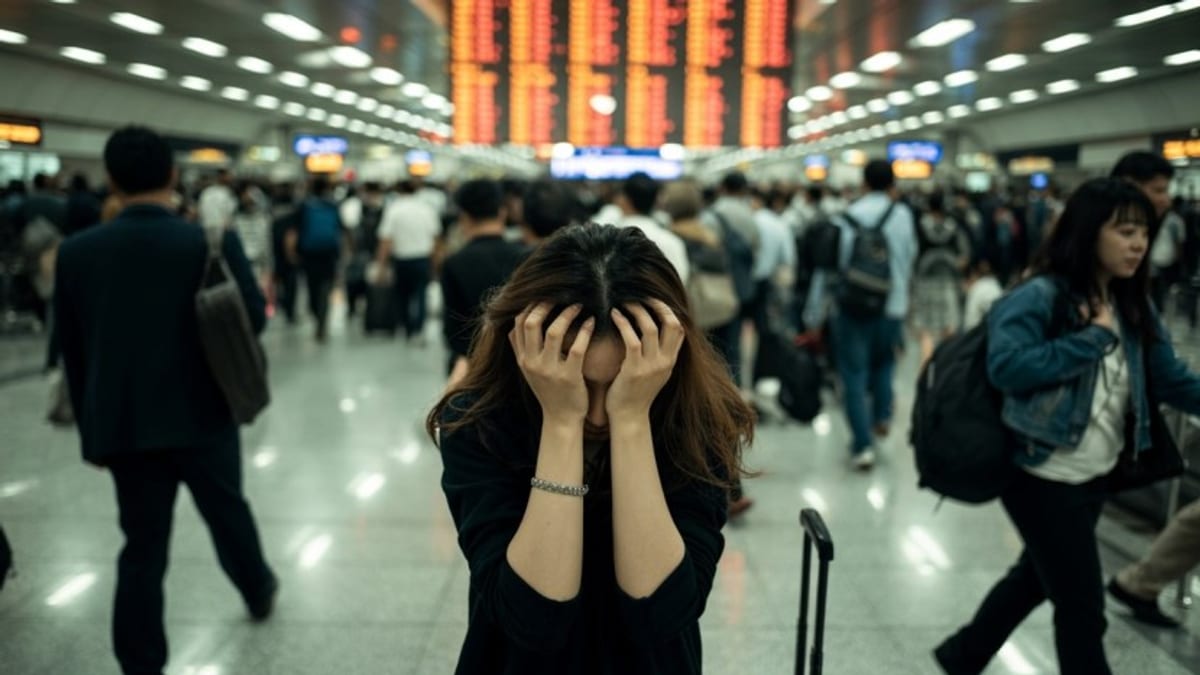
The combined effect of delayed aircraft, closed airspace and thinned-out schedules is visible on the ground in the form of gridlocked terminals and increasing numbers of stranded travelers. Coverage from regional and specialist outlets describes passengers sleeping in departure halls from Doha to Dubai and Tel Aviv as rolling cancellations and lengthy delays push connections out of reach.
Travel-industry briefings note that when a single long-haul flight from Asia arrives several hours late into a hub already operating with limited outbound capacity, dozens or even hundreds of onward connections can be missed. With airlines unable to rely on the usual network of Gulf and European partners to re-accommodate these travelers, many are being rebooked days rather than hours later, particularly on routes linking South and Southeast Asia to Europe.
Some airports have attempted to limit overcrowding by urging passengers through public notices not to arrive early or to avoid terminals altogether unless their flight is explicitly confirmed. Travel-advisory firms warn that high passenger volumes at security and border-control points increase the risk that even on-time flights depart with some booked travelers still stuck in queues.
Reports also highlight growing tension around compensation and passenger rights. In jurisdictions where consumer-protection rules attach specific rights to delays and cancellations, airlines are facing questions over their obligations during a conflict-driven airspace crisis. At the same time, insurers have begun reminding policyholders that many standard travel policies treat war-related disruptions as exclusions, adding a financial layer to an already stressful experience for affected passengers.
Longer-Term Impact on Routes and Fares
Beyond the immediate operational turmoil, analysts are beginning to assess how a prolonged airspace crisis might reshape Asia–Middle East travel. Economic assessments of the wider conflict point to steep revenue losses for Gulf super-connectors and warn that if closures persist, carriers may divert capacity to safer corridors through Central Asia, Africa or Europe, potentially redrawing global route maps.
For Asian travelers and airlines, longer routings are likely to push up ticket prices, particularly on premium long-haul links that depended on efficient Gulf stopovers. Industry commentary suggests that some corporate travelers are already shifting to itineraries that bypass the region entirely, favoring one-stop options through hubs such as Istanbul or European capitals when available.
Airport and tourism authorities in Asia are also bracing for secondary effects. Destinations that relied heavily on Middle Eastern feeder traffic could see visitor numbers soften, while hubs that gain rerouted services may struggle to scale infrastructure and staffing quickly enough to handle sustained increases in transfer passengers. The current surge in delays offers an early glimpse of how those growing pains might play out.
With security conditions and airspace rules still evolving, there is little clarity on when schedules will normalize. For now, publicly available data and advisories point to a simple reality for travelers across Asia and the Middle East: journey times are longer, connections are riskier, and the prospect of last-minute disruption is becoming a standard feature of international travel.