


More news on this day
A suspected drone sighting over Munich Airport on Saturday morning brought one of Europe’s key aviation hubs to an abrupt halt, triggering diversions, cancellations and mounting delays for thousands of passengers across the continent.
Get the latest news straight to your inbox!
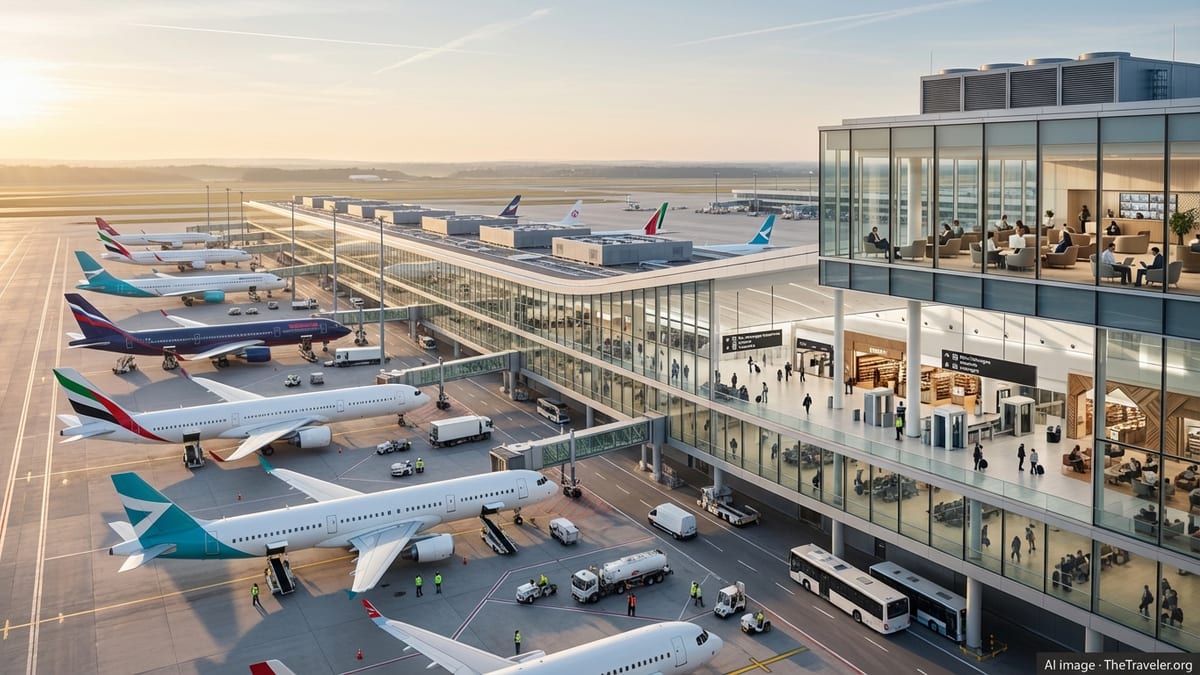
Runways Closed After Morning Drone Alert
Flight operations at Munich Airport, Germany’s second-busiest hub, were suspended shortly after 9:00 a.m. local time on May 30 after pilots reported spotting a suspicious object believed to be a drone in the vicinity of the runways. Publicly available information from multiple German media outlets indicates that at least two flight crews alerted air traffic control, prompting an immediate shutdown of both takeoffs and landings as a precautionary safety measure.
The disruption lasted for more than an hour, with reports indicating that runways remained closed until roughly 10:00 a.m. local time while police units and a helicopter swept the area. Local coverage describes a heavy security presence on the airfield and surrounding perimeter as specialists attempted to verify the sighting and ensure that no unauthorized device remained in the airport’s flight path.
Initial assessments shared in German and international reporting emphasize that the object has not yet been conclusively identified. For safety regulators and airport operators, however, the mere suspicion of a drone in controlled airspace was enough to force a rapid halt to operations at a facility that typically handles hundreds of movements each day.
Airport advisories issued once flights began to resume urged passengers to check directly with their airlines before traveling to the terminal, underscoring the scale of the resulting backlog and the likelihood of missed connections throughout the day.
Delays, Diversions and Travel Chaos Far Beyond Bavaria
Even a relatively short closure at a major hub can disrupt schedules across an entire region, and Saturday’s incident in Munich followed that familiar pattern. Tracking data and passenger reports circulating on social media and aviation forums point to multiple diversions of flights that had been scheduled to land in Munich during the closure window, with some aircraft rerouted to regional airports such as Nuremberg and others put into holding patterns before being redirected.
Published coverage from European news outlets notes that dozens of departures were delayed once operations resumed, as ground handlers, air traffic controllers and airlines worked through a sudden wave of late-arriving aircraft and displaced passengers. With Munich serving as a primary transfer point for southern Germany, Austria, Central and Eastern Europe, the knock-on effects quickly spread as travelers missed onward connections and crews ran up against legal duty-time limits.
By early afternoon, some carriers had begun cancelling flights outright, judging that the accumulated delays could not be recovered within the day’s remaining operating hours. Schedules across European short-haul networks showed growing gaps, illustrating how a relatively localized security scare can ripple through an interconnected system in a matter of hours.
Travelers heading to and from Munich reported crowded terminals, long queues at rebooking desks and limited information in the immediate aftermath of the closure, reflecting the challenge of communicating rapidly evolving operational decisions across multiple airlines and service providers.
Munich’s Repeat Drone Disruptions Raise Safety Questions
The latest shutdown comes against a backdrop of previous drone-related disruptions at Munich. Publicly available aviation reports and German press coverage highlight that in October 2025 the airport experienced at least two separate closures within a 24-hour period following suspected drone sightings, each time forcing flight suspensions and diversions while security teams searched the area.
Recent analyses from European air traffic management bodies have warned that drone incursions near major airports are becoming more frequent, with Munich and other large hubs cited as examples of facilities that have already faced operational impacts from unmanned aircraft in recent seasons. These assessments point to growing concern that even short, precautionary suspensions can generate substantial delay minutes, financial losses and passenger frustration.
While there is currently no indication that Saturday’s incident involved a hostile act, the recurrence of such events at Munich is likely to intensify scrutiny of drone enforcement in the region. Airport information available to the public clearly states that operating drones in the airport’s vicinity is strictly prohibited, yet the persistence of sightings suggests that regulatory bans and awareness campaigns have not fully deterred risky behavior.
Industry observers note that Munich’s experience mirrors a broader pattern across Europe, where airports in countries including the United Kingdom, Denmark and Poland have all reported temporary shutdowns in recent years after drones were suspected or confirmed near runways and approach paths.
Security, Technology and the Challenge of Fast Verification
The Munich shutdown again exposes a central dilemma for aviation authorities worldwide: how to balance the need to verify drone sightings quickly against the imperative to protect aircraft from even a small risk of collision. In the absence of immediate and definitive identification, conservative decisions to close runways are widely seen in public reporting as the only viable option, yet those decisions come at high operational cost.
European airspace safety studies released in recent months describe a patchwork of counter-drone measures at large airports, ranging from radar and radio-frequency detection to camera networks and geofencing. However, these tools are not uniformly deployed, and their effectiveness can be limited in complex environments with multiple potential sources of interference. The Munich incident illustrates how, in practice, pilot reports and visual observations often remain the primary trigger for emergency responses.
Experts quoted in earlier analyses of similar events, including high-profile disruptions at other major European airports, have long argued that timely situational awareness is crucial. The longer it takes to confirm or dismiss a suspected drone, the greater the likelihood that flights will be grounded, passengers stranded and crews displaced across the network.
The events in Munich are likely to renew debate over investments in standardized detection systems, shared data protocols between airports and law enforcement, and tougher penalties for unauthorized drone use in controlled airspace, as policymakers weigh the growing popularity of consumer drones against the strict safety margins required in commercial aviation.
What Travelers Can Expect in the Coming Days
For passengers booked through Munich over the rest of the weekend, publicly available advisories suggest preparing for residual disruption even after runways have reopened. Aircraft and crews remain out of position following the suspension, and tight turnarounds on intra-European routes leave little slack to absorb a shock of this kind.
Travel industry sources indicate that travelers may face longer connection times, sporadic cancellations and last-minute gate changes as airlines re-balance their fleets and prioritize long-haul operations. Some short-haul services may be consolidated, while others could see schedule changes as carriers attempt to restore normal rotations.
Passengers are being urged, through airline and airport communication channels, to arrive early, monitor flight status tools closely and be prepared for rebooking onto alternative routes, including itineraries that bypass Munich entirely. Those traveling to regional destinations previously fed through the hub may find themselves routed through other European gateways until operations fully stabilize.
With summer travel demand building across Europe, the incident at Munich serves as another reminder that even brief security scares can cascade into widespread travel headaches. For aviation planners and policymakers, it reinforces the urgency of developing faster, more reliable ways to detect and assess drone activity near airports before the next sighting brings another major hub to a standstill.