


More news on this day
President Donald Trump’s latest trip to China, framed by rapid-fire exchanges with reporters on the tarmac and aboard Air Force One, is drawing fresh attention to how the journey could reshape everything from geopolitics to practical realities for travelers moving between the United States and China.
Get the latest news straight to your inbox!
Questions Begin Before Wheels Leave The Ground
Trump’s most recent China journey began with an extended back-and-forth with the White House press corps before departure, as cameras captured the president fielding questions on China policy alongside domestic issues such as inflation and the Iran conflict. Publicly available video of the encounter shows him taking questions just steps from Marine One and again on the runway before boarding the presidential jet bound initially for Alaska and then onward to Beijing and Shenzhen.
Coverage from U.S. broadcasters indicates that Trump repeatedly linked the China visit to broader security concerns, promising to press Beijing on Iran sanctions and regional military tensions while also emphasizing trade. In those brief, unscripted exchanges, he referred to China as both a necessary economic partner and a strategic rival, underscoring the dual message he is expected to carry into meetings with Chinese leader Xi Jinping.
Reporters traveling regularly with the president note that these tarmac gaggles often serve as an informal preview of the themes likely to dominate closed-door talks. In this case, Trump’s answers suggested that the China leg of his travel would be closely tied to efforts to manage the war in Iran, discussions on oil flows through the Strait of Hormuz, and renewed questions about tariffs and technology controls affecting cross-border business travel.
Questions also touched on upcoming multilateral events, including the Asia-Pacific Economic Cooperation meetings in Shenzhen in November 2026, where Trump has signaled that China’s role in the wider Indo-Pacific and possible contacts with North Korea’s leadership could again move to the foreground.
Air Force One Becomes An In-Flight Newsroom
The question-and-answer sessions did not end at takeoff. A partial transcript of an exchange with reporters aboard Air Force One, released through public archives, shows journalists pressing Trump as the aircraft routed through Anchorage on the way toward East Asia. The discussion turned quickly to the China leg of the trip, with questions about how forcefully he would raise security and economic disputes with Beijing.
Reports from outlets that routinely track presidential travel describe the cabin of Air Force One effectively functioning as a flying newsroom on such long-haul journeys. Seats are reserved for a rotating pool of journalists who file real-time dispatches while the president walks back to the press section for on-the-record exchanges. During this particular trip, accounts posted afterward describe a sometimes combative but largely sustained question period touching on trade, sanctions, and the itinerary inside China.
The setting high above the Pacific also highlighted a key difference between earlier Trump-era China encounters and today’s environment. Whereas previous visits were dominated by tariff headlines, current coverage points to a heavier focus on strategic flashpoints such as Taiwan, freedom of navigation in nearby seas, and technology export controls. For airlines, cruise operators, and corporate travel planners watching from the ground, this evolving agenda may signal which routes, sectors, or joint ventures could face tighter scrutiny in the months ahead.
Travel watchers following public pool reports often look to these in-flight remarks for early signals on possible changes to visa policies, security advisories, or aviation agreements. On this trip, there has been no indication so far of immediate new restrictions for ordinary tourists, but the steady questioning around security and sanctions underscores how quickly the policy climate can shift.
China Itinerary Blends Summitry And Security Protocols
Publicly available schedules indicate that Trump’s China program centers on Beijing and Shenzhen, where he is expected to participate in formal talks with Xi and attend high-profile regional meetings. The Shenzhen segment is timed around the Asia-Pacific Economic Cooperation summit, scheduled for November 18 and 19, 2026, which is drawing leaders and ministerial delegations from across the Pacific.
Background reporting on the planning for this visit notes that U.S.–China tensions over technology, shipping lanes, and the status of Taiwan have created one of the most complex diplomatic backdrops for a presidential trip in years. Analysts quoted in major outlets describe the visit as both an attempt to stabilize communication and an opportunity for each side to shore up domestic narratives about standing firm abroad. That balancing act has placed unusual weight on how every remark, including off-the-cuff answers to reporters’ questions, is interpreted in both capitals.
Security and logistics measures around Trump’s travel have also become part of the story. One detailed account of a recent China visit describes a requirement that staff and reporters surrender items obtained in China before boarding Air Force One, an added layer of precaution reflecting heightened concerns over electronic surveillance and data collection. Images distributed through photo agencies depict the president taking questions from reporters under the wing of the aircraft, surrounded by a visible security perimeter.
For travelers, these restrictive protocols offer a reminder that official delegations operate under far tighter controls than tourists or business visitors. Yet they also hint at the level of mistrust informing the broader relationship, a factor that can feed into everything from export-license reviews to how quickly new air routes or tourism exchanges receive regulatory approval.
Implications For Travelers Between The U.S. And China
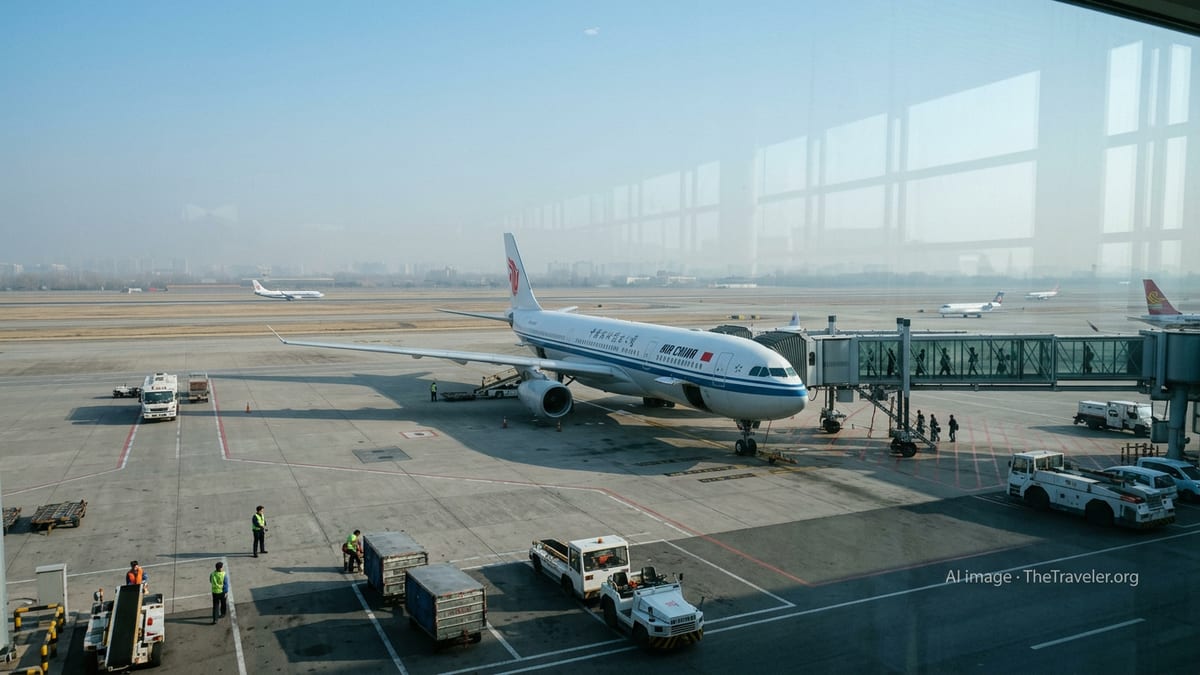
Although Trump’s exchanges with reporters revolve mainly around diplomacy and security, they carry practical implications for travelers watching from airports and booking sites. Airline capacity between the United States and mainland China has been gradually rebuilt since the sharp reductions earlier in the decade, with major carriers restoring key routes linking hubs such as Los Angeles, San Francisco, Seattle, New York, and Chicago to Beijing and Shanghai. According to published schedules, frequencies remain below pre-2020 levels, but they have been trending upward as bilateral air agreements loosen.
Travel industry coverage suggests that any breakthrough or breakdown in Trump’s talks with Xi could affect how quickly additional frequencies or new city pairs are approved. Carriers weigh not only demand but also the political environment when committing wide-body aircraft to ultra-long-haul routes. Questions reporters directed at Trump about tariffs, technology restrictions, and broader tensions signal that executives will be watching the trip’s outcomes closely before finalizing future timetables.
Visa arrangements and entry rules also remain a central concern for travelers. Publicly available guidance shows that both countries continue to require advance visas for most visitors, with processing times and documentation standards that can tighten or relax in response to the political climate. While there have been no announced overhauls tied directly to this trip, travel law specialists interviewed by major news organizations note that changes to consular staffing, security vetting, or reciprocity agreements often follow shifts at the top level of the relationship.
Travel advisories issued by government agencies can move as well, especially if maritime or air incidents occur in the region during or after the visit. Trump’s comments, captured in the pre-departure gaggle and on Air Force One, about denuclearization and regional security will therefore be monitored not only by diplomats but also by insurers, tour operators, and multinational companies that plan conferences and incentive travel in Chinese cities.
Watching The Trip From The Global Tourism Sector
The tourism and business travel industries worldwide are parsing Trump’s latest China journey as part of a broader question: whether one of the world’s most important travel corridors is heading toward a period of stabilization or renewed volatility. Industry analysts writing in travel trade publications point out that links between the two countries underpin not just tourism but also education, manufacturing, and high-tech investment that depend on predictable, affordable air access.
Reports indicate that destinations across Asia and the Pacific are following the trip closely, aware that any easing of tension between Washington and Beijing can open opportunities for multi-country itineraries, cruise deployments, and new airline partnerships. Conversely, a deterioration in tone, reflected in Trump’s public answers to questions or in statements from Chinese officials, could prompt carriers to recalibrate capacity and push international travelers to route through alternative hubs.
Hotel groups and conference organizers in Beijing, Shanghai, Shenzhen, and other major cities are likewise attuned to the signals emerging from this high-profile visit. Forward-booking data discussed in business media show that large-scale corporate events often hinge on perceptions of political risk. A visit framed by constructive press interactions and measured rhetoric could help reassure planners, while images of confrontation or sharply critical language might have the opposite effect.
For now, Trump’s China trip remains a moving story told partly through his exchanges with the press: brisk tarmac questions, mid-flight gaggles, and brief pauses on the way to summits and bilateral talks. Travelers, airlines, and destinations will be watching closely to see whether those moments of unscripted dialogue point toward a more open travel environment or another period of heightened uncertainty on one of the world’s most consequential routes.