


More news on this day
The United States has updated its travel advisory for mainland China, highlighting an elevated risk that travelers could face wrongful detention, arbitrary exit bans, and broad national security enforcement, even as the overall alert level for the country officially remains below the highest tiers used in other destinations.
Get the latest news straight to your inbox!
New “Wrongful Detention” Indicator Added for China
Publicly available information on the State Department’s travel advisory site shows that mainland China is now flagged with a specific “D” risk indicator for wrongful detention. This code is reserved for countries where Washington has determined that foreign governments present a credible risk of detaining U.S. nationals in circumstances judged to be wrongful under U.S. law.
The advisory for China continues to emphasize what it describes as arbitrary enforcement of local laws, the use of exit bans without transparent legal procedures, and the potential for extended questioning or detention in national security or public order cases. Recent media coverage indicates that these concerns apply to a wide range of visitors, including tourists, business travelers, academics, and dual nationals.
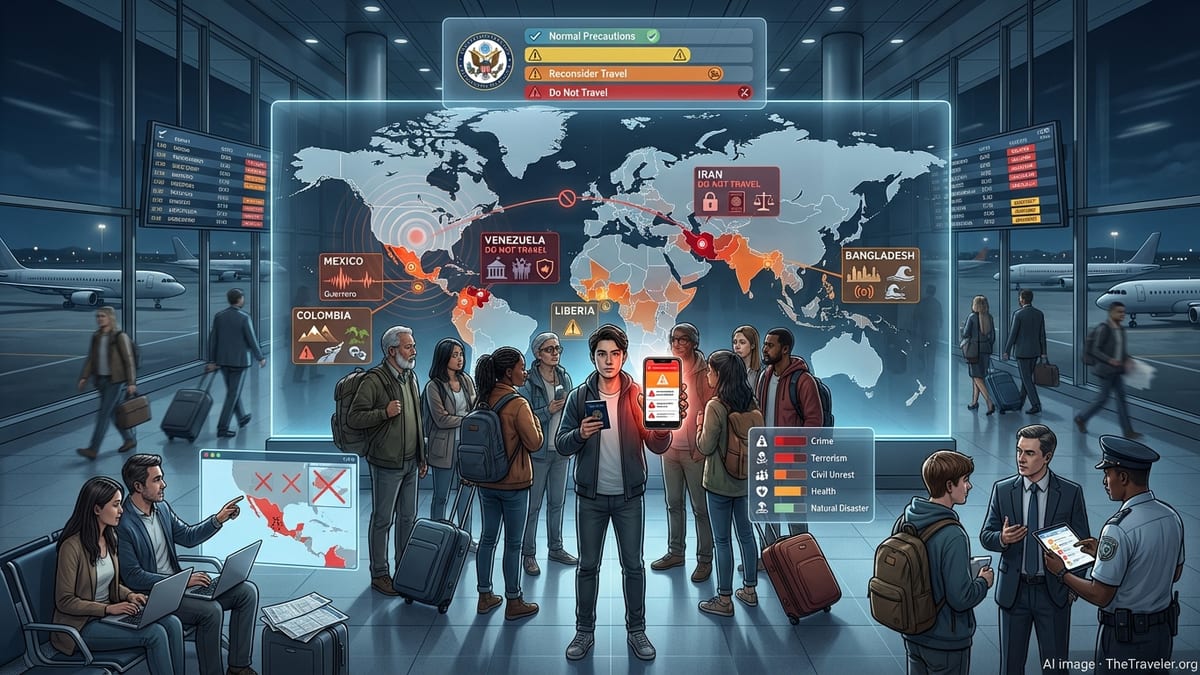
China’s overall advisory level on the State Department’s four-step scale currently directs travelers to exercise increased caution. However, the addition and reinstatement of wrongful detention language in late 2026 mark a renewed focus on legal and political risks that can affect visitors even when they have not knowingly violated local regulations.
Background reporting notes that the China advisory has shifted over recent years. After a period at Level 3, “Reconsider travel,” because of detention and exit-ban risks, it was moved to Level 2 in late 2024 before new guidance once again elevated the prominence of wrongful detention concerns.
What the Advisory Says About Detentions and Exit Bans
According to the latest advisory language and supporting public documents, U.S. travelers to mainland China are warned that they may be subject to investigation, questioning, or detention for reasons that can be difficult to anticipate. The advisory notes that the Secretary of State has determined that wrongful detentions of U.S. citizens have occurred in China within the past five years.
The text highlights that exit bans have been used in connection with criminal and civil cases, business or family disputes, and matters labeled as national security concerns. These measures can prevent an individual from leaving the country for months or longer, even when formal charges have not been announced, and there may be limited avenues to challenge such orders in court.
Published coverage points to several categories of people identified as facing greater risk, including individuals involved in sensitive commercial or technology sectors, those engaged in legal or political disputes inside China, and people with current or past affiliations to the U.S. government or security community. Some analyses also underline that Americans of Chinese heritage are not exempt from these measures and may face additional scrutiny at borders or during local checks.
The advisory further cautions that travelers may have restricted access to legal assistance, consular support, or public information about their case if detained. It also notes that Chinese authorities may limit or delay notification to U.S. consular officials in certain kinds of investigations, especially those labeled as involving state security.
National Security Laws and Expanding Legal Risks
The change in advisory status is linked in part to an evolving legal environment in China. Publicly available guidance points to recent expansions of counterespionage and national security legislation, which broaden official definitions of activities that can be considered spying or threatening to state interests.
In updated materials on China travel, U.S. officials describe how these laws can cover a wide spectrum of conduct, including ordinary business negotiations, research cooperation, data collection, or the transfer of technical information. Observers note that the scope of prohibited activity is not always clearly defined, which can create uncertainty for companies and individuals planning travel related to technology, infrastructure, or cross-border supply chains.
Recent reports from international media outlets also reference tighter rules on border controls and outbound travel from China, including new regulations that underscore the government’s authority to restrict departures for individuals believed to pose a risk to national or industrial security. Legal analysts cited in public commentary argue that this further increases the possibility that foreign travelers could face exit bans if they become linked to investigations or commercial disputes.
Universities, multinational corporations, and professional associations in the United States have begun circulating updated guidance to staff and students with planned travel to China. These advisories frequently echo the State Department’s language about wrongful detention and emphasize the need to review local laws, contractual obligations, and data-handling practices before departure.
Implications for Tourists, Students, and Business Travelers
The heightened focus on wrongful detention does not amount to a blanket prohibition on travel to China, but it does signal a more cautious posture from Washington. For leisure travelers, the advisory underscores that issues such as social media activity, photography near sensitive sites, or informal discussions of politics and security topics can draw scrutiny that might be difficult to predict.
Students and academic researchers are encouraged in public guidance materials to pay close attention to the subjects they plan to study, the data they intend to collect, and the organizations they work with inside China. Programs with ties to public policy, security affairs, or human rights have in particular been flagged in institutional advisories as warranting a careful risk assessment before travel.
For business travelers, the updated warning intersects with broader concerns about contract enforcement and compliance exposure in China. Reports indicate that commercial disputes have, in some cases, escalated into criminal allegations or immigration restrictions for company executives and staff. Trade and compliance specialists recommend that firms ensure employees understand local regulations and that contingency plans are in place should a dispute arise while personnel are in-country.
Travelers of all kinds are also reminded that digital privacy standards in China differ sharply from those in many Western countries. The State Department advisory and independent risk bulletins note that electronic devices, cloud accounts, and communications may be subject to inspection or monitoring, which can become relevant in investigations that lead to detention or exit bans.
How Travelers Can Respond to the Updated Warning
In light of the renewed emphasis on wrongful detention, travel experts and security departments at universities and corporations are urging prospective visitors to incorporate legal and political risk into their planning. Publicly accessible guidance recommends that travelers review the State Department advisory for China immediately before departure, as the detailed text and risk indicators may change over time.
Common recommendations in open-source travel security briefings include sharing detailed itineraries with trusted contacts at home, maintaining regular communication check-ins, and preparing for limited access to common messaging or mapping apps once in China. Travelers are also encouraged to carry the contact information for U.S. embassies or consulates in the region and to familiarize themselves with local emergency procedures.
Analysts following the advisory note that risk can differ substantially depending on a person’s profile and the purpose of their trip. Individuals working in sensitive sectors or on politically charged topics may opt to postpone or reroute travel, while others may decide to proceed while adopting stricter precautions and limiting discussion of work that touches on regulated technologies or policy debates.
While the new warning has drawn attention in the travel industry, publicly available information stresses that each traveler must ultimately assess their own tolerance for risk. The updated advisory for China signals that the U.S. government now views wrongful detention and exit bans as central concerns for Americans considering trips to the country, and it places those issues alongside health, crime, and disaster preparedness in evaluating whether and how to travel.