

More news on this day
Tui has been named among the worst airlines for UK flight delays in recent analyses of Civil Aviation Authority data, highlighting persistent punctuality problems that risk disrupting the country’s busy holiday travel market.
Get the latest news straight to your inbox!
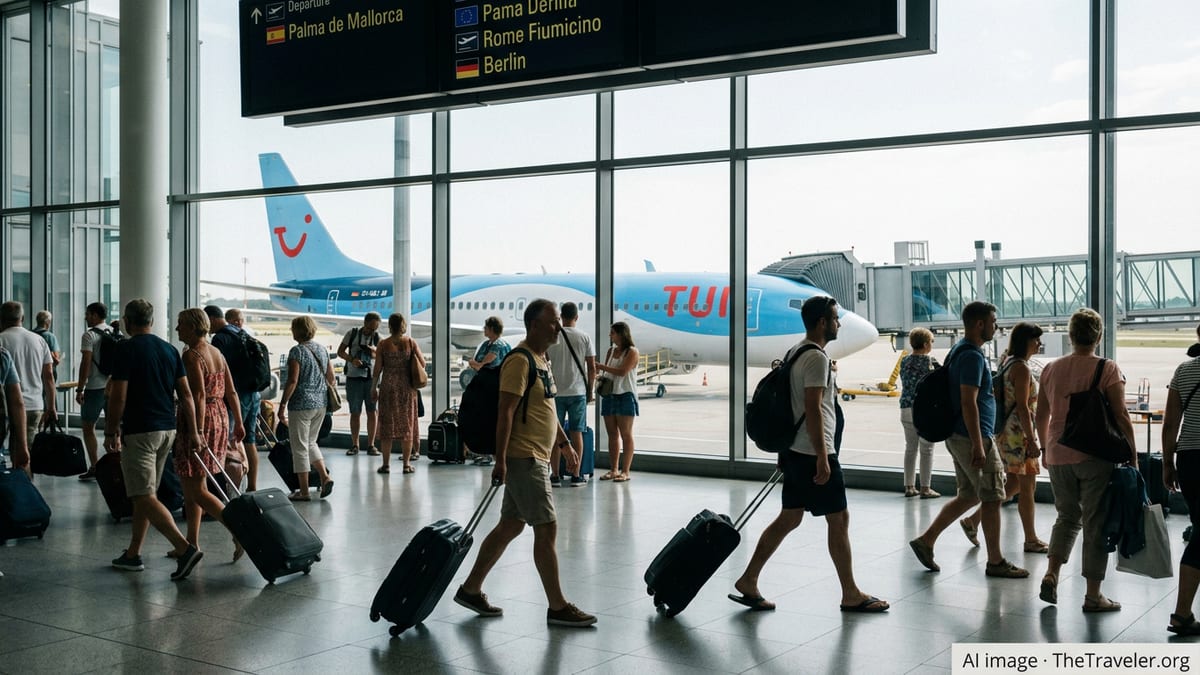
CAA data highlight scale of UK delay problem
Recent analysis of Civil Aviation Authority statistics by consumer groups and media outlets shows that flight delays remain a significant problem for passengers departing UK airports. Across all scheduled and charter services, the average delay for UK departures has been measured in the low-20-minute range in recent years, with some airlines and airports performing substantially worse than the national mean.
The figures are based on thousands of flights operated each year and consider all departures, including those that leave on time. A flight is typically classed as on time if it departs within 15 minutes of its scheduled departure. The data show that while punctuality has improved from the most disrupted months immediately after the pandemic, it has not returned to 2019 levels.
Within this wider picture, rankings compiled from CAA data have repeatedly highlighted a cluster of airlines whose services are more likely to run late. In this group, low cost and leisure carriers feature heavily, reflecting their large presence at busy UK holiday airports and complex summer schedules.
Tui repeatedly flagged among worst performers
Within those rankings, Tui Airways has been consistently identified as one of the poorest performers on punctuality from UK airports. Analyses of peak summer 2022 CAA data found that more than six in ten Tui flights were delayed by at least 15 minutes, with the airline recording an average delay of around half an hour on affected services.
Subsequent year-long tallies built from CAA departure data placed Tui among the worst major airlines for overall delays, behind ultra low cost rival Wizz Air but still in the bottom tier for on time performance. More recent consumer research looking at punctuality between 2019 and 2023 indicated that the share of Tui flights leaving on time fell notably over that period, underlining that disruption was not confined to a single difficult summer.
Industry commentary linked Tui’s position in these delay tables to a combination of heavily concentrated leisure schedules, aircraft utilisation patterns, and knock on effects when earlier flights on a given aircraft run late. Unlike some network carriers that can reassign spare aircraft, integrated tour operators typically have less flexibility when rotations begin to slip, making it harder to recover once punctuality deteriorates.
Other airlines and airports under scrutiny
Tui’s performance has drawn particular attention because of its size in the UK package holiday market, but it is far from the only airline facing punctuality questions. Multiple rounds of analysis of CAA data have placed Wizz Air at or near the bottom of delay rankings for several consecutive years, with average delays similar to or worse than those attributed to Tui.
Traditional and low cost airlines including British Airways, easyJet, Jet2 and Ryanair have also seen their on time performance weaken compared with 2019 according to consumer group research, even if they generally rank above the poorest performing carriers. For passengers, this means that flying with a better rated airline is no guarantee of an entirely punctual experience.
Airports are also part of the picture. Investigations into delay patterns at UK airports have highlighted Gatwick and Luton among those with the highest average departure delays in 2023, with staffing constraints in air traffic control towers and broader capacity pressures cited as contributing factors. Since leisure airlines such as Tui operate a large share of flights from these airports, they are particularly exposed when operational bottlenecks develop.
Impact on holidaymakers and consumer rights
For UK travellers, Tui’s appearance near the bottom of punctuality tables matters because of the airline’s prominence in the package holiday sector. Many passengers only discover an airline’s track record on delays when they encounter disruption at the start of a long awaited break, often with children in tow and tight transfer arrangements at the destination.
Delayed departures can translate into lost holiday time, missed hotel check ins and added stress, particularly on long haul services reaching resorts late at night. In the most serious cases, passengers can face overnight delays and rebooked flights, with the additional challenge of securing accommodation and food during the wait.
Under UK and retained EU regulations, passengers are entitled to care, assistance and in some circumstances financial compensation when flights are delayed beyond a set number of hours and the cause lies within the airline’s control. Guidance from regulators and consumer organisations stresses that travellers should retain boarding passes and evidence of disruption, submit claims directly to airlines, and escalate complaints to alternative dispute resolution services if they believe a claim has been unfairly rejected.
How airlines and regulators are responding
The repeated appearance of large leisure airlines such as Tui near the bottom of delay rankings has intensified debate over how much pressure should be placed on carriers to improve performance. The Civil Aviation Authority has renewed its call for stronger enforcement powers in relation to consumer rights, arguing that it should be able to impose financial penalties when airlines fall short of their obligations.
Airlines, for their part, point to a series of external pressures that have made punctuality harder to maintain, including air traffic control staffing shortages in parts of Europe, weather disruption and lingering supply chain constraints. At the same time, operators across the sector have emphasised investments in operations control, crew resourcing and aircraft maintenance intended to reduce the likelihood of long delays.
For now, CAA punctuality tables and independent analyses remain an important reference for travellers attempting to assess the relative reliability of the airlines serving UK airports. With summer peak seasons continuing to test aviation infrastructure, close scrutiny of data showing where and when flights run late is likely to continue, and airlines such as Tui that rank among the worst for delays can expect ongoing attention from both consumers and regulators.