


More news on this day
Türkiye is preparing to launch an international tender for the North Istanbul railway project, a multi‑billion‑dollar scheme that will add a new Bosphorus rail crossing, connect the city’s two main airports and create a high‑capacity freight and passenger bypass around the metropolitan core.
Get the latest news straight to your inbox!
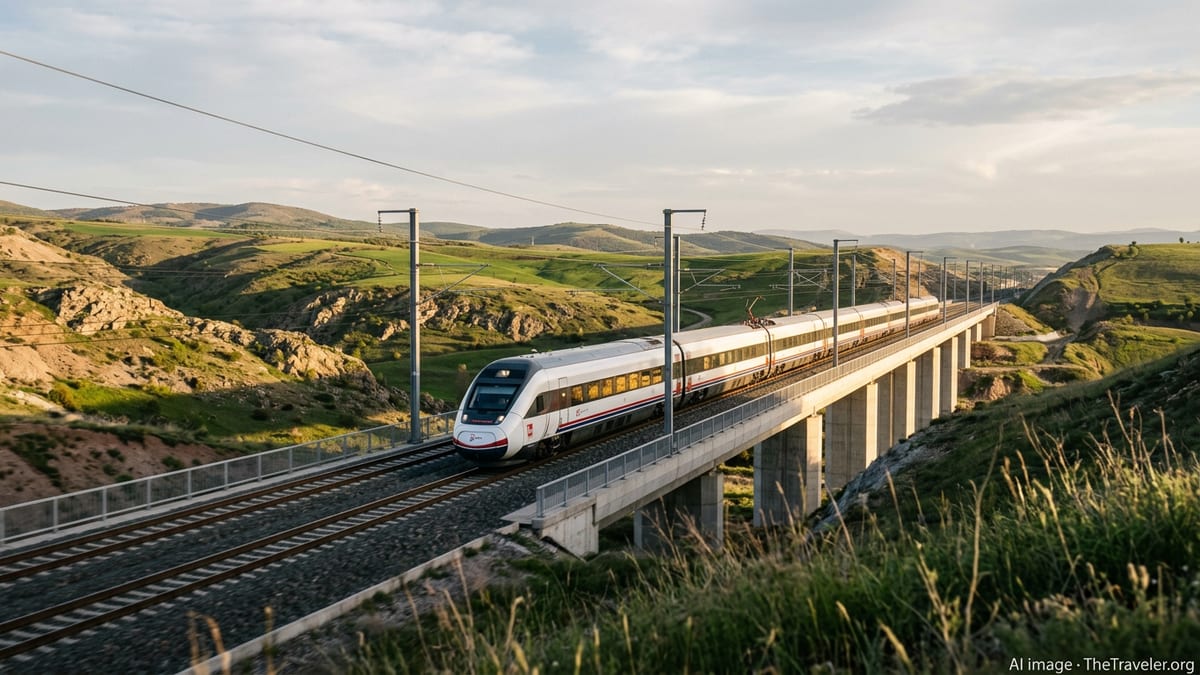
Strategic rail corridor slated for October tender
According to recent coverage in Turkish business and transport media, the tender for the Northern Ring or North Istanbul railway is scheduled for mid October 2026, with the procurement process structured to attract major global contractors and consortia. Reports indicate that the bid package will cover the core civil works and rail systems for a new cross‑Bosphorus alignment integrated with the Yavuz Sultan Selim Bridge, part of the wider Istanbul North Rail Crossing Project, also known as INRAIL.
Publicly available information from Türkiye’s General Directorate of Infrastructure Investments describes INRAIL as a greenfield double‑track, electrified and fully signalized railway bypassing the urbanized belt of Istanbul while still connecting to key logistics hubs on both the European and Asian sides of the city. The line is planned to run broadly parallel to the North Marmara Motorway, using the third Bosphorus bridge to create a second rail crossing in addition to the existing Marmaray tunnel.
Turkish press reports suggest that the tender will be structured in multiple lots to cover distinct sections of the corridor, including the Bosphorus crossing, approach viaducts, tunnels and junctions toward Istanbul Airport in the northwest and the industrial districts around Çayırova and Gebze in the east. Authorities have previously signaled a preference for design‑build contracts under international FIDIC conditions, a model that is already referenced in technical tender documentation circulated to the market.
While the government has not publicly confirmed an overall construction timetable, project summaries circulated by multilateral lenders outline an implementation window of several years once contracts are awarded, with early works and site preparation expected to follow relatively quickly after the October tender date if procurement proceeds on schedule.
International lenders line up $6.75 billion in financing
The North Istanbul railway is emerging as Türkiye’s largest foreign‑funded rail scheme to date, with multilateral development banks taking a leading role. A press release issued by the World Bank at the end of March 2026 announced a 2 billion dollar loan for the Istanbul North Rail Crossing Project, describing it as a transformative investment to strengthen rail connectivity across the Istanbul Strait and reinforce Türkiye’s position as a logistics hub between Europe and Asia.
Additional financing has been approved or proposed by a group of international institutions that includes the Asian Infrastructure Investment Bank, the Asian Development Bank, the European Bank for Reconstruction and Development, the Islamic Development Bank and the OPEC Fund for International Development. According to published project summaries, the combined external financing package is expected to reach around 6.75 billion dollars, supplemented by counterpart funding from the Turkish government.
Project information disclosed by the Asian Infrastructure Investment Bank indicates that the line will extend for roughly 122 to 127 kilometers of double‑track railway, including connections, with electrification and modern signaling. The corridor will link Çayırova, on Istanbul’s Asian side, to Çatalca on the European side, providing a continuous freight‑capable route that avoids the city’s densely built inner districts while still connecting with existing and planned urban rail lines.
Environmental and social framework documents released by lenders outline requirements for land acquisition, resettlement planning and environmental mitigation along the route. Early market engagement exercises launched by the World Bank in late 2025 invited contractors and suppliers to provide feedback on the prospective procurement approach, suggesting that the October tender builds on months of consultations with industry stakeholders.
Linking Istanbul’s airports and easing freight bottlenecks
For Istanbul’s transport network, the North Istanbul railway is designed to play a dual role: relieving chronic freight congestion through the metropolitan area and improving passenger links, particularly to the city’s two main airports. Technical summaries prepared for the project note that the new line will provide structural provisions for direct rail access to Istanbul Airport on the European side and Sabiha Gökçen Airport on the Asian side, either through dedicated spur lines or integrated junctions with other rail corridors.
By shifting heavy freight trains away from existing tracks that pass through central districts and across the Bosphorus, the project is expected to free up capacity for commuter and intercity passenger services. Publicly available analyses highlight that much of Istanbul’s current rail infrastructure functions as a mixed‑traffic system, limiting frequencies and speeds. A dedicated high‑capacity freight bypass across the Yavuz Sultan Selim Bridge is therefore seen as critical to handling projected growth in rail‑borne cargo.
The corridor is also positioned as part of a broader effort to rebalance Türkiye’s transport mix in favor of rail, following decades in which highway expansion dominated investment. Government planning documents and trade promotion materials emphasize that new freight rail capacity around Istanbul should facilitate longer‑distance corridors linking the country’s industrial heartlands to European and Middle Eastern markets, while reducing dependence on road haulage through the city’s already congested road network.
From a passenger perspective, the northern route is expected to connect with existing and planned high‑speed and intercity lines, enabling through services that avoid time‑consuming routings via central stations. While detailed operating plans have yet to be published, the presence of modern electrification and signaling along the full alignment suggests that passenger services could operate at competitive speeds once the line is complete.
Technical scope spans bridge, tunnels and new mainline
Official project briefs released by Türkiye’s infrastructure authorities and multilateral financiers provide a high‑level view of the technical scope that the forthcoming tender will cover. The Istanbul North Rail Crossing is conceived as a fully electrified double‑track mainline built largely on a new alignment, with design speeds suitable for both heavy freight and fast intercity passenger trains. The alignment closely follows the North Marmara Motorway corridor, taking advantage of existing rights of way where possible while still requiring extensive new civil works in hilly northern terrain.
One of the most distinctive elements of the scheme is the rail utilization of the Yavuz Sultan Selim Bridge, a combined road‑rail structure that currently carries motorway traffic across the Bosphorus on Istanbul’s northern fringe. While the bridge was built with space for rail tracks, these have not yet been brought into operation. The North Istanbul railway tender is expected to include contracts to install track, power, signaling and associated systems on the bridge and its approaches, finally realizing the original multimodal concept of the crossing.
Beyond the bridge, the project involves numerous tunnels, viaducts and cut‑and‑fill sections to thread a heavy‑rail alignment through the rugged landscape north of Istanbul’s urban core. Technical reports prepared as part of environmental and social impact assessments refer to multiple construction sites and disposal areas for excavated material, along with noise and vibration controls near settlements along the route. These documents indicate that contractors will be required to adhere to international standards on occupational health and safety and environmental management.
Significant attention is also being paid to interface management between INRAIL and the rest of Türkiye’s rail network. Junctions with existing lines near Çayırova and Çatalca, as well as potential connections to logistics centers, ports and industrial zones, are part of the planning brief. The complexity of these interfaces is one reason observers expect the October tender to attract consortia that combine civil engineering firms, rail systems specialists and experienced project management consultants.
Business community watches timing and phasing
As the October tender date approaches, Türkiye’s construction and logistics sectors are watching closely for final details on phasing, contract structures and risk allocation. Analysts following the country’s infrastructure program note that large international tenders of this type can be shaped as single megacontracts or divided into several packages, with implications for the range of firms that can participate. Early procurement notices and market engagement sessions suggest that officials have been weighing how to balance competition, financing requirements and project management complexity.
Industry commentary in local media points out that the North Istanbul railway will be launched in a context of tight global financing conditions and rising construction costs. The presence of committed loans from multiple development banks is seen as a stabilizing factor, but bidders will still need to price in exchange‑rate volatility, imported materials and long construction timelines. Observers also underline the importance of clear risk‑sharing provisions on geotechnical conditions, utilities relocation and potential delays in land acquisition.
For logistics operators and shippers, the main focus is on the long‑term capacity that the line can unlock rather than the immediate construction cycle. Trade promotion agencies and sectoral reports highlight that a fully operational northern rail corridor, integrated with ports and inland terminals, could lower transport costs and improve reliability for export industries clustered around Istanbul, Kocaeli, Bursa and the Thrace region. In that sense, the October tender is viewed as a pivotal step in a broader shift toward rail‑based freight chains across Türkiye.
With financing frameworks in place and environmental documentation moving through disclosure and consultation stages, the planned tender marks the transition of the North Istanbul railway from planning to implementation. How the market responds to the October call for bids will offer an early signal of international appetite for large‑scale rail investment in Türkiye at a time of renewed emphasis on sustainable, cross‑border transport corridors.