


More news on this day
Electric multiple unit trains and intelligent freight locomotives built in China are now being shipped to Malaysia for the East Coast Rail Link, marking a visible shift from civil works to operational readiness on the 665-kilometre corridor linking Kota Bharu with the Klang Valley.
Get the latest news straight to your inbox!
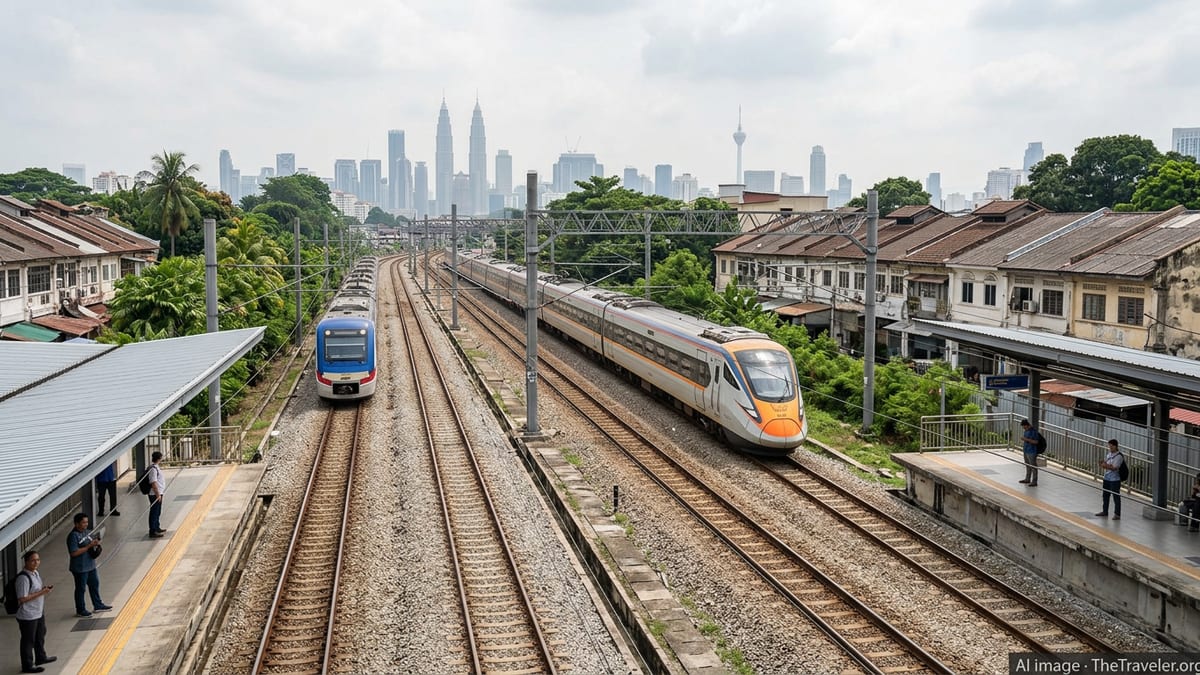
Rolling stock shipments signal new phase for ECRL
Publicly available information from the manufacturer and Malaysian project partners indicates that the first batch of ECRL electric multiple units and electric locomotives has completed production at CRRC Dalian and begun sea shipment from the port city toward Malaysia. Early batches comprise six-car EMU trainsets for passenger services and heavy-haul locomotives for freight, forming the backbone of the new line’s mixed-traffic operations.
The rolling stock supply contract, signed in 2022, covers 11 EMU sets and 12 locomotives tailored to Malaysian operating conditions. Reports indicate that the initial units will undergo extensive testing upon arrival, including thousands of kilometres of running on the new standard-gauge tracks before entering full service. The progressive arrival of these trains over the next year is expected to align with the testing and commissioning schedule now under way along the completed sections of the route.
Images and technical descriptions released by industry outlets show trains based on CRRC’s CR200J intercity platform and HXD3C freight locomotive technology, adapted for Malaysia’s tropical climate, gradients and tunnel-rich alignment. Features such as redundant train-control systems, high-capacity air conditioning and energy-efficient traction equipment are highlighted as key elements designed to support reliable operations across the line’s mix of coastal plains and interior hills.
Construction progress brings 665 km corridor close to completion
The East Coast Rail Link has moved decisively from heavy construction to systems installation and testing, particularly on the 519-kilometre stretch between Kota Bharu and Gombak, where recent coverage from Malaysian media reports that track laying and key systems have been completed. The line has now formally entered a testing and commissioning phase, a milestone that typically precedes integrated trial operations and safety approvals.
Malaysia Rail Link, the state-owned project owner, continues to report high overall completion rates, with published figures from early 2026 placing progress above 90 percent for the main alignment. The government’s previously stated target envisages substantial completion by the end of 2026, paving the way for the start of commercial services in January 2027. The arrival of EMUs and freight locomotives is therefore a critical step in keeping that timetable within reach.
Additional works are still under way on key interfaces, including a diversion into the operational area of Kuantan Port that is reported to be scheduled for completion by the end of the year. That connection is viewed in policy papers and port authority statements as a strategic element, allowing bulk and container cargo from the East Coast to transfer seamlessly between sea and rail without lengthy road hauls.
Passenger EMUs designed around speed, comfort and Malaysian identity
The passenger EMUs bound for the ECRL have been presented in public materials as six-car formations designed for a maximum operating speed of 160 kilometres per hour, in line with earlier technical disclosures on the project. Seating layouts combine business-class and economy-class accommodation, with a stated capacity of around 430 passengers per train, allowing the operator to balance intercity demand with stopping patterns along the East Coast corridor.
Design details highlighted in promotional content include wide gangways, level boarding to reduce dwell times, and accessible toilets and spaces for passengers with reduced mobility. The interior scheme focuses on bright, durable finishes suited to long-distance travel in a hot climate, while exterior liveries incorporate white and blue tones with batik-inspired motifs, intended to reflect Malaysia’s cultural heritage and the line’s East Coast identity.
Technical briefs indicate that each EMU is equipped with a dual-redundant train control and diagnostics system capable of monitoring traction, high-voltage equipment and auxiliary systems in real time. This is paired with an advanced signalling and communications environment, including the use of LTE-based railway communications, which is expected to support high-frequency operations and provide a platform for future digital enhancements such as condition-based maintenance.
Freight locomotives to anchor new logistics corridor
While the sleek EMUs attract much of the public attention, the new fleet of intelligent electric freight locomotives is central to the project’s economic rationale. Official project documentation and policy presentations consistently describe the ECRL as a freight-first railway, with about 70 percent of its design capacity reserved for cargo and the remaining 30 percent for passengers.
The locomotives, derived from proven heavy-haul platforms, are configured to haul long freight trains across the steep gradients and lengthy tunnels that characterise parts of the route. They are expected to handle a mix of bulk commodities, containers and automotive traffic, feeding industrial zones and ports such as Kuantan and Port Klang. By shifting large volumes of cargo from lorries to rail, planners aim to reduce highway congestion, cut transport emissions and lower logistics costs for manufacturers.
Recent memoranda of understanding involving Malaysia Rail Link, Kuantan Port operators, Northport at Port Klang and major shippers underscore the focus on building an integrated rail-sea logistics chain ahead of the line’s opening. These agreements outline plans for dedicated freight services, rail-port terminals and value-added distribution facilities that would leverage the ECRL’s cross-peninsula alignment as a shorter alternative to road-based east-west trucking.
Regional travel and tourism set for a shake-up
For travellers, the deployment of EMU services on the ECRL is expected to dramatically reshape journeys between the East Coast states of Kelantan, Terengganu and Pahang and the Klang Valley. Government statements and planning documents describe end-to-end travel times of around four hours between Kota Bharu and the Kuala Lumpur area, compared with road journeys that can take seven hours or more, particularly during holiday peaks.
Improved connectivity is forecast to have a pronounced impact on domestic tourism, with coastal destinations becoming more accessible to residents of the Klang Valley and central region. The presence of comfortable, air-conditioned EMU services with reserved seating, onboard facilities and integrated station developments may also encourage a modal shift away from private cars and long-distance buses, especially for families and business travellers.
Local media and academic commentary further point to the potential for new station-adjacent development, including hotels, retail clusters and logistics parks, as stations move from construction to operational planning. With infrastructure works now largely complete and the first trains on the water, attention is turning to how communities along the line can position themselves to capture the economic benefits of being connected to a high-capacity passenger and freight corridor.