


More news on this day
Rail services on one of England’s key north–south routes were severely disrupted on Friday evening after two passenger trains collided near Bedford, with early reports indicating multiple injuries and a large emergency response at the scene.
Get the latest news straight to your inbox!
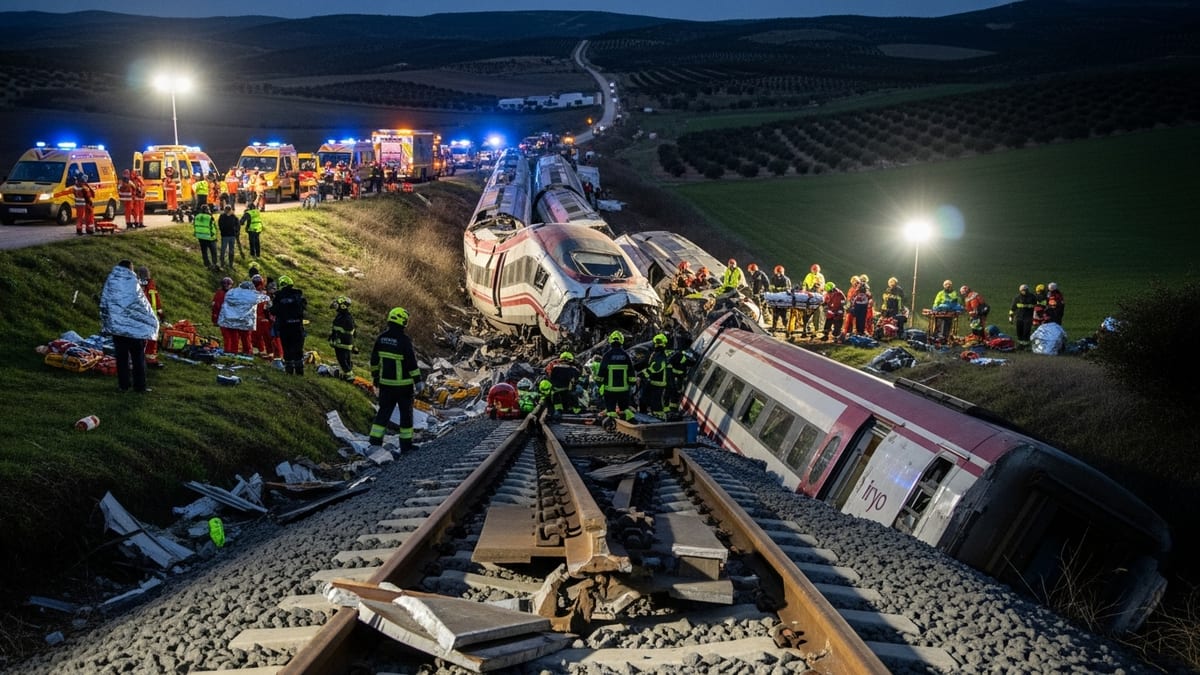
Collision south of Bedford prompts major response
The incident occurred on the Midland Main Line a few miles south of Bedford station late on Friday afternoon, on 19 June 2026, according to rail tracking data and eyewitness accounts shared on social media and in local coverage. The line is a principal artery linking London St Pancras with towns and cities across the East Midlands and northern England, meaning disruption has spread well beyond the immediate area.
Publicly available information indicates that the crash involved two northbound services operating close together on the route. Early analysis published by rail enthusiasts and commentators suggests that one train struck the rear of another on the same track, rather than a head-on impact, but the full sequence of events has yet to be confirmed by official investigations.
Images and video circulating online show at least one train sitting at an angle to the tracks, with visible damage to the leading car and debris around the trackside. Passengers can be seen standing on the ballast and verge as emergency crews work through the carriages.
Emergency services have cordoned off the area and are understood to be working with rail staff to account for everyone on board. The public has been urged to avoid the vicinity while assessment and rescue operations continue.
Passengers report injuries and chaotic scenes
Accounts shared by travellers and witnesses describe a sudden impact that threw people from their seats, followed by confusion inside the carriages as lighting and onboard systems were disrupted. Several passengers reported cuts, suspected fractures and other injuries consistent with a high-speed collision and abrupt deceleration.
Video clips referenced in online discussions show individuals lying on carriage floors receiving first aid from fellow passengers, with visible blood on clothing and interior fittings. Social media posts and forum threads indicate that some travellers were unable to leave the train immediately, remaining onboard as staff assessed damage and coordinated evacuation.
According to news alerts and rolling coverage by national and local outlets, a number of people have sustained serious injuries, though detailed casualty figures have not yet been confirmed. Medical teams were seen setting up triage areas near the tracks to prioritise treatment and stabilise those most badly hurt before transport to hospital.
Rail staff have been praised in public commentary for moving quickly between coaches to check on passengers, provide basic care supplies and relay information where available, despite the shock and difficult conditions after the collision.
Midland Main Line services suspended and diverted
The collision has brought services on part of the Midland Main Line to a standstill in the area around Bedford. Journey planners and live departure boards show extensive cancellations and long delays on routes linking London with Bedford, Wellingborough, Kettering, Corby, Leicester, Nottingham and other destinations served by the line.
Rail operators are advising customers not to travel on affected sections of the network while the incident is being managed. Replacement road transport is being arranged where possible, but congestion on local roads and the need to maintain access for emergency vehicles are limiting the number of buses that can be deployed close to the crash site.
Other train companies on neighbouring routes are reported to be accepting tickets on alternative paths where capacity allows, but passengers are being warned to expect significantly extended journey times and busy services throughout the evening. Some long-distance trains are being turned short of their usual termini, with rolling stock and crew displaced across the network.
Infrastructure managers are likely to keep the line closed until detailed inspections of the track, signalling equipment and overhead power lines can be completed, raising the prospect of disruption continuing into the weekend if substantial repairs are required.
Investigators to examine sequence of events and safety systems
The collision near Bedford is expected to prompt a full investigation into how two passenger trains came to occupy the same section of track at the same time. Rail accident investigators typically review signalling data, train on-board recordings, maintenance records and staff rosters in order to reconstruct the timeline and identify any failures in systems or procedures.
Commentary from rail specialists in early media analysis points to several potential lines of inquiry, including whether one train passed a signal at danger, whether signalling equipment malfunctioned, or whether there was a communications breakdown between control centres and train crews. The apparent rear-end nature of the impact will also focus attention on how closely spaced services are managed on busy main lines.
Modern passenger trains on Britain’s mainline network are fitted with protection systems designed to reduce the risk of collisions, including technology that can automatically apply brakes if certain signals are passed or if trains approach too closely at speed. Investigators will be expected to examine how these systems functioned at the time, and whether any temporary restrictions or engineering works in the area may have altered normal operating patterns.
Past rail incident reports have often led to recommendations on signalling upgrades, changes to operating rules or modifications to rolling stock design. The Bedford collision is likely to undergo a similar process, with findings shaping future safety measures once the immediate emergency has passed.
Public urged to avoid area as recovery continues
Local travel advisories are urging residents and motorists to stay away from the stretch of railway south of Bedford while emergency operations are ongoing. Access roads that intersect or run parallel to the line are subject to closures and traffic control, as responders move equipment and personnel to and from the site.
People living nearby have reported a constant presence of sirens and helicopter overflights as agencies coordinate rescue, medical evacuation and the first stages of recovery. Rail cranes and specialist vehicles are likely to be brought in once casualty care and evacuation are complete, in order to stabilise and remove the damaged rolling stock.
Travellers with upcoming journeys on the Midland Main Line are being advised, through journey planners and operator notices, to check for updates before setting out and to consider postponing or re-routing travel where possible. With investigations still in their early stages and the condition of the infrastructure unclear, there is significant uncertainty over when regular services through the Bedford corridor will resume.
As more information becomes available through official channels and detailed reporting, attention is expected to focus both on the experiences of those caught up in the crash and on the broader questions it raises about capacity, signalling resilience and safety margins on some of the country’s busiest intercity rail routes.