

More news on this day
Two passenger trains collided near Bedford in central England on Friday evening, injuring a number of people and severely disrupting services on a main rail artery linking London with the Midlands and northern England, according to early reports from British and international media.
Get the latest news straight to your inbox!
Evening collision on busy St Pancras corridor
Initial reports indicate that the collision occurred on the evening of 19 June south of Bedford, on the route that carries intercity and regional trains between London St Pancras and communities across the East Midlands and beyond. Coverage from outlets including the Associated Press and Spanish broadcaster Cadena SER describes a low to moderate speed impact between two trains operating on the same line.
Images shared on social media and in news coverage show at least one train with significant front-end damage and another with visible damage to carriages. Some reports describe carriages remaining upright on the tracks, suggesting that the impact, while serious, did not lead to a large-scale derailment affecting every coach.
Passenger accounts reported in British media describe a sudden jolt, broken glass and smoke in the carriages. Several travellers appeared to suffer head wounds and suspected limb injuries, with photographs showing bandages and improvised dressings. Reports also mention a strong emergency response presence along the line near Bedford, including ambulances, fire crews and specialist incident units.
Casualty numbers still emerging as hospitals placed on alert
At the time of writing, publicly available information suggests that dozens of people may have been injured, though there is no clear indication of any fatalities. Early coverage in national newspapers reports that medical teams in the Bedford area were advised to prepare for a significant number of casualties, with at least one local hospital reportedly warned it could receive as many as 50 injured passengers.
News photographs and video circulating online show passengers being treated trackside and in makeshift triage areas close to the line. Some travellers were seen being transferred to road ambulances, while others were walking wounded assisted by rail staff and fellow passengers. The precise breakdown of serious, moderate and minor injuries has not yet been confirmed in publicly available updates.
Given the fluid nature of casualty reporting in the early stages of a major transport incident, figures are expected to be refined as medical assessments progress. Travel news services and broadcasters are emphasising that official tallies will likely evolve over the coming hours as more detailed information becomes available.
Major disruption to East Midlands and commuter services
The collision has caused substantial disruption to one of the United Kingdom’s key north–south rail corridors. Services operated by East Midlands Railway to and from London St Pancras have been suspended across affected stretches of the route for the remainder of Friday, according to operator statements cited in British and European media reports.
Other operators using the same corridor, including regional and commuter services, are experiencing severe delays and cancellations as the line remains blocked for emergency operations and initial investigation work. Passengers have been advised through national rail information services to check before travelling, expect extended journey times, and seek alternative routes where possible.
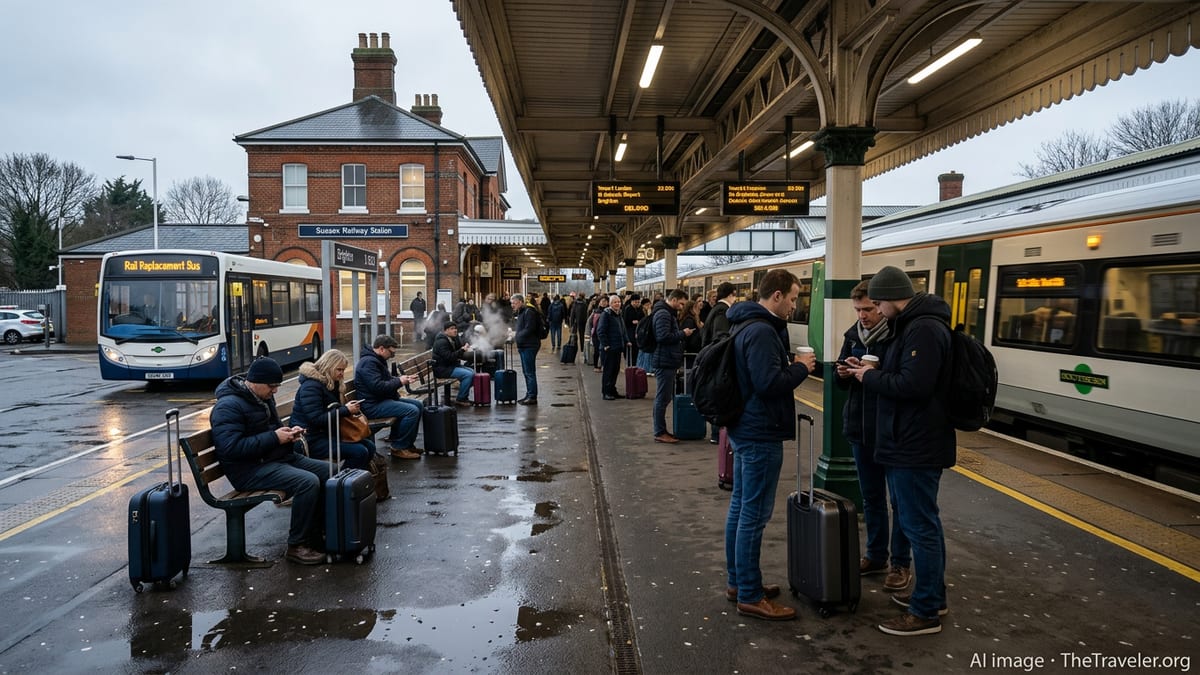
Travel industry observers note that this section of the Midland Main Line is a critical link for both business and leisure travel into London from the East Midlands and parts of northern England. The timing of the incident during the evening period is likely to have stranded many commuters and long-distance passengers, with rail replacement buses and diversions expected to be in place into the weekend.
Early focus on signalling and train spacing
Specialist rail commentators following the incident through open sources have drawn attention to the apparent rear-end nature of the collision, in which one train appears to have struck the back of another on the same track. Discussion among rail professionals and enthusiasts, including on public forums, has highlighted possible issues around train spacing, signalling, and braking, although there is no confirmed cause at this stage.
Data shared by timetable watchers suggests one of the trains had been running late and may have come to a standstill or slowed significantly south of Bedford, with a following service then making contact. Modern UK mainline routes are equipped with multiple layers of protection, including signal systems and automatic warning technology, designed to reduce the risk of such collisions. Public commentary is therefore concentrating on how a chain of events might have developed despite these safeguards.
Transport analysts note that formal investigations into comparable incidents typically examine a combination of factors, including driver actions, train control systems, communication between control centres and crews, and any infrastructure or equipment faults. Those familiar with historic inquiries caution that it can take many months before investigators publish a definitive account of what occurred and any recommended safety improvements.
Investigators expected to examine broader safety lessons
The Bedford collision comes at a time of heightened attention on rail safety in Europe and worldwide, following several significant train crashes in recent years. Rail accident investigation bodies in various countries have repeatedly called for continued investment in signalling upgrades, staff training, and maintenance to match growing demand for rail travel.
In the United Kingdom, publicly available reports from previous inquiries have led to changes in operating procedures, on-train technology and infrastructure design. While the Bedford incident is still in its earliest stages, industry observers expect any investigation to look closely at whether existing safety systems performed as intended and what additional measures, if any, could reduce the chance of a similar event.
For now, the focus remains on supporting injured passengers and restoring a safe level of service on the busy line through Bedford. As the investigation progresses and rail services gradually resume, travellers across the region are likely to face residual disruption, revised timetables and continued scrutiny of one of the country’s most important intercity rail corridors.