


More news on this day
A collision between two passenger trains north of London has left at least one person dead and at least 89 injured, according to published coverage from British rail operators and emergency services, in one of the most serious incidents on the UK rail network in recent years.
Get the latest news straight to your inbox!
Evening Collision on Busy Commuter Corridor
Publicly available information indicates that the crash occurred on Friday evening near Bedford, a major junction on the Midland Main Line that links the English Midlands with London St Pancras. Both trains were reported to be traveling south toward the capital in the evening peak when they came into contact on the approaches to the town.
Data from rail tracking services cited in multiple news reports show that the services involved were the 3:50 p.m. departure from Nottingham to London St Pancras and the 4:40 p.m. service from Corby to the same destination, both operated by East Midlands Railway. The collision was reported shortly after 5:15 p.m. local time, just as many commuters and long-distance travelers were heading toward London for the weekend.
Images and video shared on social media in the aftermath show carriages at a standstill and a large emergency presence along a road running parallel to the railway. Dozens of passengers can be seen standing or sitting on the roadside, some with visible bandages, while others appear uninjured but shaken as they wait to be assessed or transferred onward.
Rail operators have described the crash as a major incident for the route, which ordinarily carries a dense mix of intercity, regional, and commuter traffic into one of London’s busiest terminals.
Casualty Figures Point to Serious Impact
Figures released through official ambulance updates and relayed by national media outline a severe toll from the collision. According to that information, at least one person has died, while 89 others have been recorded as injured to varying degrees.
Breakdowns of the casualty data suggest that more than 30 people suffered serious or very serious injuries, with the remainder classified as having minor wounds, ranging from fractures and cuts to shock and other non–life-threatening conditions. Emergency medical teams established triage points near the line, with helicopters, critical-care teams, and multiple road ambulances deployed to the scene.
Passengers who spoke to UK outlets described a sudden, powerful jolt followed by scenes of confusion in the carriages, with some travelers thrown against seats and fittings. Witness accounts refer to smoke, broken glass, and struggling to navigate through crowded aisles to reach doors and emergency exits in the minutes immediately after the impact.
Rail unions have used public statements to highlight concerns about the scale of the injuries among both passengers and on-board staff, while also noting that the casualty numbers could have been significantly worse if trains had been traveling at higher speeds at the moment of impact.
Major Disruption Across the Midland Main Line
The Bedford corridor is a key artery linking London with cities including Nottingham, Derby, Sheffield, and Corby, and disruption spread quickly across the network after the crash. East Midlands Railway announced the suspension of all services into and out of London St Pancras on Friday evening, effectively severing one of the capital’s principal rail approaches for the remainder of the day.
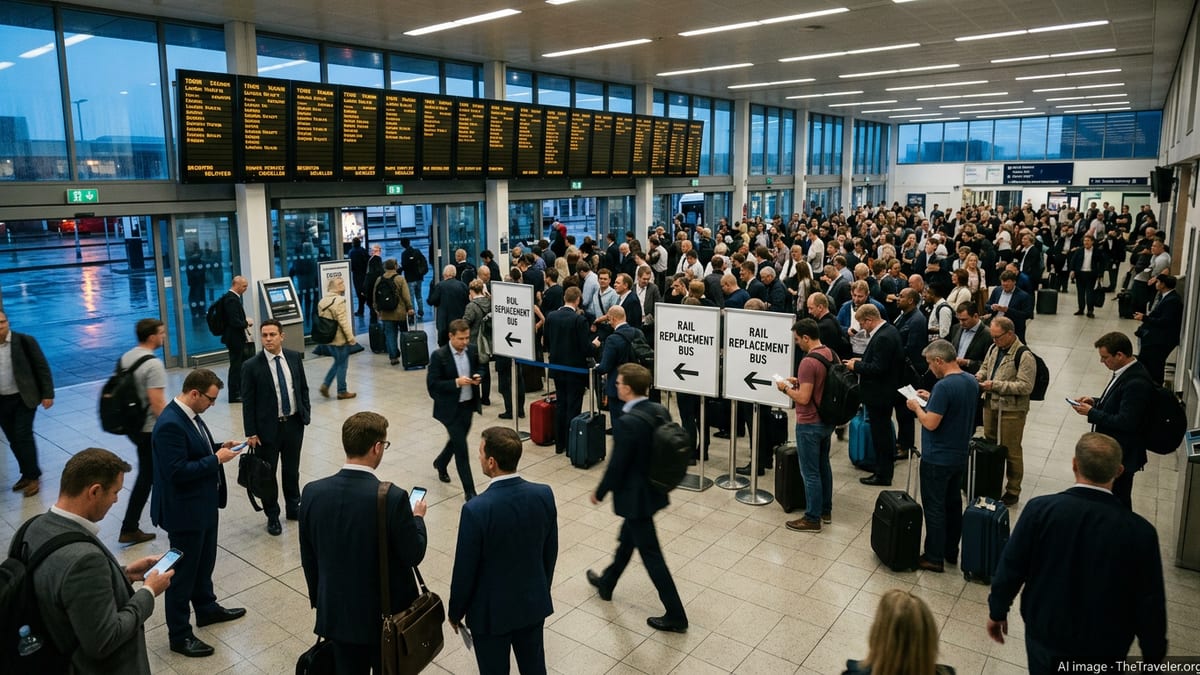
Real-time journey planners showed widespread cancellations and severe delays on intercity and regional services, with trains terminating short of London or being diverted where possible. Passengers already en route were urged through operator updates and travel alerts to seek alternative routes via other London terminals or to postpone their journeys entirely.
Knock-on effects were expected to continue into Saturday, with rail companies indicating that timetables could not be guaranteed until the line is inspected, rolling stock is recovered, and investigators grant permission to reopen affected tracks. For travelers, that raises the prospect of reduced capacity, longer journey times, and temporary bus replacements on some sections of the route.
Travel industry observers note that the incident comes at a time of strong leisure and business demand on UK rail, particularly on Fridays, amplifying the disruption for visitors, commuters, and those connecting to international services via London.
Investigation Under Way Into Cause of Crash
While the precise sequence of events has yet to be formally established, the Rail Accident Investigation Branch is expected to lead a detailed inquiry, supported by the infrastructure manager and the train operator. According to previous practice in UK rail incidents, investigators are likely to focus on signaling, train protection systems, driver actions, and the performance of rolling stock during and after the collision.
Early publicly available descriptions from rail enthusiasts and passengers referencing service patterns suggest that one southbound train may have struck the rear of another heading in the same direction, rather than a head-on collision. If confirmed, that scenario would place particular emphasis on how signal aspects were displayed, observed, and enforced, as well as the role of automatic train protection technology designed to intervene when danger signals are passed.
Safety specialists typically also examine track layout, line speeds, and recent engineering work in the area, along with any maintenance issues affecting braking systems or communication links between trains and control centers. In modern UK practice, investigators usually publish an initial bulletin outlining basic facts within days, followed by a full report over a longer period, including recommendations intended to prevent similar incidents.
For now, officials have publicly stressed that it is too early to draw conclusions about fault or systemic shortcomings, and have urged patience while data from on-board recorders, signaling logs, and witness testimony is gathered and analyzed.
Rail Safety Record and Traveler Considerations
The collision near Bedford has immediately drawn comparisons in the British press to earlier rail crashes that reshaped the country’s approach to safety, from high-profile incidents in the 1980s and 1990s to more recent, lower-speed collisions and derailments. Commentators note that, despite these events, the United Kingdom continues to record a relatively low rate of passenger fatalities in rail travel compared with road transport.
For travelers, the incident serves as a reminder of both the resilience and the vulnerabilities of a busy mixed-traffic corridor. Travel advice shared by rail companies and independent passenger groups encourages anyone planning journeys through the affected region over the coming days to check live departure boards, verify whether ticket acceptance is in place on alternative routes, and allow significantly more time than usual.
Some rail travelers stranded in Bedfordshire and along the route on Friday have reported using a patchwork of regional trains, replacement buses, rideshare options, and, in some cases, last-minute hotel stays to complete or break their journeys. Travel insurers and consumer advocates point out that passengers may be eligible for compensation under existing delay and cancellation schemes, although policies vary by operator and ticket type.
While full details of the Bedford collision remain under investigation, the scale of the emergency response and the casualty figures are likely to make it a reference point in future rail safety debates, with particular focus on train protection technology, operational procedures on congested main lines, and the balance between speed, capacity, and resilience on routes that carry millions of passenger journeys each year.