


More news on this day
Typhoon Mekkhala and Tropical Storm Higos have combined to create one of the summer’s most disruptive aviation days in Asia, with publicly available flight data showing 290 cancellations involving Air China, Japan Transocean Air, China Eastern, ANA Wings, Hainan Airlines, IndiGo, Singapore Airlines and Batik Air as severe weather sweeps across key hubs in Japan, China and Southeast Asia.
Get the latest news straight to your inbox!
Storm Systems Converge on Key Asian Aviation Corridors
The back-to-back impact of Typhoon Mekkhala and Tropical Storm Higos has put intense pressure on some of Asia’s busiest air corridors, particularly around Japan’s southern islands and coastal China. Meteorological briefings describe Mekkhala as bringing powerful winds and heavy rain to Okinawa and surrounding islands, while Higos adds unstable weather and low visibility further west, complicating routing options for airlines attempting to keep schedules moving.
Weather-focused aviation updates indicate that Naha Airport on Okinawa has seen the most severe effects from Mekkhala’s approach, with forecasts pointing to peak winds and intense rainfall over a several-hour window. This has made consistent operations difficult, prompting carriers to proactively thin out schedules rather than risk last-minute diversions or go-arounds during the worst of the storm bands.
Satellite and surface analyses for the western Pacific show Mekkhala continuing to track close to key domestic and regional routes in Japan, while Higos influences conditions across parts of the South China Sea and adjacent coastal regions. The overlapping systems have squeezed available airspace and forced airlines to re-evaluate their options for both domestic hops and popular cross-border routes linking Japan, China, Southeast Asia and long-haul connections beyond.
Major Airlines Cancel 290 Flights as Disruption Spreads
According to aggregated operations data reviewed by travel industry outlets, the two storms have contributed to at least 290 flight cancellations across Asia, affecting a mix of short-haul and regional services. Air China, China Eastern and Hainan Airlines have been among the hardest hit in mainland China, as carriers cut rotations into storm-affected coastal airports and trim frequencies on connecting domestic routes.
In Japan, Japan Transocean Air and ANA Wings, which rely heavily on routes into and out of Okinawa and other southern islands, have cancelled multiple sectors as conditions deteriorate around Naha and nearby airports. These operators play a central role in linking regional communities to mainline hubs, so each cancellation ripples quickly through onward connections on larger partner airlines.
Across South and Southeast Asia, IndiGo, Singapore Airlines and Batik Air have also recorded cancellations tied to the storm pattern and its knock-on effects. Reports indicate that some flights to and from Singapore, Jakarta and key Indian cities have been cut or retimed where aircraft or crew would otherwise have needed to transit Japan or southern China during peak weather windows, or where upstream delays made rotations unworkable.
While the 290 cancellations represent only a fraction of total daily movements in the region, they are heavily concentrated on certain hubs and time bands. This clustering has created pockets of severe congestion at terminals, as passengers from multiple cancelled departures converge at service counters searching for alternative options.
Airports from Okinawa to Shanghai Face Operational Strain
Airport-level data and media coverage portray an uneven but intense pattern of disruption, with Naha, Ishigaki and other airports in Japan’s southwest bearing the brunt of Mekkhala’s immediate impact. Strong crosswinds, heavy rain and intermittent low cloud have periodically reduced runway capacity and forced ground handlers to suspend ramp work for safety reasons, slowing boarding, refuelling and baggage operations.
On the Chinese mainland, coastal hubs have wrestled more with the indirect effects of the storms. While conditions at some airports have remained technically flyable, the need to re-route aircraft around adverse weather, comply with air traffic flow restrictions and accommodate diversions has led to tight gate space, stretched crew duty times and longer-than-normal turnaround intervals.
Further south, secondary airports in Indonesia and Malaysia have seen schedule knock-ons as Batik Air and other carriers adjust their networks around disrupted aircraft rotations. Even where local weather is relatively benign, a delayed or cancelled inbound aircraft from a storm-affected city can quickly trigger missed connections and same-day cancellations in cities far from Mekkhala’s core.
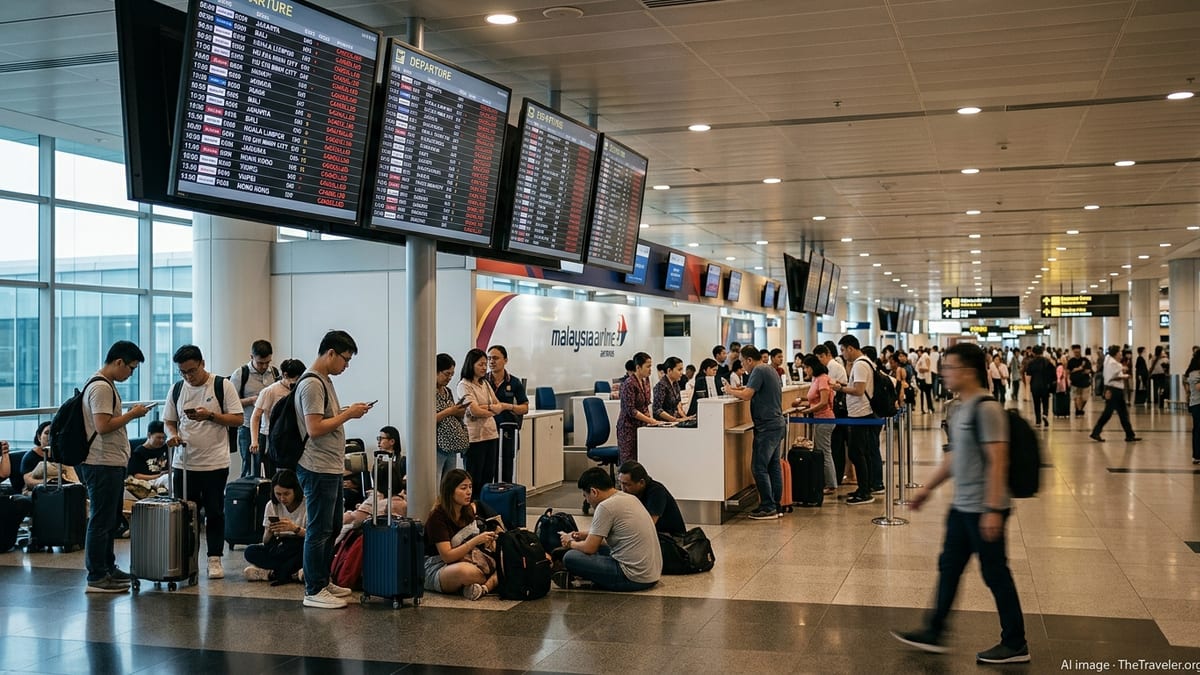
In several terminals, images and social media posts show long lines at check-in and transfer desks, highlighting the secondary impact on ground infrastructure. With many cancellations announced in clusters as revised weather data becomes available, airport staff are frequently left managing surges of displaced passengers all at once, rather than a steady flow over the day.
Thousands of Travelers Stranded or Rebooked
Across the region, the combined cancellations and associated delays have left thousands of passengers stranded at airports or forced to reroute via unfamiliar hubs. Travel media reports describe families stretched across different flights after being rebooked in smaller groups, business travelers missing onward long-haul connections, and leisure travelers facing unexpected overnight stays when last departures of the day are withdrawn.
In Japan’s island airports, limited hotel capacity has become a particular pain point. When multiple flights are cancelled in quick succession, available rooms are quickly exhausted, and some travelers resort to spending the night in terminal seating areas while waiting for space on the next available service.
Elsewhere, frequent flyers in China and Southeast Asia have reported difficulties securing timely customer service through call centers, mobile apps and airport counters. With numerous carriers affected simultaneously, digital channels have become congested, and self-service rebooking options are not always available when tickets involve interline itineraries or complex connections.
Consumer advocates note that although many airlines have issued weather-related waivers allowing itinerary changes without additional fees, rebooking is constrained by limited spare capacity on remaining flights. Even where fee waivers apply, passengers may need to accept travel several days later than originally planned to secure a seat.
What Passengers Should Do if Traveling in the Region
Given the evolving track of Typhoon Mekkhala and Tropical Storm Higos, aviation and weather specialists encourage passengers with upcoming travel in the region to monitor their bookings closely and prepare for last-minute changes. Publicly available advisories emphasize that conditions can fluctuate quickly around typhoons, sometimes prompting rapid sequences of cancellations and reinstatements as wind and visibility readings change.
Travel industry guidance generally recommends that passengers avoid going to the airport until they have confirmed that their flight is still scheduled to operate. Checking airline apps and official status pages, and enabling push notifications for schedule changes, can provide earlier warning of disruption than airport departure boards, which may lag behind real-time operational decisions.
For those already caught up in the disruption, documentation remains important. Travelers are advised to keep boarding passes, booking confirmations and any written notices of cancellation or delay, as these may be needed later when seeking refunds, travel credit or, where applicable, compensation under local consumer protection rules.
With forecasts indicating that the most intense effects of Mekkhala on Okinawa and surrounding areas may ease over the coming days, and as Higos gradually moves away from key aviation routes, operations are expected to stabilize. However, the scale of today’s 290 cancellations means that residual knock-on delays and aircraft repositioning may continue to affect Asia’s air travel network even after skies begin to clear.