


More news on this day
Typhoon Saudel has unleashed a wave of disruption across Asian aviation networks, with hundreds of flights canceled or heavily delayed from Tokyo to Okinawa, Taiwan and coastal China at the height of the late August travel season.
Get the latest news straight to your inbox!
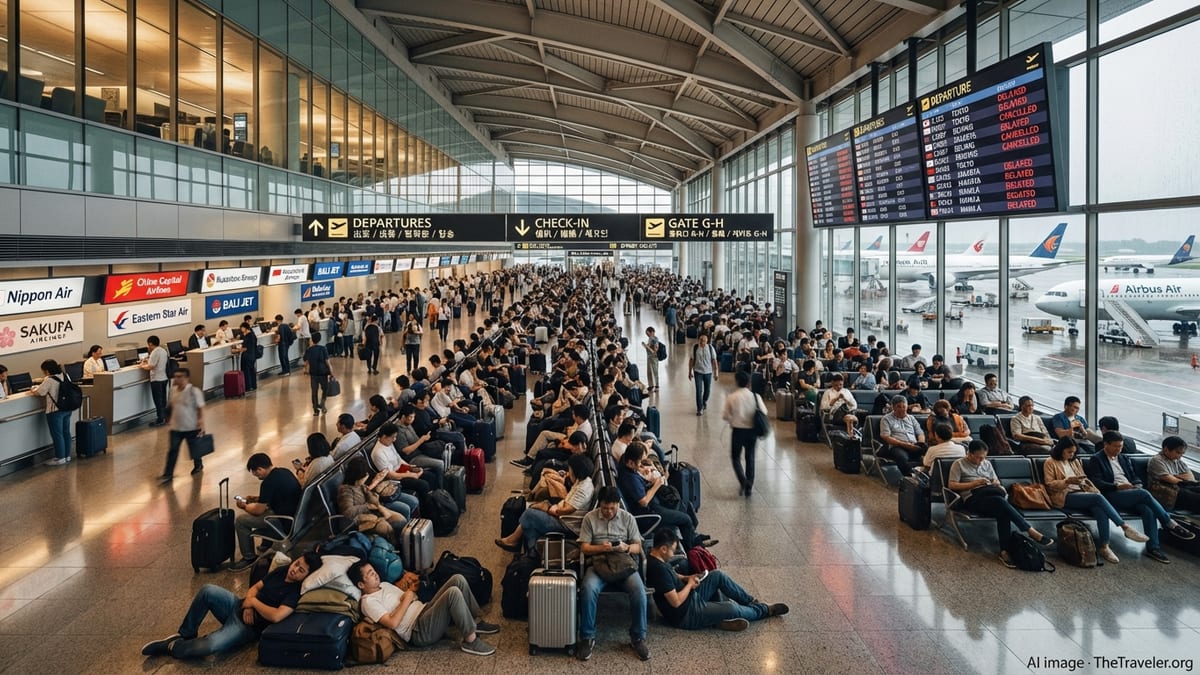
Hundreds of Flights Scrapped as Saudel Tracks Across the East China Sea
As Typhoon Saudel curves across the East China Sea, aviation data and airline travel notices indicate a sharp spike in cancellations and delays across some of Asia’s busiest routes. Regional coverage and tracking services point to at least 700 flights canceled and several thousand delayed on August 26 alone, concentrated around Tokyo and onward connections to Japan’s southern islands and neighboring hubs.
Domestic flight status pages for major Japanese carriers show operations at Okinawa’s Naha Airport severely curtailed, with notices indicating that flights to and from the island were largely canceled throughout Wednesday as strong winds and heavy rain intensified. Services linking Tokyo Haneda and Narita with Naha and other Ryukyu island airports were among the hardest hit, disrupting both local residents and holidaymakers returning at the end of Japan’s summer vacation period.
Reports from Okinawa and surrounding islands describe gusty conditions, high waves and intermittent power outages as Saudel’s outer bands swept through. While airports on Japan’s main islands remained open, ripple effects from the Okinawa shutdown and air traffic control restrictions contributed to broader delays on domestic and regional services.
Okinawa and Southern Japan Bear the Brunt
Okinawa has emerged as the epicenter of Saudel’s aviation impact. Japanese media and travel-focused outlets note that All Nippon Airways and Japan Airlines together canceled hundreds of domestic sectors touching Naha, affecting tens of thousands of passengers in a single day as the storm’s core passed to the west of the archipelago.
Low cost and regional carriers have also reshaped their schedules. Singapore based Scoot announced cancellations of key links between Singapore and Okinawa, as well as timing changes on flights to Fuzhou in China’s Fujian province, as operators sought to keep aircraft out of the most hazardous conditions and safeguard crew duty times around the storm’s passage.
Beyond the main gateway at Naha, local airports serving smaller islands in Okinawa Prefecture have faced temporary suspensions as crosswinds and visibility deteriorated. Ferry operators have imposed parallel suspensions on sea routes, further limiting options for travelers attempting to move between islands while air services remain constrained.
Spillover Disruptions in Taiwan, Hong Kong and Coastal China
Saudel’s impacts extend well beyond Japan. Publicly available airport data and regional media in Taiwan indicate that Taoyuan International Airport recorded more than a dozen flight cancellations tied to the system’s approach, affecting carriers such as China Airlines, EVA Air, Starlux and several low cost operators. Additional services have been retimed or placed under weather watch as the storm’s outer rainbands brush northern Taiwan.
In Hong Kong, travel industry coverage shows that airlines serving the popular Okinawa route, including Hong Kong Airlines and HK Express, have proactively canceled or rescheduled flights to the Japanese islands. Passengers on these routes are being shifted to later dates, particularly toward the end of the week, as planners await clearer guidance on when conditions in the East China Sea will improve.
On the Chinese mainland, airports in Zhejiang and Fujian provinces are preparing for further disruption as Saudel edges toward an expected landfall window between late Thursday and Friday morning. Local port and aviation advisories highlight the potential for additional cancellations and diversions as coastal regions face strong winds, rough seas and the risk of localized flooding.
Peak Season Travelers Face Extended Itineraries
The timing of the storm has amplified its effect on travelers. Saudel’s arrival coincides with the tail end of Japan’s summer holiday period and a busy regional travel window, creating full flights and limited spare capacity for rebooking when cancellations cascade through airline networks.
Airline statements and booking platforms show that flexible rebooking and fee waivers are being offered on many affected routes, particularly for departures to and from Okinawa, Taipei, Hong Kong and China’s eastern seaboard. However, with many flights already sold out days in advance, some passengers face extended waits before seats become available on replacement services.
Travel agents and industry analysts cited in regional coverage note that the current pattern of stronger, more frequent storms in the western Pacific is prompting airlines and airports to refine contingency planning. Carriers are increasingly adjusting schedules earlier, issuing travel alerts and encouraging customers to monitor flight status closely before heading to the airport when major systems like Saudel are forecast to cross key corridors.
What Passengers Should Expect in the Coming Days
Forecast tracks from regional meteorological centers suggest that Saudel will continue to move westward across the East China Sea, weakening gradually as it nears the coasts of Zhejiang and Fujian. Even as wind speeds decline, the combination of heavy rain, residual crosswinds and saturated airspace means airlines are likely to maintain conservative operations for at least another 24 to 48 hours on routes skirting the storm’s path.
Travelers booked on flights involving Okinawa, Taipei, Hong Kong or coastal cities in eastern China over the next few days are being urged in public advisories to check airline apps and airport websites frequently and to allow extra time for connections. Same day rebooking at airport counters may be limited where ground handling staff and security operations are also affected by severe weather.
Industry observers note that the disruptions triggered by Saudel underscore the vulnerability of Asia’s tightly scheduled short haul networks to tropical cyclones, particularly where tourism heavy islands depend on a small number of airport and ferry links. As carriers clear backlogs and reposition aircraft once the storm moves inland, residual delays and isolated cancellations could persist even after skies begin to clear.
https://www.traveldailynews.asia/destinations/typhoon-saudel-disrupts-air-travel-across-east-asia/
https://www.asiaone.com/asia/scoots-flights-japan-okinawa-china-fuzhou-typhoon-saudel
https://www.jma.go.jp/jma/jma-eng/jma-center/rsmc-hp-pub-eg/AnnualReport/2020/Text/Text2020.pdf