


More news on this day
The United Arab Emirates is moving in lockstep with the United States, Saudi Arabia, Qatar, Kuwait, Bahrain and Israel on Gulf security and travel coordination, even as Iran issues its starkest warning yet of “catastrophic consequences” should foreign powers further interfere in the region’s waterways and airspace.
Get the latest news straight to your inbox!
Iran’s Escalating Rhetoric Puts Gulf Security in the Spotlight
Recent statements from Tehran have sharpened longstanding tensions, with Iranian officials publicly warning that any additional interference by the United States and its partners in Gulf security could trigger catastrophic consequences. Publicly available information describes these warnings as part of Iran’s response to coordinated US and Israeli strikes launched on February 28, 2026, which targeted senior leadership figures and strategic infrastructure.
Since those strikes, Iran has widened its retaliation across the region, using ballistic missiles and drones against targets in Israel and several Gulf states, including the United Arab Emirates, Saudi Arabia, Qatar, Kuwait and Bahrain. Coverage from security analysts and think tanks indicates that these attacks have hit airports, ports, energy facilities and, in some cases, areas close to major civilian hubs, underscoring the vulnerability of Gulf transport and logistics networks.
Maritime security in and around the Strait of Hormuz has deteriorated sharply. Industry advisories describe a critical level of kinetic risk for vessels, amid reports of naval mines, suspected explosive devices and electronic interference affecting navigation systems. At the same time, aviation risk assessments highlight a heightened threat environment across the Persian Gulf, Gulf of Oman and adjacent airspace, with increased potential for misidentification incidents involving civilian aircraft.
Iran’s latest warning is widely viewed by regional observers as an attempt to deter what Tehran sees as a tightening security coalition that links the United States, Israel and aligned Gulf states. That coalition, however, has only deepened its coordination in response to Iran’s actions, especially in the realms of air defense, maritime control and traveler safety.
UAE Joins Regional Travel Edge as Advisories Harden
The United Arab Emirates has increasingly aligned its travel posture with that of the United States, Saudi Arabia, Qatar, Kuwait, Bahrain and Israel, forming what risk consultancies describe as a practical “travel edge” across the Gulf. This edge is built on closely synchronized airspace management, cross-border early warning systems and intelligence-sharing arrangements designed to protect commercial aviation and international visitors.
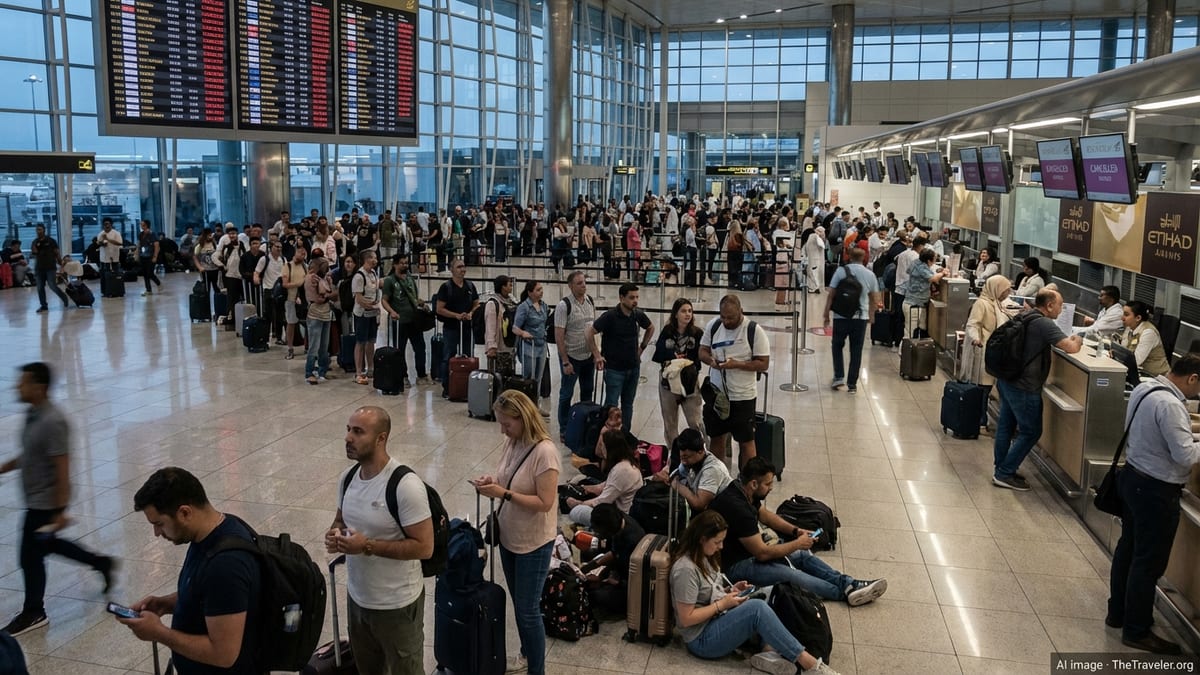
Government travel advisories for the UAE and neighboring states now emphasize the risk of further missile and drone activity, along with the possibility of sudden airspace closures or route diversions. Public information from foreign ministries and consular services notes that regional escalation has already caused flight disruptions and occasional suspensions of routes, particularly those connecting the Gulf to Israel and conflict-adjacent airspace.
Private security briefings for corporate travelers and tour operators describe the UAE as a frontline hub in this emerging travel-security architecture. Dubai and Abu Dhabi host key US and allied military facilities and have been targeted by Iranian strikes earlier in the year, prompting fortified defenses around airports, ports, industrial zones and tourist districts. Analysts note that while interception rates for incoming threats remain high, the perception of risk has shifted, and risk management protocols for travel have become more stringent.
Despite these pressures, industry reporting suggests that the UAE, Saudi Arabia, Qatar and Bahrain have reopened most of their airspace corridors after temporary closures in March and early April. Airlines continue to operate dense flight schedules through major Gulf hubs, albeit with rerouted flight paths, enhanced onboard security procedures and close coordination with aviation authorities.
Strait of Hormuz Tensions and the New Maritime Travel Reality
The Strait of Hormuz, a critical chokepoint for global oil and gas flows, has become a focal point of the current crisis. Shipping circulars indicate that US and allied naval forces have reinforced their presence, designating enhanced security transit lanes and issuing detailed guidance for merchant vessels on routing, speed, communications and emergency procedures.
Reports from maritime risk specialists describe an environment of elevated but managed danger. While Iran is assessed to retain a substantial stockpile of naval mines and fast-attack craft, US and partner navies have deployed mine countermeasure capabilities and surveillance assets to mitigate the threat. However, war-risk insurance premiums for transiting the Gulf and adjacent waters have risen, and some operators have rerouted cargoes via longer, more costly paths.
For travelers, these maritime developments translate into potential disruption of cruise itineraries, ferry services and multi-modal journeys that rely on Gulf shipping. Cruise lines and regional tour operators are quietly adjusting schedules, substituting alternative ports in the Arabian Sea, Red Sea or eastern Mediterranean when itineraries originally included calls near the Strait of Hormuz or in particularly exposed coastal areas.
Industry analysts point out that Fujairah on the UAE’s east coast, already a major oil-export terminal outside the Strait, has taken on outsized significance as carriers seek to reduce reliance on Hormuz routes. This shift reinforces the UAE’s role as a logistics and bunkering hub but also adds pressure to local security and emergency response systems.
Gulf States Present a Divided but Tightening Front
While the United Arab Emirates, Saudi Arabia, Qatar, Kuwait and Bahrain are increasingly aligned on threat assessment and travel coordination, regional policy toward Iran is not uniform. Commentaries in regional outlets describe a spectrum of approaches, from states that favor cautious containment to those that advocate more overt alignment with the United States and Israel.
Saudi Arabia and the UAE are frequently characterized as the most forward-leaning on air and missile defense integration, investing heavily in US and European systems and pressing for tighter interoperability. Bahrain, host to key US naval assets, and Kuwait, which has expended a significant share of its interceptor missile stockpiles defending against Iranian barrages, are generally seen as part of this hardening front.
Qatar, while sharing US bases and air defense responsibilities, continues to position itself as a potential mediator, maintaining open diplomatic channels with Iran even as it participates in broader Gulf security initiatives. This balancing act reflects a long-standing Qatari approach of hedging between rival power centers while prioritizing the stability of its own energy exports and aviation sector.
Despite these nuances, joint statements issued in late March by Saudi Arabia, the UAE, Kuwait, Bahrain, Qatar and Jordan condemned Iranian missile and drone attacks on regional infrastructure and reiterated support for safeguarding international shipping and aviation. Analysts interpret these communiqués as evidence that, when it comes to practical security measures and travel continuity, Gulf states are converging around a shared operational agenda.
Travelers Weigh Heightened Risk Against Gulf Resilience
For international travelers, the convergence of Iran’s aggressive rhetoric, intensified missile and drone activity, and naval friction in the Gulf presents a more complex risk landscape than in previous years. Travel risk firms describe the current environment as characterized by low-probability but high-impact events, where a single successful strike on an airport, port or tourist district could cause localized disruption and spillover effects on itineraries across the region.
At the same time, public reporting highlights the resilience of Gulf infrastructure and the speed at which the UAE and its neighbors have restored operations after recent attacks. Advanced missile defense networks, hardened critical facilities and extensive redundancy in transport links have allowed airlines, hotels and tour operators to resume services quickly following each escalation episode.
Travel guidance for visitors heading to the UAE, Saudi Arabia, Qatar, Kuwait, Bahrain and Israel generally advises close monitoring of official alerts, flexible booking arrangements and a heightened awareness of security procedures at airports, malls and large public venues. Many governments currently stop short of advising against all travel to the Gulf, instead emphasizing situational awareness and readiness for short-notice changes to flights or routes.
With Iran signaling that further interference in Gulf security could provoke catastrophic retaliation, the region’s travel edge now rests on a delicate balance: robust joint defenses and coordinated advisories on one side, and the enduring risk that a miscalculation or new strike could again redraw the map of what is considered safe for travelers and operators in the Gulf.