


More news on this day
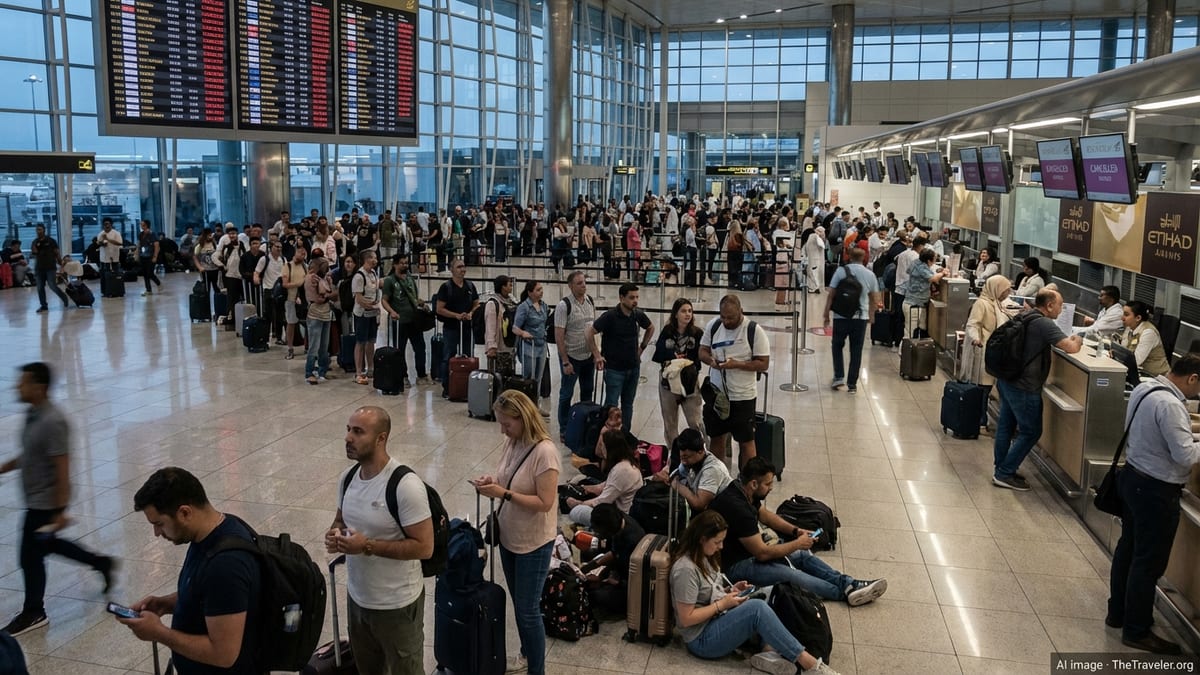
Air travel to and from the United Arab Emirates is facing fresh disruption on September 8, with flights delayed and cancelled at Dubai International Airport and Abu Dhabi’s Zayed International Airport as airlines adjust schedules in response to volcanic ash over Southeast Asia and a volatile regional security backdrop.
Get the latest news straight to your inbox!
Volcanic ash from Indonesia triggers new UAE travel disruption
Published coverage indicates that flights serving Dubai International Airport (DXB) and Abu Dhabi’s Zayed International Airport (AUH) are experiencing significant delays and cancellations on Tuesday, September 8. The latest disruption is linked to ash clouds from Indonesia’s Mount Anak Krakatau, which have prompted authorities in that region to limit operations and have forced airlines to reroute or suspend services.
Reports show that Emirates and Etihad Airways have both adjusted their Jakarta operations, with several services between the UAE and Indonesia cancelled. At Dubai International, Emirates flights from Jakarta, including EK357 and EK359, are among those listed as cancelled, alongside the corresponding outbound EK356 from Dubai to Jakarta. At Abu Dhabi’s Zayed International Airport, Etihad flight EY475 to Jakarta is reported cancelled, underscoring how airspace restrictions far from the Gulf are rippling through key Middle East hubs.
The impact is not limited to Southeast Asian routes. According to published arrival and departure boards, a wider array of flights connecting the UAE with South Asia, the Middle East and Europe are running behind schedule. Passengers travelling from cities such as Mumbai, Kochi, Islamabad and Riyadh, as well as select European and regional destinations, are being advised to expect longer journey times and potential last minute schedule changes.
Regional aviation analysts note that large hub airports such as Dubai and Abu Dhabi are particularly sensitive to disruptions on trunk routes in Asia. When a major spoke like Jakarta is compromised by volcanic activity, airlines often need to reassign aircraft, crews and slots, which can cascade into broader timetable adjustments across their networks.
Abu Dhabi: Cancellations for South Asia and long haul routes
At Abu Dhabi’s Zayed International Airport, publicly available flight information highlights a series of delays and cancellations on September 8 affecting both regional and long haul services. Coverage from local media lists a range of Etihad-operated flights impacted, including EY247 to Ahmedabad, EY303 and EY301 to Islamabad, EY299 to Karachi, EY277 to Peshawar, EY201 to Mumbai and EY213 to Delhi.
Additional Etihad routes cited as disrupted include EY343 to Chennai, EY331 to Kochi, EY556 to Riyadh, EY313 to Kabul, EY644 to Bahrain and EY405 to Bangkok. While many of these services remain scheduled to operate with delays, some have been removed from the timetable entirely. The cancellation of EY475 to Jakarta is directly associated with the ongoing volcanic ash conditions in Indonesian airspace.
Abu Dhabi’s own travel advisory pages continue to describe the airport as open and operational, but they emphasise that travellers should verify individual flight status before leaving for the terminal. Live departure boards show a mix of “scheduled” and “estimated” statuses across early morning services, indicating that airlines are working to keep much of the programme intact even as they adjust timings.
For passengers, the immediate effect is a higher level of uncertainty around departure and arrival times, particularly on South Asian routes that already operate at high load factors. Travellers connecting through Abu Dhabi may face missed onward connections where delays are substantial, making it essential to build extra buffer time into itineraries and to monitor airline communications closely.
Dubai International sees knock-on delays across key markets
Dubai International Airport, one of the world’s busiest international hubs, is also experiencing a wave of operational challenges. According to recent coverage, a number of Emirates services into Dubai are running late, including flights from Mumbai, Beijing, Hyderabad, Kochi, New Delhi, Cairo and several major European cities such as London, Rome, Geneva, Bologna and Lyon.
Low cost and regional carriers are affected as well. Flydubai flights arriving from destinations such as Makhachkala, Almaty, Minsk, Colombo, Samara and Naples are reported delayed, while other airlines serving Dubai, including Kenya Airways and Qeshm Air, are seeing schedule slippages on routes from Nairobi, Tehran, Qeshm and Indian cities served by SpiceJet.
Departures from Dubai are also disrupted. Published reports highlight delays for SpiceJet services to Mumbai and New Delhi, a flydubai service to Moscow, as well as flights from other regional carriers. In addition to the Jakarta cancellations on Emirates, at least one departure operated by Iraqi Airways to Kirkuk has been listed as cancelled, illustrating how traffic to multiple parts of the wider region is affected.
Operational data compiled over recent days suggests that Dubai International has been managing a pattern of modest average delays and a fluctuating number of cancellations. Even where overall performance remains relatively resilient, travellers on specific routes or carriers can still encounter lengthy waits, gate changes and revised departure times as airlines recalibrate their schedules.
Security environment adds further unpredictability for UAE-bound travel
While the latest wave of flight changes is directly linked to volcanic activity in Indonesia, broader regional security dynamics also continue to influence travel planning for the UAE. Recent government advisories from some countries highlight the possibility that military tensions in parts of the Middle East could lead to short notice airspace restrictions, flight cancellations or rerouting, affecting operations at both Dubai and Abu Dhabi.
One such advisory notes that UAE airspace may open or close with limited warning, which can have immediate consequences for airport traffic flows and airline network planning. Although Dubai International and Zayed International are currently open and functioning, travellers are being urged to closely monitor news and official guidance when booking or embarking on trips through the region.
Industry risk assessments produced earlier in 2026 have pointed to intermittent disruption as a likely feature of Gulf aviation for as long as external conflict risks remain elevated, particularly on routes transiting airspace over Iraq and surrounding areas. In this context, today’s volcanic ash-related disruption illustrates how environmental factors can intersect with an already complex operating landscape.
Travel insurers and corporate travel managers are recommending that passengers check policy wording around missed connections and schedule changes, as standard coverage can vary widely. For those with essential journeys, having flexible tickets and readily accessible digital itineraries is increasingly seen as a practical safeguard.
What travellers through Dubai and Abu Dhabi should do now
For passengers scheduled to fly into or out of Dubai or Abu Dhabi in the coming days, the overriding message from airlines and tourism bodies is to verify details as close to departure as possible. Airline websites and mobile applications remain the primary channels for real time updates, rebooking options and notifications about cancellations or significant delays.
Airport live departure and arrival boards, which aggregate information from multiple carriers, can provide an additional layer of visibility. These platforms show whether specific flights are on time, delayed, or cancelled, and they are frequently refreshed as operational decisions are made. Travellers already in transit are encouraged by publicly available guidance to stay close to their departure gate and monitor flight information screens for last minute changes.
Where flights are cancelled, rebooking policies generally prioritise passengers based on original travel date and ticket conditions. Some travellers may be offered alternative routings via other hubs, while others might receive hotel accommodation or meal vouchers if their disruption extends overnight, in line with each airline’s customer care commitments.
Given the combination of volcanic ash impacts and a fluid regional security climate, those planning new trips through the UAE may wish to allow longer connection windows, avoid tight same day transfers where possible and ensure that contact details in bookings are up to date. With both Dubai and Abu Dhabi remaining central to global aviation, ongoing vigilance and flexibility are likely to be essential for a smoother journey experience.
Sources: The National – UAE travel advisory, Experience Abu Dhabi – Travel advisory, AeroCorner – Dubai Airport performance data, Smartraveller – United Arab Emirates travel advice, Abu Dhabi Media Office – airport operations update