

More news on this day
Air travel through the United Arab Emirates is entering a new phase of adjustment as lingering regional tensions and altered airspace corridors continue to reshape flight paths, schedules and connection patterns across the Gulf.
Get the latest news straight to your inbox!
Airspace restrictions ease but network recovery is uneven
Publicly available information shows that the UAE has lifted precautionary airspace restrictions introduced during the height of the latest Gulf security crisis, allowing Dubai and Abu Dhabi to progressively rebuild their global networks. Dubai International Airport has highlighted its role in keeping long haul connections open through the disruption, while gradually scaling up flight movements as conditions improve.
Emirates has reported that it has restored the vast majority of its pre-disruption global network, now serving more than 130 destinations across over 70 countries with hundreds of weekly services. Etihad is operating a broad schedule from Abu Dhabi to around 80 destinations, focusing on maintaining connectivity to key markets in Europe, Asia and North America.
Despite the rebound, the pattern of flights across the region has changed. Capacity has been redeployed on certain trunk routes where demand has remained strong, while some secondary city pairs remain reduced or temporarily suspended. Industry briefings indicate that airlines are cautious about committing aircraft and crews to routes that may be affected again if tensions flare.
Travel industry assessments suggest that, although UAE airspace is fully open, recovery in frequencies and timings is still below previous peaks on some sectors. Airlines are balancing network restoration with the need to preserve operational resilience in case of further short-notice restrictions in neighbouring flight information regions.
Rerouted corridors lengthen journeys between Europe and Asia
One of the most visible effects for passengers has been the reshaping of long haul corridors that traverse the Gulf and surrounding conflict-affected areas. During the most intense phase of the crisis, airspace closures over parts of Iran, Iraq and other Middle East states forced widebody aircraft to avoid traditional, fuel-efficient tracks linking Europe and Asia via the UAE.
According to operational advisories and airline scheduling data, many carriers initially suspended services or operated with significant detours, routing flights south over the Arabian Sea or via alternative hubs on the Arabian Peninsula. These adjustments increased block times, added fuel burn and reduced the number of daily rotations aircraft could perform, limiting available capacity.
As restrictions have eased, some of the most extreme diversions have been scaled back, but many routes continue to use modified tracks that keep a wider margin around sensitive airspace. This has left some flights between Europe and Asian destinations such as India, Southeast Asia and North Asia operating with slightly longer durations than before the crisis.
Industry analysts note that the UAE’s position as a central transfer point remains intact, but that the geometry of the corridors feeding Dubai and Abu Dhabi has shifted. Airlines continue to monitor conflict zone bulletins and advisories, which remain in effect for several Middle Eastern flight information regions and limit the ability to revert fully to previous routings.
Gulf-wide disruption reshapes competitive dynamics
The disruption has not been confined to the UAE. Reports from regional aviation briefings describe a patchwork of closures and restrictions affecting airspace in multiple Gulf and Levant states, including temporary suspensions at airports in Kuwait and constraints on traffic flows through Bahrain and Qatar. This has created bottlenecks on some traditional east west corridors and pushed demand toward the most resilient hubs.
During the early weeks of the crisis, scheduled data shows that several non-UAE carriers halted or reduced flights to Dubai, Abu Dhabi and other Gulf gateways, while low cost operators in neighbouring countries suspended services to multiple regional capitals. At the same time, some Gulf airports marketed themselves as alternative transit points, taking advantage of their relative proximity to key routes and available runway slots.
Industry digests suggest that Dubai and Abu Dhabi have largely retained their share of transfer traffic, even while operating below previous capacity peaks. However, the temporary redistribution of flights and passengers has encouraged airlines and airports across the region to reconsider their reliance on any single corridor or hub, with more emphasis on redundancy and contingency planning.
Consultancy reports highlight Muscat and other regional airports as having absorbed traffic during the most severe UAE restrictions, acting as resilience hubs for rerouted flights. This diversification of options is expected to remain part of network planning even as the immediate disruption fades.
Passenger experience: longer transit times and shifting schedules
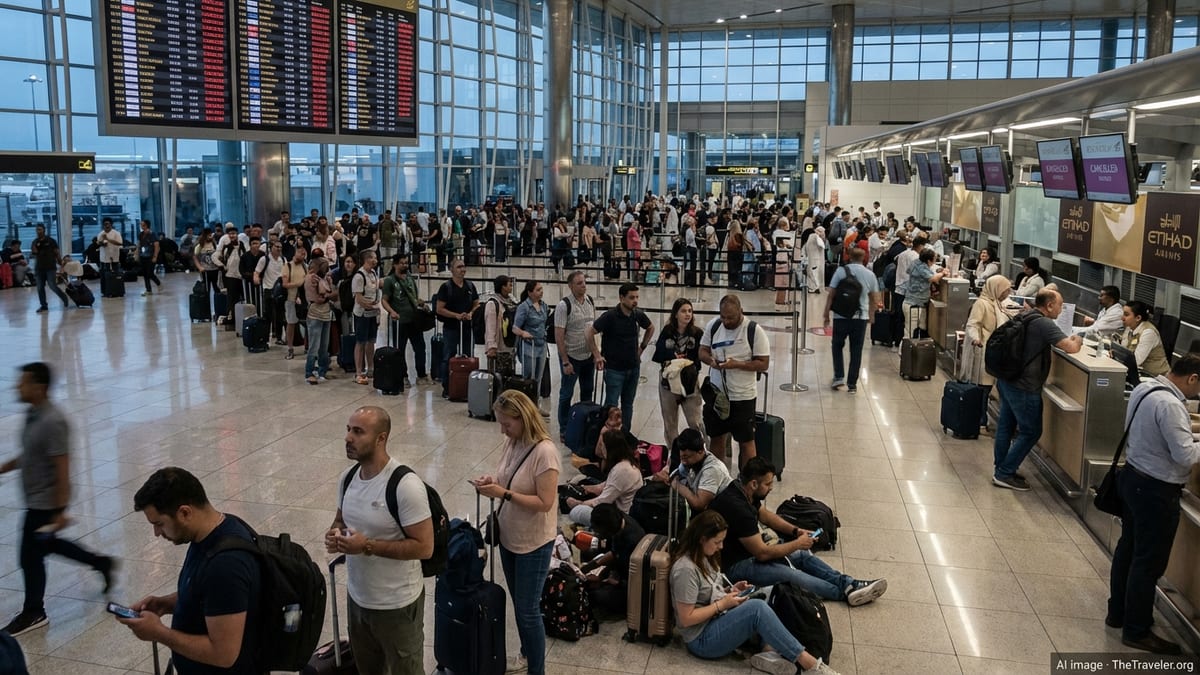
For travellers using UAE hubs, the immediate wave of mass cancellations has given way to a more subtle pattern of timetable changes, longer transit windows and occasional short notice retimings. Gulf-based media coverage indicates that airlines continue to advise passengers to check flight status frequently and to allow extra time for connections.
Rerouted paths and capacity constraints have left some long haul services operating at different times of day than before, which can affect onward connections and airport congestion patterns. In several cases, additional services have been added on high demand routes to compensate for the reduced flexibility elsewhere in the network, concentrating flows through particular waves of departures and arrivals.
Travel risk and logistics bulletins published in recent weeks describe transit times through Dubai and Abu Dhabi as generally stable but occasionally extended on specific lanes where airspace bottlenecks remain. Cargo-focused updates also note that freighter operations continue to face variable routings and potential delays, with knock on effects for time sensitive shipments that share bellyhold capacity with passenger flights.
While most routine journeys are now operating with relatively minor disruption, passengers still face a higher degree of uncertainty than before the crisis. Industry guidance consistently recommends keeping contact details updated, monitoring airline notifications and being prepared for last minute gate or timing changes when traveling through the Gulf.
Outlook: conflict risk keeps networks on a cautious footing
Strategic assessments of the Middle East aviation market describe the current phase as one of guarded normalization rather than a complete return to pre crisis patterns. Conflict related notices remain in place for several airspace regions around the Gulf, and security analysts expect airlines to maintain conservative routing assumptions until there is a sustained period of stability.
For UAE carriers, the focus is shifting from emergency response to medium term optimisation. This includes gradually restoring frequencies on profitable routes, reassessing previously planned launches into still volatile markets, and maintaining spare capacity to respond quickly if new restrictions arise. Some planned route inaugurations to nearby conflict exposed destinations remain on hold without firm restart dates.
Airport operators in the UAE continue to signal confidence in long term growth, pointing to resilient passenger demand and the country’s geographic advantage on global east west flows. However, the experience of sudden, wide ranging airspace closures has reinforced the need for flexible terminal operations, diversified air traffic control contingencies and closer coordination with airlines on scenario planning.
Travel industry experts expect that, for the coming season, the Gulf’s aviation landscape will reflect a blend of restored connectivity and lasting structural change. The UAE’s main hubs are likely to remain central to global travel, but with route maps and daily schedules that bear the imprint of a turbulent period in the region’s skies.