


More news on this day
United Arab Emirates stock markets weakened this week after fresh warnings that regional air travel faces prolonged disruption, unsettling investors in an economy where aviation, tourism and airport-linked services are central pillars of growth.
Get the latest news straight to your inbox!
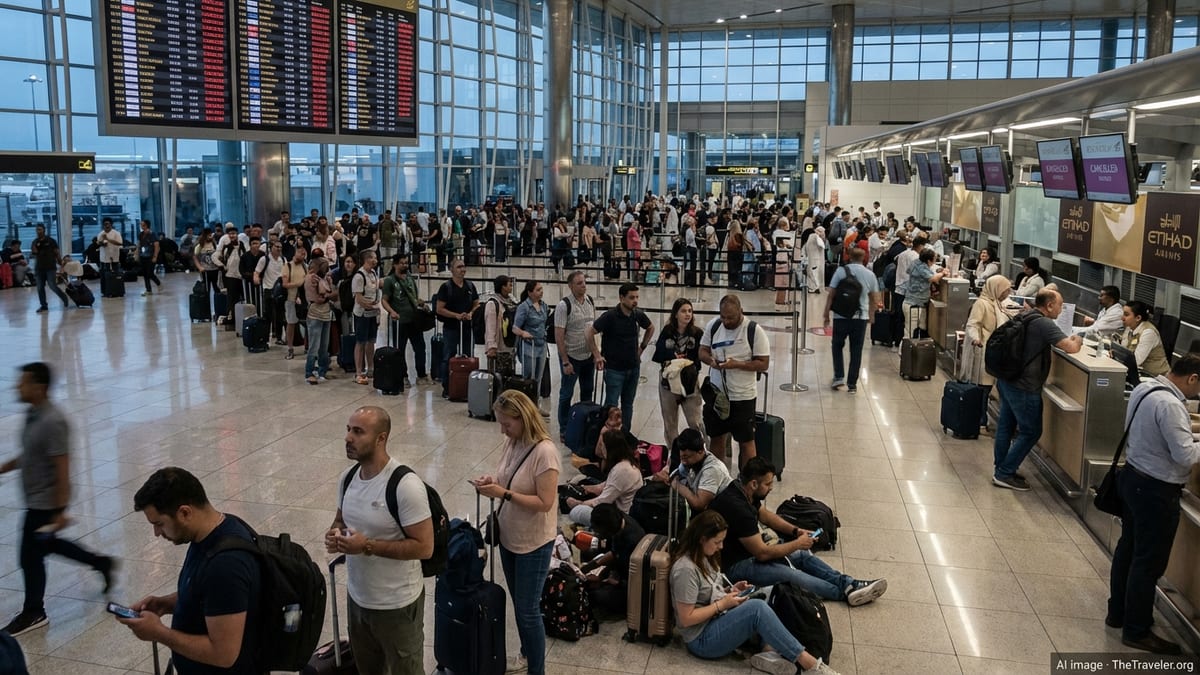
Air Travel Warning Rekindles Market Jitters
Recent analysis of Middle East aviation trends has highlighted the risk that extended airspace restrictions and security concerns could weigh on Gulf travel flows well into 2026, with particular implications for the United Arab Emirates. A report cited in regional business coverage warns that higher fuel costs, rerouted flight paths and constrained airline capacity across the Gulf could take months to unwind, keeping pressure on both ticket prices and passenger volumes.
Publicly available data shows that the UAE’s travel and tourism sector contributed roughly 257 billion dirhams, equivalent to about 13 to 14 percent of national output in 2025. As a result, any prolonged shock to regional air connectivity, whether through formal airspace closures or ad hoc operational disruptions, is closely watched by equity investors in Dubai and Abu Dhabi.
Financial market commentary indicates that the latest concerns stem not only from route changes and delays but also from a broader reassessment of the Gulf’s role as a global aviation hub. Analysts referenced in Gulf media have cautioned that if current patterns of disruption persist, alternative routings through non-Gulf hubs could become more entrenched, potentially eroding the competitive position of airports and airlines in the UAE.
Against this backdrop, investors have adopted a more cautious stance toward sectors tied to cross-border mobility. Travel-related equities, airport services and some consumer-facing names have faced additional scrutiny as traders weigh the impact of a more volatile operating environment for airlines across the Middle East.
Dubai and Abu Dhabi Indexes Lose Ground
Market reports on Gulf trading sessions over the past 24 hours show most regional bourses under pressure, with the UAE among the decliners. Data compiled by regional exchanges and summarized by financial news outlets indicate that Dubai’s main share index has slipped around 0.4 percent in the latest session, while Abu Dhabi’s benchmark ended about 0.6 percent lower.
Banking and blue-chip names have led the downturn. Coverage of Thursday’s trading points to losses for major lenders such as Emirates NBD in Dubai, contributing to weakness in the broader index. In Abu Dhabi, the retreat has been more broadly based, with financials and select industrials edging lower as investors reassessed risk across the Gulf.
Market analysis links the selling pressure to an overlapping set of concerns, including the prospect of further disruptions to civil aviation and persistent geopolitical tensions around the Strait of Hormuz. While global risk appetite has also been uneven, traders in Dubai and Abu Dhabi appear particularly sensitive to developments that could affect passenger flows, cargo routes and tourism receipts.
Despite the pullback, trading volumes remain within a typical range, and there have been no indications of disorderly conditions on the UAE’s main exchanges. The moves instead reflect a rotation away from more cyclical, travel-exposed sectors toward perceived havens such as utilities and selected defensive holdings within the Gulf.
Flight Disruptions Underscore Vulnerability of Gulf Hubs
The renewed stock market weakness comes against a backdrop of continuing, if uneven, disruption to air travel into and out of the UAE. Flight-status updates compiled by regional media on Thursday show that carriers including Emirates, Etihad Airways, flydubai and Air Arabia are still adjusting schedules in response to regional tensions, with a mix of delays, cancellations and reroutings across certain routes.
Travel advisories issued by airlines and published by local outlets emphasize that services to specific destinations remain particularly fluid and that departures can change at short notice. Earlier this month, detailed lists of affected services at Dubai International Airport and Abu Dhabi’s Zayed International Airport highlighted cancellations from cities such as Almaty, Bishkek, Moscow and several regional destinations, illustrating how widely the disruption has spread across airline networks.
Although airports in the UAE continue to operate and the core infrastructure remains open, the combination of heightened security protocols and changing flight paths has lengthened journey times on some long-haul routes and added complexity for passengers transiting through Gulf hubs. Aviation-focused research circulated by a major UAE bank notes that temporary airspace restrictions across the Middle East have contributed to a mixed operating environment for transport companies in 2026.
Independent assessments of the regional aviation market further suggest that, under a scenario of sustained disruption, global travel volumes could fall by several percentage points, with relative weakness in flows that normally pass through Gulf hubs. Such projections have reinforced the sense among investors that listed UAE carriers and airport-linked service providers may face a more challenging backdrop over the coming quarters.
Travel, Tourism and Listed Companies Feel the Strain
Beyond headline index levels, the air travel warning has focused attention on specific companies and sectors that depend heavily on the seamless movement of people and goods. Research on the UAE transportation sector prepared for institutional clients and cited in banking summaries indicates that airport and tourism-related activity has already softened, with one dataset pointing to a year-on-year drop of more than 20 percent in taxi and limousine trips during the second quarter of 2026.
Budget carriers and regional airlines have featured prominently in recent market discussions. Previous episodes of heightened tension saw stocks such as Air Arabia and other aviation-linked names record outsized declines when trading resumed after temporary exchange closures. While recent moves have been more contained, the memory of earlier drawdowns continues to influence how investors price in potential future disruptions.
Hospitality and real estate firms oriented toward international visitors have also come under closer scrutiny. Market commentary from July and August noted that Dubai and Abu Dhabi benchmarks weakened as traders weighed the knock-on effects of conflict-related headlines on hotel occupancy, retail spending and longer-term investment plans in tourism districts.
For now, publicly available forecasts still anticipate that the UAE will retain a central role in global aviation once tensions ease, given the scale of its airports and the reach of its flag carriers. However, the latest travel warning has sharpened debate about how quickly demand can rebound if travelers become more price-sensitive, delay bookings or opt for itineraries that bypass the Gulf altogether.
Investors Weigh Risks to Future Connectivity
The deterioration in market sentiment toward UAE equities comes at a time when global investors are increasingly focused on resilience in transportation and logistics networks. Frequent references in recent research notes to a global air transport system under “acute stress” capture the broader context in which Gulf markets now operate.
For long-term investors, the question is whether current turbulence represents a temporary shock or a more structural challenge to the Gulf’s connectivity model. Some analysis suggests that if alternative routes and hubs gain share over an extended period, it could be harder for UAE airports to recapture all pre-crisis transfer traffic, even once security conditions stabilize.
In the near term, portfolio managers monitoring Dubai and Abu Dhabi are likely to continue differentiating between companies with direct exposure to cross-border travel and those with more domestically focused revenue streams. The latest session’s declines demonstrate that headlines about regional air travel risks can move sentiment quickly, particularly when combined with warnings about potential additional restrictions on flights.
Market participants now face a delicate balance between recognizing the UAE’s strong infrastructure and track record as a global hub, and acknowledging that prolonged uncertainty around Middle East airspace may keep aviation-sensitive stocks under pressure. With geopolitical conditions and flight schedules both subject to rapid change, investors are expected to track new travel advisories and airline updates closely as they gauge the outlook for UAE markets.