


More news on this day
Emergency services in England are responding to a serious collision between two passenger trains near Bedford, north of London, with early reports pointing to multiple injuries and major disruption on one of the country’s key intercity rail corridors.
Get the latest news straight to your inbox!
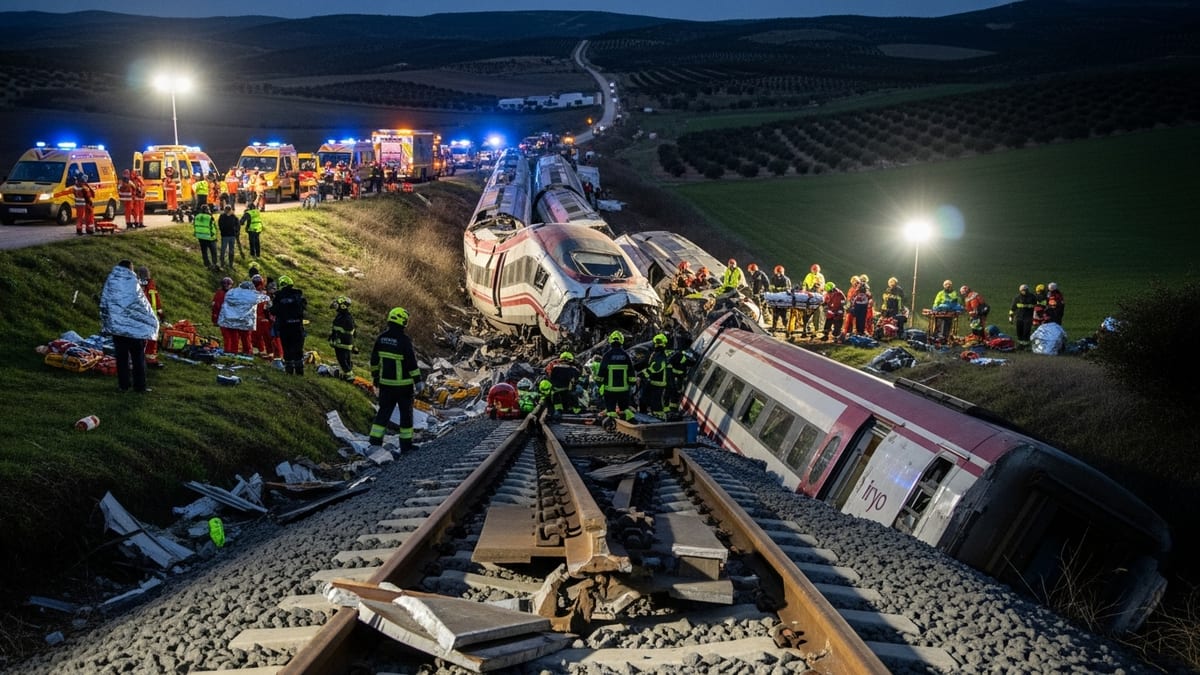
Collision on busy route north of London
Initial information from British media and rail industry channels indicates that the incident occurred on Friday evening, June 19, on the main line linking London St Pancras with the East Midlands. Reports describe a collision involving two East Midlands Railway services a few miles south of Bedford station, a significant junction on the route between the capital and cities such as Nottingham, Leicester and Corby.
According to published coverage and live rail data cited by UK outlets, one train is believed to have run into the rear of another service that was ahead of it on the same southbound track. Images and video shared on social media show a damaged Luton Airport Express train upright on the rails and another intercity set in front of it, with passengers evacuated onto adjacent fields.
Passenger accounts posted online describe a sudden impact with little or no apparent warning, with at least one carriage reported to have left the rails. Visual evidence from the scene suggests that the crash occurred on open countryside rather than at a station, complicating access for emergency vehicles but allowing passengers to be moved to nearby fields away from the tracks.
The line where the collision occurred is one of the principal rail arteries in and out of London St Pancras, carrying long distance services to the Midlands, commuter trains to Bedford and beyond, and dedicated airport links serving Luton. Any major incident on this stretch is likely to have a rapid knock-on effect across the wider network.
Emergency services launch large-scale response
Publicly available statements from local services and national rail operators indicate that a full emergency response was triggered shortly after reports of the collision emerged early on Friday evening. Bedfordshire Fire and Rescue Service confirmed that crews had been sent to the scene following an alert received around 6:45 p.m. local time, while rail operators reported that emergency services were dealing with an incident between London St Pancras and Leicester.
Video footage circulating on social platforms shows numerous fire engines, ambulances and police vehicles positioned near the tracks, as well as helicopters operating overhead. Witnesses living in the wider Bedford area have described hearing continuous sirens and seeing aircraft movement as responders converged on the rural crash site.
Early reports from passengers and local media point to a number of serious injuries, with some on-board video showing people receiving first aid on the floor of a damaged carriage. There has been no confirmed public tally of casualties, and official investigations into the causes and full consequences of the collision are only beginning.
Specialist rail incident teams are understood to be working alongside local emergency responders to secure the site and assess the stability of the affected rolling stock. Their immediate priorities include treating the injured, ensuring that all passengers and crew are accounted for, and making the damaged trains safe for investigators to enter.
Widespread disruption for rail passengers
The crash has prompted major disruption across the Midland Main Line, affecting both long distance and commuter services. According to rail operator updates and journey planners, trains between London St Pancras and the East Midlands are being heavily delayed, diverted or cancelled as the section of track near the collision remains closed.
East Midlands Railway has advised passengers not to travel on affected routes unless essential, citing the ongoing emergency and uncertainty over when lines can safely reopen. Replacement road transport options are limited by the scale of the incident and the rural location of the crash, leaving some travellers facing extended journey times and crowded alternative services.
The Luton Airport Express, which connects London with Luton Airport Parkway, is among the services impacted. Travellers heading to or from the airport are being urged to check live departure boards and allow significantly more time for journeys, with knock-on disruption affecting other operators that share infrastructure in the St Pancras corridor.
Industry observers note that even after the immediate emergency response ends, residual disruption could continue into the weekend. Damaged rolling stock will need to be removed, infrastructure inspected and, if necessary, repaired before normal operations can resume. Timetables may be adjusted at short notice as operators work around any remaining restrictions.
Questions raised over rail safety and signalling
While it is far too early for definitive conclusions, the circumstances described in early reports are likely to focus attention on the performance of signalling and train protection systems on one of Britain’s flagship intercity routes. Rear-end collisions on modern, signalled main lines are rare events, and rail professionals and enthusiasts have already begun debating how two passenger trains could come into conflict on the same track.
Commentary from rail analysts and enthusiasts shared online points to several broad possibilities that investigators may explore, including a potential failure of signalling equipment, incorrect movement authorities, driver error, or a mechanical problem that caused one train to stop unexpectedly in a location where it was exposed to following traffic. The precise sequence of events, including the speeds involved at the moment of impact, has not yet been established in the public domain.
In the UK, serious railway accidents of this nature typically trigger a multi-layered investigation process involving the safety bodies responsible for infrastructure and operations. Investigators are expected to examine data from on-train recorders, signalling logs and communications, as well as physical evidence from the crash site, to determine what went wrong and whether similar incidents could be prevented in future.
Rail safety advocates are already highlighting the incident as a reminder that, although train travel in Britain remains statistically one of the safest modes of transport, the consequences of any system failure can be severe. The images from Bedford are prompting comparisons with past rear-end collisions that led to significant changes in signalling practices and safety culture.
Impact on local communities and future travel plans
Beyond the immediate disruption to rail timetables, the collision is likely to have a wider impact on communities along the Bedford corridor and on public perceptions of rail travel. Residents close to the crash site have described an evening marked by continuous sirens and helicopter activity, with rural roads partially closed to allow emergency access and staging areas.
Travel organisations and consumer groups anticipate a wave of claims from passengers whose journeys were cancelled or severely delayed, as well as from those directly involved in the collision. Standard rail compensation schemes may apply for delays, while separate processes typically cover injury claims and longer-term support for those affected by major incidents.
For travellers planning upcoming trips through London St Pancras and the East Midlands, industry sources recommend checking journey details frequently over the coming days, especially for Friday evening and weekend departures. Even once the line reopens, altered stopping patterns, reduced frequencies or short-notice cancellations may continue as the network recovers.
As investigations progress and more confirmed information becomes available, rail operators and infrastructure managers are expected to face renewed scrutiny over how risks are managed on busy mixed-traffic corridors. For many regular passengers on the Bedford route, the priority in the short term will be clear information, practical alternatives and reassurance that lessons from the collision are being rapidly identified and addressed.